In this interview, News-Medical speaks with Dr. Agnes Haber, Product Manager Benchtop NMR at Bruker BioSpin, about benchtop NMR systems and how they are making nuclear magnetic resonance more accessible across research, education, and industry. The discussion explores software workflows for users with different levels of experience, applications ranging from teaching to pharmaceutical and materials research, and high-throughput analysis using autosamplers and reaction monitoring.
NMR has traditionally been housed in centralized facilities with restricted access and scheduled measurement time. What does the Fourier 80 change about where and how scientists interact with the technique?
Many people are familiar with MRI or NMR, which are based on the same underlying physical principles. Even as a student or patient, entering an MRI environment can feel intimidating.
What is particularly compelling about the Fourier 80 is that it helps remove that sense of intimidation. High-field NMR systems have traditionally been located in centralized laboratories, where users often require access approval and scheduled measurement time. The Fourier 80 lowers that barrier. It is built on the same core technology as high-field systems but offers a more accessible interface. Importantly, it also runs the same software environment as high-field Bruker NMR instruments.
This means that whether users are working in a teaching laboratory or a quality control setting, they can become familiar with NMR from a benchtop perspective and later transfer that knowledge to graduate-level research or more advanced applications. They already understand the workflow and interface.
One of the most valuable aspects of the Fourier 80 is the breadth of areas in which it can be applied. It brings NMR out of the centralized facility and places it where the chemistry is actually happening. Rather than sending samples to another part of the building for measurement, scientists can have the instrument close at hand, quickly determine whether a reaction has worked, and gain faster, more confident answers to their chemistry questions.
What Benchtop NMR Can Really Do: Real‑World Applications of Benchtop NMR
The Fourier 80 is aimed at users with very different backgrounds. How does it make NMR practical for students, technicians, and routine analysis teams?
The Fourier 80 helps reduce the barriers to becoming proficient in NMR. Traditionally, users needed a deeper understanding of NMR theory, pulse sequences, and instrument operation. With the Fourier 80, users can choose how deeply they want to engage with the underlying NMR science.
For example, a student who is just beginning to learn about NMR can use ready-made workflows that are already configured and begin measuring samples immediately. At the same time, more experienced users can work with complex pulse sequences that they develop and test themselves.
This flexibility opens opportunities not only in education, but also for routine users in environments such as quality control. A user may not need detailed knowledge of NMR fundamentals to perform a quality check but can still be confident that the result they obtain is reliable and relevant to the question they are trying to answer.
Where is the Fourier 80 being used today? Can you outline the main application areas, from education to newer markets?
The Fourier 80 can be applied across a wide range of fields. At the undergraduate level, it can be used to teach the fundamentals of NMR, giving students hands-on experience with the technique and helping them understand how NMR data are generated and interpreted.
It is also used in basic research, both in academia and industrial research settings, including chemistry and pharmaceutical development. Beyond these areas, there are dedicated applications in batteries, polymers, chemical analysis, pharmaceuticals, reaction monitoring, food, environmental analysis, and materials science.
For laboratories focused on throughput, what does the autosampler add to day-to-day routine measurements?
The Fourier 80 can also be equipped with an autosampler. For laboratories measuring multiple samples or operating in high-throughput environments where each sample may be different, the autosampler enables measurement of up to 252 samples at room temperature. This allows users to set up extended measurement runs, including overnight or weekend operation, without requiring continuous supervision.
For samples that degrade quickly, the newly launched version also includes cooling capabilities. Samples can be maintained at a constant temperature, such as 4 °C, to help prevent degradation before measurement. The system also includes a heating function, so each sample can be brought to the required temperature immediately before analysis.
Another important feature is the integrated barcode reader, which supports traceability and helps ensure that the correct sample is being measured.
Together, these features enable a robust high-throughput workflow for applications that require consistent, reliable, and traceable analysis. The interface is straightforward enough that users can configure a full measurement sequence, allow the system to run unattended, and focus on other tasks while the workflow is completed.
In busy industrial or regulated environments, what makes a benchtop system like the Fourier 80 suitable for daily use?
The Fourier 80 can be used in a variety of settings, from basic research in universities to applied markets such as quality control and manufacturing. In these environments, reliability and robustness are essential, both for the laboratory and for the end customer.
In applied laboratories, including quality control and process technology, it is important to have a system that delivers dependable results. The Fourier 80 is designed to provide this through robust construction and low maintenance requirements. When combined with the autosampler, it further supports the consistency, throughput, and quality needed in demanding daily-use environments.
The system also offers a range of software interfaces suitable for different applications, including quality control and GMP-regulated environments. This provides users with the safety, reliability, robustness, and confidence required across a broad range of laboratory settings.
What software environments are available, from push-button workflows to expert methods development?
The Fourier 80 offers different software environments depending on the level of NMR expertise within the laboratory.
For novice users, GoScan provides a user-friendly interface with predefined workflows, allowing users to obtain results with the push of a button.
Advanced Chemical Profiling offers an end-to-end workflow through to report generation, supporting traceability and documentation in the laboratory.
For expert users who want to develop methods or explore new applications on the benchtop while waiting for access to a high-field system, the Fourier 80 also supports TopSpin. TopSpin is the industry-standard software for Bruker NMR systems and provides the same interface and pulse sequences used on high-field instruments. This allows users to test and refine approaches on the benchtop before transferring them to larger systems.
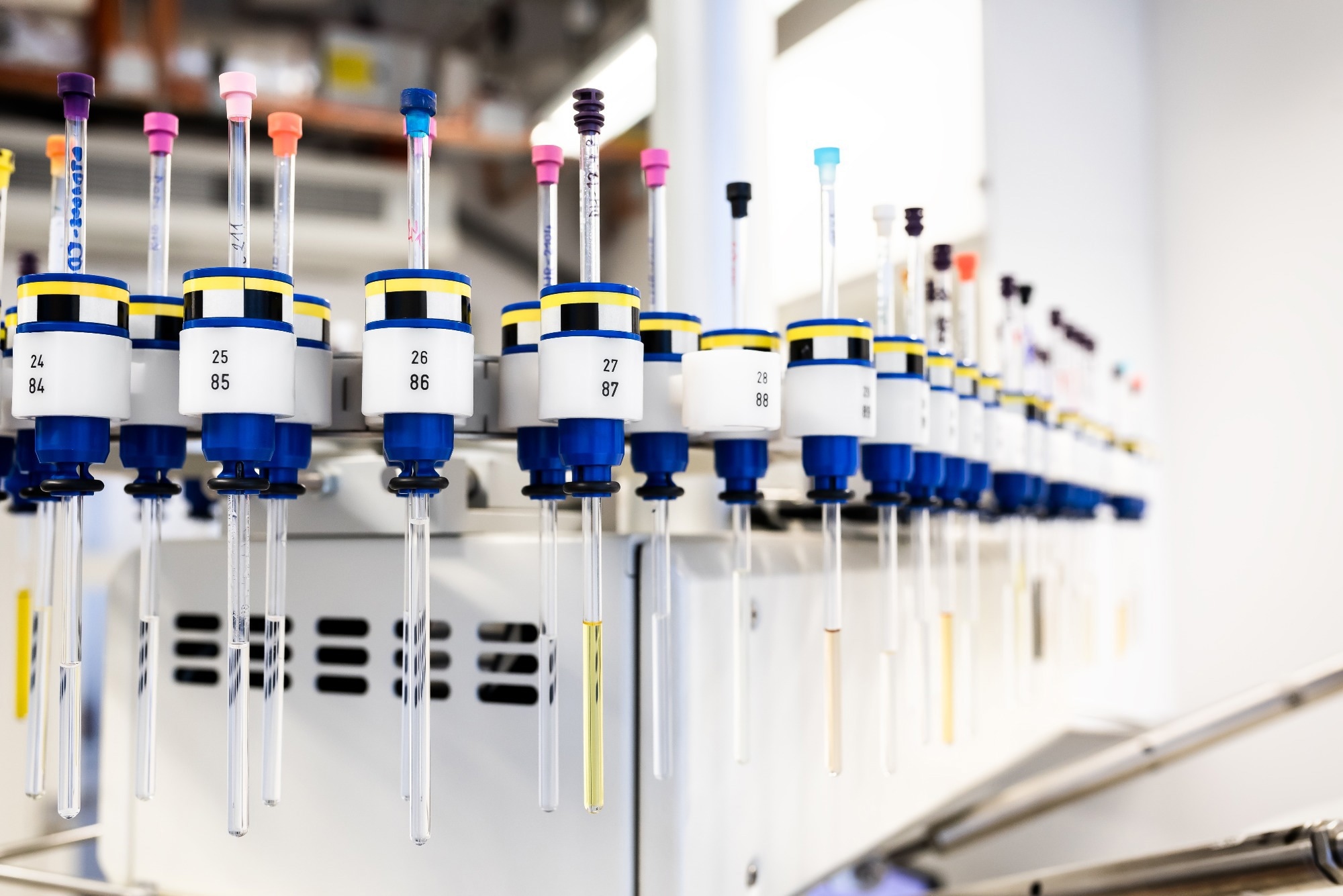
Image Credit: Forance/Shutterstock.com
Outside academia, which applied markets are finding the most value in benchtop NMR, and what stands out in forensics and metabolomics?
The Fourier 80 supports a broad range of applications beyond academia. These include chemistry, pharmaceuticals, food analysis, materials science, and manufacturing. In a process analytical technology context, for example, it can support continuous manufacturing processes operating around the clock.
Two additional areas of particular interest are forensics and metabolomics. In forensics, when a new drug appears on the market and needs to be identified, the Fourier 80 can provide both qualitative and quantitative information about the compound. This can be valuable when rapid information is needed, including for communication with regulatory authorities.
Metabolomics presents a different requirement: very high throughput. Large numbers of samples must be measured quickly, under consistent conditions and using the same parameters. This consistency and traceability are especially valuable for developing metabolite profile databases that support ongoing research in the field.
Reaction monitoring often works best when the instrument is located next to the chemistry. How does pairing the Fourier 80 with automated sample preparation change that workflow?
Reaction monitoring is another important application area for the Fourier 80. Because the instrument can be placed directly in the laboratory, close to the reaction itself, users can monitor chemistry in a more immediate and practical way.
When paired with Bruker’s Chemspeed automation system, sample preparation can also be automated to help ensure consistent reaction conditions. The reaction can flow through the system, generating results that show how it evolves over time.
This provides a robust and reliable way to assess reaction progress and determine whether full conversion has been reached by the end of an experiment.
About Agnes Haber
Dr. Agnes Haber is Product Manager Benchtop NMR at Bruker BioSpin. She has worked in benchtop NMR application development and product management, and her research background includes low-field NMR studies of porous media, emulsions, and hydrate formation.
About Bruker BioSpin Group
The Bruker BioSpin Group designs, manufactures, and distributes advanced scientific instruments based on magnetic resonance and preclinical imaging technologies. These include our industry-leading NMR and EPR spectrometers, as well as imaging systems utilizing MRI, PET, SPECT, CT, Optical and MPI modalities. The Group also offers integrated software solutions and automation tools to support digital transformation across research and quality control environments.
Bruker BioSpin’s customers in academic, government, industrial, and pharmaceutical sectors rely on these technologies to gain detailed insights into molecular structure, dynamics, and interactions. Our solutions play a key role in structural biology, drug discovery, disease research, metabolomics, and advanced materials analysis. Recent investments in lab automation, optical imaging, and contract research services further strengthen our ability to support evolving customer needs and enable scientific innovation.
 Bruker Acquires Spectral Instruments Imaging, the Performance Leader in Preclinical In-Vivo Optical Imaging Systems