In this interview, News-Medical speaks with Carmen Pistillo about the critical role of vibration control in photonics, exploring how even the smallest mechanical disturbances can compromise the accuracy, stability, and performance of precision optical systems.
Pistillo discusses common sources of vibration, strategies for effective isolation, and how advances in photonics, quantum technologies, and semiconductor manufacturing are driving the need for increasingly sophisticated vibration control solutions.
Please could you introduce yourself and tell us about your academic background, your experience in photonics and optical technologies, and how your career has led you to focus on vibration control and precision environments?
My name is Carmen Pistillo, and I have a degree in Chemical Engineering from Cleveland State University. In the past, I worked as an R&D Engineer for Litton Industries developing 3rd GEN Night Vision technologies for the military and III-V Semiconductor Research MOCVD for Photocathode production (Photonic detector).
Why is vibration such a critical concern in photonics, and what makes optical and laser-based systems particularly sensitive to even very small mechanical disturbances?
Vibration is critical in photonics because optical systems often measure or control phenomena at scales comparable to the wavelength of light itself. When your instrument can detect nanometer-scale changes, the environment suddenly becomes "alive" with disturbances that would otherwise seem insignificant.
In photonics, vibration can evolve from a mechanical issue into an optical issue, manifesting in issues such as beam instability, phase noise, measurement uncertainty, loss of alignment, reduced resolution, and degraded system performance. As optical technologies continue to push toward higher precision, automation, and quantum-scale measurements, vibration control is increasingly a foundational requirement rather than an optional enhancement.
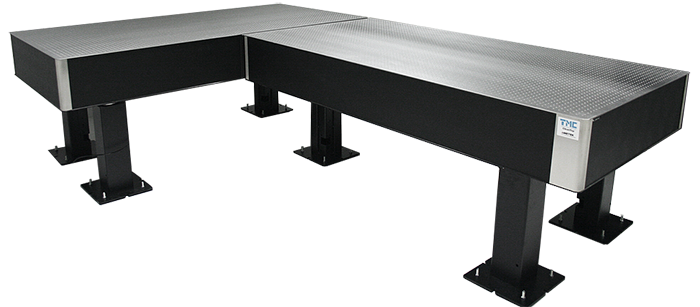
Image Credit: TMC Vibration Control
What are some of the most common sources of vibration in photonics laboratories and manufacturing environments, and are there any less obvious sources that engineers and researchers frequently underestimate?
The biggest misconception in photonics is that vibration only comes from the floor. Disturbance energy can enter an optical system through the building structure, air, utilities, cables, hoses, and even the instrument's own mechanical resonances.
The most successful photonics facilities therefore take a holistic approach, controlling not only floor vibration but also acoustic noise, airflow, utility connections, and structural resonances to maintain the stability required for modern laser, imaging, metrology, and quantum-optics applications.
How can vibration affect the performance of lasers, optical benches, and other precision photonics instruments, particularly regarding beam alignment, measurement accuracy, repeatability, and overall system stability?
Vibration affects photonics systems by converting tiny mechanical movements into optical errors. Those errors may appear as beam wander, misalignment, phase noise, image blur, measurement uncertainty, reduced fiber-coupling efficiency, poor repeatability, or long-term instability.
The problem is so severe because photonics instruments often operate at scales comparable to the wavelength of light itself. As a result, motion that might be insignificant in most mechanical systems can become a dominant source of error in lasers, optical benches, interferometers, metrology tools, and advanced photonics manufacturing equipment. This is why vibration control is often considered a foundational requirement, not an accessory, for achieving the accuracy, repeatability, and stability demanded by modern photonics applications.
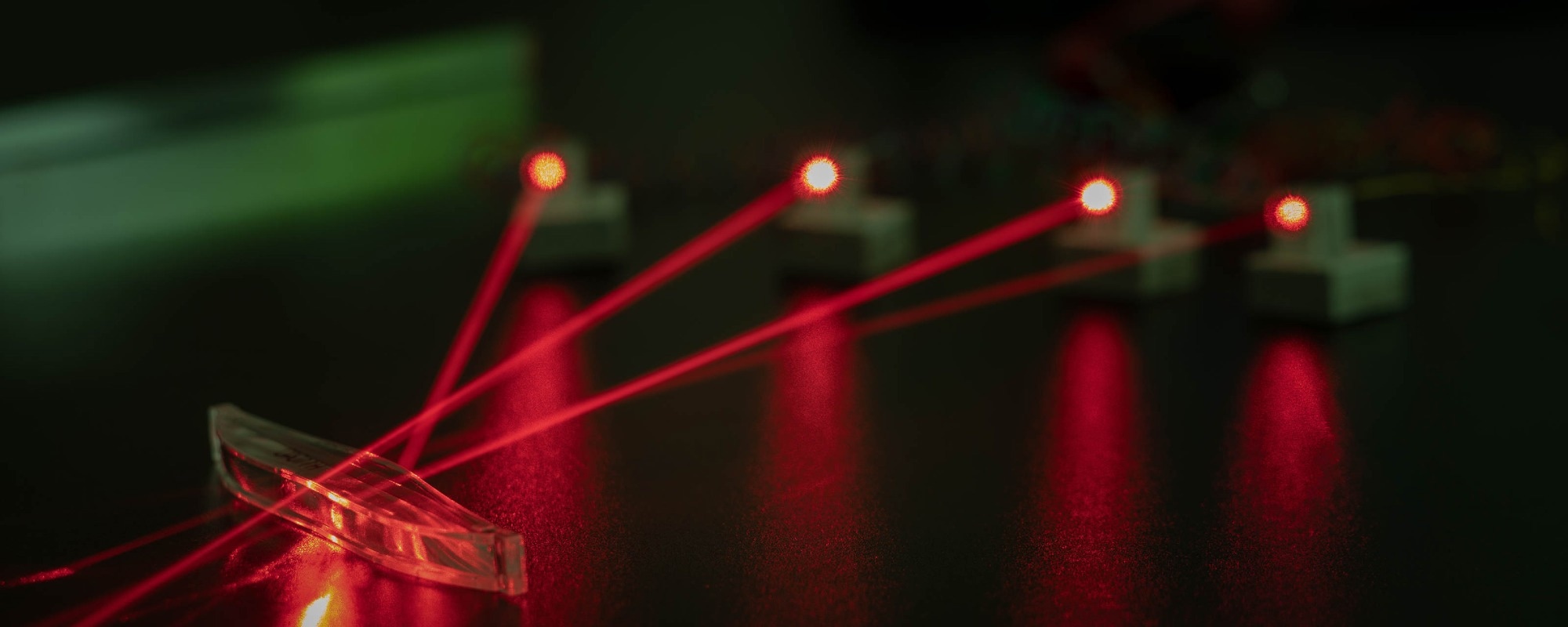 Image Credit: Shutterstock.com/lynxF
Are there certain photonics applications that are especially vulnerable to vibration? For example, how might the requirements differ between interferometry, semiconductor inspection, quantum photonics, optical communications, and microscopy?
Virtually every photonics application is affected by vibration, but the mechanism differs: interferometers and quantum photonics systems are primarily limited by phase stability; semiconductor tools demand nanometer-scale positioning accuracy; optical communication systems require stable beam pointing, while microscopes are concerned with image quality and resolution.
As photonics technologies continue pushing toward smaller feature sizes, higher resolutions, faster data rates, and quantum-scale measurements, vibration requirements become increasingly stringent. In many of today's most advanced photonics applications, achieving the desired performance is often as much a vibration-control challenge as it is an optical one.
When a photonics system is producing inconsistent or degraded results, how can engineers determine whether vibration is the underlying cause? What measurements, environmental surveys, or diagnostic techniques can help identify and quantify the problem?
The most reliable way to determine whether vibration is responsible for degraded photonics performance is to combine symptom analysis, direct vibration measurements, frequency-domain analysis, environmental surveys, and controlled testing. The goal is to correlate optical performance with measured mechanical motion.
In many cases, engineers discover that the issue is not simply "too much floor vibration," but a specific source such as an HVAC unit, pump, cable connection, structural resonance, or utility line transmitting motion into the instrument. Identifying that pathway is often the critical step toward restoring beam stability, measurement accuracy, repeatability, and overall system performance.
Once vibration has been identified as an issue, how do engineers decide between approaches such as passive isolation, active vibration cancellation, optical table design, and broader changes to the facility or laboratory environment?
The decision between passive isolation, active vibration cancellation, improved optical table design, or facility modifications comes down to understanding where the vibration originates, how it travels, what frequencies are involved, and how sensitive the application is.
In many photonics environments, the most effective strategy is not to choose one approach over another, but to combine multiple layers of source control, structural design, isolation, and environmental engineering to achieve the stability required for modern systems.
Often, specific tools or pieces of equipment have published vibration specifications that can be compared to the measured environment. Once this comparison has been made, the appropriate solution can be identified.
Can you share a real-world example in which vibration limited the performance of a photonics system? What was causing the disturbance, how was it identified, and what difference did the eventual solution make?
A compelling real-world example comes from a custom optical table installation completed for Cheminitz, where environmental vibration from building infrastructure and everyday facility activity was limiting the performance of a sensitive laser-based photonics system. After a vibration assessment confirmed that floor motion was coupling into the optics and affecting stability, TMC engineered a custom vibration-isolated optical table solution.
The result was a dramatically more stable platform that reduced alignment drift, improved measurement repeatability, and enabled the system to achieve the precision performance required for advanced photonics research and testing. This project demonstrates how controlling even subtle environmental vibration can have a significant impact on optical system performance.
For organizations building a new photonics laboratory or production facility today, what steps should they take from the outset to minimize vibration-related problems rather than trying to correct them after equipment has been installed?
The biggest lesson from successful photonics laboratories, semiconductor facilities, and quantum research centers is that vibration control is fundamentally a facility-design challenge, not just an equipment challenge.
Organizations that evaluate sites carefully, separate vibration sources, design utilities intelligently, and create vibration-appropriate laboratory spaces from the outset can avoid years of troubleshooting and allow their lasers, optical metrology tools, microscopes, and quantum systems to operate at their full performance potential from day one.
Looking five to 10 years ahead, as photonics moves toward even greater precision, smaller scales, quantum technologies, and more demanding manufacturing processes, where do you expect the biggest gaps in vibration control to emerge, and how do you see TMC evolving its technologies to help fill those gaps?
Looking ahead, I think the biggest challenge in photonics will be that instrument precision is advancing faster than the environments supporting those instruments. Whether it's quantum photonics, semiconductor inspection, or advanced optical metrology, we're seeing increasing sensitivity to sub-nanometer motion, phase instability, and long-term drift.
The gap will be less about optics and more about environmental control. For example, quantum systems require exceptional phase stability, while next-generation semiconductor tools demand ever-tighter positioning accuracy and repeatability.
I see TMC addressing those challenges through a combination of proven technologies and smarter system integration. Solutions like STACIS® active vibration cancellation, MaxDamp® optical tables, and Gimbal Piston™ pneumatic isolators already provide industry-leading vibration control.
The next evolution will likely involve more facility-level optimization, environmental monitoring, and predictive diagnostics to help customers identify and mitigate disturbances before they impact performance.
Ultimately, TMC's opportunity is to move beyond vibration isolation alone and continue enabling complete precision environments, allowing researchers and manufacturers to confidently push the limits of photonics, quantum technologies, and advanced manufacturing.
About Carmen Pistillo
Carmen Pistillo has a degree in Chemical Engineering from Cleveland State University. He worked as an R&D Engineer for Litton Industries developing 3rd GEN Night Vision technologies for the military. III-V Semiconductor Research MOCVD for Photocathode production (Photonic detector). Carmen is now the owner and president of eQuestus Corporation, a part of the Professional and Commercial Equipment and Supplies Merchant Wholesalers industry and is located in Colorado, United States.
About TMC Vibration Control
TMC is a global leader in precision floor vibration isolation systems with over 50 years of experience.
Major research centers, OEM and end-user semiconductor manufacturers, drug discovery companies, and nanotechnology labs across all seven continents rely on TMC solutions to support ultra-precision measurements, instruments, and manufacturing.
TMC’s precision floor vibration isolation product line ranges from isolated microscope bases and damped optical tables to sophisticated active vibration cancellation systems featuring piezoelectric actuators and digital controllers.
In addition, TMC offers active magnetic field cancellation systems and acoustic noise isolation enclosures that, together with vibration isolation, provide complete environmental noise control. Environmental surveys performed on-site by experienced TMC service engineers and state-of-the-art measurement equipment are also available.
TMC systems are designed and manufactured at the company’s vertically integrated factory and headquarters in Peabody, Massachusetts. The facility is ISO 9001:2015 certified.
TMC is a unit of AMETEK Ultra Precision Technologies, a pioneer in the development of ultraprecision measurement instruments and a global leader in ultraprecise machine tools and manufacturing systems for the semiconductor, photovoltaic, nanotechnology, military, defense, and ophthalmic lens markets.
AMETEK Ultra Precision Technologies is a division of AMETEK, Inc., a leading global manufacturer of electronic instruments and electromechanical devices with annualized sales of approximately $5 billion.