Sponsored Content by HORIBAReviewed by Olivia FrostJan 20 2026
Transferrin is a glycoprotein with a molecular weight of 80 kDa, synthesized in the liver.
Each transferrin molecule can bind up to two iron atoms for distribution to cells. The half-life of transferrin in humans is approximately eight days, while the delivery of iron via the transferrin/transferrin receptor cycle can be completed in approximately five to 20 minutes, depending on the cell type.
This means each transferrin molecule can facilitate hundreds of cycles of iron binding and delivery to cells in its lifespan.1
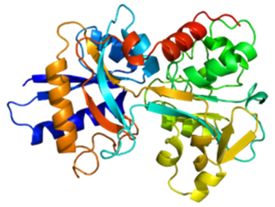
Figure 1. Transferrin 3D structure (PDB, RCSB)2. Image Credit: HORIBA Scientific
Measuring transferrin iron levels in serum is an essential part of evaluating iron metabolism. Abnormal transferrin levels in serum are associated with various diseases, including certain cancers and other inflammatory syndromes.3
Duetta is a highly sensitive spectrofluorometer that can be used to measure transferrin at very low concentrations. By integrating both fluorescence and absorbance measurements simultaneously, the Duetta spectrofluorometer offers key advantages in protein analysis.
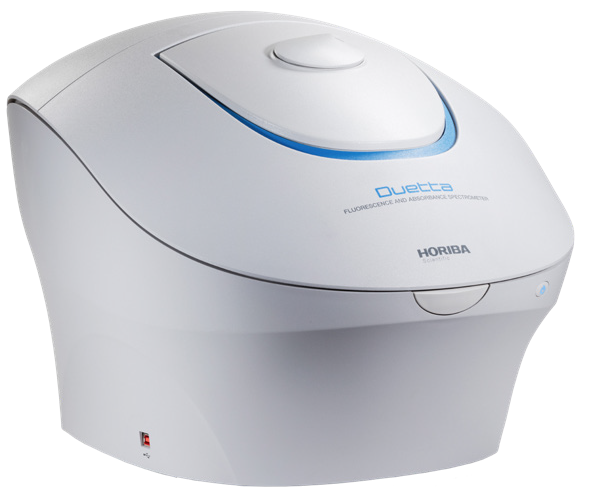
Image Credit: HORIBA Scientific
In their comparative study, Horiba assessed the fluorescence results obtained using the Duetta with absorbance results from a dedicated low-volume benchtop spectrophotometer.
Methods and results
Transferrin was prepared at concentrations ranging from 50 µg/mL to 0.75 µg/mL in 10 mM PBS for fluorescence and absorbance measurements. The same buffer, devoid of protein, was utilized as a blank.
The excitation wavelength was set to 250 nm, with emission collected from 265 nm to 550 nm, using a two second integration time on the CCD and 10 nm slits.
Transferrin solutions from 0.75 µg/mL to 50 µg/mL were measured in absorbance mode. A comparison of the absorbance spectra obtained from both systems at the highest concentrations is shown below.
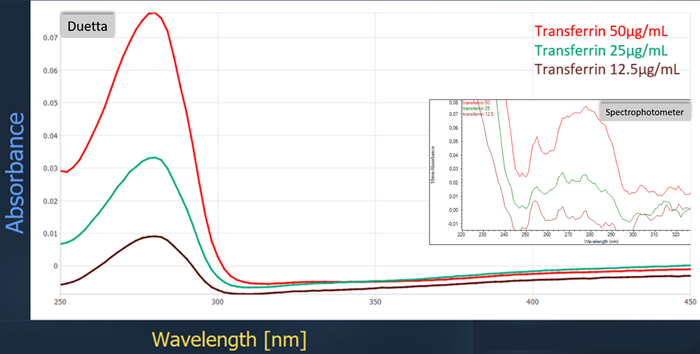
Figure 2. Comparison of Absorbance spectra between the instruments. Image Credit: HORIBA Scientific
The spectra obtained demonstrate notable differences. The Duetta spectrofluorometer detected transferrin at 12.5 µg/mL, with the signal increasing proportionally to concentration. The comparative data from the spectrophotometer exhibited a limit of detection around 25 µg/mL, with visibly noisy curves.
Figure 3 shows the overlaid fluorescence spectra obtained.
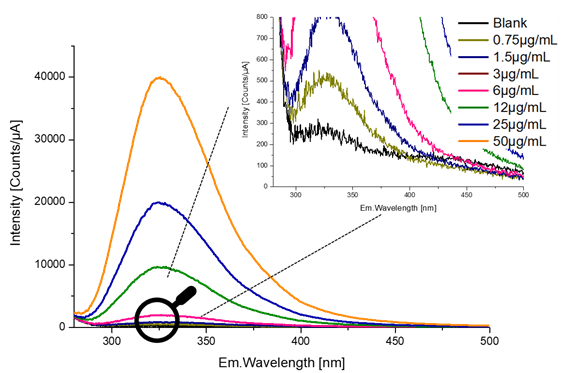
Figure 3. Fluorescence Emission spectra of transferrin at increasing concentrations (from 0.75 μg/ml to 50 μg/ml). Image Credit: HORIBA Scientific
The zoom on the lowest concentrations indicates a limit of detection around 0.75 µg/mL.
Although the Duetta demonstrates twice the sensitivity in measuring protein concentration via UV absorption, its superior performance is further exemplified through fluorescence, as shown in the fluorescence profile in Figure 4.
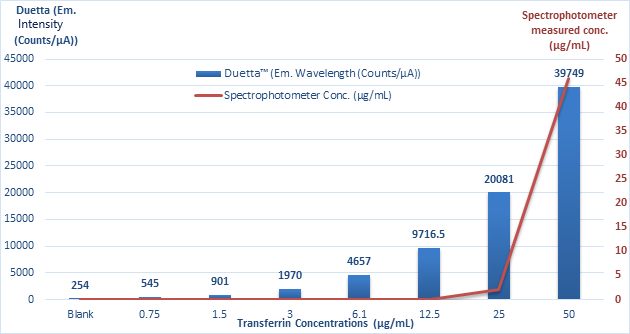
Figure 4. Comparison of Transferrin concentration measurements obtained with the spectrophotometer and Duetta instruments. Image Credit: HORIBA Scientific
The graph indicates a limit of detection for transferrin of approximately 0.75 µg/mL using the Duetta. The signal amplitude is directly proportional to the measured concentrations.
In contrast, the lowest concentration detected by the spectrophotometer is 25 µg/mL, 33 times less sensitive than the Duetta. This further demonstrates the sensitivity of its fluorescence spectroscopy.
Conclusions
Fluorescence spectroscopy has numerous applications in life sciences, spanning cell biology to genomics. In protein characterization, the intrinsic fluorescence of certain amino acids (tryptophan, tyrosine, and phenylalanine) provides a valuable capability for studying proteins without the need for labeling.
The study presented here illustrates the high sensitivity of the Duetta through fluorescence measurements in comparison to the traditional UV-absorbance approach.
While the Duetta’s limit of detection is approximately 25 µg/mL using absorbance, it can successfully detect transferrin at 0.75 µg/mL using fluorescence. This limit of detection can be enhanced by optimizing certain parameters, such as increasing the integration time, widening the slits, and enhancing the emission increment (binning).
The Duetta is capable of measuring both UV-visible absorbance spectra and fluorescence spectra, exhibiting greater sensitivity than other benchtop spectrophotometers that are exclusively designed for absorbance measurements.
The optimized optical layout and dual-purpose design of the Duetta spectrofluorometer make it ideal for protein spectroscopy and analysing low-concentration solutions.
References and further reading
- Choi, S. ed., (2018). Encyclopedia of Signaling Molecules. https://doi.org/10.1007/978-3-319-67199-4.
- MacGillivray, R.T.A., et al. (1998). Two High-Resolution Crystal Structures of the Recombinant N-Lobe of Human Transferrin Reveal a Structural Change Implicated in Iron Release†,‡. Biochemistry, 37(22), pp.7919–7928. https://doi.org/10.1021/bi980355j.
- Gkouvatsos, K., Papanikolaou, G. and Pantopoulos, K. (2012). Regulation of iron transport and the role of transferrin. Biochimica et Biophysica Acta (BBA) - General Subjects, 1820(3), pp.188–202. https://doi.org/10.1016/j.bbagen.2011.10.013.
About HORIBA

Founded in 1953, HORIBA has explored a wide range of unique measurement and analysis technologies to meet global customer needs from 47 group companies and local sites spread across 29 countries and regions. Under the corporate motto Joy and Fun, the company has expanded and refined its core technologies to solve society's energy issues of today and tomorrow. Our unique measurement and analysis technologies are valued in various fields of society, including the three megatrend business fields of Energy & Environment, Biology & Healthcare, and Materials & Semiconductors. For more Information on HORIBA, visit https://www.horiba.com/int/company/about-horiba/home/
Sponsored Content Policy: News-Medical.net publishes articles and related content that may be derived from sources where we have existing commercial relationships, provided such content adds value to the core editorial ethos of News-Medical.Net which is to educate and inform site visitors interested in medical research, science, medical devices and treatments.