A 12-year national study reveals that aging need not mean decline. Researchers show that many older adults maintain or even improve their cognitive and physical abilities, and that positive beliefs about aging are linked to better long-term health trajectories.

Study: Aging Redefined: Cognitive and Physical Improvement with Positive Age Beliefs. Image Credit: Finist4 / Shutterstock
In a recent study published in the journal Geriatrics, a group of researchers determined whether older adults can experience improvements in cognitive and physical functioning over time and whether positive beliefs about aging predict such improvements.
Background: Rethinking Assumptions About Aging Decline
Many people assume that growing older inevitably means worsening memory, slower movement, and declining independence. Recent studies find that about 80% of people think cognitive decline is a natural part of aging. Health care professionals often share similar assumptions about aging trajectories among their patients. This affects how older adults are viewed by society and how they view themselves.
There is a growing body of evidence suggesting that some aspects of aging-related decline may be less inevitable than previously believed. It is possible that an individual’s cultural attitudes toward aging, combined with their personal beliefs about aging, shape their physical and mental functioning as they age. Understanding these influences is essential for promoting healthier aging worldwide. Further research is needed to clarify how beliefs about aging shape long-term health trajectories.
Study Population and Longitudinal Data Source
Participants were drawn from the Health and Retirement Study (HRS), a nationally representative longitudinal survey of adults aged 50 years and older in the United States conducted by the Institute for Social Research at the University of Michigan. The study is funded by the National Institute on Aging (NIA) and collects health, social, and economic data every two years. Individuals included in the analyses had baseline measurements of age beliefs and at least one follow-up assessment of cognitive or physical functioning.
Measures of Cognitive Performance and Physical Function
Cognitive performance was assessed using the Telephone Interview for Cognitive Status (TICS), and physical functioning was evaluated using walking speed measured during a 2.5-meter walking test. A faster walking speed indicated better physical function, and participants were followed for up to 12 years.
Assessment of Age Beliefs
Age beliefs were measured using the Attitude Toward Aging subscale of the Philadelphia Geriatric Center Morale Scale, with higher scores indicating more positive beliefs about aging.
Cognition was measured among participants aged 50 to 99 years, whereas walking speed was assessed among participants aged 65 years and older at baseline and final follow-up. Statistical analyses examined whether participants improved in cognition or walking speed from baseline to the final follow-up. Logistic regression analysis was used to determine whether positive attitudes toward aging predicted improvement in both cognition and walking speed while controlling for demographic, health, and psychosocial factors.
Results: Improvements in Cognitive and Physical Function
The findings challenged the widely held belief that aging inevitably leads to decline. A substantial proportion of participants showed improvements in either cognitive or physical functioning during the follow-up period. Overall, 45.15% of participants experienced improvements in cognition or walking speed over time, demonstrating that positive health changes are not rare in later life.
When examined separately, 31.88% of participants improved their cognitive performance, and 28% improved their walking speed. These rates greatly exceeded the benchmark established by the United States Healthy People 2030 initiative, which the study used as a reference threshold for defining a “meaningful” proportion of improvement, set at at least 11.5% of older adults.
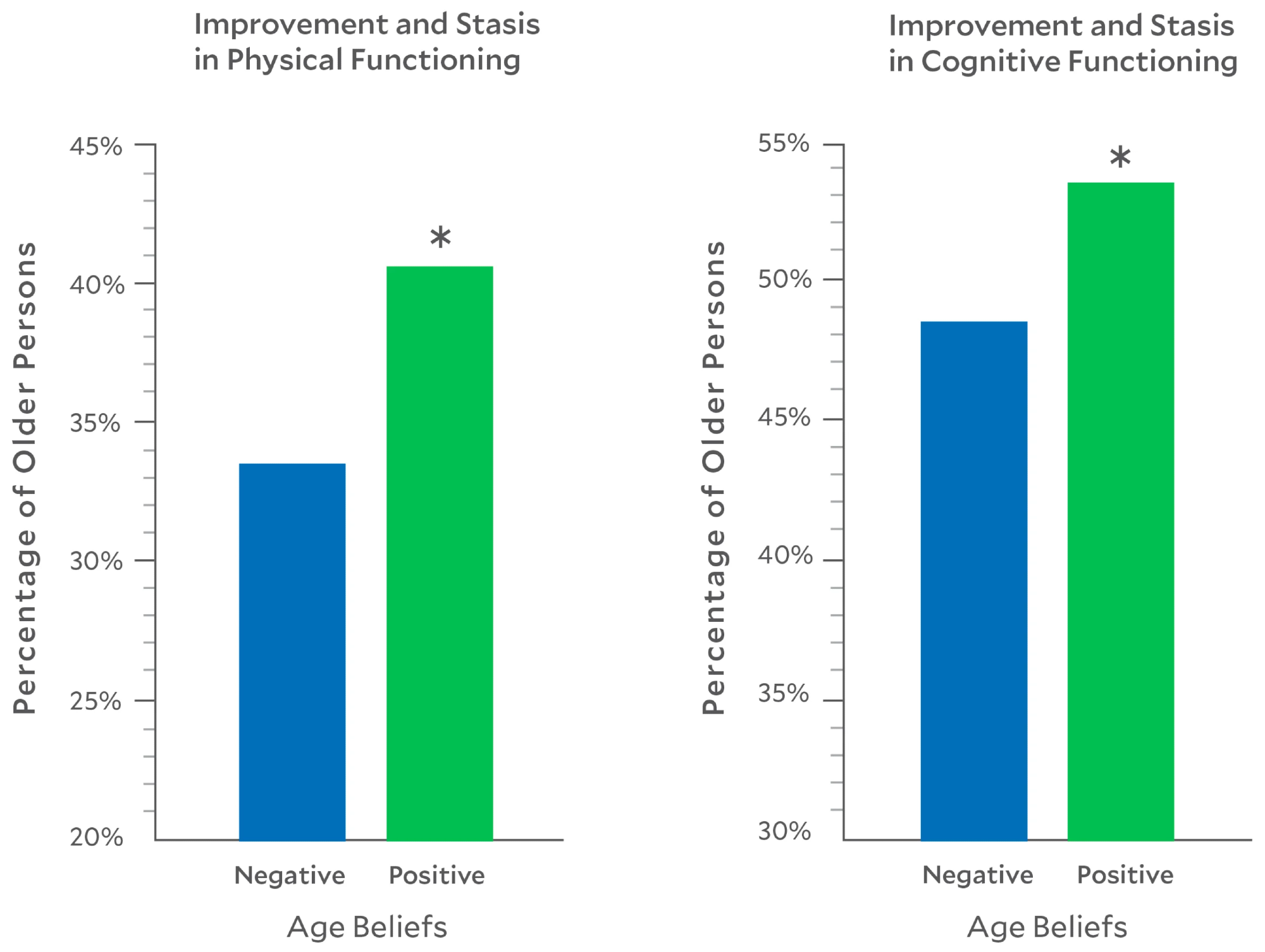
Positive age beliefs predict physical and cognitive improvement and stasis. Note: * p < 0.05. In the physical improvement and stasis group, 58% improved, and in the cognitive improvement and stasis group, 40% improved.
Stability and Variation in Aging Trajectories
The results also showed that stability itself was common. When individuals whose functioning remained stable were added to those who improved, 51.06% of participants showed stable or improved cognitive function, and 37.56% demonstrated stable or improved walking speed. These findings highlight that many older adults maintain or enhance their abilities rather than experiencing continuous decline.
Some individuals improved in memory but not mobility, while others walked faster without significant cognitive gains. Among participants who improved in cognition, approximately 44% also improved their walking speed, showing that these health domains may develop somewhat independently.
Influence of Positive Age Beliefs on Health Outcomes
Further analyses explored whether beliefs about aging influenced these improvements. Positive age beliefs significantly predicted better outcomes in both domains. Individuals with more optimistic attitudes toward aging had higher odds of experiencing improvements in cognitive functioning and walking speed, even after accounting for age, education, health conditions, sleep problems, depressive symptoms, and other factors.
For example, statistical models showed that participants with stronger positive age beliefs had increased odds of cognitive improvement and faster walking speed during the follow-up period. These relationships remained significant even when stricter criteria for improvement were applied, such as requiring larger gains in cognitive test scores or walking speed.
Additional analyses examined participants who already had normal baseline levels of cognitive or physical function. Even among these individuals, positive age beliefs predicted future improvements. This suggests that the relationship between beliefs and health is not limited to people recovering from impairment but also applies to individuals who begin with relatively good functioning.
Overall, the results demonstrate that improvement in later life is both possible and common. They also indicate that psychological and cultural factors, such as beliefs about aging, may influence how individuals age physically and cognitively. The study builds on the framework of stereotype embodiment theory, which proposes that people internalize societal beliefs about aging over the life course and that these beliefs can later influence health outcomes when they become self-relevant.
Conclusions: Positive Beliefs and Healthy Aging
The findings show that aging does not inevitably lead to decline. Many adults experienced increases in their physical and cognitive abilities over time, contrasting with common assumptions about aging. More positive beliefs about aging were associated with a higher likelihood of improvement, suggesting that mindset and cultural attitudes toward aging may influence health trajectories in later life.
Promoting more positive attitudes toward aging may therefore have implications for healthcare practices, policies, and personal behaviors, with the goal of supporting aging populations in maintaining or improving health and functioning. The authors also note that many aging studies average health changes across participants, which can mask improvement occurring within subgroups of older adults.
Journal reference:
- Levy, B. R., & Slade, M. D. (2026). Aging Redefined: Cognitive and Physical Improvement with Positive Age Beliefs. Geriatrics. 11(2). DOI: 10.3390/geriatrics11020028, https://www.mdpi.com/2308-3417/11/2/28
 Sex-specific biological clocks reveal how aging differs across the body in women and men