In this interview, News Medical-Life Sciences speaks with Gabi Saavedra, Application Specialist at Thermo Fisher Scientific, about the evolving landscape of plant-based foods, including how scientific tools, consumer experience, and cultural perspectives are shaping the future of food innovation.
Can you please introduce yourself and your role at Thermo Fisher Scientific?
My name is Gabi Saavedra, and I’ve been working at Thermo Fisher Scientific for over three years as an Application Specialist, primarily focused on extrusion. I specialize in texture engineering for food, especially plant-based products. Texture is a huge factor in consumer acceptance, so my work is all about helping manufacturers develop foods that feel just right – whether that’s the crunch of a crisp or the creaminess of yogurt.
What inspired your journey into food science?
I’ve always had a passion for biology and started out studying bioengineering in Germany. Initially, I thought I would work in pharmaceuticals or enzyme research, but I realized I wasn’t patient enough for that field. When I discovered food science, it immediately clicked. Food isn’t just about nutrition – it’s part of our rituals, our social lives, our joy. I wanted to contribute to society through science, even if I wasn’t curing cancer. Making food better and more enjoyable felt like a meaningful way to do that.
Texture plays a major role in food experience. How do you scientifically measure it?
Texture is incredibly multi-dimensional – it’s about how food looks, feels in your hand, and behaves in your mouth. We use instrumentation to measure objective forces like resistance and deformation. For example, how easily something spreads or how it compresses when bitten. These are physical interactions we can measure, but we also validate them with sensory panels to ensure they align with human experience. This hybrid approach helps us quantify subjective experiences and speed up product development.
You mentioned using a rheometer - can you explain how that works in food science?
Sure! A rheometer is a device that measures how fluids and semi-solids respond to forces – things like viscosity and deformability. In food science, we can use different sensors and accessories to mimic how we chew, or how food interacts with the tongue and palate. This helps us understand things like creaminess or roughness. It’s a multifunctional tool that allows us to replicate mouthfeel and chewing behavior in the lab, especially important when replacing animal fats with plant-based alternatives.
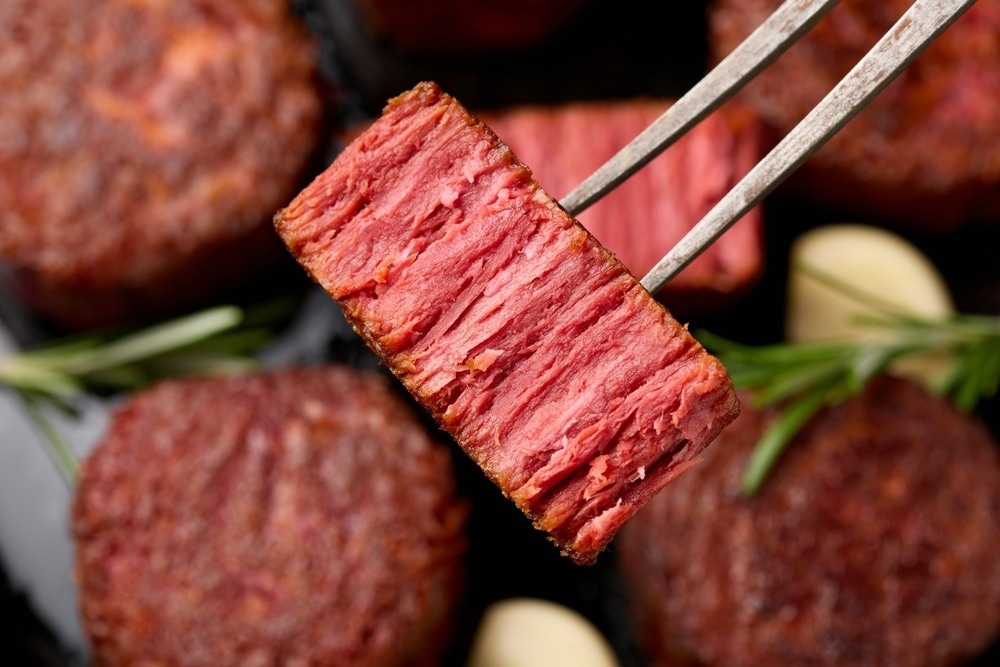
Image Credit: DronG/Shutterstock.com
How do you use extrusion to develop meat-like structures in plant-based products?
Extrusion is essential for creating the fibrous, anisotropic structures that mimic muscle fibers. We start with plant protein powders, mix them with water, apply heat and pressure, and then cool them in a controlled way. This allows us to control the flow and alignment of the protein, resulting in textures that resemble real meat. The challenge now is replicating intramuscular fat, like marbling in beef, which extrusion can’t yet fully mimic. That’s one of the areas where innovation is still needed.
Are consumers still interested in plant-based products that mimic meat, like the Impossible or Beyond Burger?
Yes and no. Plant-based is still a strong trend, but it’s shifting. Products like Impossible and Beyond are mostly targeted at flexitarians – people who enjoy meat but want to reduce consumption for environmental, ethical, or health reasons. These consumers want a meat-like experience. Vegetarians, on the other hand, often don’t want something that feels like raw meat. So the market is evolving from imitation meat toward more innovative, enjoyable plant-based options that don’t necessarily mimic beef.
How does culture influence the development of plant-based foods?
Culture plays a huge role, though it’s often overlooked in food science. In regions like Asia, vegetarian and vegan options like tofu or tempeh are already culturally embedded, so there’s less need for meat alternatives. But in Western and South American cultures, meals are typically centered around meat. That creates a demand for replacements to keep family meals inclusive. Cultural relevance is key to acceptance, and scientists should consider these emotional and societal factors – not just technical ones.
Are cultural considerations becoming more common in scientific research?
Not yet, but I hope that changes. I saw promising work at Cal Poly Pomona where researchers are developing plant-based options for specific cultural dishes, like Indian or Mexican cuisine. These types of initiatives really bridge the gap between science and emotion. Food is not just nutrition – it’s tied to memory, emotion, and community. For plant-based trends to succeed, we need to think beyond functionality and consider the full context of how people eat.
How Texture Drives Consumer Acceptance in Plant-Based Foods
What are some of the most exciting trends you see in the future of plant-based and food science?
Precision fermentation is really exciting - being able to grow meat or dairy proteins in bioreactors without animals is a game-changer, although it’s still in early stages and expensive. There’s also increasing focus on aging populations. As people eat less with age, foods need to be enriched with nutrients like vitamins and fiber. Encapsulation is another big trend – embedding nutrients or active plant compounds into foods so they’re easier to consume. It’s all about making food smarter, not just plant-based.
Do you see plant-based foods becoming more personalized and functional?
Absolutely. With longer lifespans and more dietary needs, the future is about nutrient-dense, functional foods tailored to health and lifestyle. From protein-rich bars to foods that work alongside medications like GLP-1s, we’re moving toward foods that serve both body and mind. It’s not just about eating less meat – it’s about eating better, and making those foods both scientifically sound and emotionally fulfilling.
About Gabi Saavedra
Gabi Saavedra is an Application Specialist at Thermo Fisher Scientific, where she focuses on extrusion technologies and texture development for plant-based and functional foods. Originally from South America, Gabi pursued her higher education in Germany, where she earned a degree in Bioprocess Engineering from the Karlsruhe Institute of Technology (KIT), later specializing in food process engineering. Her work bridges science and sensory experience, with a strong emphasis on how food texture impacts consumer acceptance. She has a particular interest in plant-based innovation and is passionate about aligning scientific development with cultural and emotional connections to food. Gabi is also a prominent voice in international food science conversations, having participated in global initiatives from Singapore to California, advocating for culturally relevant and sustainable food technologies.
About Thermo Fisher Scientific – Pharmaceutical and Biopharmaceutical Solutions
Overview
With over five decades of innovation in spectroscopy, materials characterization, and process analytics, Thermo Fisher Scientific empowers pharmaceutical and biopharmaceutical manufacturers to bring therapies to patients faster - safely, compliantly, and efficiently.
Our portfolio of Thermo Scientific™ instruments and software supports every stage of the molecule lifecycle, from discovery through commercial manufacturing. From early molecular profiling to process analytical technology (PAT) and final quality release, our integrated solutions help ensure data integrity, process efficiency, and regulatory confidence.
We work in partnership with the pharmaceutical industry to apply advanced technologies in ways that enable manufacturers to have better information and control over their processes. From raw material identification through manufacturing operations to finished and packaged pharmaceutical product inspection, we offer a complete range of technologies and business solutions that can help improve each stage of the production process, gain efficiencies, and deliver a higher quality product to the end-consumer.
Solutions across the drug lifecycle
Research & discovery
Accelerate discovery with high-sensitivity, low-volume analytical tools that deliver reproducible data even from scarce samples. Our NanoDrop™ microvolume spectrophotometers and fluorometers, GENESYS™ Vis/UV-Vis Spectrophotometers and Evolution™ UV-Vis Spectrophotometer instruments, and DXR™ SmartRaman spectrometers provide rapid molecular insight and material identification, supporting target validation and early screening. These technologies give researchers the confidence to make faster go/no-go decisions and strengthen the foundation for scale-up and compliance.
Formulation & process development
Scale from grams to pilot batches with confidence. Bench-scale extruders, rheometers, and FT-NIR analyzers help optimize formulations, assess stability, and ensure consistent API dispersion. Complementary XRD and FTIR systems identify polymorphs and crystallinity to improve solubility and bioavailability - critical for modern dosage form design. Each platform is built to align with Quality by Design (QbD) principles and 21 CFR Part 11 requirements, streamlining regulatory submission and method transfer.
Clinical and commercial manufacturing
Ensure process reliability and product quality at scale. Inline and at-line process analyzers - such as the MarqMetrix™ All-In-One Raman, Prima BT/PRO Process Mass Spectrometers, and Antaris™ II FT-NIR - enable real-time PAT monitoring for consistent production. Handheld TruScan™ G3 analyzers provide non-destructive raw material verification through sealed packaging, reducing sampling delays and ensuring regulatory compliance. Our inline inspection systems (X-ray, checkweighers, and metal detectors) protect final product integrity through fill, finish, and packaging.
Quality control & regulatory confidence
Thermo Scientific analytical platforms are backed by validated, GMP- and 21 CFR Part 11–ready software suites, including OMNIC™ Paradigm and Security Suite, ensuring data traceability, audit readiness, and compliance across global operations. Our technologies help pharmaceutical teams maintain alignment with USP, EP, and FDA standards while safeguarding data integrity from research to release.
Services & support
We provide comprehensive service and support to help minimize cost of ownership, maximize uptime, and maintain compliance. Our tiered plans include preventive maintenance, priority response, calibration, and remote monitoring to keep operations running efficiently. Order OEM-compliant spare parts directly from Thermo Fisher with confidence in their quality and compatibility and rely on our global technical support network to reduce downtime across spectroscopy, extrusion, compounding, process analysis, and inspection systems.
Thermo Fisher Scientific: Partnering across the drug lifecycle
From ideation to delivery, we enable our partners to innovate faster, protect yield and quality, ensure compliance, and deliver therapies with confidence.
 mRNA vaccine methodologies: Production, value and spectrometer use