Introduction
What Is a Digital Twin in Drug Discovery?
Core Components of Digital Twins
Applications Across the Drug Discovery Pipeline
Benefits and Potential Impact
Limitations and Challenges
Relationship to AI and Machine Learning
Future Outlook
References
Further reading
Digital twins introduce a shift from static, retrospective modeling to continuously learning systems that adapt as new biological and clinical evidence emerges. By linking mechanistic understanding with artificial intelligence (AI)-driven prediction, they enable earlier failure detection, smarter trial design, and more confident decision-making across the drug development lifecycle.
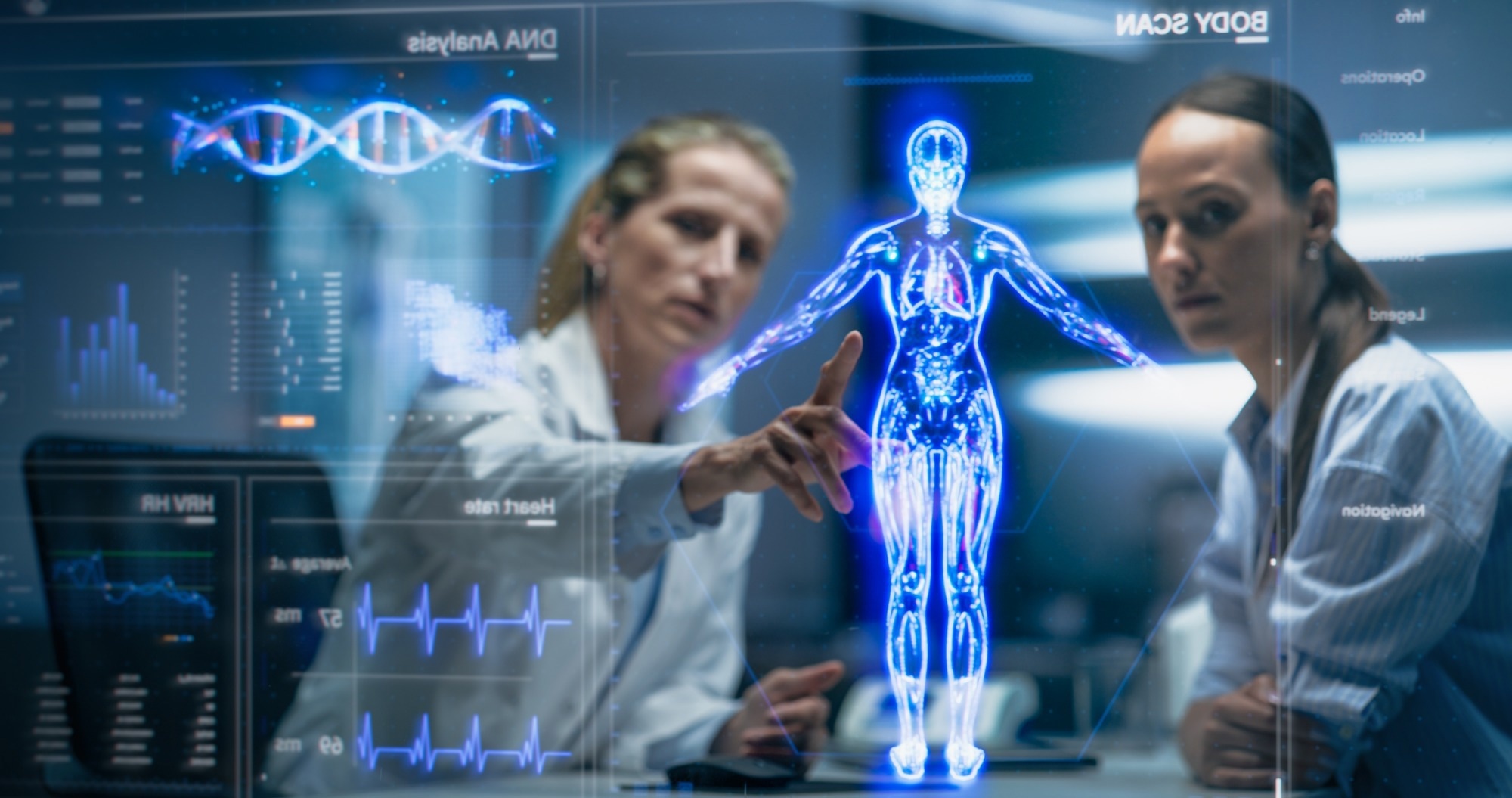 Image credit: Gorodenkoff/Shutterstock.com
Introduction
Digital twins are virtual representations of physical or biological systems that evolve in response to real-world observations. These replicas enable simulation, prediction, and optimization of system behavior.
The foundational concept of digital twins was articulated earlier than 2010, notably in engineering frameworks proposed by Michael Grieves in the early 2000s and later expanded in aerospace applications by NASA, emphasizing a persistent, bidirectional data linkage between physical systems and their digital counterparts. While digital twins are now widely used across engineering and manufacturing, their application in healthcare and life sciences is more recent.1,2
Drug discovery is increasingly adopting computational and data-driven methods to address persistent challenges, including high attrition rates, lengthy development timelines, and escalating costs. In this context, digital twins are emerging as a promising tool, providing virtual models of biological processes, drug candidates, and patient systems to support hypothesis testing, lead optimization, and decision-making throughout the drug development pipeline.1,2
What Is a Digital Twin in Drug Discovery?
In a biomedical and pharmaceutical context, a digital twin is a dynamic, data-driven virtual replica of a biological system that evolves as new experimental or clinical data are incorporated. Unlike traditional computational models or static simulations, which are typically built for a single purpose or dataset, digital twins are continuously updated through bidirectional data exchange, allowing them to reflect changing biological states.2,3
In drug discovery, digital twins can model entities across multiple biological scales, from molecules and cells to tissues, organs, and entire patient populations. By enabling computer-based simulations and virtual testing, they aid target validation, the refinement of promising compounds, pharmacokinetic and pharmacodynamic modeling, and the design of clinical trials. Recent reviews emphasize that these multiscale twins increasingly integrate mechanistic models with AI-driven components to balance biological interpretability and predictive performance.4
Core Components of Digital Twins
Digital twins in drug discovery are built by integrating biological data, computational models, and continuous refinement. Biological inputs, including omics profiles, imaging, and clinical measurements, form the foundation of virtual models of molecules, cells, tissues, or patients. Computational models, mechanistic, statistical, or hybrid, then replicate biological processes, disease progression, and drug responses. These models evolve through feedback loops, where experimental results, clinical observations, and new data are incorporated to refine predictions and improve accuracy over time.1,5
Increasingly, artificial intelligence (AI) and machine learning (ML) enhance these models by handling complex datasets and exploring chemical or biological space. Generative AI methods, including variational autoencoders and generative adversarial networks, are now used to simulate realistic molecular structures, biological responses, and virtual patient trajectories within digital twin frameworks.3,4
The digital twin – Artificial intelligence in medicine
Video credit: uzh_dsi/Youtube.com
Applications Across the Drug Discovery Pipeline
Digital twins are applied across multiple stages of the drug discovery and development pipeline. In early discovery, they support target validation, pathway modeling, and virtual screening by simulating molecular interactions and disease networks. During preclinical development, digital twins help model drug–target interactions, predict toxicity and metabolism, and optimize dosing strategies by integrating structural biology and pharmacokinetic data.3,5
In later stages, digital twins increasingly represent diseases or patient populations, particularly in complex, heterogeneous conditions such as oncology or neurodegenerative disorders. These patient-level or population-based models can simulate treatment responses, support clinical trial design, and enable patient stratification. Several studies highlight the emerging use of digital twins to partially virtualize control arms and forecast disease trajectories, thereby supporting more efficient, ethically optimized clinical trials.1,4
Benefits and Potential Impact
Digital twins are transforming drug discovery by combining biological data with advanced computational models to improve early prediction of drug efficacy, safety, and metabolism. This allows promising candidates to be identified sooner while filtering out likely failures, reducing reliance on costly late-stage experiments and animal models.3
By simulating realistic patient or disease trajectories and continuously integrating experimental and clinical data, digital twins support biomarker discovery, dose optimization, and identification of patient cohorts most likely to benefit from therapy. Evidence from recent reviews suggests that these approaches are particularly valuable for precision medicine in complex diseases such as Alzheimer’s disease and cancer.1
 Image credit: Pickadook/Shutterstock.com
Limitations and Challenges
Despite their promise, digital twins face scientific, technical, and regulatory hurdles that limit broad adoption. Their accuracy depends on the availability, quality, and integration of diverse biological and clinical datasets, which can be incomplete, heterogeneous, or biased. Capturing the complexity of biological systems across molecular, cellular, and physiological scales remains challenging, making continuous validation against experimental and clinical data essential, but resource-intensive.3,4
Data privacy and security also pose significant concerns, particularly when patient information or real-world clinical records are used, requiring robust governance and transparent data practices. Regulatory acceptance is still evolving, with agencies emphasizing interpretability, reproducibility, and validated evidence. Consequently, digital twins currently serve as decision-support tools that complement, rather than replace, traditional experiments and clinical trials.3,4
Relationship to AI and Machine Learning
AI and ML are central to the development of digital twins. They enable the analysis of complex, high-dimensional biological data and support tasks related to outcome prediction, drug response modeling, and virtual patient simulation. ML algorithms can integrate multi-omics, imaging, and clinical datasets, while generative AI methods help explore chemical and biological space by creating realistic molecular structures or virtual patient trajectories.2,3
However, AI alone does not constitute a digital twin. Digital twins provide the dynamic, systems-level framework in which AI-driven models are refined iteratively as new observations are incorporated through bidirectional data exchange between physical systems and their virtual counterparts. Recent expert analyses stress the importance of combining AI-driven models with mechanistic and physiology-based approaches to maintain interpretability in regulated drug development settings.4
Future Outlook
Looking ahead, digital twins are expected to evolve from proof-of-concept models into more comprehensive, patient-level representations that integrate molecular, physiological, and clinical data across time. Continued advances in AI technology and ML algorithms are likely to improve predictive accuracy and scalability. Closer integration with real-world evidence, such as electronic health records, imaging data, and wearable sensors, will enable more dynamic and clinically relevant simulations.4
In parallel, digital twins are increasingly being aligned with Industry 4.0 principles in pharmaceutical and biopharmaceutical manufacturing, supporting continuous monitoring, process optimization, and quality-by-design strategies alongside drug discovery. Rather than replacing experimental or clinical studies, digital twins are likely to function as complementary tools that streamline development, reduce attrition, and support more efficient and personalized drug development pathways.1,3,4,5
References
- Ren, Y., Pieper, A. A., & Cheng, F. (2025). Utilization of precision medicine digital twins for drug discovery in Alzheimer's disease. Neurotherapeutics, 22(3), e00553. DOI:10.1016/j.neurot.2025.e00553, https://www.sciencedirect.com/science/article/pii/S1878747925000315
- Mariam, Z., Niazi, S. K., & Magoola, M. (2024). Unlocking the Future of Drug Development: Generative AI, Digital Twins, and Beyond. BioMedInformatics, 4(2), 1441-1456. DOI:10.3390/biomedinformatics4020079, https://www.mdpi.com/2673-7426/4/2/79
- Adhikari, C., Das, P. K, Pramanik, T. (2025). Digital Twins for Drug Design: Importance, Applications and Future Perspectives. Orient J Chem;41(6). DOI:10.13005/ojc/410617, https://www.orientjchem.org/vol41no6/digital-twins-for-drug-design-importance-applications-and-future-perspectives/
- Maharjan, R., Kim, N. A., Kim, K. H., & Jeong, S. H. (2025). Transformative roles of digital twins from drug discovery to continuous manufacturing: Pharmaceutical and biopharmaceutical perspectives. International Journal of Pharmaceutics: X, 10, 100409. DOI:10.1016/j.ijpx.2025.100409, https://www.sciencedirect.com/science/article/pii/S2590156725000945
- Bordukova, M., Makarov, N., Rodriguez-Esteban, R., Schmich, F., Menden, M.P. (2024). Generative artificial intelligence empowers digital twins in drug discovery and clinical trials. Expert Opin Drug Discov;19(1):33-42. DOI:10.1080/17460441.2023.2273839, https://www.tandfonline.com/doi/10.1080/17460441.2023.2273839
Further Reading
Last Updated: Feb 9, 2026