From InstemReviewed by Olivia Frost
This article and associated images are based on a poster originally authored by Frances Hall and Brenda Finney and presented at ELRIG Drug Discovery 2026 in affiliation with Instem.
This poster is being hosted on this website in its raw form, without modifications. It has not undergone peer review but has been reviewed to meet AZoNetwork's editorial quality standards. The information contained is for informational purposes only and should not be considered validated by independent peer assessment.
The challenge in modern drug discovery is not generating data, but rather transforming these diverse experimental findings into actionable insights that improve predictions and support translational decision-making.
As organizations adopt AI-driven approaches, the need for connected, high-quality, and analysis-ready data has never been greater. In this context, lab-in-the-loop strategies provide a mechanism for continuously learning from experimental outcomes, enabling better experiments, better models, and ultimately better development decisions.
The translational learning circle
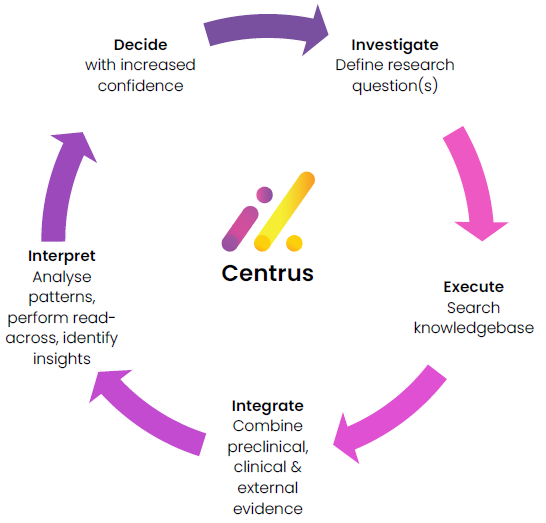
Image Credit: Image courtesy of Frances Hall and Brenda Finney in partnership with ELRIG (UK) Ltd.
Real-world use case
The challenge: Toxicology data is often fragmented across studies, projects, and departments, making it difficult to quickly answer scientific questions or reuse prior knowledge.
How Centrus helps:
- Centralizes preclinical and SEND data in a single trusted repository
- Enables rapid target safety and read-across assessments
- Supports data standardization and curation for downstream AI/ML initiatives
- Facilitates cross-functional collaboration and scientific publication activities
Outcome:
Organizations use Centrus as a strategic data foundation to accelerate scientific insight, improve knowledge reuse, and support more informed drug discovery and safety decisions.
Ideal data journey workflow
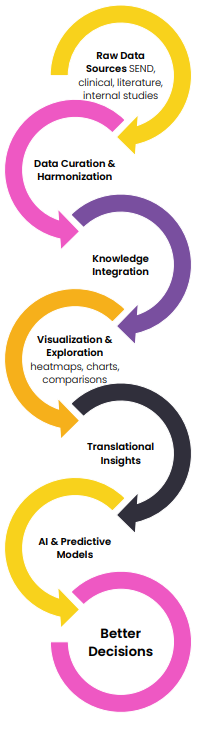
Image Credit: Image courtesy of Frances Hall and Brenda Finney in partnership with ELRIG (UK) Ltd.
History
2017: Launch
- Consortium formed across pharmaceutical companies, academia, SMEs, and informatics experts
- eTRANSAFE established under the Innovative Medicines Initiative (IMI2)2
- Project vision: Improve translational safety assessment through secure data sharing, integration, and predictive analytics
2017–2020: Development
- Establishment of data-sharing frameworks, originally known as ToxHub, balancing collaboration and confidentiality
- Adoption of SEND and other standards to improve interoperability and data quality
- Integration of preclinical, clinical, literature, and post-marketing safety information
2021: Publication
- Publication of The eTRANSAFE Project on Translational Safety Assessment Through Integrative Knowledge Management: Achievements and Perspectives2
- Demonstrated progress in data integration, visualization, translational analysis, and predictive modeling
- Highlighted development of computational tools supporting drug safety decision-making
2021–2023: Expansion
- Development of translational analysis tools, safety visualization tools, and predictive models
- Enhanced capabilities for cross-species comparison and read-across approaches
- Support for biomarker discovery and improved prediction of human safety outcomes
2023: Completion
- Nearly 10,000 repeated-dose toxicology studies shared and standardized
- Demonstrated industry-wide collaboration around translational safety data
- Established one of the largest shared repositories of toxicology knowledge in the pharmaceutical sector3
2023–now: Evolution
- Instem becomes the trusted custodian of eTRANSAFE assets
- eTRANSAFE innovation evolves into the Centrus platform
- Clinical and preclinical evidence brought together in a single translational environment
- Foundation established for AI-enabled discovery and translational decision-making
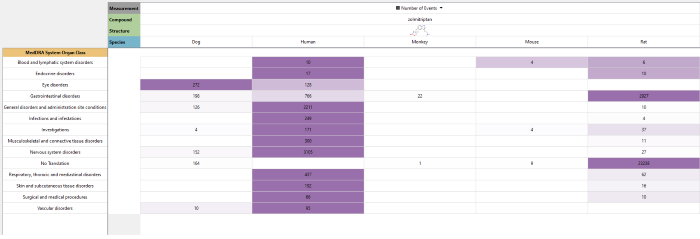
Cross-species translational safety heatmap generated in Centrus. Adverse events observed in humans and preclinical species are visualized side by side, enabling rapid identification of shared and species-specific safety findings to support translational risk assessment and decision-making. Image Credit: Image courtesy of Frances Hall and Brenda Finney in partnership with ELRIG (UK) Ltd.
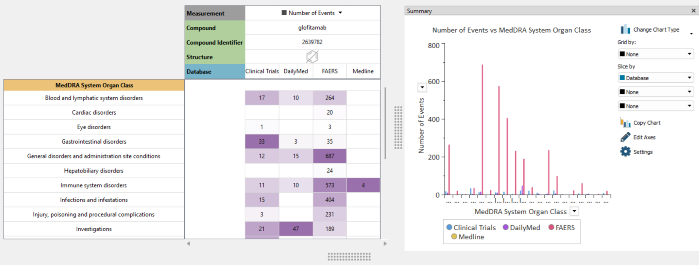
Heatmap and line graph data visualizations side by side. The same data can be explored from multiple perspectives to reveal different patterns and relationships. In this example, observations have been grouped by MedDRA System organ class and compared across databases, providing a high-level view of the distribution of findings.
Interactive visualizations allow researchers to rapidly identify areas of interest, compare trends, and investigate potential safety signals. Results can be displayed as heatmaps, bar charts, scatter plots, line graphs, or other visualization formats, enabling users to tailor analyses to their specific scientific questions and communication needs. Image Credit: Image courtesy of Frances Hall and Brenda Finney in partnership with ELRIG (UK) Ltd.
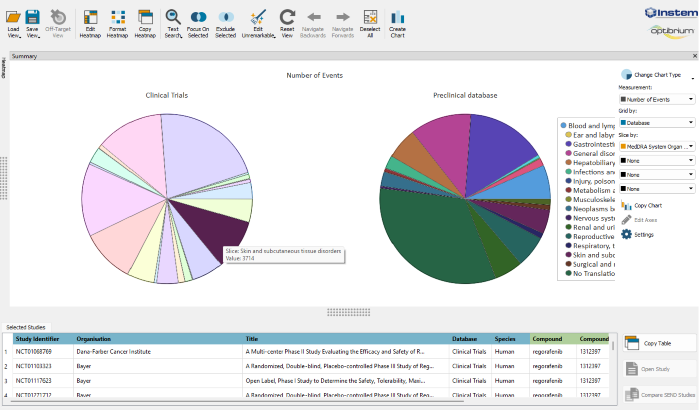
Double pie chart visualization of clinical and preclinical observations. Colors represent different biological areas, enabling rapid comparison of safety findings across datasets and highlighting patterns that may support translational safety assessment. Image Credit: Image courtesy of Frances Hall and Brenda Finney in partnership with ELRIG (UK) Ltd.
Conclusions
- Effective translational research depends on the integration of experimental design, high-quality data, and continuous learning workflows.
- Lab-in-the-loop approaches create a feedback cycle in which experimental results continuously inform future studies, predictive models, and translational decisions.
- By unifying clinical and preclinical data within a searchable, analysis-ready environment, Centrus enables researchers to identify relationships, perform read-across assessments, and derive greater value from existing scientific knowledge.
- Real-world applications demonstrate value across multiple use cases, including translational safety assessment, preclinical knowledge management, and AI/ML-ready data foundations.
- Establishing a connected data foundation can accelerate model development, improve translational confidence, and support more informed decision-making throughout the drug discovery process.
Key takeaways
The future of translational research will be driven by:
- Companies continuing to share data
- Learning effectively from data through continuous, transparent, data-driven scientific feedback loops
References and further reading
- Pognan, F., et al. (2021) The eTRANSAFE Project on translational safety assessment through integrative knowledge management: Achievements and perspectives, Pharmaceuticals, 14(3), 237. DOI:10.3390/ph14030237. https://www.mdpi.com/1424-8247/14/3/237.
- European Commission CORDIS (2023) eTRANSAFE: Enhancing translational safety assessment through integrative knowledge management. Grant Agreement No. 777365. European Commission. Available at: https://cordis.europa.eu/project/id/777365.
- Sanz, F., et al. (2023) eTRANSAFE: Data science to empower translational safety assessment, Nature Reviews Drug Discovery, 22(7), pp. 521–522. Available at: DOI:10.1038/d41573-023-00099-5. https://www.nature.com/articles/d41573-023-00099-5.
About Instem
Instem is a UK-founded company established in 1969 that provides SaaS platforms and services to the life sciences industry.
The company delivers software solutions across areas including in-silico data insights, study management, regulatory submission, and clinical-trial analytics.
About ELRIG (UK) Ltd.
The European Laboratory Research & Innovation Group (ELRIG) is a leading European not-for-profit organization that exists to provide outstanding scientific content to the life science community. The foundation of the organization is based on the use and application of automation, robotics and instrumentation in life science laboratories, but over time, we have evolved to respond to the needs of biopharma by developing scientific programmes that focus on cutting-edge research areas that have the potential to revolutionize drug discovery.
Comprised of a global community of over 12,000 life science professionals, participating in our events, whether it be at one of our scientific conferences or one of our networking meetings, will enable any of our community to exchange information, within disciplines and across academic and biopharmaceutical organizations, on an open access basis, as all our events are free-of-charge to attend!
Our values
Our values are to always ensure the highest quality of content and that content will be made readily accessible to all, and that we will always be an inclusive organization, serving a diverse scientific network. In addition, ELRIG will always be a volunteer led organization, run by and for the life sciences community, on a not-for-profit basis.
Our purpose
ELRIG is a company whose purpose is to bring the life science and drug discovery communities together to learn, share, connect, innovate and collaborate, on an open access basis. We achieve this through the provision of world class conferences, networking events, webinars and digital content.
Sponsored Content Policy: News-Medical.net publishes articles and related content that may be derived from sources where we have existing commercial relationships, provided such content adds value to the core editorial ethos of News-Medical.Net which is to educate and inform site visitors interested in medical research, science, medical devices and treatments.
Last Updated: Nov 3, 2026