This article and associated images are based on a poster originally authored by Eleni Charla, Guido Zagnoli Vieira, Anastasiia Gryniukova, Ana TEIXEIRA-SILVA, and Jo Francis, and presented at ELRIG Drug Discovery 2026 in affiliation with AstraZeneca.
This poster is being hosted on this website in its raw form, without modifications. It has not undergone peer review but has been reviewed to meet AZoNetwork's editorial quality standards. The information contained is for informational purposes only and should not be considered validated by independent peer assessment.

Abstract
Hepatotoxicity remains a critical challenge in drug development, demanding early, mechanistically informed detection across all therapy areas and modalities, including emerging ones such as PROTACs. Within the Mechanistic Biology and Profiling unit, researchers have built an imaging-led strategy in which high-content imaging (HCI) coupled with AI-driven image analytics forms the analytical backbone of hepatic liability assessment.
At its core is the LiverTox imaging assay, a fully automated, high-throughput platform that captures fluorescence readouts from HepG2 liver-derived cells to interrogate phospholipidosis, a key marker of lipid dysregulation and potential hepatotoxicity. Robotics-enabled, high-content imaging generates reproducible, plate-scale datasets, while deep-learning models incorporated into SiMA analytics resolve subcellular structures and quantify organelle-level perturbations, capturing subtle morphological changes that traditional readouts miss.
Quantitative descriptors of lipid accumulation, organelle dysfunction, and cellular stress provide direct mechanistic insight, and scalable analytics translate millions of cellular images into decision-ready metrics that support data-driven compound prioritization early in discovery. The imaging pipeline is modality-agnostic, extending mechanistic hazard identification to small molecules, biologics, and novel degraders alike.
By transforming pixels into predictive, mechanistic insights, this platform accelerates early hazard identification, reduces the risk of drug-induced liver injury (DILI), and enables safer therapeutic development across diverse modalities.
Phospholipidosis (PLD) value to predict drug-induced liver injury (DILI) risk
LiverTox imaging assay workflow: Automation, high-content imaging, and AI analytics
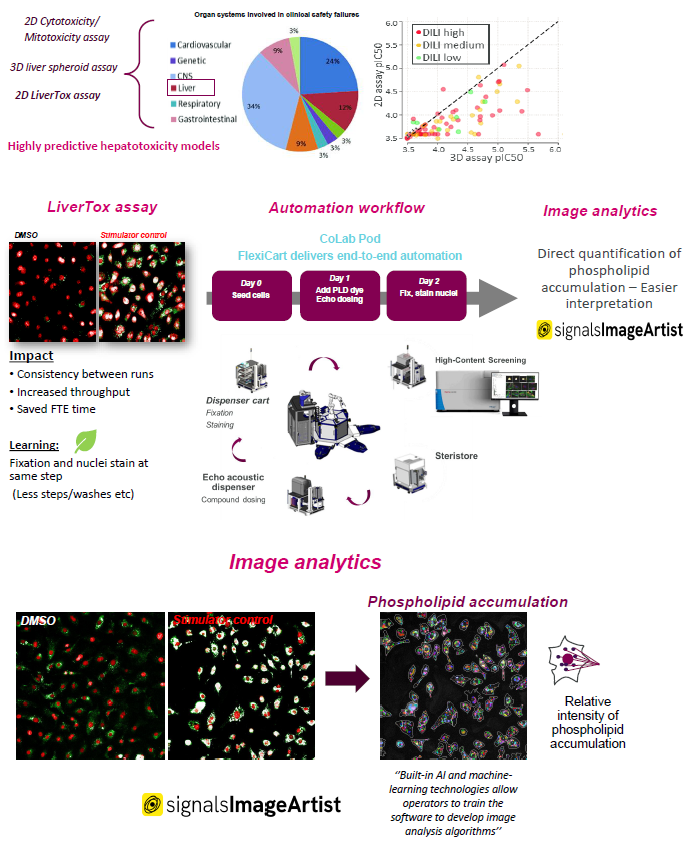
Image Credit: Image courtesy of Eleni Charla et al., in partnership with ELRIG (UK) Ltd.
The hepatotoxicity safety screening cascade progresses from 2D cytotoxicity and mitochondrial toxicity assays to more physiologically relevant 3D liver spheroid and 2D LiverTox models, improving prediction of drug-induced liver injury (DILI).
LiverTox imaging assay is built using end-to-end automation from compound delivery to imaging screening. The use of AI-driven analytics allows for diet quantification of phospholipid dye accumulation, a marker of lipid dysregulation in cells that clinically can lead to organ dysfunction.
AI-driven analytics: Highly sensitive and predictive assay
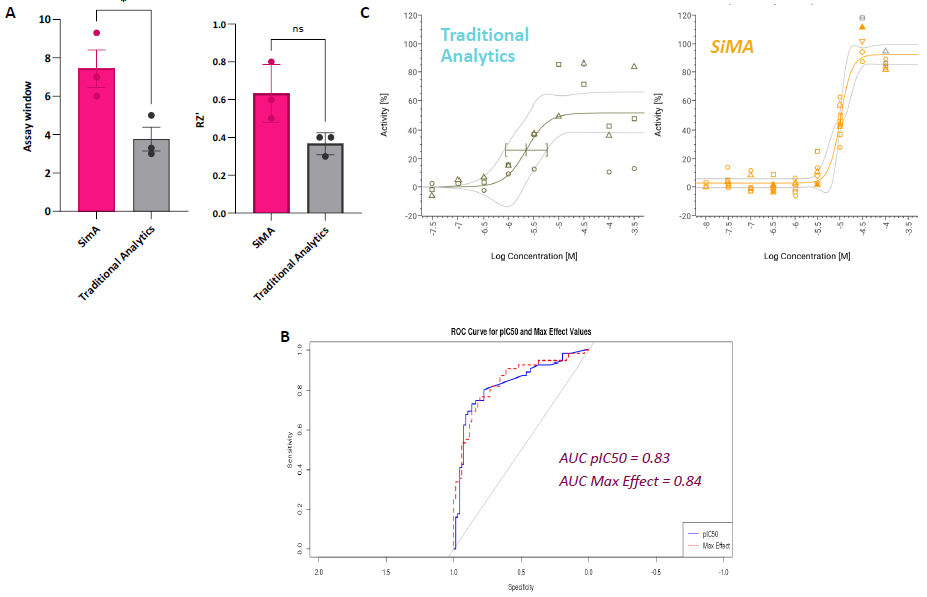
Validation data generated testing a mixture of 110 compounds with positive and negative PLD flags. (A) Signal Image artist results in higher quality assay statistics (assay window and robust Zprime factor (RZ’) which informs regarding positive and negative control separation). (B) ROC plot yields AUC values of 0.83 for pIC50 and 0.84 for max concentration effect; both values are considered excellent. (C) SiMA yields a higher-quality dose-response curve than traditional image analytics. Image Credit: Image courtesy of Eleni Charla et al., in partnership with ELRIG (UK) Ltd.
New modalities and associated hepatic liabilities
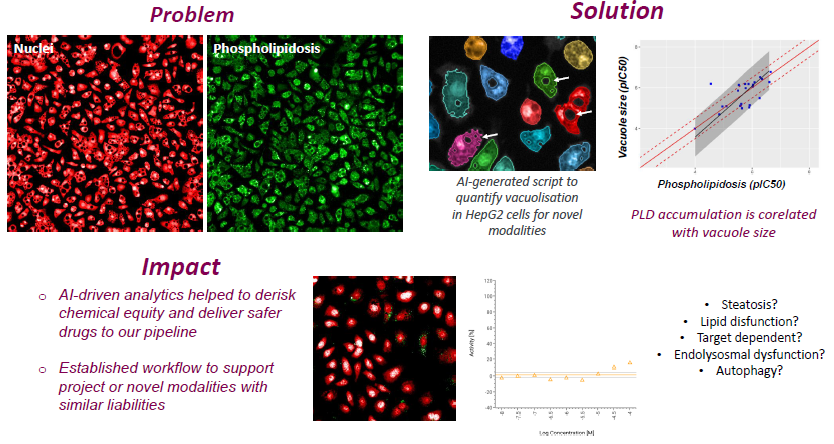
Image Credit: Image courtesy of Eleni Charla et al., in partnership with ELRIG (UK) Ltd.
- Problem: Novel modality caused stress in HepG2 cells, as evidenced by vacuolization and lipid accumulation.
- Solution: The AI-generated script enabled identification and vacuole quantification, and allowed observations of phospholipidosis and vacuole-size correlation (the y-axis represents the log of IC50 derived from vacuole-size calculations, and the x-axis represents the log of IC50 for phospholipid accumulation).
- Impact: Implementation of new analytics to identify and quantify vacuole size, along with improved LiverTox assay analytics, helped the project derisk chemical equity and move away from hepatic liabilities such as vacuolization and phospholipid accumulation in HepG2 cells.
Future highlights
Upcoming plans for hepatotoxicity screening capabilities:
- Improved DILI Bayesian models
- Streamlined hepatotoxicity cascade
- Scope for additional safety assays to enhance the hepatotoxicity cascade
References and further reading
- Garside, H., et al. (2014) 'Evaluation of the use of imaging parameters for the detection of compound-induced hepatotoxicity in 384-well cultures of HepG2 cells and cryopreserved primary human hepatocytes', Toxicology in Vitro, 28(2), pp. 171–181. Available at: DOI:10.1016/j.tiv.2013.10.014. https://www.sciencedirect.com/science/article/pii/S0887233313002701?via%3Dihub.
- Williams, D.P., et al. (2019) Predicting drug-induced liver injury with Bayesian machine learning, Chemical Research in Toxicology, 32(10), pp. 1978–1989. Available at: DOI:10.1021/acs.chemrestox.9b00138. https://pubs.acs.org/crtoec/article-abstract/33/1/239/595032/Predicting-Drug-Induced-Liver-Injury-with-Bayesian?redirectedFrom=fulltext.
- Rodrigues, R.M., et al. (2019) Drug-induced gene expression profile changes in relation to intestinal toxicity: State-of-the-art and new approaches, Cancer Treatment Reviews, 75, pp. 18–26. DOI:10.1016/j.ctrv.2019.03.001. https://www.cancertreatmentreviews.com/article/S0305-7372(19)30082-9/fulltext.
- Olubamiwa, O.A., et al. (2025) DILIrank 2.0: An updated and expanded database for drug-induced liver injury risk based on FDA labeling and a literature review, Drug Discovery Today, 30(1), 104245. DOI:10.1016/j.drudis.2024.104245. https://www.sciencedirect.com/science/article/pii/S1359644625001989?via%3Dihub.
About AstraZeneca
AstraZeneca is a global, science-led patient-focused pharmaceutical company that focuses on transforming the future of healthcare by unlocking the power of what science can do for people, society and the planet.
Science defines who we are. We push the boundaries of science to deliver life-changing medicines. It is why we come to work every day and is part of our DNA. We are committed to operating sustainably, in a way that recognises the interconnection between business growth, the needs of society and the limitations of our planet. We want the way we work to be inclusive, open and collaborative. This approach runs through all that we do.
We focus on three main therapy areas – Oncology, BioPharmaceuticals and Rare Disease.
Everything we do is aimed at enhancing the lives of people with disease and illness. Decisions we make across the patient experience are informed by what people tell us matters most to them. Our teams also work alongside the world's leading academic and biotech research institutions to stimulate innovation and evaluate emerging technologies such as Modified RNA and CRISPR genome editing. AstraZeneca operates in over 100 countries and its innovative medicines are used by millions of patients worldwide.
About ELRIG (UK) Ltd.
The European Laboratory Research & Innovation Group (ELRIG) is a leading European not-for-profit organization that exists to provide outstanding scientific content to the life science community. The foundation of the organization is based on the use and application of automation, robotics and instrumentation in life science laboratories, but over time, we have evolved to respond to the needs of biopharma by developing scientific programmes that focus on cutting-edge research areas that have the potential to revolutionize drug discovery.
Comprised of a global community of over 12,000 life science professionals, participating in our events, whether it be at one of our scientific conferences or one of our networking meetings, will enable any of our community to exchange information, within disciplines and across academic and biopharmaceutical organizations, on an open access basis, as all our events are free-of-charge to attend!
Our values
Our values are to always ensure the highest quality of content and that content will be made readily accessible to all, and that we will always be an inclusive organization, serving a diverse scientific network. In addition, ELRIG will always be a volunteer led organization, run by and for the life sciences community, on a not-for-profit basis.
Our purpose
ELRIG is a company whose purpose is to bring the life science and drug discovery communities together to learn, share, connect, innovate and collaborate, on an open access basis. We achieve this through the provision of world class conferences, networking events, webinars and digital content.
Sponsored Content Policy: News-Medical.net publishes articles and related content that may be derived from sources where we have existing commercial relationships, provided such content adds value to the core editorial ethos of News-Medical.net, which is to educate and inform site visitors interested in medical research, science, medical devices and treatments.
Last Updated: Nov 2, 2026
 St George Street Capital signs agreement with AstraZeneca to develop two compounds in the clinic