This article is based on a poster originally authored by Pengfei Gao, Marta Westwood, Xinghan Liu, Yasong Cui, Yuhui Wang, Fang He, Chunyan Han, Cheng Zhang, Xiaoxue Wang, Mandy Xu, Tan Pang, Chong Wang, and Mengya Tong.
A current challenge in ADC discovery is deconvoluting the effects of target engagement, trafficking, stability, and linker/payload behavior to characterize factors that may influence efficacy and safety during early development.
This article summarizes an integrated workflow for mechanistically profiling ADCs using Dato-DXd (datopotamab deruxtecan) as a case study. An FDA-approved Trop2-directed ADC, Dato-DXd contains a DXd topoisomerase-I inhibitor payload linked through a protease-cleavable tetrapeptide linker designed for plasma stability and lysosomal cleavage. Following target-mediated internalization, this design enables intracellular release of the DXd payload.
Using Dato-DXd as a case study, the authors demonstrate how this integrated workflow can be applied to characterize key aspects of ADC biology, including preferential binding and internalization in Trop2high cells, lysosomal DXd release, and donor-dependent bystander killing.
Key Elements of Pharmaron’s in vitro ADC Profiling Workflow
Target antigen evaluation
- Profiling cell lines, organoids, and animal tissues using genomics, transcriptomics, and proteomics
- Integration of in-house and public databases
- Quantifying and localizing target antigen expression for internalization
Payload identification
- High-throughput screening of biochemical and cell-based tests
- Affinity selection-mass spectrometry (AS-MS)
- Synthesis and screening of DEL libraries
Linker evaluation and in vitro ADMET
- Plasma stability and DAR
- Catabolism and release of payloads via lysosomes and proteases
- ADC internalization and payload release following internalization
- Bioanalysis for component tracking
Functional ADC testing and biomarkers
- DNA damage, apoptosis, and cell cycle analysis
- Cell death, growth, and signal modulation
- Translational organoid models and bystander effects
- Biomarker testing using genomes, proteomics, and cellomics
Biophysical and structural evaluation
- Epitope accessibility and binding affinities
- Structural integrity, stability, and aggregation after bioconjugation
- CryoEM for payload positioning and linker orientation
ADC in vitro toxicology
- Fc-mediated immunotoxicity
- Cytokine storm
- Screening for off-target toxicity using normal organoids and safety panels
- Toxicity to the mitochondria and liver
1. Trop2 binding affinity is maintained after conjugation
Source: Pharmaron
| Test article |
ka (1/Ms) |
kd (1/s) |
KD (M) |
Rmax (RU) |
Stoichiometry |
| Datopotamab |
2.21E+05 |
2.13E-03 |
9.62E-09 |
221.6 |
2.0 |
| Dato-Dxd |
2.59E+05 |
2.05E-03 |
7.91E-09 |
255.8 |
2.0 |
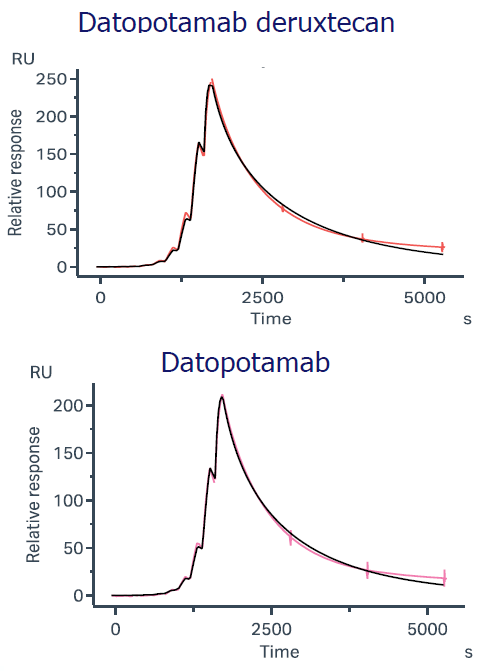
Image Credit: Pharmaron
SPR analysis reveals that datopotamab and Dato-DXd have comparable nanomolar affinity for Trop2, implying that conjugation does not impede Fab-Trop2 binding. Binding kinetics and stoichiometry values demonstrate that epitope accessibility remains intact, as do functional binding sites.
2. Selective binding to Trop2high cells
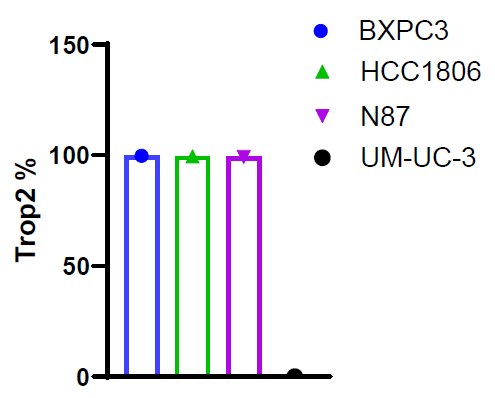
Image Credit: Pharmaron
Flow cytometry revealed high Trop2 surface levels on BxPC-3, HCC1806, and N87, but low expression on UM-UC-3.
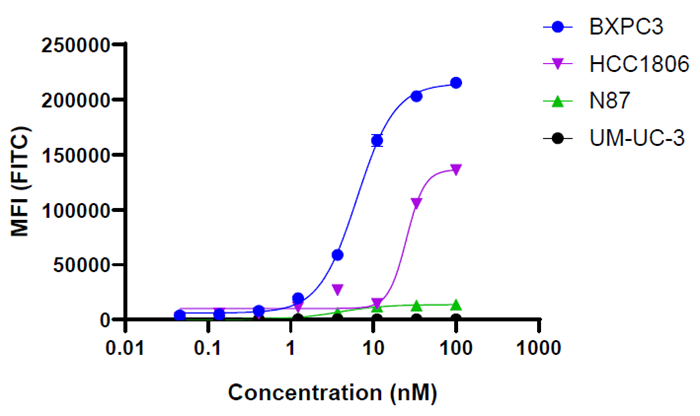
Image Credit: Pharmaron
Dato-DXd binds preferentially binds Trop2high cells, with minimal or no detectable binding in the Trop2low line UM-UC-3, indicating target-dependent engagement.
3. Internalization only in Trop2high cells
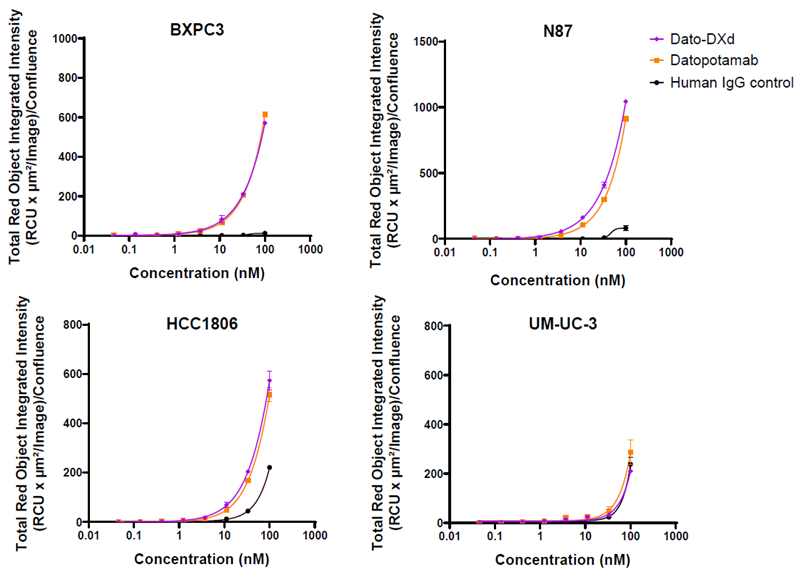
Image Credit: Pharmaron
A pH-sensitive fluorescence test (with Phrodo-labeled antibodies) and Incucyte imaging were used to evaluate ADC internalization. The results confirmed efficient internalization and lysosomal trafficking in Trop2high cell lines.
4. Trop2-Datopotamab structure

Image Credit: Pharmaron
The Trop2-Datopotamab complex's preliminary structure was determined using cryo-electron microscopy. Trop2 protein was expressed in Hi-5 cells, and the cis-dimeric complex architecture was determined through a complete cryo-EM structure determination workflow, from raw micrographs to a refined atomic model.
5. Lysosomal cleavage and plasma stability

Image Credit: Pharmaron
- The payload release assay indicates that DXd is released from Dato-DXd via protease-mediated cleavage under lysosomal conditions. Cathepsins L and S account for most of the cleavage, with Cathepsin B contributing less and more slowly. These findings indicate Cathepsin L and S as the major enzymes responsible for intracellular linker cleavage and payload release.
- In vitro plasma stability of Dato-DXd across human, monkey, rat, and mouse plasma over 21 days demonstrates that the intact ADC remains largely stable in all species. Free DXd payload gradually increases over time, with greater release in human and mouse models and lower release in monkey and rat, indicating species-dependent linker stability.
- DAR values decline with time in all species, indicating gradual deconjugation of the ADC. Human and monkey plasma exhibit better stability, whereas rats and mice experience faster DAR loss.
6. Trop2-specific cytotoxicity
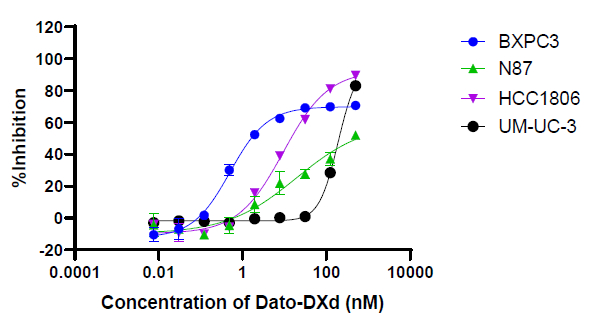
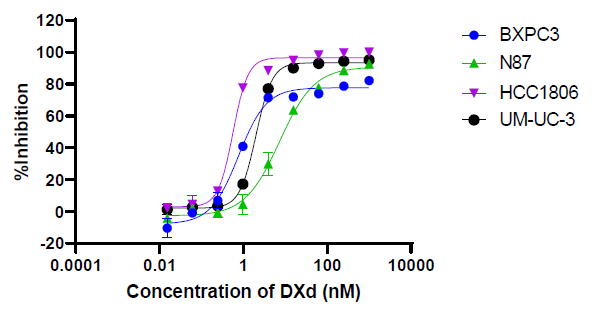
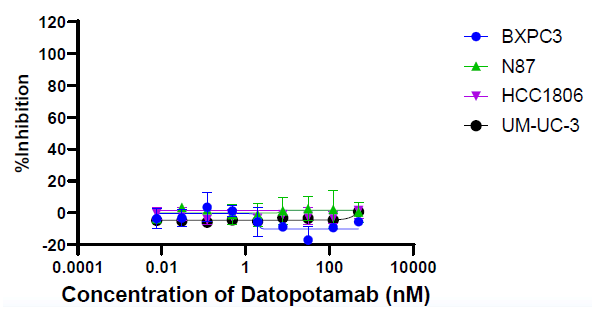
Image Credit: Pharmaron
Dato-DXd cytotoxicity
Dato-DXd exhibits greater cytotoxicity in Trop2high cells (BxPC-3 and N87) than in Trop2low cells (UM-UC-3), consistent with target-dependent payload delivery.
DXd cytotoxicity
Free DXd kills both Trop2high and Trop2low cell lines.
Datopotamab cytotoxicity
The naked antibody has no killing activity.
7. Efficacy in PDX-derived organoids correlates with Trop2 expression level
A. Organoids exhibit similar Trop2 expression levels as original tumor tissue
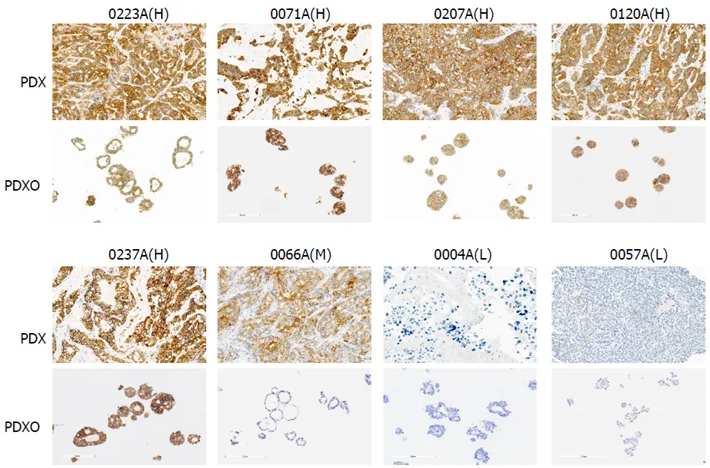
Image Credit: Pharmaron
B. Dato-DXd efficacy in organoids is Trop2-dependent
Source: Pharmaron
| Trop2-TPM |
Trop2-IHC |
PDXO_ID |
Datopotamab |
Dato-DXd |
Deruxtecan |
DXd |
| IC50 (nM) |
IC50 (nM) |
IC50 (nM) |
IC50 (nM) |
|
|
|
mAb |
ADC |
Payload+linker |
Payload |
| 1153.77 |
High |
PANC0223A |
> 694.4 |
0.54 |
189.15 |
1.3 |
| 671.22 |
High |
NSCLC0071A |
> 694.4 |
160.47 |
1150 |
3.37 |
| 401.43 |
High |
NSCLC0207A |
> 694.4 |
0.54 |
435.59 |
1.72 |
| 363.69 |
High |
OVC0120A |
> 694.4 |
0.08 |
182.4 |
0.47 |
| 343.35 |
High |
CRC0038A |
> 694.4 |
0.824 |
296.2 |
0.979 |
| 250.98 |
High |
GAS0101A |
> 694.4 |
>671.1 |
854.9 |
2.67 |
| 224.04 |
High |
NSCLC0181A |
> 694.4 |
149.46 |
595.05 |
1.64 |
| 215 |
High |
NSCLC0238A |
> 694.4 |
10.13 |
615.57 |
1.26 |
| 170.59 |
High |
NSCLC0196A |
> 694.4 |
86.39 |
458.4 |
1.09 |
| 140.82 |
High |
NSCLC0237A |
> 694.4 |
440.67 |
1209 |
3.759 |
| 113.96 |
High |
NSCLC0175A |
> 694.4 |
64 |
565.2 |
0.17 |
| 58.89 |
Moderate |
NSCLC0066A |
> 694.4 |
581.1 |
560.28 |
1.88 |
| 11.28 |
low |
CRC0004A |
> 694.4 |
292 |
183.3 |
0.42 |
| 1 |
low |
GAS0057A |
> 694.4 |
175.97 |
452.8 |
1.4 |
- Immunohistochemistry (IHC) of patient-derived xenograft tumors (PDX) and match organoids was used to confirm preserved Trop2 expression ex vivo.
- Dato-DXd selectively killed Trop2high organoids, but the antibody alone had no cytotoxic activity. The reduced effect of DXd+linker compared to free DXd illustrates the restricted permeability of the conjugated payload.
8. Efficient bystander killing in vitro demonstrated by two independent assays
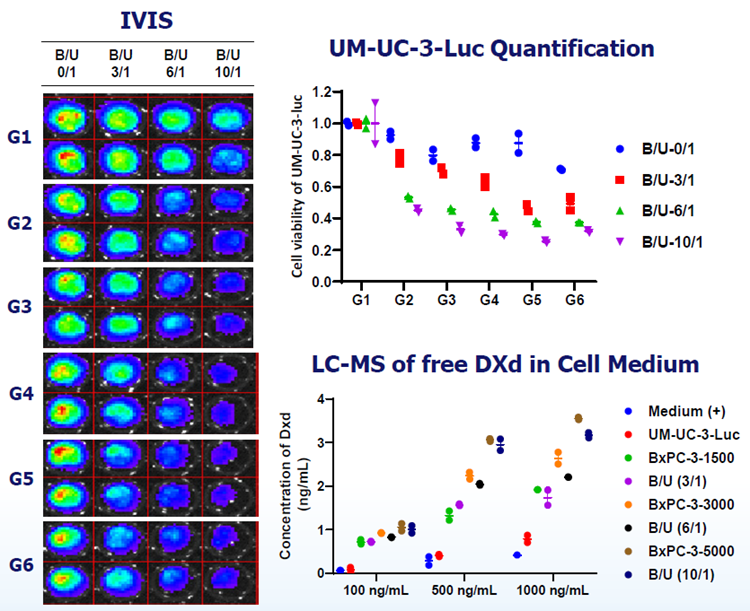
Image Credit: Pharmaron
a) Luciferase co-culture assay
BxPC-3 (Trop2high) and luciferase-expressing UM-UC-3-Luc (Trop2low) cells were co-cultured with predetermined B/U ratios.
After Dato-DXd treatment, the luminescence of UM-UC-3-Luc diminished only when BxPC-3 cells were present, indicating that DXd-mediated bystander death is donor-dependent. LC-MS confirmed that the medium contained more free DXd as the number of BxPC-3 cells increased.
G1. Dato-DXd-0 ng/mL
G2. Dato-DXd-100 ng/mL
G3. Dato-DXd-200 ng/mL
G4. Dato-DXd-500 ng/mL
G5. Dato-DXd-1000 ng/mL
G6. Dato-DXd-2000 ng/mL
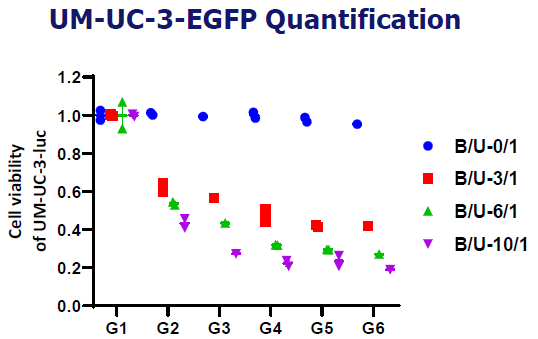
Image Credit: Pharmaron
b) IncuCyte EGFP co-culture assay
A similar experiment was carried out using IncuCyte and EGFP-expressing UM-UC-3 cells. Dato-DXd promoted selective loss of EGFP-positive UM-UC-3 cells, but only in the presence of BxPC-3, suggesting DXd-mediated removal of nearby Trop2low bystander cells.
9. Assessment of FcRn binding, ADCP, and ADCC after conjugation
FcRn Binding Affinity is Preserved after Bioconjugation. Source: Pharmaron
| Sample |
ka (1/Ms) |
kd (1/s) |
KD (M) |
Affinity KD (M) |
| Datopotamab |
5.36E+05 |
4.16E-01 |
7.75E-07 |
7.93E-07 |
| Dato-DXd |
2.92E+05 |
2.70E-01 |
9.26E-07 |
1.03E-06 |
SPR analysis shows that Dato-DXd has FcRn binding affinity comparable to datopotamab, implying that conjugation does not impede IgG-like recycling.
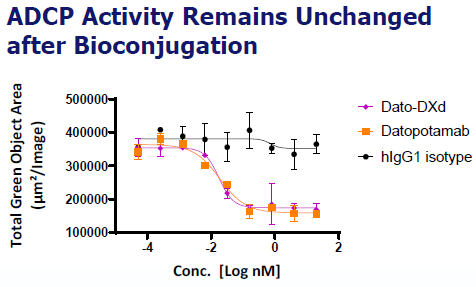
Image Credit: Pharmaron
Identical ADCP (antibody-dependent cellular phagocytosis) efficacy in macrophages and N87 cells shows that bioconjugation does not interfere with macrophage engagement or phagocytic clearance.
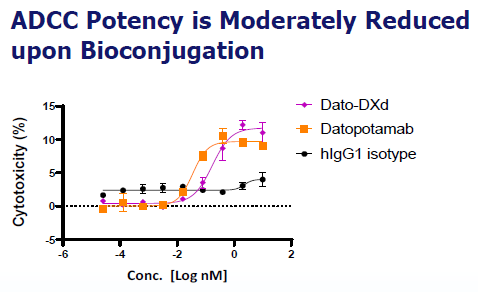
Image Credit: Pharmaron
ADCC (antibody-dependent cellular cytotoxicity) activity with NK and N87 cells exhibits a five-fold decrease in Dato-DXd efficacy, indicating partial Fc-effector reduction upon conjugation.
Conclusion
- Pharmaron’s integrated in vitro profiling workflow enabled assessment of key mechanistic characteristics, including target engagement, trafficking, stability, and payload release.
- Using Dato-DXd as a case study, the researchers demonstrated selective internalization into Trop2high cells, lysosomal release, and donor-dependent bystander killing.
- Mechanistic characterization of ADCs may provide insights that support candidate selection and early-stage development decisions.
Acknowledgments
Produced using materials originally authored by Pengfei Gao, Marta Westwood, Xinghan Liu, Yasong Cui, Yuhui Wang, Fang He, Chunyan Han, Cheng Zhang, Xiaoxue Wang, Mandy Xu, Tan Pang, Chong Wang, and Mengya Tong from in vitro Biology, Pharmaron, in vitro ADMET, Pharmaron, and in vivo Pharmacology, Pharmaron.
About Pharmaron
Pharmaron is a premier R&D service provider for the life sciences industry. Founded in 2004, Pharmaron has invested in its people and facilities, and established a broad spectrum of research, development and manufacturing service capabilities throughout the entire drug discovery, preclinical and clinical development process across multiple therapeutic modalities, including small molecules, biologics and CGT products. With over 17,000 employees, and operations in China, the U.S., and the U.K., Pharmaron has an excellent track record in the delivery of R&D solutions to its partners in North America, Europe, Japan and China.
Sponsored Content Policy: News-Medical.net publishes articles and related content that may be derived from sources where we have existing commercial relationships, provided such content adds value to the core editorial ethos of News-Medical.net, which is to educate and inform site visitors interested in medical research, science, medical devices and treatments.
Last Updated: Nov 9, 2026