Introduction
What Are Antibodies?
Antibodies as Research and Diagnostic Tools
The Rise of Therapeutic Antibodies
ADCs
Bispecific Antibodies and T-Cell Engagers
Future Directions
Conclusion
References
Further Reading
Antibodies are essential components of the adaptive immune system that have transformed biomedical research, diagnostics, and precision medicine through their ability to specifically recognize and target antigens. This article explores antibody structure, laboratory applications, therapeutic antibodies, antibody-drug conjugates (ADCs), bispecific antibodies, and emerging innovations that continue to advance targeted disease treatment.
 Image credit: Corona Borealis Studio/Shutterstock.com
Introduction
Antibodies have changed modern biomedical research and medicine owing to their exceptional ability to identify specific antigens with high affinity. Produced naturally by B lymphocytes as part of adaptive immunity, antibodies have repeatedly proven indispensable tools for the identification of proteins, markers, and pathogens in laboratories and clinics. Progress in antibody engineering has broadened the scope of their use beyond laboratories, enabling targeted treatments in oncology, autoimmune diseases, infectious diseases, and other conditions.
In the present time, new antibody-based modalities such as monoclonal antibodies, antibody-drug conjugates (ADCs), and bispecific antibodies continue transforming medicine and enhancing patients' lives. Advances in recombinant antibody technologies, phage display, transgenic mouse platforms, and single B-cell isolation have further accelerated the discovery and clinical translation of antibody therapeutics.1-4
This article explores how antibodies function as essential research tools and powerful therapeutics, covering their structure, laboratory applications, monoclonal antibodies, ADCs, bispecific T-cell engagers, and emerging advances shaping the future of precision medicine.
What Are Antibodies?
Antibodies, or immunoglobulins (Ig), are Y-shaped glycoproteins produced by B lymphocytes and plasma cells, which are part of the adaptive immune system. Antibodies consist of two identical heavy chains and two identical light chains linked to one another by disulfide bonds. Each antibody has two fragment antigen-binding (Fab) regions that bind antigens and one fragment crystallizable (Fc) region that interacts with immune cells and complement proteins to trigger immune responses. The antigen-binding specificity resides within the variable domains of the heavy and light chains, where complementarity-determining regions (CDRs) recognize specific epitopes, the distinct regions or molecular features of an antigen that are recognized by an antibody. This structure helps antibodies to recognize foreign compounds, neutralize them, and promote their elimination.1,3,4
Naturally occurring antibodies are broadly classified as polyclonal antibodies, which recognize multiple epitopes on an antigen, and monoclonal antibodies, which bind a single epitope with high specificity. Advances in biotechnology have also enabled the creation of recombinant antibodies designed to improve their efficacy, reliability, and effectiveness in research laboratories, clinical trials, and therapeutic practice. Recombinant antibodies also improve batch-to-batch consistency by avoiding many of the variability issues associated with traditional animal-derived antibodies.1,2,4
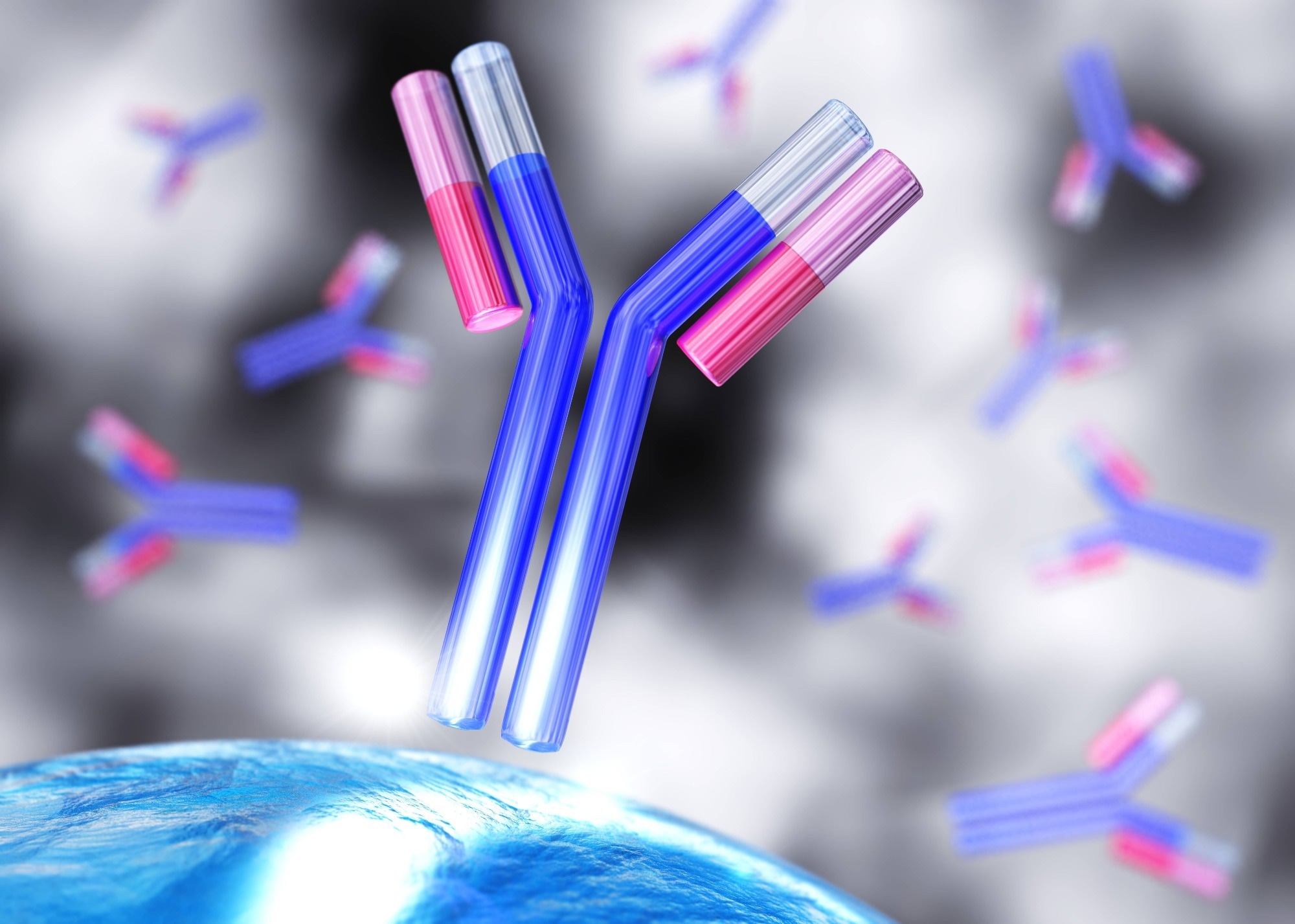 General structure of an antibody (immunoglobulin). Antibodies are Y-shaped glycoproteins composed of two identical heavy chains and two identical light chains linked by disulfide bonds. The two arms (Fab regions) contain variable domains that bind specific antigens, while the stem (Fc region) interacts with immune cells and complement proteins to help coordinate the body's immune response. Image credit: ustas7777777/Shutterstock.com
Antibodies are now among the most crucial tools in laboratories because they can recognize and bind specific antigens with high sensitivity and specificity. This high specificity enables scientists and physicians to detect even small amounts of proteins, biomarkers, viruses, and many other substances in very complicated systems. Thus, antibody-based methods have gained significant importance in biomedical research, disease diagnosis, therapeutic monitoring, and drug development. Their reliability, reproducibility, and versatility have made them fundamental components of both basic and applied research.3
One of the most widely used antibody-based methods is the enzyme-linked immunosorbent assay (ELISA), which uses the principle of antigen-antibody interactions to detect and quantify proteins, hormones, antibodies, and pathogen-related products. Western blotting uses antibodies to identify specific proteins after electrophoretic separation, confirming their presence and helping determine their molecular weight. Immunohistochemistry is a technique that uses antibodies to detect proteins in histological sections and has proven very useful in many cases of disease diagnosis. Additional antibody-based applications include immunoaffinity chromatography for protein purification and molecular imaging, where antibodies deliver imaging agents selectively to diseased tissues.3
Similarly, immunofluorescence utilizes fluorescently labeled antibodies to detect target antigens and examine their localization within cells and tissues under a fluorescence microscope. Flow cytometry is a method that combines fluorescently labeled antibodies with laser-based procedures to identify and quantify different cell populations based on the presence of surface or intracellular markers. Together, these antibody-based techniques provide highly sensitive and specific platforms for detecting and quantifying proteins, biomarkers, and pathogens, supporting advances in biomedical research, clinical diagnostics, and the development of targeted therapies. In therapeutic antibody development, additional analytical methods, including chromatographic, electrophoretic, spectroscopic, and mass spectrometric techniques, are extensively used during quality control to characterize antibody structure, purity, post-translational modifications, and biological activity.3
The Rise of Therapeutic Antibodies
The development of monoclonal antibody technology has transformed the treatment of numerous diseases by enabling highly specific targeting of disease-associated molecules. The hybridoma technology developed by Köhler and Milstein in 1975 has led to the creation of therapeutic antibodies by producing identical antibodies. The first approved therapeutic monoclonal antibody, muromonab-CD3, entered clinical use in 1986, establishing antibody-based therapeutics as a new class of medicines.
However, early murine antibodies often triggered immune responses in patients, prompting the development of chimeric, humanized, and eventually fully human antibodies through advances such as complementarity-determining region grafting, phage display, transgenic mouse platforms, and single B-cell technologies. These innovations have significantly reduced immunogenicity while improving therapeutic efficacy, safety, and clinical applicability across diverse disease areas.2,3,4
Therapeutic antibodies exert their effects through multiple mechanisms of action. They can block disease-associated targets by preventing ligand–receptor interactions, activate or inhibit receptors to regulate cellular signaling pathways, and recruit immune effector mechanisms such as antibody-dependent cellular cytotoxicity, antibody-dependent cellular phagocytosis, and complement-dependent cytotoxicity to eliminate diseased cells.
The Fc region plays a central role in mediating these effector functions through interactions with Fc receptors on immune cells and complement proteins, while Fc engineering can further enhance or reduce these activities depending on the therapeutic objective. In addition, immune checkpoint inhibitors can reactivate antitumor immunity by blocking inhibitory pathways such as programmed cell death protein 1 (PD-1), programmed death ligand 1 (PD-L1), and cytotoxic T-lymphocyte-associated antigen 4 (CTLA-4). The development of therapeutic antibodies is important for treating diseases like cancer and autoimmune diseases, including rheumatoid arthritis and inflammatory bowel disease.1,2,4
Therapeutic antibodies (Part 2): mechanism of action
Video credit: PhosphoUk/Youtube.com
ADCs
ADCs are an advanced class of targeted therapeutics designed to combine the specificity of monoclonal antibodies with the potent cell-killing activity of cytotoxic drugs. ADCs consist of three main parts: a monoclonal antibody that binds to the tumor antigen, a linker that connects the drug to the antibody, maintaining stability in blood circulation, and an appropriate cytotoxic agent that destroys the tumor cells after internalization. The proper selection and optimization of each of the three components help ensure the drug's efficiency and safety. Both cleavable and non-cleavable linkers are used, with linker stability playing a critical role in balancing systemic safety and efficient intracellular payload release.1,2,4
After administration, the antibody binds specifically to antigens on the surface of diseased cells, resulting in internalization of the ADC via receptor-mediated endocytosis. Inside the targeted cell, the linker is cleaved or degraded, releasing the cytotoxic agent and interfering with important cellular processes such as DNA replication or microtubule assembly, leading to cell death. This delivery strategy minimizes exposure of normal tissues to the drugs, thereby reducing their toxicity. Some membrane-permeable payloads can also produce a bystander effect by eliminating neighboring antigen-positive or antigen-low tumor cells, potentially improving efficacy in heterogeneous tumors.2,4
Recent advances in antibody engineering, linker chemistry, and payload development have accelerated the clinical success of ADCs. Regulatory approvals have increased steadily in recent years, thus escalating the use of ADCs in multiple types of malignancies, including breast cancer, hematological cancers, and solid tumors. Current research is focused on improving target selection, site-specific conjugation methods, novel payload classes, and optimized drug-to-antibody ratios to further enhance therapeutic efficacy while minimizing off-target toxicity.2,4
Bispecific Antibodies and T-Cell Engagers
Advances in antibody engineering have led to the development of bispecific antibodies, a new generation of therapeutics capable of simultaneously recognizing two different antigens or epitopes. Bispecific antibodies target two distinct molecules at once, which helps treat diseases more effectively and improves therapeutic efficacy compared with normal antibodies. This dual-targeting capability can enhance selectivity, overcome resistance mechanisms, and broaden treatment strategies across a range of diseases. Depending on their design, bispecific antibodies may simultaneously bind two receptors on the same cell, bridge two different cell types, or block multiple signaling pathways involved in disease progression.1,2,4
Among the most successful bispecific antibody formats are bispecific T-cell engagers (BiTEs), which simultaneously bind CD3 on T lymphocytes and a tumor-associated antigen on cancer cells. This physical bridging promotes the formation of immunological synapses, resulting in T-cell activation, release of cytotoxic granules, and targeted killing of tumor cells, independent of conventional antigen presentation. This approach has shown remarkable clinical success in several hematological malignancies and is being actively investigated for the treatment of solid tumors.2,4
Want a printable version? Download the free PDF to access the full article anytime, even without an internet connection.
Future Directions
The field of antibody therapeutics continues to evolve rapidly as advances in protein engineering, antibody discovery technologies, and precision medicine reshape treatment development. Modern discovery platforms, including high-throughput single B-cell technologies, next-generation sequencing, phage display, and transgenic animal models, are accelerating the identification of highly specific therapeutic antibodies. At the same time, artificial intelligence and machine learning are being integrated into antibody discovery to support target identification, antibody design, affinity maturation, structural modeling, and immunogenicity prediction, helping to streamline and shorten the development process.2,4
These technological advances are also driving the emergence of new therapeutic formats, such as nanobodies, multispecific antibodies, antibody fragments, antibody–cytokine fusion proteins, and antibody-guided cell therapies including CAR-T cells, thereby expanding the clinical applications of antibody engineering. Further advances in the field include novel delivery approaches such as mRNA–lipid nanoparticle platforms and in vivo engineering strategies that are being explored to simplify manufacturing and improve tissue-specific delivery. Collectively, these advances are expected to enhance treatment precision, reduce toxicity, and broaden the range of diseases that can be effectively treated with antibody-based medicines.2,4
Conclusion
Antibodies have become indispensable tools in biomedical research, diagnostics, and modern medicine. Their remarkable specificity has enabled their widespread application in laboratory techniques while simultaneously driving the development of highly targeted therapeutics for cancer, autoimmune disorders, infectious diseases, and many other conditions. Continued innovations in antibody engineering, analytical characterization, and next-generation therapeutic platforms are expected to further enhance the efficacy, safety, and accessibility of antibody-based medicines.2-4
As technologies such as ADCs, bispecific antibodies, nanobodies, engineered Fc domains, AI-assisted antibody discovery, and precision delivery systems continue to mature, antibody therapeutics are likely to remain one of the fastest-growing and most influential areas of modern biomedicine.2,4
References
- Chiu, M. L., Goulet, D. R., Teplyakov, A., & Gilliland, G. L. (2019). Antibody Structure and Function: The Basis for Engineering Therapeutics. Antibodies. 8(4). DOI:10.3390/antib8040055, https://www.mdpi.com/2073-4468/8/4/55
- Lu, R.-M., Chiang, H.-L., Yuan, J. P.-Y., Wang, H.-H., Chen, C.-Y., Panda, S. S., Liang, K.-H., Peng, H.-P., Ko, S.-H., Hsu, H.-J., Kumari, M., Su, Y.-J., Tse, Y.-T., Chou, N.-L., & Wu, H.-C. (2025). Technological advancements in antibody-based therapeutics for treatment of diseases. Journal of Biomedical Science. 32(1). DOI:10.1186/s12929-025-01190-2, https://link.springer.com/article/10.1186/s12929-025-01190-2
- Alhazmi, H. A., & Albratty, M. (2023). Analytical Techniques for the Characterization and Quantification of Monoclonal Antibodies. Pharmaceuticals. 16(2). DOI:10.3390/ph16020291, https://www.mdpi.com/1424-8247/16/2/291
- Wang, Z., Wang, G., Lu, H., Li, H., Tang, M., & Tong, A. (2022). Development of therapeutic antibodies for the treatment of diseases. Molecular Biomedicine. 3(1). DOI:10.1186/s43556-022-00100-4, https://link.springer.com/article/10.1186/s43556-022-00100-4
Further Reading
Last Updated: Jul 27, 2026