Sponsored Content by PittconMar 14 2019
Law enforcers rely on forensic scientists to provide reliable interpretation of evidence taken from crime scenes and specimens from people of interest. Forensic scientists, in turn, rely on analytical methods and techniques to help them meet the challenges of forensic analysis both in the laboratory and in the field.
The Pittcon 2019 Conference will feature the 2nd Annual Forensic Science Symposium organized by the National Institute of Justice, and this article outlines some of the latest trends that will be covered there.
Advances in forensic profiling
Forensic profiling involves building a profile of an offender’s lifestyle based on trace evidence left at a crime scene. Chemicals left on persons’ skin from food, beauty products, hygiene products, environmental conditions, medications, and drugs can be transferred to fingerprints, or personal belongings left crime scenes. Analysis of trace chemicals can then be used to create a forensic profile of an individual, which can narrow a pool of suspects and aid prosecution. Dr Amina Bouslimani from the University of California will outline her latest research into lifestyle profiling using personal objects at Pittcon 2019 in her presentation entitled ‘Lifestyle Profiling Using Metabolomics of Personal Objects.’1-4
In this research, Dr Bouslimani used an UltiMate 3000 UPLC system from Thermo Fisher Scientific combined with a Maxis Q-TOF mass spectrometer from Bruker Daltonics, to identify chemical residues. Both will be exhibiting at Pittcon 2019, along with other leaders in UPLC equipment, such as Thermo Fisher Scientific and Phenomenex.
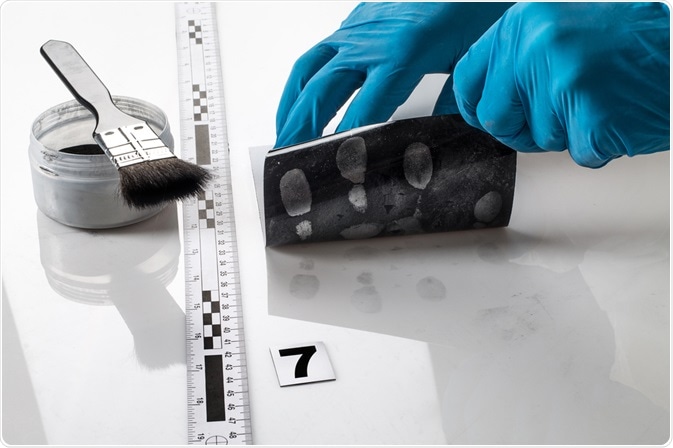
© Arkadiusz Fajer/Shutterstock.com
In addition to leaving chemical residues on our skin, our lifestyle habits also affect the composition of our microbiomes. Analyzing microbes at crime scenes using new, high-throughput analysis techniques can, therefore, aid forensic profiling. Dr Kathleen Brim of Virginia Commonwealth University will give a talk entitled ‘Forensic Body Fluid Identification Using Microbiome Signature Attribution through 16S rDNA High-Throughput Sequencing.’ Her presentation will describe her research into analyzing bacteria from crime scenes to identify bodily fluids.5
Applications of innovations in mass spectrometry to forensic analysis
Mass spectrometry (MS) has been a staple of forensic analysis for decades. It is considered the premier technique for analysis of trace compounds and unknown substances, which is often required in forensics, due to its high sensitivity and specificity.6
Newly developed MS technologies are beginning to be applied to forensic science. For example, MS imaging techniques can be used to map trace chemicals on fingerprints, hair strands, and tissues. Dr Young-Jin Lee from Iowa State University will outline developments in MS imaging for forensic science in his presentation ‘Recent Progress in MS Imaging of Latent Fingerprints’.7
Portable technology for on-scene investigations
Many applied analytical sciences are now utilizing portable technology to conduct analyses in the field, and forensic science is no exception. Technologies that enable identification of substances such as illegal drugs at crime scenes and other points of interest could significantly reduce the workload for forensic laboratories and speed up criminal investigations.
Portable Raman spectroscopy, infrared spectroscopy, MS, and GC-MS have all been utilized to conduct analyses at crime scenes. PerkinElmer will be available at the Expo at Pittcon 2019 to provide an overview of their GC-MS devices. For forensic scientists wishing to learn about the latest developments in portable spectroscopy, Pittcon’s short course entitled ‘Modern Portable Analytical Spectroscopy’ is essential.
Pittcon will also feature a number of presentations on portable MS technology including one from Dr William L Fatigante of Illinois State University entitled ‘Towards On-Site, High-Throughput Drug Evidence Confirmation Using Ambient Sampling, Portable MS’, and another from Dr Brooke Weinger Kammrath of the University of New Haven on ‘Portable GC/MS Identification of Mitragynine in Kratom.’
Additionally, David Nash of the University of Central Florida will give a talk on ‘A Novel Method for the Identification of Controlled Substances Using Photoluminescent Indicators and its Implementation into a Portable System for Field Use.’
Analyzing new psychoactive substances (NPS)
NPS, also known as ‘designer drugs’ or ‘legal highs’ represent a significant challenge to forensic scientists due to their unknown and constantly changing nature. As a result, novel techniques are required to identify and classify NPS. Dr Rabi Musah from the University at Albany will describe one method for NPS analysis in his presentation entitled ‘Chemometric Processing of Direct Analysis in Real Time (DART) Mass Spectrometric Data for the Identification and Classification of New Psychoactive Substances.’8
The rise of e-cigarettes and their use to consume illicit substances also brings new challenges to the field of forensic science. E-cigarette analysis will be discussed in a presentation by Dr Michelle Peace from Virginia Commonwealth University entitled ‘The Efficacy of Electronic Cigarettes - The Public Health Challenge Became a Criminal Justice Problem.’9
Conclusions
Forensic science is a challenging and interdisciplinary field that frequently relies on the identification, quantification, and mapping of unknown substances. The 2019 Pittcon Conference and its forensic science symposia will feature a range of cutting-edge contributions from experts, making it a fantastic opportunity to learn about the latest trends in forensic analysis.
Forensic analysis relies heavily on a range of analytical techniques including MS, spectroscopy, and chromatography. The Pittcon 2019 Expo will feature all the leading technology suppliers and is the ideal place to find companies providing the latest analytical technology for forensic science.
References and further reading
- ‘Detection and mapping of illicit drugs and their metabolites in fingermarks by MALDI MS and compatibility with forensic techniques’ - Groeneveld G, de Puit M, Bleay S, Bradshaw R, Francese S, Scientific Reports, 2015.
- ‘An update on MALDI mass spectrometry based technology for the analysis of fingermarks – stepping into operational deployment’ - Francese S, Bradshaw R, Denison N, Analyst, 2017
- ‘Lifestyle chemistries from phones for individual profiling’ - Bouslimani A, Melnik AV, Xu Z, Amir A, da Silva RR, Wang M, Bandeira N, Alexandrov T, Knight R, Dorrestein PC, PNAS, 2017.
- Revealing Individual Lifestyles through Mass Spectrometry Imaging of Chemical Compounds in Fingerprints’ - Hinners P, O’Neill KC, Lee YJ, Scientific Reports, 2018.
- ‘The Human Microbiome – A New Potential Fingerprint in Forensic Evidence?’
https://www.news-medical.net/news/20180329/The-Human-Microbiome-e28093-A-New-Potential-Fingerprint-in-Forensic-Evidence.aspx
- A History of the Forensic Applications of Mass Spectrometry’ - Jackson GP, Barkett MA, The Encyclopedia of Mass Spectrometry, 2016.
- Detection and mapping of illicit drugs and their metabolites in fingermarks by MALDI MS and compatibility with forensic techniques’ - Groeneveld G, de Puit M, Bleay S, Bradshaw R, Francese S, Scientific Reports, 2015.
- ‘New psychoactive substances: catalysing a shift in forensic science practice?’ - Tettey J, Conor Crean C, Philosophical Transactions B, 2015.
- ‘Are Electronic Cigarettes Facilitating Illicit Drug Use?’ https://www.news-medical.net/news/20190205/Are-Electronic-Cigarettes-Facilitating-Illicit-Drug-Use.aspx
About Pittcon
Pittcon is North America’s largest conference and exposition in laboratory science, attracting thousands of industry, academia, and government attendees and exhibitors from around the world in. Pittcon goes beyond the typical conference; it's a global community dedicated to advancing science through education, collaboration, and philanthropy. By bringing together scientists, researchers, educators, students, and industry leaders, Pittcon creates opportunities to learn, connect, and inspire innovation. Beyond the event itself, more than 90% of Pittcon's net proceeds support science education and outreach initiatives locally and globally, funding scholarships, grants, STEM programs, laboratory improvements, and other efforts that strengthen communities and expand access to science.
Pittcon delivers world-class educational and professional development opportunities through its Technical Program, Short Courses, and Networking Workshops and Roundtables. Attendees can explore the latest scientific research through symposia, oral and poster presentations, enhance their skills with expert-led deep-dive courses, and connect with peers through interactive workshops and networking experiences designed to foster collaboration and career growth.
The Pittcon Expo brings the scientific community together in an immersive environment where attendees can discover the latest laboratory technologies, meet with leading instrument and service providers, and experience science in action. Beyond the exhibit booths, the Expo Floor features engaging attractions, educational experiences, demonstrations, and networking spaces, while receptions, parties, and social events create opportunities to build lasting connections with colleagues from around the world.
Sponsored Content Policy: News-Medical.net publishes articles and related content that may be derived from sources where we have existing commercial relationships, provided such content adds value to the core editorial ethos of News-Medical.net, which is to educate and inform site visitors interested in medical research, science, medical devices and treatments.