Location and long-term planning are two critical elements that should always be considered when designing a new laboratory or expanding an existing setup. This is because both can have a significant impact on operational efficiency and running costs. Conversely, poor decisions made at the design stage can lead to costly and frustrating consequences for many years.
The experts’ view
Many customers are often surprised to learn that Air Products does far more than supply liquid nitrogen and other gases for cryogenic storage.
The company has a dedicated team of specialists who can support the planning, installation, and maintenance of cryogenic facilities to create more efficient and sustainable operations that consume less gas.
As the only gas supplier in the United Kingdom that also offers a comprehensive range of high-quality freezers, Air Products can ensure that every aspect of a facility is aligned with specific operational needs.
For any cryo-room project, numerous factors must be considered. One of the most important is the position, or location, of the cryo-room itself.
Think about location
Whether the project involves designing a new facility, creating space for future expansion, or reconfiguring an existing laboratory to improve efficiency, careful consideration must be given to where the cryo-room is located within the building.
Best practice indicates that the ideal location is on the ground floor against an external wall, with adequate space outside for a liquid nitrogen storage tank that can be easily accessed for deliveries.
This configuration places freezers as close as possible to the liquid nitrogen supply, allowing for a short pipeline that provides consistent pressure, minimizes losses during filling, and removes the need to transport liquid nitrogen vessels throughout the building.
Ventilation requirements are also simplified, and future expansion can be more easily accommodated. While this approach is well-suited to new-build facilities, space constraints, particularly in city center clinics, can mean cryo-rooms are located on upper floors or in basements.
In these cases, compromises may be unavoidable, including higher liquid nitrogen consumption, the need for forced extraction, or the transport of liquid nitrogen via elevators. However, experience has shown that many challenges initially considered unsolvable can often be addressed by adopting a different design approach.
The importance of thinking ahead
As a general guideline, it is advisable to consider future requirements five to ten years in advance.
Questions to address include the size of the cryo-room required today, whether expansion will be needed, how many liquid nitrogen freezers may be required, and whether additional storage or pipework will be necessary. Consideration should also be given to how safety regulations and legislation may evolve.
Although it is impossible to predict the future with certainty, factoring these considerations into early planning can deliver long-term benefits, making future expansion or operational changes simpler and more cost-effective.
Choosing the right equipment
Selecting the appropriate equipment is just as important as choosing the right location for a cryo-room. Consideration should first be given to what is being stored, such as stem cells, eggs, embryos, sperm, blood, or tissue, along with the volume required and whether vapor or liquid storage is needed.
These factors determine the type and size of freezer required, as well as the inventory system used. Racking is typically best for vials, goblets are used for storing straws, and blood bags can be stored using boxes, cassettes, or racking. With the correct design, available freezer space can be optimized.
Equipment selection also has a significant impact on ongoing operating costs. In a recent project, a customer was transitioned to MVE HEco freezers, which required filling only twice per week compared with previous freezers that needed filling every 18 hours.
This resulted in a substantial reduction in liquid nitrogen consumption and improved sample security.
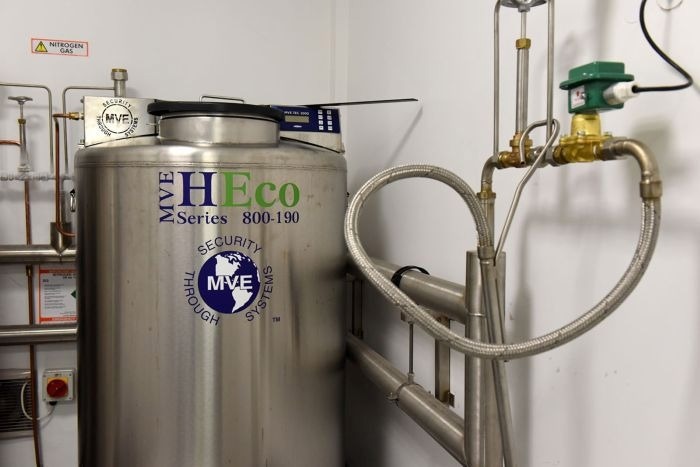
Image Credit: Air Products PLC
Perfect pipework
Pipework is another critical consideration. Most installations use a Super Insulated Vacuum Line (SIVL), and keeping this as short as possible helps reduce installation costs while minimizing liquid nitrogen losses between the storage tank and the freezers.
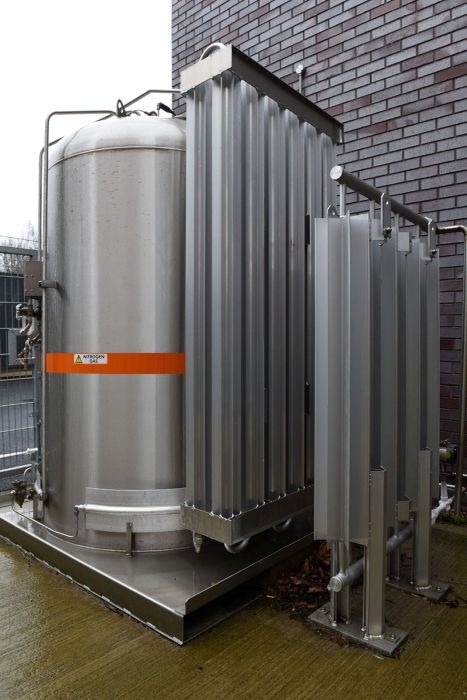
Image Credit: Air Products PLC
The choice of liquid nitrogen storage vessel depends on consumption requirements and the SIVL design.
As a general rule, storage capacity should cover at least two weeks of consumption plus an additional 30 to 50 percent, based on a biweekly delivery schedule. Greater storage capacity reduces the risk of supply interruptions and can significantly lower delivery costs.
Fixed vessels are ideally located outdoors to minimize cost and health and safety risks, with adequate clearance, secure fencing, and suitable access for delivery vehicles.
Where this is not possible, wheeled storage vessels may be used, although they introduce higher health and safety risks, stricter usage limitations, and significant weight considerations. A 230-liter cylinder, for example, weighs more than 300 kilograms when full.
The BCGA regulations
A range of regulatory requirements must be met, particularly for new facilities. These are primarily administered by the British Compressed Gases Association (BCGA).
The key guidance document is Biomedical Cryogenic Storage Systems Design and Operation 2021 (CP45), which addresses the design, installation, and operation of systems used for cryogenic storage.
Other considerations to think about
Additional factors must also be addressed when designing a cryo-room. Appropriate materials must be selected for flooring and doors.
Alongside oxygen monitoring, a suitable extraction system is required to prevent alarms from triggering during normal filling operations. Security measures, such as card access or coded entry systems, should also be implemented.
Think you might need expert help?
Designing a new cryo room or reconfiguring an existing space to improve efficiency is a complex process that involves many interdependent considerations. Coordinating multiple suppliers and ensuring all aspects are managed correctly can be time-consuming and challenging.
For this reason, many organizations choose to work with a single experienced provider with specialist knowledge of liquid nitrogen and its safe supply.
The Air Products team has delivered numerous successful installations across a wide range of facilities and supports customers at every stage, from acting as a design consultant to installing liquid nitrogen supply systems and managing entire projects from start to finish.
Regardless of the specific requirements or objectives of a cryo-room project, Air Products can help manage the process to save time, reduce costs, and avoid design decisions that could limit future expansion.
Acknowledgments
This article was produced using materials originally authored by Andrew Jones at Air Products.
About Air Products PLC
Air Products touch the lives of consumers around the globe in positive ways every day. With approximately 16,000 employees and operations in 50 countries, we serve customers across a wide range of industries from food and beverage to medical, energy, and transportation. We supply a unique portfolio of atmospheric and process gases, equipment, and services.
Founded in 1940, Air Products has built a reputation for its innovative culture, operational excellence, and commitment to safety and the environment. Our passionate, talented, and committed employees from a diversity of backgrounds are driven by Air Products’ higher purpose to create innovative solutions that benefit the environment, enhance sustainability and address the challenges facing customers, communities, and the world.
Sponsored Content Policy: News-Medical.net publishes articles and related content that may be derived from sources where we have existing commercial relationships, provided such content adds value to the core editorial ethos of News-Medical.net, which is to educate and inform site visitors interested in medical research, science, medical devices and treatments.