Sponsored Content by UltrarayReviewed by Olivia FrostMar 30 2026
Facilities that work with radioactive materials require practical solutions for storing, transporting, and managing small quantities of isotopes and radioactive waste. In nuclear medicine, radiopharmacy, research laboratories, and industrial inspection environments, shielded storage containers play an important role in maintaining safe handling procedures.
Lead-lined storage containers provide localized radiation protection for materials that must be moved, temporarily stored, or handled outside fixed shielding systems. These containers are typically used alongside broader radiation protection strategies that include facility shielding, controlled workflows, and regulated access procedures.
Not all radioactive materials remain inside shielded rooms or cabinets throughout their lifecycle. Materials often need to be moved between workstations, stored temporarily, or managed during waste decay periods.
Lead-lined containers help address these operational needs by providing localized radiation protection around smaller quantities of material.
Typical situations where these containers are used include:
- Transporting isotopes between controlled work areas
- Storing radiopharmaceuticals before preparation or administration
- Managing radioactive waste during decay
- Disposing of contaminated sharps such as syringes
- Holding calibration sources or research materials
In these situations, the container provides an additional layer of protection that complements existing facility shielding.
Common container types used in nuclear medicine and laboratory environments
Several different container designs are used depending on the material being handled and the workflow requirements.
Lead-lined storage containers
Lead-lined containers are used for transporting and storing radioactive materials across medical, industrial, and scientific applications. They are available in multiple sizes to accommodate different material quantities and handling requirements.
These containers are commonly used when portability is required without removing radiation protection.
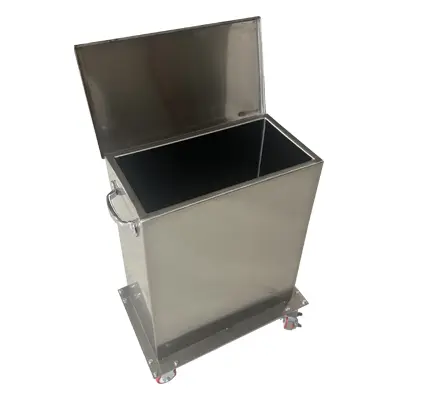
Image Credit: Ultraray
Shielded decay drums
Decay drums are used for storing radioactive waste materials while they undergo decay before disposal. These containers often include drop ports that allow waste to be deposited without fully opening the lid.
Facilities frequently operate two drums in rotation so that one container can be actively filled while another remains in decay storage.
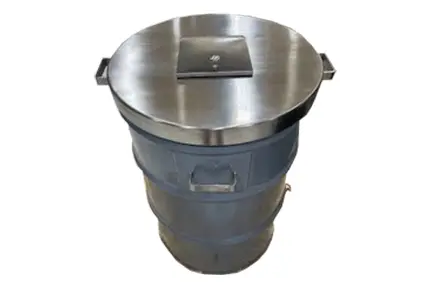
Image Credit: Ultraray
Shielded waste containers
Shielded waste containers are designed specifically for low-energy beta and gamma radiation waste. These containers often incorporate layered shielding materials and protective access doors to limit exposure during routine waste handling.
They are commonly used in laboratory and hot lab environments where radioactive waste is generated regularly.
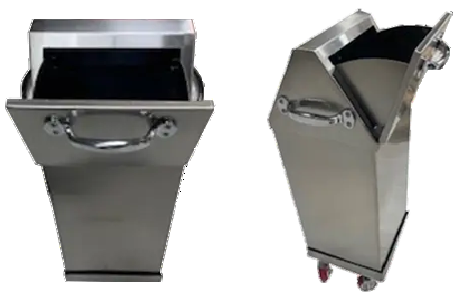
Image Credit: Ultraray
Shielded sharps disposal systems
Sharps container shields provide localized shielding for used syringes contaminated with radioactive residue. These systems allow syringes to be deposited through controlled openings while protecting users during disposal.
They are typically used in nuclear medicine hot labs where injectable radiopharmaceuticals are handled.
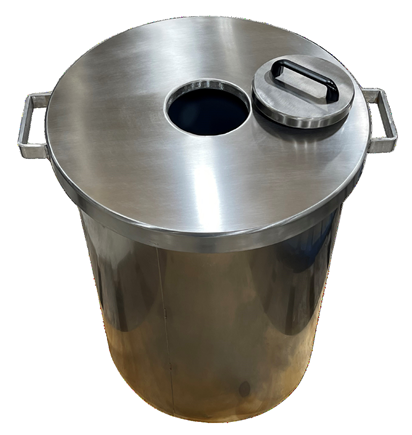
Image Credit: Ultraray
Lead-lined canisters
Lead-lined canisters provide portable shielding for radioactive isotopes stored in small quantities. These containers are often cylindrical and designed for manual handling with integrated lifting grips.
They are commonly used when materials must be moved between preparation areas, storage areas, and testing environments.
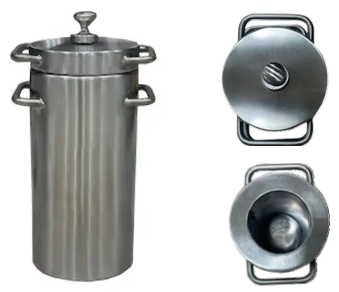
Image Credit: Ultraray
Where lead-lined storage containers are commonly used
Shielded storage containers are found in a wide range of controlled environments, including:
- Nuclear medicine departments
- Radiopharmacy hot labs
- Research laboratories
- Industrial radiography facilities
- Quality control laboratories
- Hospital radioactive waste handling areas
While the environments may differ, the objective remains consistent: safely managing radioactive materials during storage and handling.
Supporting safe handling and transport of radioactive materials
Lead-lined storage containers are designed to support safe operational practices rather than replace facility-level radiation protection systems.
Their role is to provide localized shielding during specific tasks such as transport, waste staging, or temporary storage. Proper selection depends on factors such as material type, activity level, workflow patterns, and handling procedures.
Understanding how different container types are used helps facilities choose solutions that align with their operational needs while maintaining effective radiation protection practices.
About Ultraray
At Ultraray, we provide radiation shielding solutions and supplies for Hospital and Clinic Construction, Industrial NDT, Power Generation, Security and Defense, Aerospace and Nuclear Industries.
We believe the keystone to our success is offering just the right mix of industry know-how matched to unrivalled supply and customization services.
Uniquely positioned, our team of niche market specialists bring over 30 years of hands-on experience to all sizes of project. Working from offices across North America, we’re pleased to always provide the level of project management, consulting or partnership that works best for you.
Sponsored Content Policy: News-Medical.net publishes articles and related content that may be derived from sources where we have existing commercial relationships, provided such content adds value to the core editorial ethos of News-Medical.net, which is to educate and inform site visitors interested in medical research, science, medical devices and treatments.