Sponsored Content by MaxCyte, Inc.Reviewed by Louis CastelOct 27 2026
As cell therapies have become increasingly complex, there is a growing need for faster, more efficient development workflows. Researchers must optimize a range of variables during discovery phases and process development, including cell-handling procedures, gene-editing components, expression constructs, cargo type and concentration, and electroporation conditions.
Existing optimization methods can require considerable time and manual effort and can delay progression from discovery to development as a result.
Reproducible performance is a key element of any successful screening workflow. Consistent delivery and cell viability are essential for producing high-quality data, as they allow researchers to directly link any differences they observe to the variables they are evaluating.
All this facilitates meaningful comparisons of results, and once optimal conditions have been identified, they should be transferable to larger-scale workflows without requiring re-optimization.
The ExPERT DTx™ electroporation platform offers fast, reproducible screening of up to 96 conditions in parallel, optimizing cell therapy development workflows and acting as a gateway to larger-scale ExPERT™ instruments for clinical and commercial manufacturing.
Study aims
This study demonstrates the application of the ExPERT DTx™ for high-throughput screening to quickly optimize CRISPR-mediated CAR-T production.
It demonstrates that ExPERT DTx™ can deliver reproducible performance and high cell viability, and facilitate the seamless transfer of optimized conditions from the discovery-scale DTx™ to the larger-scale ExPERT GTx® instrument, which is suitable not only for process development but also for clinical and commercial manufacturing.
Workflow
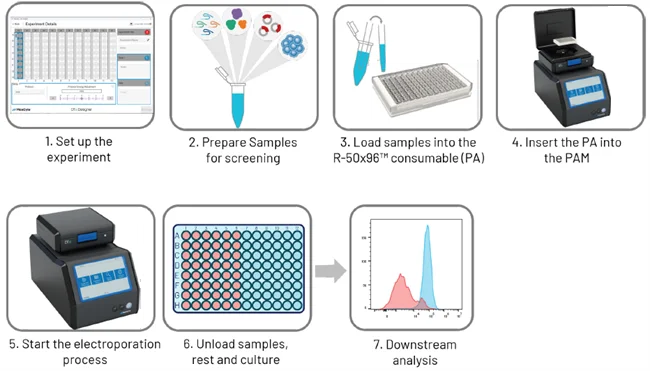
Image Credit: MaxCyte, Inc.
Screening variables include:
- Cell densities
- Electroporation protocols
- Concentrations
- Molar ratios
- Promoters
- gRNA sequences
- Nucleases
- HDR template formats
- Binding sequences
Study results
High-throughput screening rapidly identifies optimal CAR-T engineering conditions
The study authors evaluated the performance of ExPERT DTx as a high-throughput screening tool for CRISPR-mediated CAR-T cell engineering (Figure 1). They screened activated T cells across guide RNA sequences, nuclease types and concentration, and HDR template format and concentration, identifying optimal editing conditions in rapid timeframes.
The authors screened five TRAC-targeting guide RNAs (A), with the top-performing guide, TRAC_5, achieving over 93% TRAC knockout. Cell viability remained above 76% across all tested concentrations.
Cas9 was identified as the optimal nuclease after screening four nucleases, producing over 99% TRAC knockout and over 76% viability when combined with TRAC_5 (B). After optimizing the HDR template concentration, 200 micrograms (µg) per milliliter (mL) of a CD19 CAR nanoplasmid donor template resulted in a CAR knock-in of over 72% (C).
By evaluating multiple editing variables simultaneously, the DTx enabled the rapid identification of conditions that maximized editing efficiency while preserving cell viability. This approach optimized the workflow for engineered cell therapy applications.
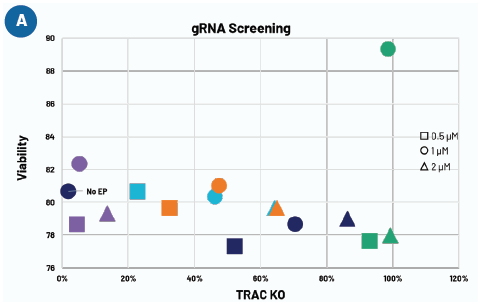
A: Experimental conditions
| |
|
| gRNA |
TRAC_1, TRAC_2, TRAC_3, TRAC_4 or TRAC_5 |
| Nuclease |
Cas9 |
| RNP concentration |
0.5, 1, or 2 µM |
| Protocol |
ETC-2 |
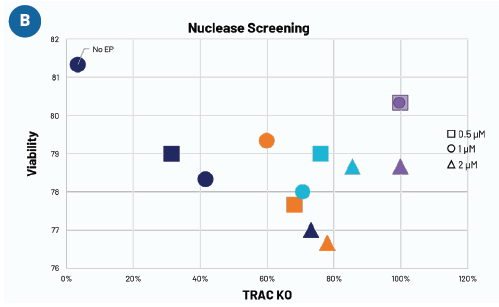
B: Experimental conditions
| |
|
| gRNA |
TRAC_5* |
| Nuclease |
Cas9, Cas12a, Nuclease A, or Nuclease B (proprietary) |
| RNP concentration |
0.5, 1, or 2 µM |
| Protocol |
ETC-2 |
*The TRAC_5 gRNA was adapted for use with both Cas9 and Cas12a nucleases
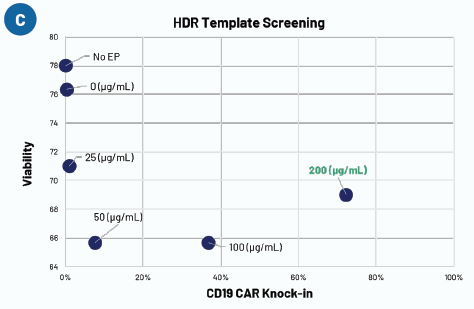
C: Experimental conditions
| |
|
| gRNA |
TRAC_5 |
| RNP concentration |
0.5 µM |
| Protocol |
ETC-4 |
| HDR Template |
Nanoplasmid CD19 CAR |
| HDR Template concentration |
0, 25, 50, 100, or 200 µg/mL |
| Treatment |
2 µM of M38124 for 24 hours |
Figure 1. High-throughput screening identifies optimal conditions for CRISPR-mediated CAR-T engineering. Activated T cells (1x10⁸ cells/mL) were electroporated with RNPs (2:1 gRNA to nuclease ratio) in 25 mL sample volumes using either electroporation protocol ETC-2 (for knockout) or ETC-4 (for knock-in). Screening of guide RNAs (A), nucleases (B), and HDR template concentrations (C) identified conditions supporting >99% TRAC knockout and >72% CD19 CAR knock-in while maintaining high viability, generating viable CAR-T cells suitable for downstream analysis. Image Credit: MaxCyte, Inc.
Reproducible screening workflows generate scalable CAR-T production processes
The optimized conditions were subsequently tested using T cell samples from multiple healthy donors. Cells were electroporated using both the ExPERT DTx and ExPERT GTx instruments (Figure 2).
It was possible to achieve over 50% CD19 CAR knock-in with the optimized workflow, and the authors also observed comparable viability, CAR expression, and cell yields between the DTx and GTx™.
Both instruments maintained high cell viability following electroporation, supporting continued cell expansion and achieving sufficient cell numbers for downstream characterization and functional testing.
These findings show that optimized workflows identified through using the DTx can be transferred directly to larger-scale MaxCyte platforms that are suitable for use in current Good Manufacturing Practice (cGMP)-compliant manufacturing.
Direct scalability like this reduces the need for extensive reoptimization during process development and can therefore shorten the timeframes involved in progressing from discovery to development.
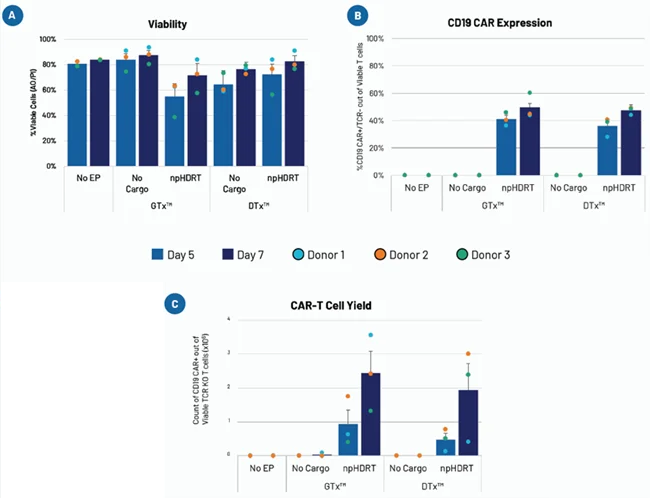
Figure 2. Optimized CAR-T engineering workflows are reproducible and scalable. Activated T cells from three healthy donors were electroporated using the conditions identified with the ExPERT DTx (see Table D below). Optimized conditions maintained high cell viability (A), generated high levels of CAR expression (B), and resulted in consistent CAR T cell yields across multiple donors (C) using both the DTx and the GTx platforms. Image Credit: MaxCyte, Inc.
D. Experimental conditions
| |
|
| Cell Type |
Activated T cells |
| gRNA + nuclease (1:2) |
TRAC_5 + Cas9 |
| RNP concentration |
0.5 µM |
| Cell Density |
1 x 10⁸ cells/mL |
| Sample Volume |
50 µL |
| Instrument & PA |
DTx™ (R-50x96) or GTx™ (OC-100) |
| Protocol |
ETC-4 |
| HDR Template |
Nanoplasmid CD19 CAR |
| HDR Template concentration |
200 µg/mL |
| Treatment |
2 µM of M38124 for 24 hours |
Summary
The ExPERT DTx enables rapid, reproducible optimization of cell engineering workflows through high-throughput electroporation-based screening.
In CAR-T engineering applications, the DTx generated consistent performance across multiple conditions while maintaining high cell viability and delivery efficiency. Additionally, it was possible to transfer these optimized workflows to larger-scale MaxCyte electroporators, eliminating the need to re-optimize workflows and enabling researchers to move from discovery to development with greater efficiency.
By combining high-throughput screening, reproducible performance, and scalability, the ExPERT instrument range from MaxCyte provides the opportunity to significantly accelerate discovery workflows from a single platform.
About MaxCyte, Inc.
At MaxCyte, we pursue cell engineering excellence to maximize the potential of cells to improve patients’ lives. We have spent more than 20 years honing our expertise by building best-in-class platforms, perfecting the art of the transfection workflow, and venturing beyond today’s processes to innovate tomorrow’s solutions.
Our ExPERT™ platform, which is based on our Flow Electroporation® technology, has been designed to support the rapidly expanding cell therapy market and can be utilized across the continuum of the high-growth cell therapy sector, from discovery and development through commercialization of next-generation, cell-based medicines. The ExPERT family of products includes: four instruments, the ATx™, STx™, GTx™ and VLx™; a portfolio of proprietary related processing assemblies or disposables; and software protocols, all supported by a robust worldwide intellectual property portfolio.
By providing our partners with the right technology, as well as technical and regulatory support, we aim to guide them on their journey to transform human health. Learn more at maxcyte.com and follow us on Twitter and LinkedIn.
Sponsored Content Policy: News-Medical.net publishes articles and related content that may be derived from sources where we have existing commercial relationships, provided such content adds value to the core editorial ethos of News-Medical.net, which is to educate and inform site visitors interested in medical research, science, medical devices and treatments.