Sponsored Content by MaxCyte, Inc.Reviewed by Louis CastelOct 27 2026
Therapeutic developers who want to progress their work to human trials must receive approval after submitting an investigational new drug (IND) filing in the USA, a clinical trial application (CTA) in the EU, or equivalent regulatory submission in other regions.
The US Food and Drug Administration (FDA) provides guidance for gene and genome-editing therapy developers, with recommendations for completing the non-clinical safety assessments required in IND filings.1 These assessments can include identifying, quantifying, and characterizing on- and off-target genome editing events.
The guidance also recommends the use of multiple, orthogonal, high-sensitivity methods to detect low-frequency editing events. It also emphasizes the importance of accounting for genomic heterogeneity and evaluating the functional consequences of on- and off-targeting genome editing.
This article will describe a workflow for guiding RNA screening and nomination that addresses FDA recommendations.
An introduction to proprotein convertase subtilisin kexin type 9 (PCSK9)
Ischemic heart disease resulting from atherosclerosis continues to be the leading cause of death worldwide. Elevated LDL cholesterol levels in the bloodstream contribute to the development of atherosclerosis, and long-term reduction of cholesterol levels may reduce the development of atherosclerotic plaques and reduce the risk of cardiovascular events, such as heart attack and stroke.
The LDL receptor plays a central role in clearing LDL cholesterol from the bloodstream. PCSK9 promotes the degradation of LDL receptors on hepatocytes, making it an important therapeutic target for lowering cholesterol.
Two anti-PCSK9 monoclonal antibodies capable of lowering cholesterol are currently available, but they require repeat doses every two to four weeks.3
Gene editing is a promising alternative to existing therapies, offering the potential of one-off delivery for durable gene knockdown. Musunuru et al. described a potential in vivo gene therapy strategy that uses base editing to reduce PCSK9 expression by disrupting splice donor and acceptor sites in the PCSK9 gene.2
The study identified three guide RNAs (gRNAs), PCSK9-1, PCSK9-3 and PCSK9-4, that demonstrated relatively high editing efficiency in primary human liver cells. This potential therapeutic approach was effective in cynomolgus monkeys.
Following a single treatment with lipid nanoparticles containing adenine base editor mRNA (ABE8.8) and PCSK9-1 gRNA, circulating PCSK9 concentrations were reduced by 90% and LDL levels by 60%, with these effects continuing for at least eight months.
Study outline
The study objective was to illustrate a SeQure workflow for gRNA screening and off-target nomination using Cas9 editing and the published PCSK9 guide RNAs2 reported by Musunuru et al.2
The authors used Guide Profiler to rank eight of the PCSK9 gRNAs reported by Musunuru et al.2 They then used Guide Select for detailed profiling of the on- and off-target risk associated with the three gRNAs that produced the highest reported editing activity in primary human hepatocytes2.
For their final step, the authors used ONE-seq to provide variant-aware, off-target nomination for the leading guide RNA identified by Guide Select as having the lowest overall risk.
Method overview
Guide Profiler (Figure 1) is an in silico assay that screens candidate gRNAs with up to six differences from the intended target site. It identifies potential off-targets, assesses their potential biological impact, and analyzes on-target variation to create gRNA risk profiles for early informed gRNA selection.

Figure 1. Workflow overview of Guide Profiler. 1) Computational (in silico) search for sequence matches, 2) On-target variant analysis, 3) Off-target variant analysis, 4) Analysis of the potential biological impacts of cutting at predicted off-target loci, and 5) Summarize and report guide RNA risk profile. Image Credit: MaxCyte, Inc.

Figure 2. Workflow overview of Guide Select and ONE-seq. 1) In silico search for potential off-target sites with ≤4 (Guide Select) or ≤6 (ONE-seq) differences from the intended on-target sequence, 2) Target oligos synthesized on a DNA chip, 3) Uniform ONE-seq library, 4) In vitro editing with Cas9 and multiplexed (Guide Select) or single (ONE-seq) gRNAs, 5) Deep NGS Sequencing, and 6) Off-target nomination and analysis of biological impacts. Image Credit: MaxCyte, Inc.
Potential off-target loci are identified through sequence-similarity-based in silico searches of the hg38 genome and 3502 haplotype-phased human genomes from the 1000 Genomes and Human Genome Diversity Project (HGDP) initiatives.
Guide Select and ONE-seq (Figure 2) combine in silico and biochemical analyses. Potential off-target sites are first identified through a genome-wide, in silico, variant-aware search. Candidates are subsequently evaluated through in vitro cutting with the relevant editor and guides, allowing low-frequency off-target events to be detected with high sensitivity.4
Variant-aware risk profiling is performed by screening against the human reference genome (hg38) and 3502 haplotype-phased genomes from the 1000 Genomes and HGDP, allowing up to six sequence differences. Understanding the geographical origin of genomic sequences is essential when evaluating genetic variations that could influence on- and off-target editing within intended treatment populations.
Study results
Guide Profiler enabled rapid risk evaluation and gRNA ranking by Risk Profiler
The study authors used Guide Profiler to run in silico analysis of eight guide RNAs targeting the PCSK9 gene (Table 1). The analysis was used to pick out potential off-target editing sites as well as on-target variant sequences.
Table 1. PCSK9-targeting gRNA sequences. Source: MaxCyte, Inc.
| Guide ID |
Guide Sequence |
| PCSK9-1 |
CCGCACCTTGGCGCAGCGtgg |
| PCSK9-2 |
GGTGGCTCACCAGCTCCAGCagg |
| PCSK9-3 |
GCTTACCTGTCTGTGGAAGCggg |
| PCSK9-4 |
TGCTTACCTGTCTGTGGAAGCgg |
| PCSK9-5 |
TTGGAAAGACGGAGGCAGCStgg |
| PCSK9-6 |
GAAAGACGGAGGCAGCCTGtgg |
| PCSK9-7 |
TCCCAGGCCTGGAGTTTATTcgg |
| PCSK9-8 |
AGCACCTACCTCGGGAGCTGagg |
Genetic variation within an on-target site can have adverse effects on the intended gene-editing event, and as a result, identifying and evaluating on-target variants is crucial for successful therapeutic development.
Guide Profiler analysis identified genomic variants that could impact on-target editing guided by five of the gRNAs (Table 2). It was only possible to identify 25% and 35% of potential off-target sites by screening variant genomes (Figure 3), illustrating just how important it is to consider genomic diversity when assessing the risk of genome-editing-based therapies.
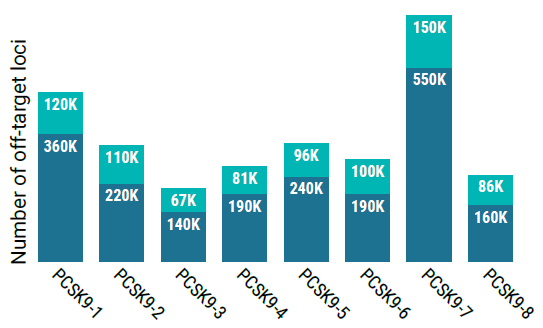
Figure 3. Guide Profiler enumerates putative off-target loci. The count of potential off-target sites found for each gRNA in the reference genome hg38 (blue) and any of the 3502 haplotype-phased variant genomes (green) is shown. Image Credit: MaxCyte, Inc.
PCSK9-7 produced the highest number of identified off-target sites, whereas PCSK9-3 produced the lowest. However, while the total number of assumed off-target edits contributes to the editing risk profile, it is important to also consider the location of off-target sites.
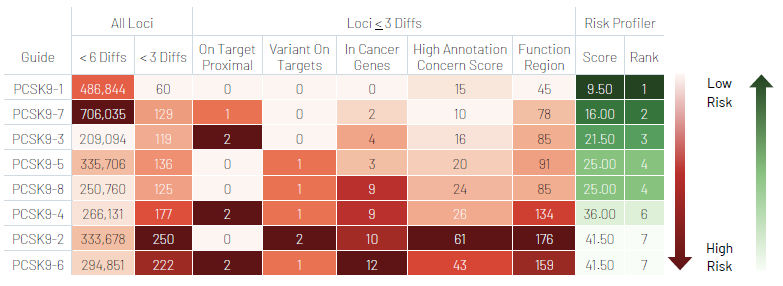
Guide Profiler analyzed the potential biological impact of off-target editing for the eight guides at two risk thresholds: ≤3 differences and ≤6 differences. The guides were scored and ranked by relative risk using the criteria shown in Table 2. Despite having many candidate off-targets (≤6 differences), PCSK9-1 received the highest ranking overall.
Musunuru et al. reported the in vitro ABE editing efficiencies for the tested gRNAs.2 The three leading candidates, PCSK9-1, PCSK9-3, and PCSK9-4, were classified as having low to medium risk by Risk Profiler and were chosen for further evaluation as a result.
Table 2. Guide Profiler risk preview for eight gRNAs targeting PCSK9. Guide RNAs are ranked according to their risk profile. The total number of putative off-target sites with up to three and up to six differences is shown. Guide Profiler provides further information regarding the risk of potential off-target sites (≤3 differences). Risk Profiler assigns a risk score for each guide, indicating their relative off-target risk. Cells are colored according to the risk as indicated. Source: MaxCyte, Inc.
Guide Select’s rapid variant-aware in silico and biochemical evaluation for guide ranking
Guide Select was used to evaluate these three leading gRNAs. This in silico screening identified a combined total of 6642 potential off-target sequences with ≤4 differences from the intended target.
The identified sequences were synthesized on a DNA chip and subjected to an in vitro Cas9-mediated cleavage assay performed in triplicate. Cleaved sites were classified using the edits of relative concern (ERC) framework (Table 3). This framework simplifies the interpretation of the potential biological impact of cleavage by classifying cuts according to multiple assessment criteria, as outlined in Table 3.
Table 3. The potential biological risk of off-targets is ranked with reference to the ERC framework. Potential off-target sites are grouped into tiers according to the criteria noted. Source: MaxCyte, Inc.
| |
Tier 1 |
Tier 2a |
Tier 2b |
Tier 3 |
| ERC Tier Description |
Higher cleavage frequency |
Higher cleavage frequency |
Lower cleavage frequency |
Lower cleavage frequency |
| Higher chance of functional impact |
Lower chance of functional impact |
Higher chance of functional impact |
Lower chance of functional impact |
| PCSK9-1 |
2 |
6 |
3 |
19 |
| PCSK9-3 |
2 |
9 |
9 |
33 |
| PCSK9-4 |
3 |
11 |
7 |
40 |
Further assessment of nominated off-target sites was performed by cross-referencing the results with the Cancer Gene Census (CGC) and ClinGen databases (Table 4). PCSK9-1 was found to have the lowest risk within the ERC framework and also produced the smallest number of off-target sites associated with the CGC and ClinGen databases.
Table 4. Off-target sites are classified according to their potential clinical significance. Candidate off-target loci in Tiers 1 and 2 (according to the ERC framework) linked to genes annotated in the CGC and ClinGen databases are noted. Source: MaxCyte, Inc.
| Guide |
CGC Tier 1 |
CGC Tier 2 |
Clingen Database |
Cancer Gene List |
| PCSK9-1 |
1 |
0 |
4 |
COL2A1 |
| PCSK9-3 |
2 |
0 |
10 |
CAMTA1 |
| PCSK9-4 |
2 |
0 |
13 |
APC, MLLT3 |
The distance between an off-target locus and the intended on-target site is another factor relevant to editing safety. High editing frequencies at off-target sites close to the on-target locus can increase the chance of intrachromosomal rearrangements.
Figure 4 illustrates the location of off-target loci with ≤4 differences from Tier 1 and Tier 2a (high cleavage frequency) on the same chromosome as the on-target locus. PCSK9-1 presented the lowest risk associated with off-target proximity.
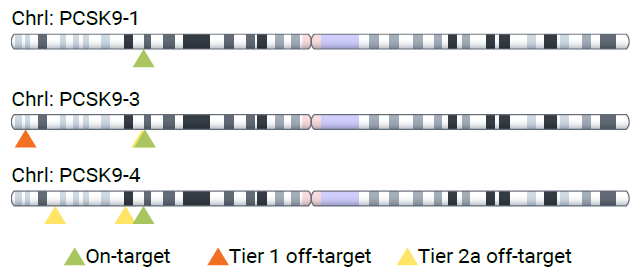
Figure 4. Proximal off-target sites. The on-target and candidate off-target loci from Tier 1 and Tier 2a (high cleavage frequency) are shown. Due to scaling, closely co-located sites may not be individually discernible. Image Credit: MaxCyte, Inc.
Guide Select identified PCSK9-1 as the gRNA with the most favorable on-target profile and off-target risk. As a result, PCSK9-1 was progressed to ONE-seq screening.
ONE-seq nominated off-target sites for the lead gRNA, PCSK9-1
A high-stringency in silico search allowing for ≤6 differences identified 486,844 potential off-target sequences for PCSK9-1. These sequences were synthesized and screened at three different DNA:RNP ratios in triplicate for in vitro cleavage by Cas9 and PCSK9-1. Cleaved off-target sites were classified according to the ERC framework. A summary of the identified sites can be seen in Figure 5.
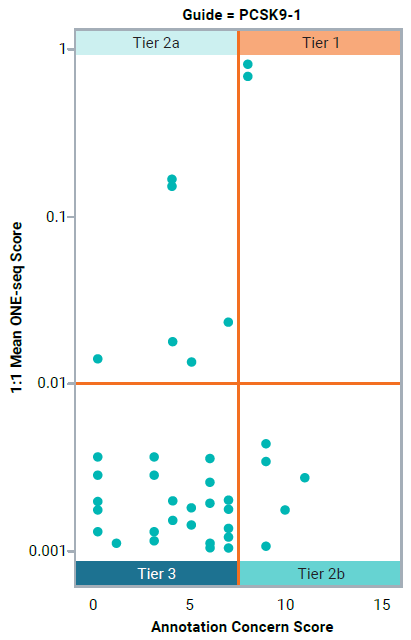
Figure 5. Graphic representation of ONE-seq off-target cleavage by tier for PCSK9-1. Higher ONE-seq scores indicate higher cleavage frequencies in the ONE-seq assay. Annotation concern scores summarize genomic, functional, and known disease associations of loci. Image Credit: MaxCyte, Inc.
Most of the Tier 1 and Tier 2 off-target sequences cleaved in vitro are only present in variant genomes and would be missed in searches limited to the human reference genome. This highlights the importance of variant-aware screening.
Ultimately, ONE-seq nominated 13 high-risk Tier 1 and Tier 2 off-target sites and identified 30 Tier 3 sites.
Summary
This article has outlined a workflow for prioritizing, selecting, and nominating off-target guides for a series of therapeutically relevant guide RNAs.
Guide Profiler provided rapid insight into potential off-target risk for candidate guide RNAs, allowing developers to make informed decisions about the selection of guide RNAs.
Guide Select and ONE-seq offered computational analysis and biochemical testing to provide variant-aware identification and nomination of candidate off-target sites across thousands of genomes. Despite having a fairly high number of potential off-target sites, PCSK9-1 gRNA was deemed to have the best risk profile overall.
These findings show that risk assessments for genome-editing risk should consider factors beyond the quantification of off-target sites. In particular, therapeutic developers should consider the genetic ancestry of donors, the populations for which treatments are intended, and clinical trial participants.
The potential biological impacts of off-target editing should also be incorporated into the safety assessments of genome-editing risk.
References and further reading
- U.S. Food and Drug Administration. (2024). Human gene therapy products incorporating human genome editing draft guidance for industry. Available at: https://www.fda.gov/media/156894/download.
- Musunuru, K., et al. (2021). In vivo CRISPR base editing of PCSK9 durably lowers cholesterol in primates. Nature, 593(7859), pp.429–434. DOI:10.1038/s41586-021-03534-y. https://www.nature.com/articles/s41586-021-03534-y.
- Mohamed, F., Mansfield, B. and Raal, F. (2023). Targeting PCSK9 and beyond for the management of low-density lipoprotein cholesterol. Journal of Clinical Medicine, 12(15), p.5082. DOI:10.3390/jcm12155082. https://www.mdpi.com/2077-0383/12/15/5082.
- Petri, K., et al. (2021). Global-scale CRISPR gene editor specificity profiling by ONE-seq identifies population-specific, variant off-target effects. DOI:10.1101/2021.04.05.438458. https://www.biorxiv.org/content/10.1101/2021.04.05.438458v1.
About MaxCyte, Inc.

At MaxCyte, we pursue cell engineering excellence to maximize the potential of cells to improve patients’ lives. We have spent more than 20 years honing our expertise by building best-in-class platforms, perfecting the art of the transfection workflow, and venturing beyond today’s processes to innovate tomorrow’s solutions.
Our ExPERT™ platform, which is based on our Flow Electroporation® technology, has been designed to support the rapidly expanding cell therapy market and can be utilized across the continuum of the high-growth cell therapy sector, from discovery and development through commercialization of next-generation, cell-based medicines. The ExPERT family of products includes: four instruments, the ATx™, STx™, GTx™ and VLx™; a portfolio of proprietary related processing assemblies or disposables; and software protocols, all supported by a robust worldwide intellectual property portfolio.
By providing our partners with the right technology, as well as technical and regulatory support, we aim to guide them on their journey to transform human health. Learn more at maxcyte.com and follow us on Twitter and LinkedIn.
Sponsored Content Policy: News-Medical.net publishes articles and related content that may be derived from sources where we have existing commercial relationships, provided such content adds value to the core editorial ethos of News-Medical.net, which is to educate and inform site visitors interested in medical research, science, medical devices and treatments.