Sponsored Content by MaxCyte, Inc.Reviewed by Louis CastelOct 27 2026
Tumor-infiltrating lymphocyte (TIL) therapies have been investigated as a treatment for solid cancers, including non-small-cell lung carcinoma, osteosarcoma, and cervical cancer,1 for over 40 years.
Early TIL therapies used T cells isolated from a patient’s resected tumor, expanded them ex vivo, and reinfused them into the patient, often alongside interleukin-2 (IL-2) molecules. Following successful clinical outcomes in melanoma cases, developers focused on these tumors, ultimately leading to the approval of the first cell therapy for solid cancer.2
However, developers are still facing several key challenges. One major obstacle is the state of exhaustion that patient tumor-derived TILs often begin in. T cell exhaustion is linked to reduced effector function and can be characterized by the expression of co-inhibitory receptors such as PD-1, TIM-3, and LAG-3.
Although expanding TIL ex vivo with IL-2 can reverse this exhaustion temporarily, TILs typically revert back to an exhausted state very quickly after being reinfused.
T cell exhaustion can reduce anti-tumor activity and persistence; strategies that reverse this phenotype could improve TIL efficacy. It is the immune checkpoint inhibitory receptors (ICIs), including PD-1, TIM-3, and TIGIT, that contribute to the exhausted phenotype, so researchers have investigated ways to disrupt these pathways.
Single-gene PD-1 knockout (KO), recently including the use of CRISPR-Cas9, has resulted in TILs with potentially improved function.3 However, simultaneously eliminating multiple synergistic ICIs may be a more effective approach than targeting a single gene. A clinical study has demonstrated that CRISPR-Cas9 can be successfully utilized for multiplex gene KO.4
Although carefully designing and screening guide RNAs can reduce off-target activity, there remains a risk of unwanted indels and chromosomal rearrangements, especially in multiplex editing strategies.
Base editing provides an alternative to conventional CRISPR-Cas nuclease approaches by enabling precise gene editing with very few double-stranded DNA breaks, and sometimes with none at all. However, delivering large base editors to sensitive patient TILs is challenging.
MaxCyte electroporation provides a way to efficiently deliver complex gene-editing cargo to primary human cells, including TILs, preserving cell health, viability, and phenotype. Overcoming the barriers that delivery presents could allow for safer multiplexed ICI KO and result in more effective engineered TIL therapies.
The study aims
Researchers investigated whether dual knockout of TIM-3 and TIGIT via base editing could enhance the therapeutic potential of TILs derived from patients with melanoma and ovarian cancer.5
MaxCyte electroporation was used to establish a workflow compatible with Good Manufacturing Practice (GMP) regulations to deliver adenine base editor (ABE) mRNA and guide RNAs into sensitive patient-derived T cells while preserving their cellular phenotype.
Using this approach, the researchers generated engineered dual KO TILs and observed improvements in their proliferative capacity and effector function, along with enhanced control of patient-derived tumor outgrowth in mouse models.
Workflow

Image Credit: MaxCyte, Inc.
- Pre-expansion TILs (pre-REP TILs) were thawed and activated for one to two days in X-VIVO15 with hIL-2 and anti-CD3.
- Activated TILs were washed and resuspended in MaxCyte electroporation (EP) buffer and mixed with 2 µg of ABE8.20 mRNA and 3 µg of matched gRNA(s). MaxCyte EP buffer was added to a final sample volume of 25 mL.
- Samples were transferred to OC-25x3™ processing assemblies (PAs) and electroporated with protocol ETC-3 on the MaxCyte ExPERT ATx®.
- Post-electroporation, cells were rested for 15 minutes at 37 °C.
- Rapid expansion protocol (REP): After the resting period, cells were transferred to G-Rex 24-well plates and cultured in X-VIVO15 supplemented with hIL-2, anti-CD3, and irradiated allogeneic PBMC feeder cells at a 1:100 TIL-to-feeder ratio. On day seven, following electroporation, the wells were replenished with X-VIVO15 containing IL-2.
- REP-TILs were collected between days 14 and 17 and analyzed.
Results
To deliver safer multiplex gene-edited therapies, efficient delivery of base editors into patient-derived TILs is crucial. In this study, MaxCyte electroporation was used to deliver ABE8.20 mRNA and splice-disrupting guide RNAs into thawed, activated pre-REP TILs derived from melanoma and ovarian tumors. The resulting cells were evaluated for their KO efficiency, cell phenotype, and functionality.
High-efficiency single and dual ICI KO by base editing in frozen TILs
Activated TILs expanded from resected melanomas (Mel-TILs) and ovarian tumors (Ova-TILs) exhibited relatively high expression of TIM-3 and TIGIT. As expression increased upon restimulation (data not shown), researchers selected TIM-3 and TIGIT as targets for their study.
The next investigation looked into whether adenine base editing could efficiently disrupt these ICIs. Researchers designed two ABE-matched splice-disrupting guide RNAs (gRNAs) for each target.
Thawed, activated pre-REP Mel-TILs and Ova-TILs were electroporated with ABE8.20 mRNA and a single gRNA to assess TIM-3 and TIGIT KO by ABE. Electroporated cells were then expanded using the REP described in the workflow, after which knockout efficiency at the protein level was measured (Figure 1).
The best-performing gRNA for each target delivered on average approximately 95% TIGIT KO (sgRNA#1) and approximately 88% TIM-3 KO (sgRNA#1) in electroporated Mel-TILs and Ova-TILs. As a result, these guides were chosen for subsequent experiments.
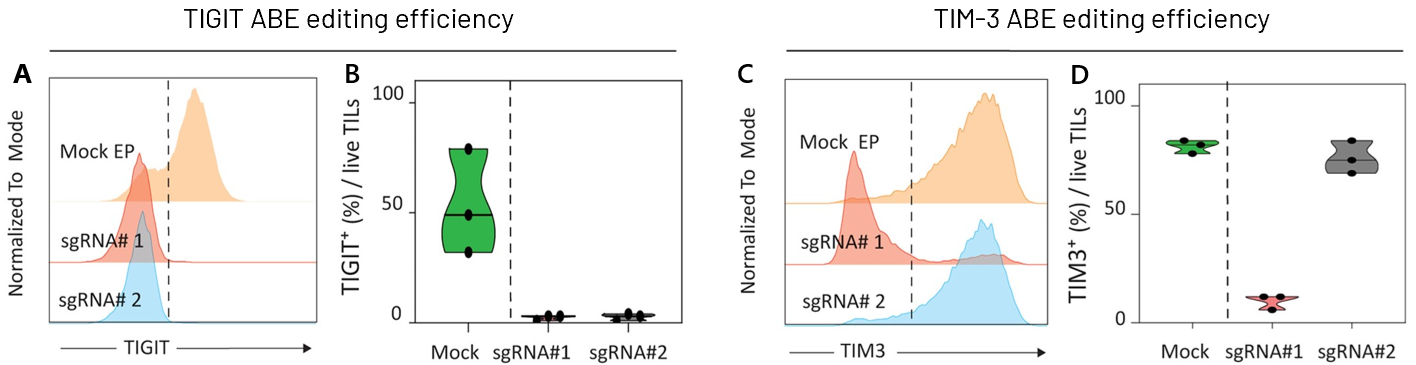
Figure 1. Single gene KO by ABE in patient TILs. Representative histograms of A) TIGIT expression and C) TIM-3 expression in patient-tumor-derived TILs. Violin plots quantifying B) TIGIT and D) TIM-3 levels in Ova-TILs and Mel-TILs (n=3). Control samples were electroporated with ABE mRNA alone. Image Credit: MaxCyte, Inc.
When TILs were co-electroporated with ABE mRNA and both selected gRNAs, dual TIM-3/TIGIT knockout reached up to 93% in CD4+ cells and 97% in CD8+ cells. These high levels of dual KO were observed in both unstimulated and stimulated CD4+ and CD8+ TIL populations (Figure 2).
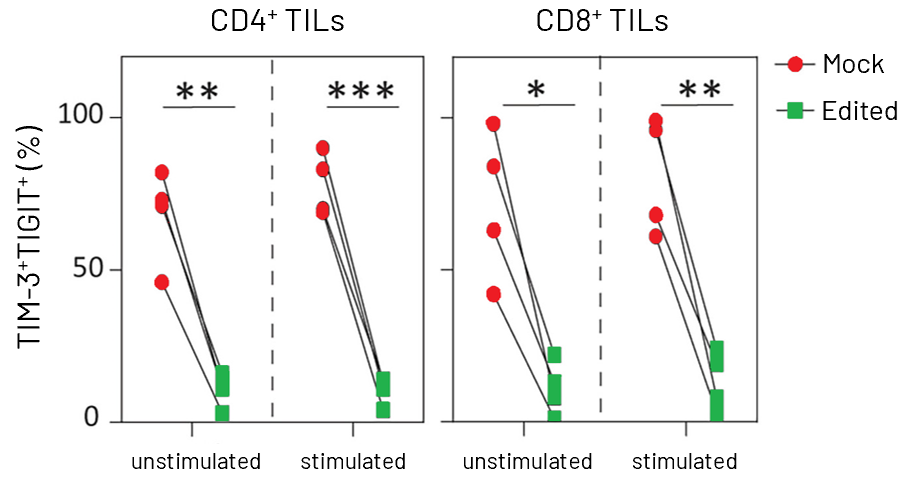
Figure 2. Dual TIM-3 and TIGIT KO in TILs. Bar plot showing the efficiency of dual TIGIT and TIM-3 KO in unstimulated or stimulated CD4+ or CD8+ TILs. For statistical analysis, a paired t-test was performed. Statistical significance indicated as *p <0.05, **p <0.01, and ***p <0.001. Image Credit: MaxCyte, Inc.
Dual TIM-3/TIGIT KO preserved TIL phenotype and improved expansion
Researchers assessed the phenotype of dual KO TILs after the REP was completed. Levels of activation, expression, and exhaustion markers in mock EP or dual KO TILs did not change (Figure 3A).
Similarly, dual KO did not affect the CD4+/CD8+ ratios in Ova-TILs and Mel-TILs (Figure 3B). Analyzing differentiation markers revealed that in both mock EP and dual KO TILs, most cells maintained an effector memory (TEM) phenotype (Figure 3C).
Although the viability of ABE TILS was lower immediately after electroporation (47%) than for mock EP TILs (63%), the fold expansion of dual KO TILs was notably much higher than that of mock EP TILs (Figure 3D).
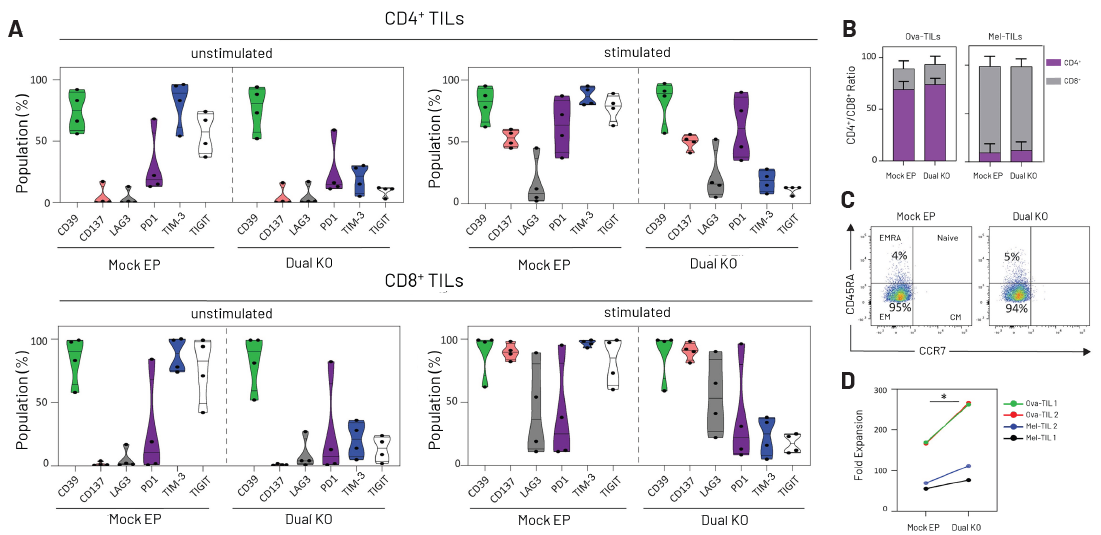
Figure 3. Phenotypic characterization and expansion of dual KO TILs. A) Violin plots illustrate the expression of activation and exhaustion markers in the CD4+ and CD8+ subsets of unstimulated and stimulated Ova- and Mel-TILs. B) Bar chart shows the CD4+/CD8+ ratio in mock and dual KO Ova- and Mel-TILs.
C) Exemplary dot plot showing the phenotype of mock EP and dual KO TILs (Naïve: CCR7+ CD45RA+, EM (effector memory): CCR7- CD45RA-, EMRA (terminally differentiated effector memory T cells re-expressing CD45RA): CCR7- CD45RA+, CM (central memory) CCR7+ CD45RA-. D) Fold-expansion of Ova-TILs and Mel-TILs at the end of the REP was calculated using the cell counts immediately after electroporation as the base. For statistical analysis, a paired t-test was performed. Statistical significance was indicated as *p <0.05. Image Credit: MaxCyte, Inc.
Dual TIM-3/TIGIT KO enhances cytokine production and anti-tumor activity in vivo
To examine effector function, researchers assessed cytokine production by mock EP and dual KO TILs following challenge with autologous tumor cells that naturally express TIM-3 and TIGIT-specific ligands. They found that the frequency of IFNγ and TNFα-producing cells was higher in dual KO TILs than in mock EP TILs (Figure 4A).
The in vivo anti-tumor capacity of dual KO TILs was tested in NSG mice co-injected with autologous patient-derived melanoma cells and PBS, dual KO TILs, or mock EP TILs. Administering dual KO TILs reduced tumor outgrowth (Figure 4B) and improved survival (Figure 4C) compared with mice that received PBS or mock EP TIL treatment.
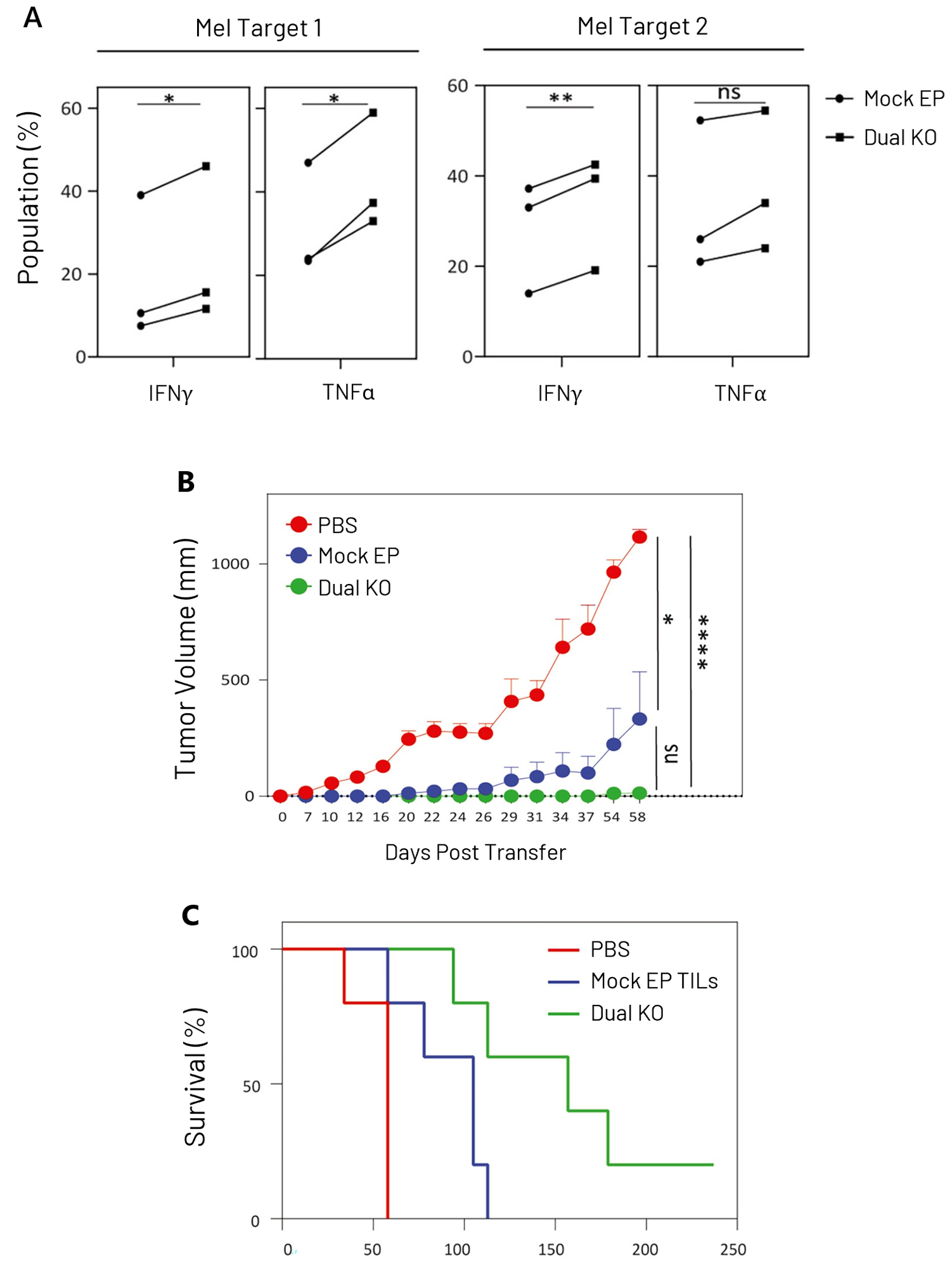
Figure 4. Enhanced cytokine production and tumor control from dual KO TILs. A) Plot representing IFNγ and TNFα production from dual KO TILs after overnight co-culture (effector-to-target ratio of 1:1) with autologous melanoma target cells (pooled results, n=3 experiments for each target). NSG mice (five per condition) were co-injected with patient-derived melanoma cells and either PBS, mock EP TILs, or dual KO TILs (effector-to-target ratio of 3:1). Mice were treated with hIL-2 daily for six days. Tumor-outgrowth (B) and mouse survival (C) were recorded. For statistical analysis, a paired t-test was performed. Statistical significance indicated as *p <0.05, **p <0.01. ns = not significant. Image Credit: MaxCyte, Inc.
Summary
This study demonstrated that dual TIM-3 and TIGIT knockout by base editing can enhance the function and expansion of patient-derived TILs without changing their phenotype.
Researchers have outlined a GMP-compatible workflow for multiplexed base editing in patient-derived TILs using MaxCyte electroporation, and this technology has allowed them to deliver base editor mRNA and gRNA even with frozen starting material and limited cell numbers.
In mice, the resulting engineered TILs with dual TIGIT and TIM-3 KO exhibited increased cytokine production and higher fold expansion, and also demonstrated improved survival rates and tumor control.
These findings support multiplex checkpoint knockout via base editing as a promising strategy to enhance TIL-based therapies.
By enabling the efficient introduction of base-editor mRNA and guide RNAs into TILs from patients and retaining the cellular phenotype and function, MaxCyte electroporation of TILs can facilitate the development of next-generation engineered TIL therapies.
References and further reading
- Chen, R., et al. (2025). Tumour-infiltrating lymphocyte therapy landscape: Prospects and challenges. BMJ oncology, 4(1), p.e000566. DOI:10.1136/bmjonc-2024-000566. https://bmjoncology.bmj.com/content/4/1/e000566.
- Hu, L., et al. (2025). FDA approval summary: Lifileucel for unresectable or metastatic melanoma previously treated with an anti–PD-1–based immunotherapy. Clinical Cancer Research, 31(19), pp.4004–4009. DOI:10.1158/1078-0432.ccr-25-0880. https://aacrjournals.org/clincancerres/article-abstract/31/19/4004/765498/FDA-Approval-Summary-Lifileucel-for-Unresectable?redirectedFrom=fulltext.
- Chamberlain, C.A., et al. (2022). Highly efficient PD-1-targeted CRISPR-Cas9 for tumor-infiltrating lymphocyte-based adoptive T cell therapy. Molecular therapy oncolytics, 24, pp.417–428. DOI:10.1016/j.omto.2022.01.004. https://www.cell.com/molecular-therapy-family/oncology/fulltext/S2372-7705(22)00008-0.
- Stadtmauer, E.A. et al. (2020). CRISPR-engineered T cells in patients with refractory cancer. Science, 367(6481). doi:10.1126/science.aba7365. https://www.science.org/doi/10.1126/science.aba7365.
- Hafezi, M., et al. (2025). Highly efficient gene knockout in tumor-infiltrating lymphocytes by adenine base editing. Molecular therapy. Oncology, 33(3), p.201041. DOI:10.1016/j.omton.2025.201041. https://www.cell.com/molecular-therapy-family/oncology/fulltext/S2950-3299(25)00110-9?_returnURL=https%3A%2F%2Flinkinghub.elsevier.com%2Fretrieve%2Fpii%2FS2950329925001109%3Fshowall%3Dtrue.
About MaxCyte, Inc.

At MaxCyte, we pursue cell engineering excellence to maximize the potential of cells to improve patients’ lives. We have spent more than 20 years honing our expertise by building best-in-class platforms, perfecting the art of the transfection workflow, and venturing beyond today’s processes to innovate tomorrow’s solutions.
Our ExPERT™ platform, which is based on our Flow Electroporation® technology, has been designed to support the rapidly expanding cell therapy market and can be utilized across the continuum of the high-growth cell therapy sector, from discovery and development through commercialization of next-generation, cell-based medicines. The ExPERT family of products includes: four instruments, the ATx™, STx™, GTx™ and VLx™; a portfolio of proprietary related processing assemblies or disposables; and software protocols, all supported by a robust worldwide intellectual property portfolio.
By providing our partners with the right technology, as well as technical and regulatory support, we aim to guide them on their journey to transform human health. Learn more at maxcyte.com and follow us on Twitter and LinkedIn.
Sponsored Content Policy: News-Medical.net publishes articles and related content that may be derived from sources where we have existing commercial relationships, provided such content adds value to the core editorial ethos of News-Medical.net, which is to educate and inform site visitors interested in medical research, science, medical devices and treatments.