Introduction: Creatine and Female Brain Health
Cerebral Bioenergetics & The Phosphocreatine System
Mitigation of Cognitive Deficits During Sleep Deprivation
Mood Modulation, Hormonal Shifts, and Mental Well-being
Practical Dosing Protocols, Bioavailability, and Safety
Conclusions & Future Research Directions
References
Further reading
From sleepless nights to hormonal shifts, women’s changing energy demands are prompting researchers to investigate creatine’s potential role in brain health.
 Image Credit: Fario.O / Shutterstock.com
Introduction: Creatine and Female Brain Health
Creatine is a naturally occurring compound that supports cellular energy metabolism. The body synthesizes creatine and obtains it from dietary sources. Interest in creatine monohydrate (CrM) for female brain health centers on its role in energy metabolism and the possible influence of hormonal changes on creatine metabolism. CrM is the most extensively studied supplemental form of creatine, with one water molecule per creatine molecule. As researchers look for new ways to address age-related cognitive decline, they are investigating whether CrM can improve brain function in addition to physical performance.
Aging can affect memory, attention, and other cognitive abilities, with mixed evidence on the benefits of CrM supplementation in older women. Some research reports lower creatine concentrations in certain brain regions in females than males, but these findings do not establish a uniform brain creatine deficit in women.1,5
Hormonal fluctuations associated with the cyclic regulation of sex hormones across menstruation, pregnancy, perimenopause, and menopause may influence creatine metabolism. Serum creatine kinase (CK) levels have been reported to vary across reproductive stages, with levels decreasing with age and pregnancy. Females have also been reported to have approximately 10% higher resting muscle creatine concentrations than males, though total body stores, tissue concentrations, and brain measurements should be considered separately.1
In women, CrM supplementation has been proposed to support energy metabolism across the menstrual cycle. For vegans and vegetarians, who often have reduced muscle creatine stores because of low intake of creatine-rich animal products, CrM supplementation can improve physical performance and some cognitive outcomes.
This article examines CrM supplementation as a potential strategy for supporting brain energy metabolism, while distinguishing female-specific hypotheses from demonstrated clinical effects.1,2,4
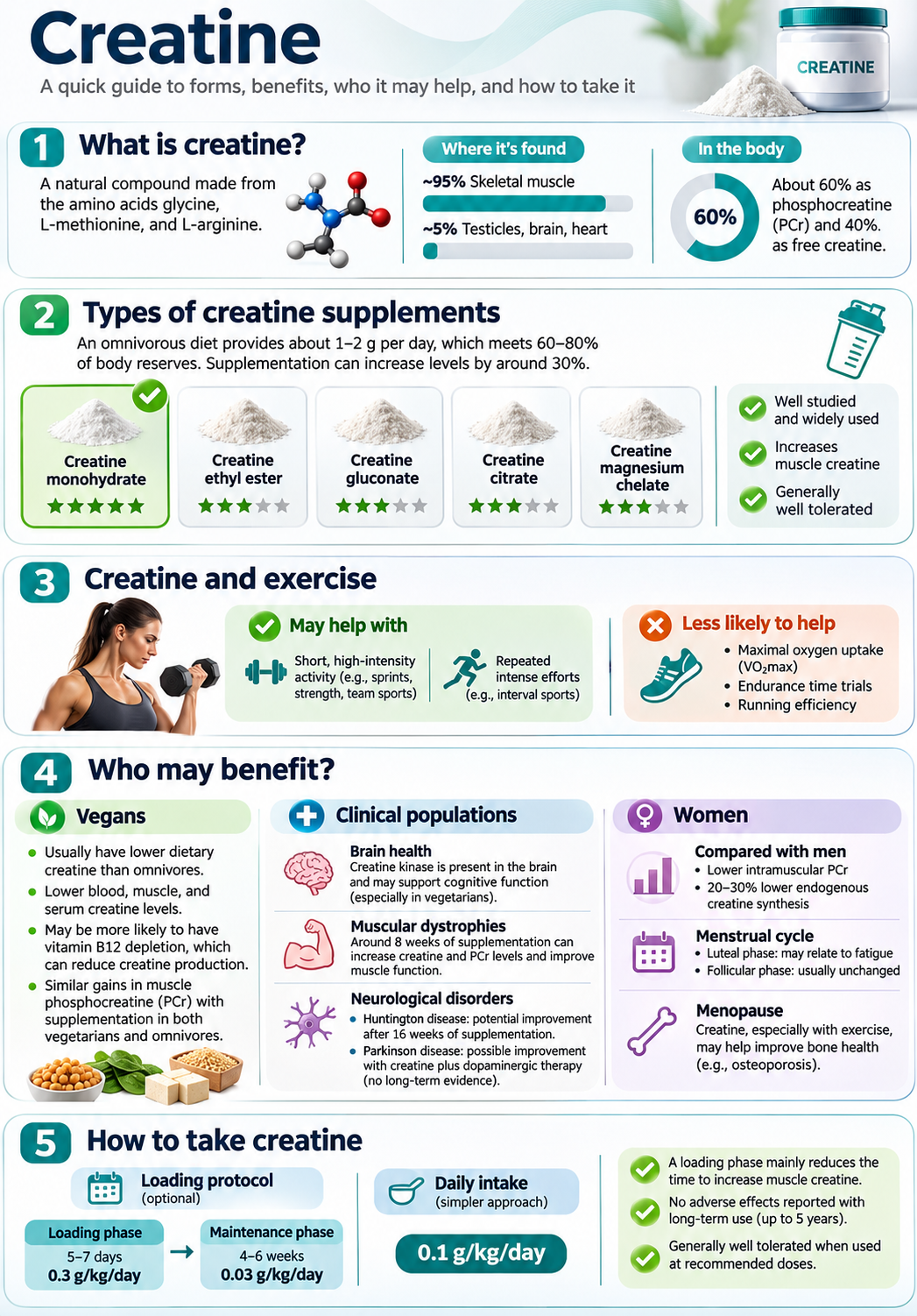
Infographic of the benefits of creatine supplementation in women, vegans, and clinical populations.2
Cerebral Bioenergetics & The Phosphocreatine System
Creatine is plentiful in organs with high energy demands, such as skeletal muscle and brain tissue. Within cells, creatine is converted into phosphocreatine (PCr), using adenosine triphosphate (ATP) in a reversible reaction catalyzed by CK. When energy demand rises, PCr donates a phosphate group to adenosine diphosphate to regenerate ATP.1,3
Brain creatine constitutes less than five percent of total body creatine but helps maintain energy balance in metabolically active cells. The brain relies on rapid ATP turnover, especially during complex cognitive tasks or high neural activity, with creatine facilitating ATP regeneration through the phosphocreatine system. The brain also synthesizes creatine locally, so brain and muscle responses to CrM supplementation can differ.4
Creatine may help preserve the balance between brain energy supply and demand during metabolic stress. By supporting brain energy metabolism, CrM supplementation may influence energy-dependent cognitive processes in the prefrontal cortex, including executive function and working memory.
Brain activity can rapidly reduce PCr levels, increasing PCr demand and potentially impairing ATP turnover. Increasing available creatine may help sustain cognitive performance during energy stress. Pooled trials of CrM found no significant overall benefit for executive function, so improvements across cognitive domains remain unproven.1,3 Creatine may also support memory by influencing neurotransmitter function, with effects on acetylcholine synthesis proposed as one possible mechanism.3
Across 16 randomized controlled trials involving 492 adults, creatine monohydrate supplementation was associated with improved memory and shorter completion times on attention and processing-speed tasks, but not with significant overall improvements in executive function or global cognition. Attention and processing-speed scores did not improve significantly.3
Exploratory subgroup findings favored females for processing-speed time and adults aged 18-60 years or participants with illnesses for attention time. Significant results in females and nonsignificant results in males do not, by themselves, establish a difference in treatment response between the sexes.3
Mitigation of Cognitive Deficits During Sleep Deprivation
During cognitive stress, such as sleep deprivation or complex cognitive tasks, ATP availability may decline while extracellular adenosine accumulates, slowing cognitive processes. Sleep deprivation has been associated with impaired cognition, while hormonal fluctuations across the menstrual cycle may further influence sleep and cognitive function. In these situations, CrM supplementation may improve some measures of cognitive performance by supporting cellular energy reserves.
Evidence for this possibility comes from a small trial in which 15 participants received a single dose of 0.35 g/kg creatine monohydrate or placebo during acute sleep deprivation. Compared with placebo, CrM improved word-memory performance and shortened processing times on memory, language, logical reasoning, and numerical tasks, though the trial’s small sample and high experimental dose limit generalization to everyday use. These findings provide a basis for further research in people experiencing sleep disruption, including postpartum women and shift workers, whose responses and appropriate dosing require direct study.6
Mood Modulation, Hormonal Shifts, and Mental Well-being
Sex hormones, predominantly estrogen and progesterone, affect CK activity and the expression of key enzymes involved in endogenous creatine synthesis. Animal studies have demonstrated that estrogen may influence the expression of arginine-glycine aminotransferase (AGAT), which catalyzes the rate-limiting step of creatine synthesis. In rodents, CK activity increased and decreased in sync with estrogen levels.1
Estrogen levels usually peak in the late follicular or pre-ovulatory phase. Hormone-related changes in creatine metabolism have prompted interest in CrM supplementation across reproductive stages, including menopause. CrM supplementation has also been studied as a possible countermeasure to menopause-related muscle and bone losses, though these musculoskeletal findings do not establish treatment effects on menopause-related cognitive symptoms.1
The severity of a depressive episode has been inversely linked to white matter creatine and PCr concentrations within the brain, suggesting a relationship between brain creatine metabolism and depression. Studies of females with major depressive disorder have reported alterations in brain energy metabolites, including lower beta-nucleoside triphosphate, a measure related to high-energy phosphates like ATP, and higher phosphocreatine levels. These region- and measurement-specific observations do not support a simple, uniform creatine deficiency model of depression, but have prompted investigation of brain energy metabolism as a treatment target.1,4
Pre-clinical and clinical evidence indicates possible positive effects from creatine supplementation on mood and cognition, with improved brain energy metabolism and mitochondrial function proposed as mechanisms. Creatine may also protect brain cells from neuroinflammation and oxidative damage, though these mechanisms are supported mainly by experimental evidence.
Clinical studies suggest that creatine monohydrate supplementation may reduce depressive symptoms, particularly when combined with selective serotonin reuptake inhibitors (SSRIs).7 Phosphocreatine levels are also being evaluated as a potential biomarker in female major depressive disorder (MDD), rather than an established clinical test.1,4 Further controlled evidence is required before CrM can be considered an established adjunct to antidepressant therapy.1,4
What women need to know about creatine
Practical Dosing Protocols, Bioavailability, and Safety
Common creatine monohydrate protocols use a loading dose of about 20 g/day for five to seven days, followed by 3–5 g/day. Loading protocols can rapidly increase muscle creatine stores, but the most effective dose and duration for increasing brain creatine remain unclear. A 2021 review of creatine supplementation in women’s health proposes 15–20 g/day for three to seven days followed by 5–10 g/day for brain uptake, but this regimen has not been validated for women’s brain health.1,3
While creatine is available in several supplemental forms, including gluconate, citrate, and magnesium chelate, CrM has the strongest evidence base. Findings from CrM trials cannot automatically be applied to other formulations. The blood-brain barrier regulates creatine entry into the brain, so high oral bioavailability does not guarantee rapid brain uptake.2,4
Some people are reluctant to use creatine supplements because of concerns about body weight, water retention, and kidney safety. CrM supplementation may cause a rapid early increase in weight because of increased cellular hydration, which must be distinguished from fat gain, though persistence varies with the protocol and individual response. Early weight changes should be considered when interpreting body composition changes.1,2
When combined with resistance training, CrM supplementation may increase fat-free mass and improve some body composition measures.1,2 Available studies generally support the kidney safety of CrM at studied doses in healthy people, including during longer-term use.
CrM supplementation can increase serum creatinine without indicating kidney injury, complicating interpretation of creatinine-based kidney assessments. Evidence in people with pre-existing kidney disease remains insufficient.2
Gastrointestinal symptoms and water-related weight gain can occur. Human evidence is insufficient to establish the safety or cognitive benefits of CrM supplementation during pregnancy and breastfeeding. Reports of mania or hypomania in people with bipolar disorder also warrant clinical supervision when CrM is considered for mood symptoms.1,4
 Image Credit: KenamiRyoko / Shutterstock.com
Conclusions & Future Research Directions
Creatine monohydrate supplementation may improve selected memory and task-completion outcomes, with possible relevance to women and people experiencing sleep deprivation. Changes in creatine homeostasis across the lifecycle, particularly those related to estrogen, justify further study rather than proving greater cognitive benefit in women.1,3-6
Further trials are required to address heterogeneity in study design and clarify the precise mechanisms underlying potential cognitive effects in older adults. Future research should also evaluate CrM dosing strategies and creatine levels among people with cognitive impairment using human biomarkers and neuroimaging techniques.
Peripheral measurements should be distinguished from direct assessments of brain creatine. Creatine levels should also be assessed based on individual profiles, considering factors that influence creatine concentrations, such as dietary intake, physical activity, sex, and muscle mass.
Larger clinical trials accounting for menstrual cycle phases and menopausal status could test whether these factors alter responses to CrM supplementation. Longer follow-up is needed to determine whether short-term improvements on tests translate into sustained benefits in daily functioning.3,5
References
- Smith-Ryan, A. E., Cabre, H. E., Eckerson, J. M., & Candow, D. G. (2021). Creatine Supplementation in Women’s Health: A Lifespan Perspective. Nutrients 13(3), 877. DOI: 10.3390/nu13030877. https://www.mdpi.com/2072-6643/13/3/877
- Gutiérrez-Hellín, J., Coso, J. D., Franco-Andrés, A., et al. (2024). Creatine Supplementation Beyond Athletics: Benefits of Different Types of Creatine for Women, Vegans, and Clinical Populations - A Narrative Review. Nutrients 17(1). DOI: 10.3390/nu17010095. https://www.mdpi.com/2072-6643/17/1/95
- Xu, C., Bi, S., Zhang, W., & Luo, L. (2024). The effects of creatine supplementation on cognitive function in adults: A systematic review and meta-analysis. Frontiers in Nutrition 11. DOI: 10.3389/fnut.2024.1424972. https://www.frontiersin.org/journals/nutrition/articles/10.3389/fnut.2024.1424972/full
- Juneja, K., Bhuchakra, H., Sadhukhan, S., et al. (October 16, 2024). Creatine Supplementation in Depression: A Review of Mechanisms, Efficacy, Clinical Outcomes, and Future Directions. Cureus 16(10): e71638. DOI: 10.7759/cureus.71638. https://www.cureus.com/articles/301707-creatine-supplementation-in-depression-a-review-of-mechanisms-efficacy-clinical-outcomes-and-future-directions
- Marshall, S., Kitzan, A., Wright, J., et al. (2026). Creatine and Cognition in Aging: A Systematic Review of Evidence in Older Adults. Nutrition Reviews 84(2); 333-344. DOI: 10.1093/nutrit/nuaf135. https://academic.oup.com/nutritionreviews/article/84/2/333/8253584
- Gordji-Nejad, A., Matusch, A., Kleedörfer, S., et al. (2024). Single dose creatine improves cognitive performance and induces changes in cerebral high energy phosphates during sleep deprivation. Scientific Reports, 14, 4937. DOI: 10.1038/s41598-024-54249-9. https://www.nature.com/articles/s41598-024-54249-9
- Lyoo, I. K., Yoon, S., Kim, T. S., et al. (2012). A randomized, double-blind placebo-controlled trial of oral creatine monohydrate augmentation for enhanced response to a selective serotonin reuptake inhibitor in women with major depressive disorder. American Journal of Psychiatry, 169(9), 937-945. DOI: 10.1176/appi.ajp.2012.12010009. https://pmc.ncbi.nlm.nih.gov/articles/PMC4624319/
Further Reading
Last Updated: Nov 26, 2026