Introduction
Eating disorders and vulnerability to misuse
Appetite suppression, behavioral effects, and psychological risk
Social media influence and normalization of nonmedical use
Body image, cultural pressure, and weight stigma
Real-world use patterns and off-label expansion
Future directions
References
Further reading
As appetite-suppressing medications gain visibility online, researchers are examining how their use intersects with eating behaviors, body image, and the pressures surrounding weight loss.
 Image Credit: MillaF / Shutterstock.com
Introduction
Glucagon-like peptide 1 (GLP-1) receptor agonists (RAs) are widely used to manage obesity and type 2 diabetes. Their use also extends beyond approved medical indications, particularly for nonmedical weight loss among individuals seeking changes in body weight and appearance. Investigational treatment for binge eating should be distinguished from misuse, and absence of obesity alone does not establish that prescribing is inappropriate: some patients receive these medications for diabetes or for overweight accompanied by qualifying weight-related conditions.1,2
The growing demand for these medications, including reports of use without appropriate medical supervision, has raised concerns about potential misuse and the lack of evidence guiding their use outside approved indications. While GLP-1 RAs have improved weight management for many patients, researchers are examining their potential effects on eating behaviors, mental health, and body image, particularly amid growing digital influences and changing perceptions of weight loss.1,2,4
Eating disorders and vulnerability to misuse
Early clinical studies have reported reductions in Binge Eating Scale (BES) scores following GLP-1 RA use, along with improvements in binge eating frequency and metabolic outcomes. A meta-analysis comprising five studies and 182 participants reported a pooled BES reduction approximately 8.1 points greater than controls across GLP-1 RAs. Results varied substantially between studies; this was not a semaglutide-specific estimate or proof of superiority over lisdexamfetamine or topiramate.3
Liraglutide and dulaglutide have shown preliminary benefits for binge eating, but the evidence includes small and uncontrolled studies. A pilot placebo-controlled liraglutide trial found greater weight loss without a significant difference in binge-eating remission.1,3 Appetite suppression could worsen restrictive eating in vulnerable individuals, particularly without medical supervision; however, available reviews do not establish that GLP-1 RAs cause anorexia nervosa.1,2
It remains unclear whether GLP-1 RA use contributes to nutritional deficiencies in individuals who prioritize reduced food intake over nutritional quality. Nausea and vomiting may also complicate eating disorder treatment, particularly when vomiting could reinforce existing purging behaviors. These findings emphasize the importance of screening patients for current or past eating disorders before starting GLP-1 treatment, in addition to monitoring their psychological status throughout treatment.1,2
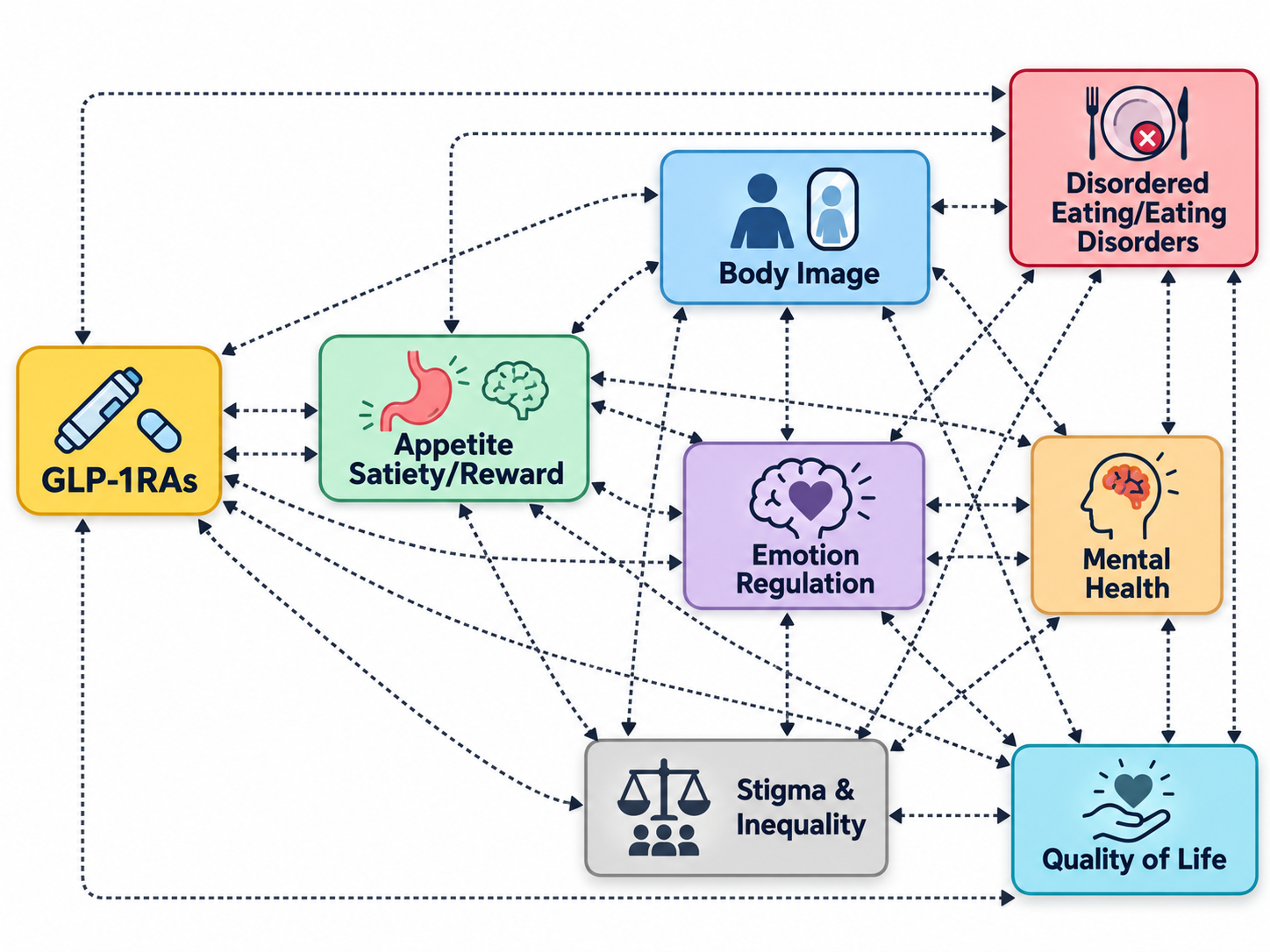
Conceptual model of biological, psychological, and social pathways linking GLP-1RA use to eating and mental health outcomes.2
Appetite suppression, behavioral effects, and psychological risk
In the gastrointestinal tract and central nervous system (CNS), GLP-1 RAs activate GLP-1 receptors, increasing satiety. Animal and early human studies suggest that GLP-1 signaling influences brain regions involved in appetite, satiety, and reward processing. Through central and peripheral mechanisms, including delayed gastric emptying and effects on appetite and reward pathways, these medications can reduce hunger, food cravings, emotional eating, and preferences for high-calorie foods.2,3
Some studies report short-term reductions in emotional eating, but sustained benefits are uncertain. One observational study discussed in the Nutrients review found improvement at three months, with scores returning to baseline by 12 months. These effects may benefit some patients, while reinforcement of rigid eating patterns or compulsive weight-control behaviors remains a theoretical concern in vulnerable individuals.2
Findings on depression differ across study designs and populations. Some studies report improvements in depressive symptoms, whereas others have raised concerns about mood changes or suicidal thoughts in susceptible individuals. The 2025 Nutrients review reports that randomized-trial evidence did not show increased suicidality.
Spontaneous adverse-event reports and online accounts cannot establish causation or estimate incidence. Short follow-up and the exclusion of some patients with psychiatric conditions limit conclusions about long-term safety in these groups.1,2,4
 Image Credit: FOTO Eak / Shutterstock.com
Social media platforms can portray GLP-1 drugs as cosmetic weight-loss tools, rather than medical therapies. Popular hashtags like #Ozempic, #Wegovy, and #Mounjaro, along with celebrity endorsements, before-and-after imagery, and anecdotal success stories, may normalize nonmedical use while minimizing potential risks. Many of these posts focus on dramatic weight-loss results while providing limited information about appropriate prescribing, possible adverse effects, or the importance of medical supervision.2,4
Content analyses summarized in the Nutrients review found that Reddit discussions frequently addressed weight loss, dosing, and side-effect management. A TikTok analysis likewise found limited discussion of off-label use, shortages, or alternatives such as bariatric surgery. These findings suggest that digital spaces may amplify desirability while minimizing risk, with platform-specific differences in reliability.2
These messages may be particularly influential for adolescents and people vulnerable to eating disorders by reinforcing unrealistic body ideals and rapid weight-loss expectations. Appearance-focused content and transformation imagery may heighten social comparison, body dissatisfaction, and disordered eating risk.
Importantly, most GLP-1 social media studies describe posted content; they do not establish that exposure causes medication misuse or eating disorders. Selected online samples also cannot establish how common misuse is in the wider population.2,4
Body image, cultural pressure, and weight stigma
GLP-1 use exists within a broader sociocultural context of thinness ideals and weight stigma. Weight loss may leave existing body dissatisfaction unresolved, and researchers have proposed that rapid changes could complicate body perception in susceptible individuals. These proposals draw partly on broader eating disorder research, rather than direct studies of medication effects. Direct longitudinal evidence that GLP-1 RA treatment worsens body image remains scarce.2
GLP-1 RAs may also perpetuate existing stigma in new ways. For example, GLP-1 RA users may be labeled “taking the easy way out,” and face judgment when weight regain occurs after stopping treatment.
Experimental studies summarized in the Nutrients review found that people judged medication-assisted weight loss more negatively than weight loss attributed to diet and exercise. Co-designed research involving people who use these medications could clarify how such judgments affect daily life and healthcare experiences.2
Real-world use patterns and off-label expansion
GLP-1 RAs are increasingly used beyond traditional clinical indications, including for aesthetic weight loss. Off-label prescribing, nonprescribed use, and misuse are distinct categories.
Off-label prescribing refers to use outside a product’s approved indication, while nonprescribed use occurs without a prescription. Misuse concerns inappropriate use and can overlap with either category. Clinician-supervised investigation of GLP-1 RAs for binge eating should be assessed separately from use for cosmetic weight loss without appropriate assessment.1,2,4
The clinical concern is whether patients receive appropriate assessment and follow-up. The supplied papers raise concerns about inadequate screening and monitoring but do not quantify how often these problems occur across prescribing settings. Restrictive eating can be overlooked when weight loss is interpreted as treatment success, particularly in patients whose body weight does not suggest an eating disorder.1,2
The supplied papers do not establish that GLP-1 drugs cause addiction. Compulsive reliance on appetite suppression is a proposed psychological risk, but evidence does not establish that an increasing number of users develop dependence. Research is needed to distinguish appropriate ongoing treatment from compulsive use driven by eating disorder symptoms.1,2,4
Popular weight loss drugs may worsen eating disorders in patients
Future directions
Together, these observations support assessing psychiatric history, eating disorder risk, body image concerns, and behavioral factors before starting GLP-1 RA therapy, as these factors may influence treatment outcomes. Healthcare providers should carefully evaluate the risk-benefit balance for each patient, considering individual medical, psychiatric, and treatment-related factors. Assessment should address eating behaviors across body sizes, since restrictive disorders may be missed in patients whose weight is within or above conventional reference ranges.1,2,4
Larger randomized controlled trials are needed to test efficacy for binge eating disorder, alongside long-term studies of mental health and eating behaviors. Studies should distinguish changes in eating disorder symptoms from weight loss and use objective measures alongside patient reports. Carefully designed research in restrictive eating disorders is also needed to investigate safety without assuming that findings from binge eating disorder apply to these patients.1-3
Future studies should include appropriately selected younger populations and people without obesity or diabetes, where ethical and clinically justified. Researchers must also examine lived experiences, stigma, and access to healthcare to support evidence-based prescribing and individualized care. Controlled studies of social media exposure could test whether different messages affect body dissatisfaction, treatment expectations, or interest in nonmedical use.1-3
Addressing the emotional and psychological factors underlying eating disorders remains necessary. Appetite suppression does not demonstrate recovery from distress about food, weight, or body image. Psychological treatment, including cognitive behavioral therapy, remains central to eating disorder care. Follow-up should assess nutritional intake, restrictive or compensatory behaviors, mood, and the patient’s relationship with food, alongside metabolic outcomes.1,2
References
- Kałas, M., Stępniewska, E., Gniedziejko, M., et al. (2025). Glucagon-like Peptide-1 Receptor Agonists in the Context of Eating Disorders: A Promising Therapeutic Option or a Double-Edged Sword? Journal of Clinical Medicine 14(9); 3122. DOI: 10.3390/jcm14093122. https://www.mdpi.com/2077-0383/14/9/3122
- Krug, I., Dang, A. B., Portingale, J., et al. (2025). Beyond Weight Loss: GLP-1 Usage and Appetite Regulation in the Context of Eating Disorders and Psychosocial Processes. Nutrients 17(23); 3735. DOI: 10.3390/nu17233735. https://www.mdpi.com/2072-6643/17/23/3735
- Radkhah, H., Anaraki, S. R., Roudsari, P. P., et al. (2025). The impact of glucagon-like peptide-1 (GLP-1) agonists in the treatment of eating disorders: A systematic review and meta-analysis. Eating and Weight Disorders 30(1); 10. DOI: 10.1007/s40519-025-01720-9. https://link.springer.com/article/10.1007/s40519-025-01720-9
- Arillotta, D., Floresta, G., Guirguis, A., et al. (2023). GLP-1 Receptor Agonists and Related Mental Health Issues; Insights from a Range of Social Media Platforms Using a Mixed-Methods Approach. Brain Sciences 13(11); 1503. DOI: 10.3390/brainsci13111503. https://www.mdpi.com/2076-3425/13/11/1503
Further Reading
Last Updated: Oct 26, 2026
 Rapid rise of GLP-1 medicines brings obesity and eating disorders together