Introduction
How Legionella reaches the respiratory tract
Who is most vulnerable, and what past outbreaks have revealed
Prevention and control
Emerging challenges
References
Warm water, bubbling jets, and hidden microbial communities raise questions about what makes a hot tub safe and who faces the greatest risk.
 Image Credit: pv Productions / Shutterstock.com
Introduction
Legionella are environmental bacteria that normally inhabit freshwater environments and can contaminate warm artificial aquatic systems like spas, public baths, and recreational hot tubs.4 Legionnaires' disease, which is caused by infection with Legionella, is often associated with hospitals, cooling towers, and large building water systems.
Recreational hot tubs are another important potential source of infection, where warm water and inadequate maintenance can create ideal conditions for Legionella to grow. At the same time, jets disperse contaminated droplets into the air.2,4
Warm hot tub water can fall within the 25-45°C temperature range favorable for Legionella growth. Importantly, this describes conditions that support bacterial growth, not a recommended operating temperature.3,4 Insufficient disinfectant concentrations can allow bacterial growth in these warm water systems, making them one of the most common environmental factors that cause recreational water outbreaks, along with low residual disinfectant levels.4
Together, these processes can promote bacterial biofilm formation along internal piping, where microbial communities adhere to surfaces and bacteria can persist. Disinfection and cleaning must address these reservoirs.2-4
How Legionella reaches the respiratory tract
Legionella transmission primarily occurs through inhalation of aerosolized droplets from contaminated water systems. Hot-tub jets produce fine water droplets, including respirable aerosols that can reach the lower respiratory tract.3,4
Legionella are intracellular bacteria that can cause Legionnaires' disease, a form of pneumonia.1 Exposure can also cause Pontiac fever, a milder illness without pneumonia.2,4
Pontiac fever typically causes flu-like symptoms that resolve within a few days. The 2018 systematic review identified 620 Pontiac fever cases associated with recreational water, with no deaths, and described a high proportion of exposed people becoming ill in outbreaks.4
Legionnaires' disease, by comparison, is a form of pneumonia that can become severe and progress to respiratory failure, shock, multi-organ failure, and death.1 A smaller proportion of exposed people generally develop Legionnaires' disease than Pontiac fever, but affected patients may require hospitalization.
The diagnosis and treatment review reports an overall mortality rate of 4-18%, varying with patient characteristics and care setting. Notably, this range concerns Legionnaires' disease generally, rather than hot tub infections alone.1,4
What is Legionnaires' disease?
Who is most vulnerable, and what past outbreaks have revealed
Several host factors influence the risk and severity of Legionella infections.3,4 Adults 50 years of age and older, current or former smokers, and people whose immune defenses are weakened are particularly vulnerable to Legionnaires' disease.1,2 The presence of pre-existing conditions like chronic obstructive pulmonary disease (COPD) and malignancy is also associated with greater susceptibility to Legionnaires' disease.1
A 2018 systematic review identified 42 events involving 1,079 cases of legionellosis associated with recreational water. Of these cases, 459 were Legionnaires' disease. Twenty-nine people with Legionnaires' disease died.4
A community outbreak occurred in Palma Nova, Mallorca, Spain, in 2017, involving 27 travel-associated cases and one death, which amounted to a 3.7% fatality rate. Investigators linked this outbreak to stagnant, outdoor private-use hot tubs on hotel penthouse balconies.3
The 2018 review also found gaps in water treatment, cleaning, and monitoring. Among 22 events with environmental information, 21 involved failure to follow at least one recommended preventive measure. Incomplete maintenance records and differences between investigations limited comparisons and conclusions about the contribution of individual factors.4
The Mallorca outbreak is another exemplary case of how contaminated hot tubs can expose people beyond those who use the water.3
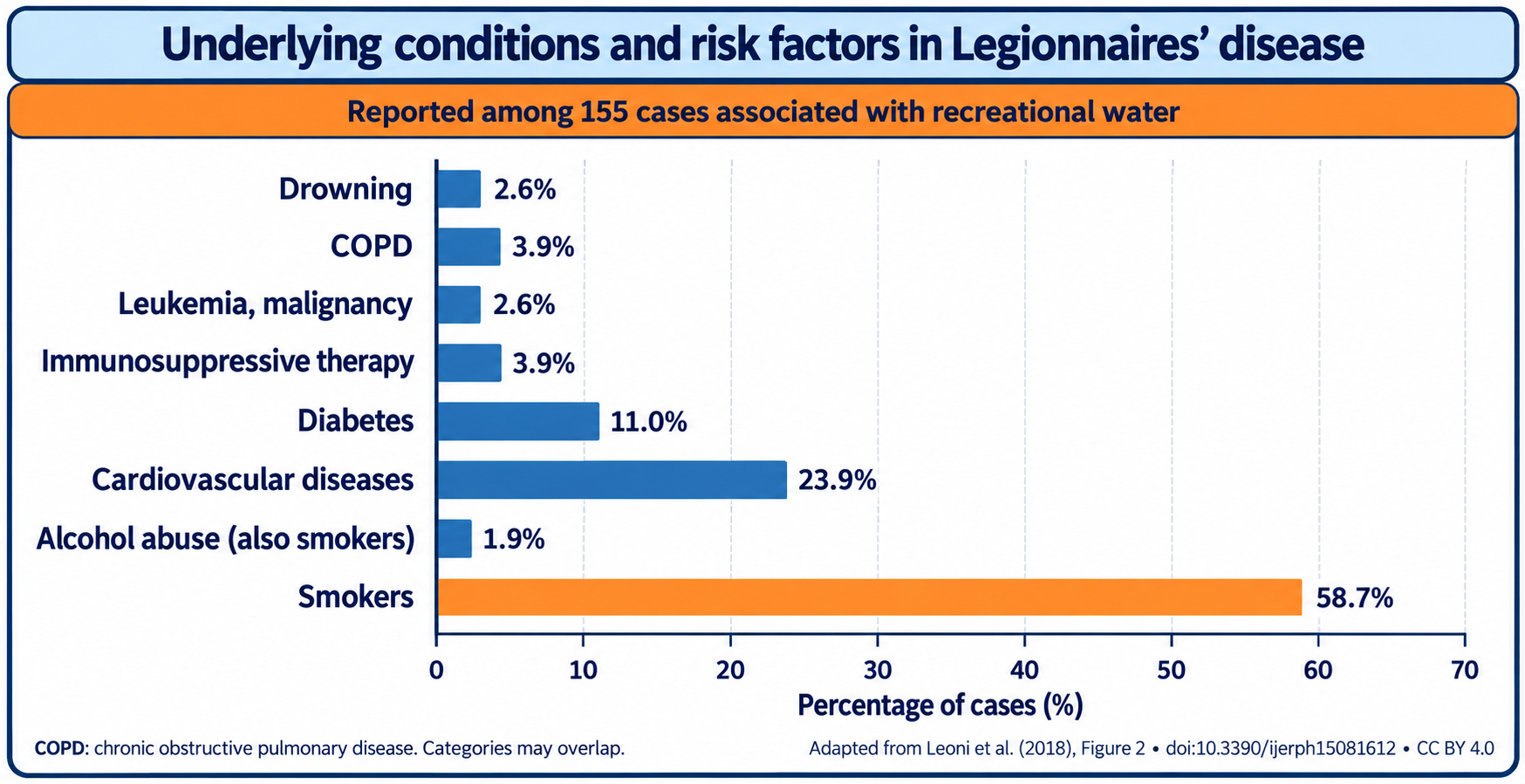 Distribution of underlying medical conditions and risk factors in 155 cases of Legionnaires’ disease.4
Prevention and control
Appropriate chemical disinfection, filtration, and water-system maintenance are central to limiting Legionella growth.2,4 Recommended disinfectant levels vary among guidelines and regulatory settings; the CDC recommends at least 3 parts per million (ppm) free chlorine or at least 4 ppm bromine, with a pH of 7.0-7.8.
Operators should check these values at least twice daily, and more often during heavy use. Users can check the water with unexpired test strips and report improper readings.2
Clean filters and pipelines regularly to remove organic debris that can shield bacteria and promote biofilm formation.2,4 Regular flushing of low-flow lines helps reduce stagnation in building water systems.3 Hot tub operators should also scrub away biofilm daily and replace filters and water according to manufacturer recommendations and applicable health department requirements.2
Public health entities like the U.S. CDC recommend water management programs to identify and address site-specific operational risks. Preventing water stagnation in dormant spas is crucial, as stagnant zones can lose disinfectant and allow Legionella to multiply.1,3 People who develop cough, shortness of breath, fever, or muscle aches after using a hot tub within the previous two weeks should seek medical care right away and mention the exposure.2
 Image Credit: Giovanni Cacemi / Shutterstock.com
Emerging challenges
Rising legionellosis incidence has renewed attention to environmental and infrastructure factors that can affect Legionella growth and transmission.3 Stagnation, sediment accumulation, corrosion, and biofilm formation within aging water systems can help bacteria persist.3
Temperature, humidity, and other climatic factors have also been associated with Legionnaires' disease patterns and may influence Legionella ecology. To date, research on how climate change affects individual sources and transmission pathways remains limited.1,3
Alongside improved water management, faster surveillance tools could help identify contamination and trace outbreaks more efficiently. For hot tub investigations, comparing bacteria from patients and water samples can help assess whether the facility was the source.1,4
While traditional bacterial culture methods are slow and sometimes take up to 14 days to isolate strains, whole-genome sequencing, which examines bacteria's complete genetic material, can characterize isolates and investigate potential outbreak sources.1,3
Quantitative polymerase chain reaction (qPCR) can detect Legionella DNA more rapidly than culture; however, it can also detect dead bacteria. Thus, these results require careful interpretation, and molecular testing complements culture-based surveillance.3
References
- Viasus, D., Gaia, V., Manzur-Barbur, C., & Carratalà, J. (2022). Legionnaires' Disease: Update on Diagnosis and Treatment. Infectious Diseases and Therapy 11(3), 973-986. DOI: 10.1007/s40121-022-00635-7. https://link.springer.com/article/10.1007/s40121-022-00635-7
- U.S. Centers for Disease Control and Prevention. (2025). About Protecting Yourself from Legionella in Hot Tubs. Accessed 24 June 2026. https://www.cdc.gov/healthy-swimming/prevention/preventing-legionella-from-hot-tubs.html
- Yao, X. H., Shen, F., Hao, J., et al. (2024). A review of Legionella transmission risk in built environments: sources, regulations, sampling, and detection. Frontiers in Public Health 12. DOI: 10.3389/fpubh.2024.1415157. https://www.frontiersin.org/journals/public-health/articles/10.3389/fpubh.2024.1415157/full
- Leoni, E., Catalani, F., Marini, S., & Dallolio, L. (2018). Legionellosis Associated with Recreational Waters: A Systematic Review of Cases and Outbreaks in Swimming Pools, Spa Pools, and Similar Environments. International Journal of Environmental Research and Public Health 15(8); 1612. DOI: 10.3390/ijerph15081612. https://www.mdpi.com/1660-4601/15/8/1612
Further Reading
Last Updated: Oct 15, 2026