This article and associated images are based on a poster originally authored by Erin Kennedy, Kyle Vrtis, Eric Hunt, and Ashley Luck and presented at ELRIG Drug Discovery 2026 in affiliation with New England Biolabs, Inc.
This poster is being hosted on this website in its raw form, without modifications. It has not undergone peer review but has been reviewed to meet AZoNetwork's editorial quality standards. The information contained is for informational purposes only and should not be considered validated by independent peer assessment.

Nucleic acid-based therapeutic modalities continue to expand across RNA medicines, viral vectors, genome-editing strategies, and non-viral delivery platforms. These applications increasingly demand DNA templates that are free of bacterial backbones, antibiotic-resistance markers, and sequence instability–limitations inherent to plasmid DNA (pDNA) produced via E. coli fermentation.
dbDNA (Figure 1) is an enzymatically produced, closed-ended linear DNA format that eliminates bacterial sequences and allows scalable, cell-free manufacturing.
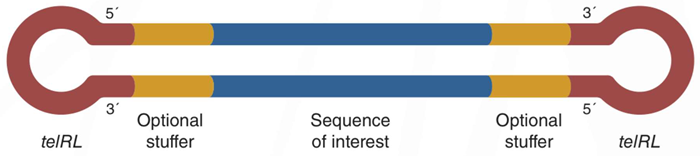
Figure 1. dbDNA is a linear, double-stranded DNA containing a sequence of interest (SOI) with covalently closed ends. Image Credit: Erin Kennedy et al., in partnership with ELRIG (UK) Ltd.
New England Biolabs developed the EnClose® Cell-free dbDNA™ Synthesis Kit* in collaboration with Touchlight Genetics. It provides the first off-the-shelf system that enables any research laboratory to generate dbDNA in a single day.
This study describes the performance of the EnClose Cell-free dbDNA Synthesis Kit and highlights its advantages for RNA therapeutics, AAV payload construction, gene editing donor design, and applications in non-viral delivery.
Methods
Cloning strategies for diverse therapeutic DNA architectures
The EnClose Cell-free dbDNA Synthesis Kit contains a dedicated dbDNA Vector (Figure 2) supporting flexible insertion of sequences of interest (SOIs) via:
- Traditional restriction enzyme cloning
- NEBuilder® HiFi DNA Assembly
- Golden Gate Assembly for complex or repetitive internal elements
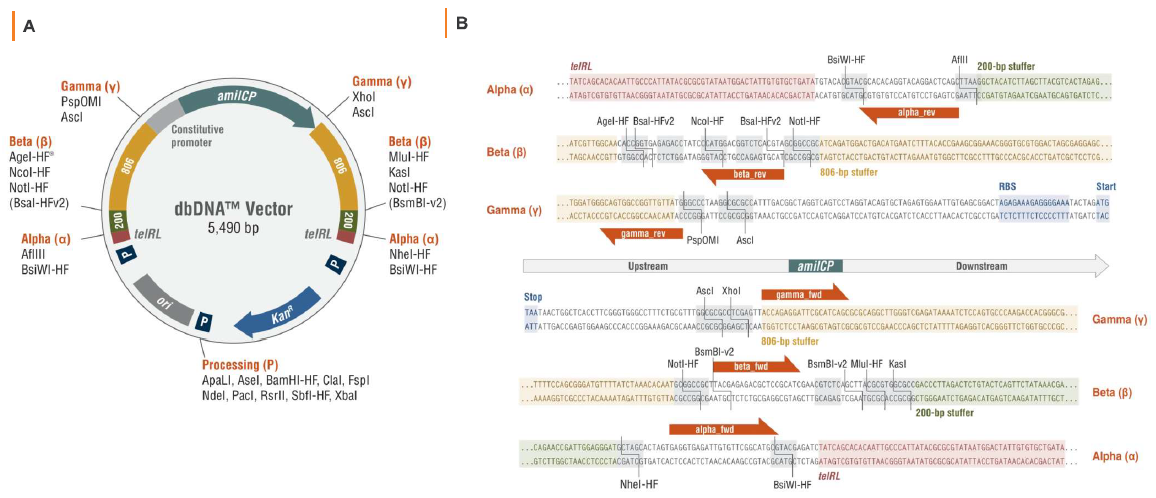
Figure 2. dbDNA Vector plasmid map & sequence. A. dbDNA Vector plasmid map. B. Upstream (top) and downstream (bottom) sequence of dbDNA Vector for traditional restriction enzyme cloning and NEBuilder® HiFi DNA Assembly primer design. Image Credit: Erin Kennedy et al., in partnership with ELRIG (UK) Ltd.
Results
Overview of the EnClose Cell-free dbDNA Synthesis Kit workflow:
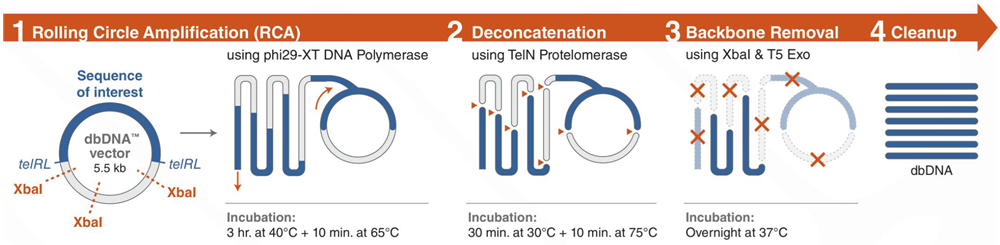
Figure 3. Overview of the EnClose Cell-free dbDNA Synthesis Kit Workflow. Image Credit: Image courtesy of Erin Kennedy et al., in partnership with ELRIG (UK) Ltd.
Constructed vectors were amplified using Phi29-XT DNA Polymerase for high-yield RCA, then treated with TelN Protelomerase to deconcatenate and covalently close the resulting linear dsDNA. The workflow supports:
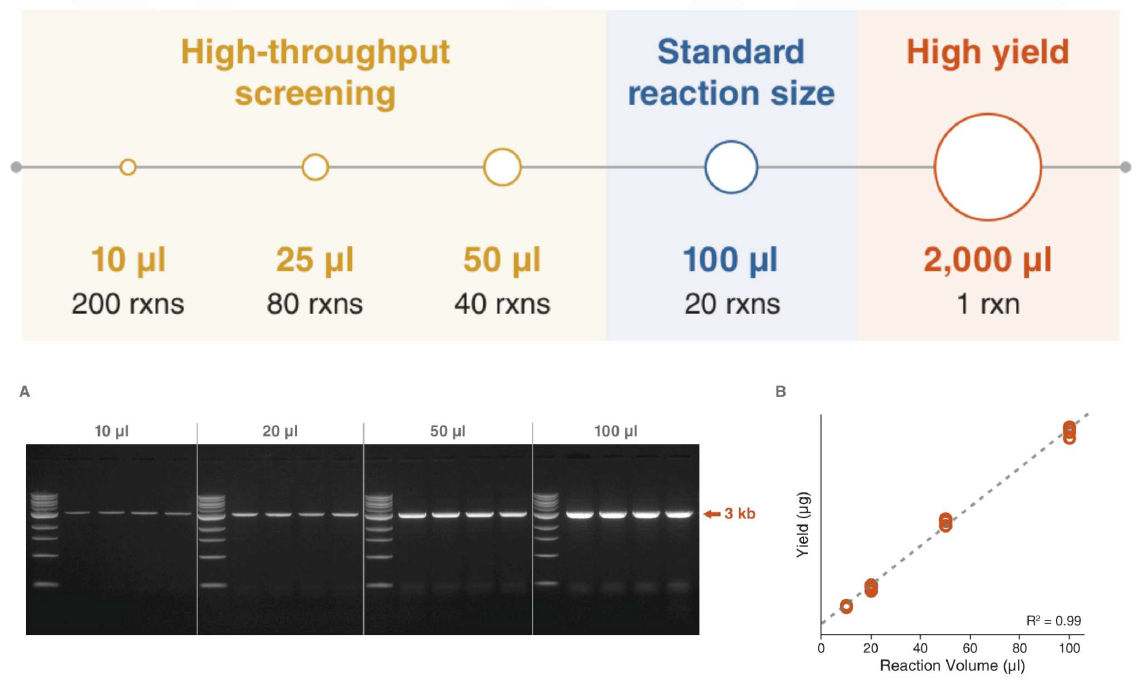
Figure 4. dbDNA yield scales linearly with RCA reaction volume between 10 µl and 100 µl. Quadruplicate dbDNA reactions were initiated using RCA reaction volumes of 10, 20, 50, or 100 µl with the dbDNA control input. The volumes of reaction components added for each subsequent step were scaled proportionately to the protocol in the E9301 kit manual. The dbDNA products were purified using the Monarch® Spin High-Capacity DNA Cleanup Kit (NEB #T1135) and eluted in 100 µl of 0.1X Tris-EDTA. A. Products were run on a 1.2% agarose gel to verify dbDNA size and purity. B. Product yields were quantified using an Unchained Labs® Lunatic® spectrophotometer. Image Credit: Image courtesy of Erin Kennedy et al., in partnership with ELRIG (UK) Ltd.
An extended RCA step enables a fully cell-free workflow by converting NEBuilder HiFi DNA Assembly reactions directly into dbDNA without purification or bacterial propagation.
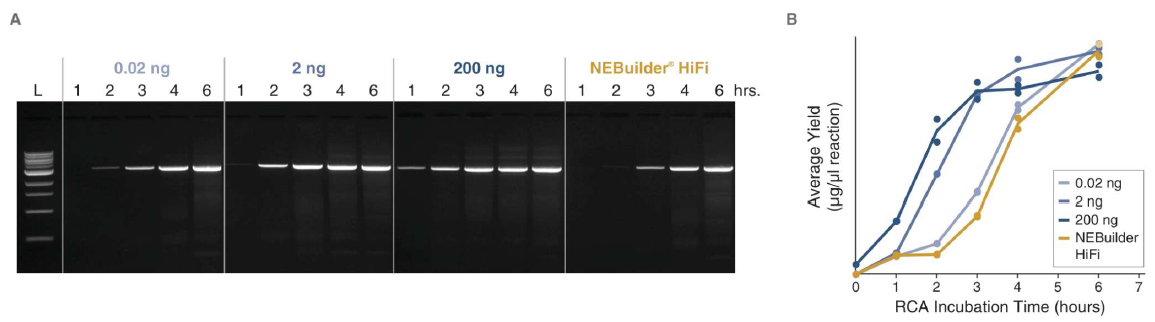
Figure 5. dbDNA reactions generate high yields of product in a short period of time, even from diluted NEBuilder® HiFi DNA Assembly reactions. Duplicate dbDNA reactions were carried out using the indicated amount of dbDNA control input or diluted NEBuilder HiFi reaction DNA. NEBuilder HiFi reactions were diluted 1:10 with 0.1X Tris-EDTA, and 0.4 µl of diluted NEBuilder HiFi reaction was used per 20 µl RCA reaction. 20 µl RCA reactions were carried out for the indicated times. A. Products were run on a 1.2% agarose gel to verify dbDNA size and purity. B. Product yields were quantified using an Unchained Labs Lunatic spectrophotometer. Image Credit: Image courtesy of Erin Kennedy et al., in partnership with ELRIG (UK) Ltd.
Conclusions
The EnClose Cell-free dbDNA Synthesis Kit provides a transformative platform for rapid, scalable, and contamination-free production of therapeutic-grade DNA templates tailored to the needs of RNA therapeutics, AAV vector development, gene editing, and non-viral delivery systems.
Key advantages include:
- Enzymatic construction, backbone-free composition eliminating bacterial contaminants
- High yields with linear scalability from micrograms to milligrams
- Preservation of long and repetitive sequences critical to mRNA/saRNA design
- Fast turnaround enabling true design-build-test iteration cycles
- Compatibility with complex viral and non-viral genetic architectures
- Closed-ended structure providing enhanced stability and reduced non-homologous end joining
By delivering high-purity, scalable DNA without the constraints of bacterial propagation, the EnClose dbDNA platform advances development across multiple therapeutic modalities and provides a next-generation template system aligned with the rapid innovation requirements of modern gene and RNA medicine.
*For Research Use Only. Not for use in diagnostic procedures.
About New England Biolabs
Established in the mid 1970's, New England Biolabs, Inc. (NEB) is the industry leader in the discovery and production of enzymes for molecular biology applications and now offers the largest selection of recombinant and native enzymes for genomic research. NEB continues to expand its product offerings into areas related to PCR, gene expression, sample preparation for next generation sequencing, synthetic biology, glycobiology, epigenetics and RNA analysis. Additionally, NEB is focused on strengthening alliances that enable new technologies to reach key market sectors, including the development of molecular diagnostics, as well as nucleic acid vaccines. New England Biolabs is a privately held company, headquartered in Ipswich, MA, and has extensive worldwide distribution through a network of exclusive distributors, agents and subsidiaries located in Australia, Canada, China, France, Germany, Japan, New Zealand, Singapore, South Korea and the UK.
About ELRIG (UK) Ltd.
The European Laboratory Research & Innovation Group (ELRIG) is a leading European not-for-profit organization that exists to provide outstanding scientific content to the life science community. The foundation of the organization is based on the use and application of automation, robotics and instrumentation in life science laboratories, but over time, we have evolved to respond to the needs of biopharma by developing scientific programmes that focus on cutting-edge research areas that have the potential to revolutionize drug discovery.
Comprised of a global community of over 12,000 life science professionals, participating in our events, whether it be at one of our scientific conferences or one of our networking meetings, will enable any of our community to exchange information, within disciplines and across academic and biopharmaceutical organizations, on an open access basis, as all our events are free-of-charge to attend!
Our values
Our values are to always ensure the highest quality of content and that content will be made readily accessible to all, and that we will always be an inclusive organization, serving a diverse scientific network. In addition, ELRIG will always be a volunteer led organization, run by and for the life sciences community, on a not-for-profit basis.
Our purpose
ELRIG is a company whose purpose is to bring the life science and drug discovery communities together to learn, share, connect, innovate and collaborate, on an open access basis. We achieve this through the provision of world class conferences, networking events, webinars and digital content.
Sponsored Content Policy: News-Medical.net publishes articles and related content that may be derived from sources where we have existing commercial relationships, provided such content adds value to the core editorial ethos of News-Medical.net, which is to educate and inform site visitors interested in medical research, science, medical devices and treatments.
Last Updated: Oct 27, 2026
 VWR, New England Biolabs expand distribution agreement