Introduction: The Rise of Data-Driven Agriculture
What Are Plant Biosensors?
IoT Networks: Connecting the Modern Farm
How AI Turns Sensor Data into Agricultural Intelligence
Smart Irrigation and Water Management
Biosensors and AI for Pest and Disease Prediction
Challenges and Future Opportunities
Future Outlook for Precision Agriculture
References
Plant-wearable biosensors, IoT connectivity, and AI are shifting precision agriculture from reactive crop management to continuous, data-driven decision-making. Despite challenges related to sensor reliability, interoperability, and large-scale deployment, these technologies are laying the foundation for smarter irrigation, earlier disease detection, and more sustainable farming.
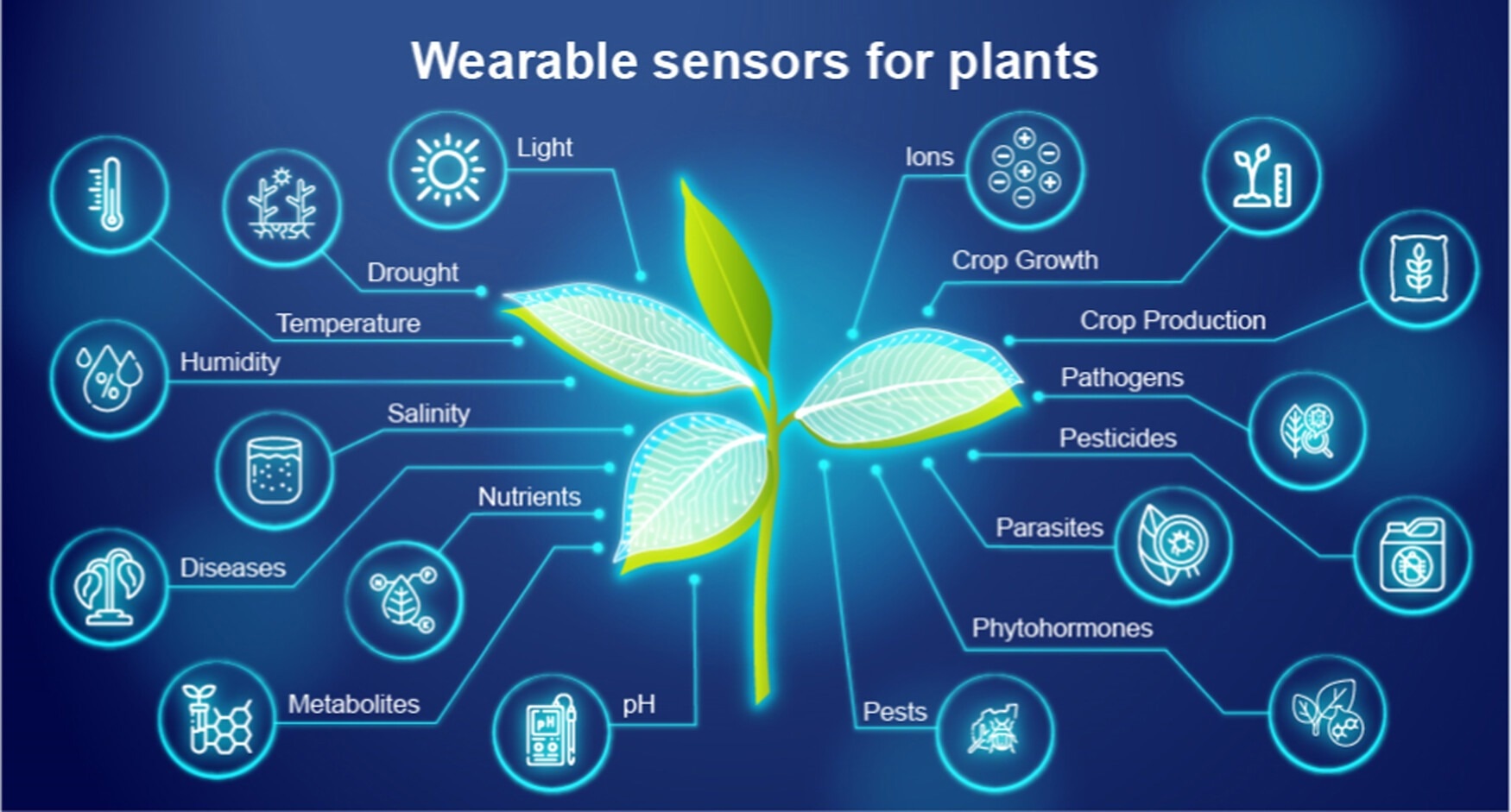 Image credit: Teixeira et al. (2025)
Against the backdrop of ever-increasing climate instability and recent reports that predict a 70% global food demand increase by 2050, reviews assessing the state of modern agriculture emphasize that the most pressing need in the field is the development of transformative crop monitoring systems capable of detecting physiological stress before visible symptoms occur, thereby supporting earlier and more targeted interventions.1
The "Internet of Plants" (IoP) is a proposed concept that attempts to address these needs by integrating plant-wearable biosensors, IoT networks, and predictive AI to enable real-time crop monitoring at scale. Rather than representing a single standardized technology, the Internet of Plants (IoP) is an emerging framework for digital agriculture that integrates distributed sensing, wireless communication, edge computing, cloud analytics, and AI-driven decision support. IoP's functional architecture further leverages microscale sensors to detect early biochemical signals (e.g., salicylic acid dynamics) before the observable manifestation of disease symptoms.2,3,10
This article synthesizes the latest advances in the field, demonstrating how this novel digital paradigm translates real-time biophysical signals into automated farming directives and feedback decision loops, thereby enabling precise resource allocation, optimizing water efficiency, supporting earlier pest and disease management, and securing sustainable food systems for tomorrow's society.8,10
Introduction: The Rise of Data-Driven Agriculture
While agriculture is one of the longest and best-studied human pursuits, climate change-driven erratic weather, biodiversity loss, resource depletion, and mounting global water scarcity are posing unprecedented challenges for the field.4
Reports highlight that despite accounting for nearly 70% of global freshwater withdrawals, conventional agricultural irrigation systems can lose substantial quantities of water because of inefficient scheduling, over-irrigation, and distribution inefficiencies, with reported losses frequently ranging from approximately 40% to 60% depending on irrigation method and local conditions.4,8
Concurrently, global warming is driving the rapid evolution and geographical redistribution of conventional and novel pathogens, with annual pathogen-associated losses estimated at more than $220 billion globally even before accounting for threats to natural biodiversity.3
While traditional diagnostic modalities (e.g., polymerase chain reaction [PCR] assays for pathogen identification) do exist, these approaches are highly accurate but are often time-consuming, laboratory-dependent, and resource-intensive, limiting their suitability for continuous field-scale monitoring and rapid decision-making.3,9
Scientists now believe that mitigating these challenges requires transitioning to continuous, non-destructive physiological monitoring. Consequently, ongoing research seeks to integrate wearable plant biosensors, Low-Power Wide-Area Network (LPWAN)-linked IoT networks, and predictive AI with existing crop monitoring systems, expanding real-time monitoring capabilities while improving resource utilization efficiency. Increasing emphasis is also being placed on multimodal sensor fusion, in which wearable sensors are combined with hyperspectral imaging, UAV remote sensing, weather observations, and soil sensing to improve robustness under real-world field conditions.3,6,7,9
What Are Plant Biosensors?
A New Wearable Technology — For Plants | Headline Science
Video credit: AmerChemSociety/Youtube.com
Plant biosensors are novel devices that combine biological recognition elements with physical transducers to convert biochemical variations into electronic signals. These devices are structurally designed to be directly attached to the plant structure and are functionally designed to enable continuous, real-time physiological tracking. Depending on their design, plant biosensors may target biochemical, physiological, or environmental parameters and increasingly serve as components within broader precision agriculture sensing ecosystems rather than as standalone monitoring devices.1-3
Since their pilot development in the 1990s, most plant biosensors can largely be classified as capturing specific biophysical processes across four major categories:
Electrochemical Biosensors
These specialize in monitoring plant defense activation (and associated acquired resistance phenotypes) by measuring phytohormone concentrations at the leaf's interface. Depending on the sensing chemistry employed, electrochemical biosensors can also quantify metabolites, nutrients, ions, pesticides, pathogens, and oxidative stress markers, making them among the most versatile platforms for continuous plant monitoring.1,3
An example of these devices is described in Teixeira and colleagues' (2025) review. This device was capable of estimating salicylic acid concentrations ranging from 50 to 1,500 μM. These biomarkers are particularly valuable because they participate in plant defense signaling pathways that often become activated before visible disease symptoms develop.1,3
Optical and Photonic Biosensors
Fluorescence spectroscopy or hyperspectral imaging can be used to identify physiological stress, disease development, and wounding sites, and to inform pre-symptomatic pathogen detection. Studies have validated their performance in detecting minute levels of chemical alerts, such as hydrogen peroxide accumulation, over a range of 10-100 μM. Recent reviews further emphasize that hyperspectral and multispectral sensing can distinguish subtle spectral signatures associated with both biotic and abiotic stress before conventional visual inspection becomes possible.1,7,9
The recent integration of hyperspectral optical sensing with modern AI models has been successfully used to detect pest damage using ground-based remote sensing data, revealing that 31 near-infrared wavelengths between 817 and 941 nm, particularly the 907.69 nm band, can be used to accurately classify pre-symptomatic spider mite infections in cotton. More broadly, recent systematic reviews conclude that AI-assisted spectral sensing is transitioning from single-sensor disease detection toward multimodal perception frameworks that integrate hyperspectral imagery with RGB imaging, thermal sensing, IoT telemetry, and UAV platforms to improve robustness under field conditions.7,9
Capacitive and Resistive Biosensors
These specialize in detecting transpiration dynamics and plant water potential by measuring localized impedance variations. These sensors are increasingly incorporated into wearable platforms that continuously monitor leaf hydration, stem water transport, and plant water status while minimizing disturbance to normal plant physiology.1,2
Modern applications of real-time leaf capacitance displays have already demonstrated a positive correlation with lab-measured moisture content, suggesting that these devices can enable rapid, precise quantification of transpiration to inform irrigation decisions at scale. When combined with soil moisture sensors and environmental monitoring, these measurements provide a more comprehensive representation of crop water demand than any individual sensing modality alone.2,8
Microneedle-based technologies
These devices are designed to pierce outer tissues minimally to scan interstitial fluids, thereby enabling highly sensitive tracking of macronutrients and intracellular calcium ions down to 40 nmol. These data are now considered essential to accurately evaluate the plant's cellular pH homeostasis (pH 4 to 8) and nutritional status.1
Modern implementations of plant biosensors reportedly prioritize avoiding tissue damage. Most devices are wearables that employ highly flexible, biodegradable substrates like cellulose acetate, chitosan, polylactic acid, and polyvinyl alcohol, which allow these devices to conform to leaf surfaces without obstructing transpiration. Current research additionally emphasizes long-term mechanical stability, biocompatibility, sustainable materials, low power consumption, wireless connectivity, and seamless integration with IoT platforms as essential requirements for large-scale agricultural deployment.1,2,3
IoT Networks: Connecting the Modern Farm
A farm-wide LPWAN pipeline (e.g., LoRaWAN, NB-IoT) is a multidevice network that aggregates telemetry from wearable nodes across several kilometers. Depending on farm size, energy constraints, and communication requirements, additional wireless technologies such as Zigbee, Wi-Fi, Bluetooth Low Energy (BLE), and cellular IoT may also be incorporated into precision agriculture deployments.5,6,8
Documented implementations of these pipelines often adopt a three-tier architecture: the "perception" tier uses wearable sensors and soil probes to sample transpiration and soil moisture; the "edge" tier processes telemetry locally to maintain irrigation during cloud outages; and the "cloud" tier hosts time-series databases to store historical records and train machine learning models. Recent reviews further describe this architecture as an edge-cloud continuum in which latency-sensitive decisions (such as irrigation valve control or anomaly detection) are performed locally, while computationally intensive analytics, long-term storage, and model retraining occur in cloud environments.4,6,8
When combined with multispectral drone and satellite remote sensing, these networks of wearable devices are observed to substantially mitigate the limitations of conventional single-sensor monitoring systems, even when accounting for field spatial variability. Multimodal sensor fusion also improves resilience against missing data, sensor failures, and environmental variability that commonly affect large-scale agricultural deployments.7,9
Explore our collection of Clean Technology articles to learn how advances in AI, renewable energy, sustainable engineering, and environmental technologies are driving the transition to a more sustainable future.
How AI Turns Sensor Data into Agricultural Intelligence
Unstructured agricultural data, especially data derived from multi-sensor networks, is complex and non-linear, requiring significant expert time and energy investment and representing a persistent limitation of conventional monitoring systems. In addition to high data volume, agricultural datasets frequently exhibit temporal variability, data collected from diverse sensor types, missing observations, and domain shifts caused by changing weather, crop varieties, and geographical conditions.7,9
AI models are excellent at addressing these limitations. Traditional machine learning algorithms, including Support Vector Machines and Random Forest models, remain widely used because they provide strong performance with relatively modest computational requirements and training datasets. These algorithms have already been shown to accurately classify stress conditions from multi-source streams in a fraction of the time taken by human experts. However, recent reviews emphasize that model generalization under real-world field conditions remains a significant research challenge.7,9,10
For temporal profiling, Long Short-Term Memory (LSTM) neural networks, which process multi-parameter sensor arrays, such as leaf surface temperature and relative humidity, have been successful in identifying stress progression. Al-Sammarraie and colleagues' (2025) review emphasizes that deep learning models can predict nutrient deficiencies up to 10 days earlier than conventional computer vision, permitting proactive nutrient application. More recent reviews additionally highlight Vision Transformers (ViTs), state-space models such as Mamba, multimodal foundation models, and vision-language models as emerging architectures capable of integrating heterogeneous agricultural data from wearable sensors, hyperspectral imagery, UAVs, and IoT platforms.2,7,9
Smart Irrigation and Water Management
Unlike conventional farmland hydration systems, which operated almost exclusively on static timers, IoP-informed smart systems leverage real-time data from soil moisture and plant water status sensors to generate feedback loops that efficiently and dynamically allocate water to the zones that require it most. Modern smart irrigation platforms increasingly integrate soil, plant, weather, and hydraulic sensing to optimize both irrigation and fertigation while adapting to changing environmental conditions.4,5,8
AI scheduling models can be trained using Model Predictive Control (MPC) and reinforcement learning (RL), as well as fuzzy logic and machine-learning regression models, to estimate reference crop evapotranspiration, thereby enabling optimized water distribution. Time-series forecasting models such as LSTM networks are also increasingly used to predict soil moisture dynamics and irrigation demand several hours or days in advance.4,8
Colizzi and colleagues (2025) suggest that AI-integrated irrigation systems have the potential to reduce water usage by 20% to 40% and energy consumption by 15% to 30%. Across recent systematic reviews, reported improvements vary considerably depending on crop type, climate, irrigation infrastructure, and sensor configuration. Encouragingly, field evaluations of pilot AI-assisted irrigation systems corroborate these estimates, showing a 35% yield increase, a 36% reduction in water use, and a 109% improvement in water-use efficiency (WUE). Rather than representing universal outcomes, these values should be interpreted as representative results achieved under specific experimental conditions.4,5,8
Efficiency gains can be further enhanced using low-cost capacitive plant biosensors, which are reported in several studies to achieve 20% to 45% water savings in vegetable crop farms. However, recent reviews consistently emphasize that accurate field calibration, compensation for soil-specific properties, long-term validation, and sensor maintenance remain essential for achieving comparable performance in commercial agricultural settings.5
Biosensors and AI for Pest and Disease Prediction
Decades of botanical research have established that pathogen infections trigger metabolic defense responses, including hydrogen peroxide oxidative bursts and salicylic acid signaling. Plant biosensors are uniquely equipped to detect these defense responses potentially significantly earlier than traditional symptomatic observations. Depending on the sensing platform, biosensors may also monitor phytohormones, volatile organic compounds, metabolites, nutrient status, and other biochemical indicators associated with both biotic and abiotic stress.1,3
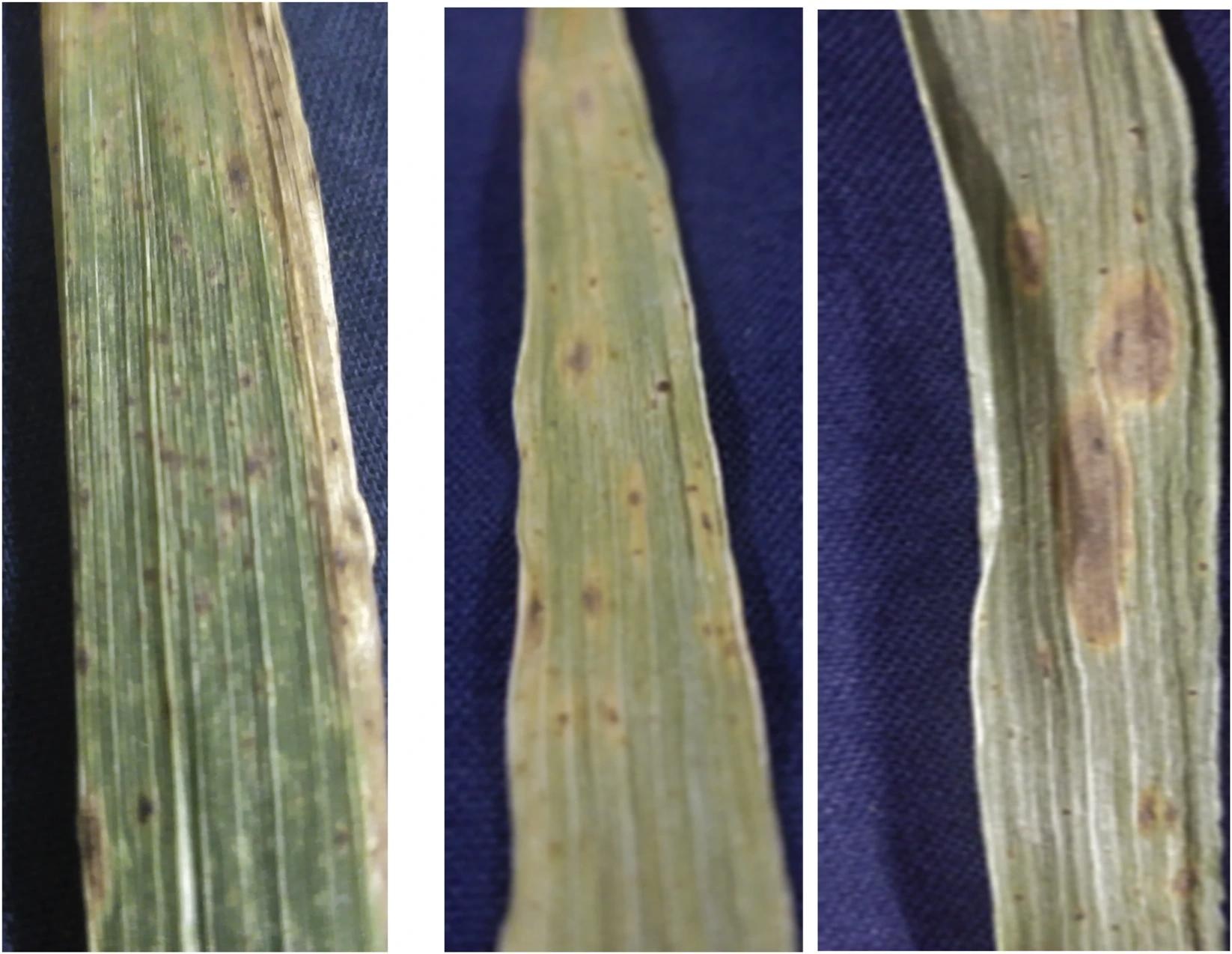 Representative examples of disease lesions on crop leaves, illustrating the visible symptoms of pathogen infection that conventional visual inspection detects after disease has become established. Wearable plant biosensors and AI-assisted monitoring aim to identify earlier physiological and biochemical changes before these symptoms appear. Image credit: Shikha et al. (2026).
Consequently, Smart Pest and Disease Management (SPDM) services combine wearable telemetry with microclimate variables like relative humidity and leaf wetness duration to synthesize vast amounts of raw data, which are subsequently processed by AI-based predictive models.6
The models, in turn, generate epidemiological risk maps and can forecast pathogen (or pest) spread, thereby enabling automated, targeted pesticide application that has the potential to reduce chemical runoff. Recent AI reviews additionally emphasize multimodal fusion, in which spectral imagery, IoT sensors, weather observations, and robotics are jointly analyzed to improve early detection accuracy and operational robustness under field conditions.6,7,9
Challenges and Future Opportunities
Despite these success stories, reviews in the field caution that the transition of plant biosensors from controlled laboratory environments and pilot field tests to routine use in farmland poses several technical, economic, and operational challenges. Firstly, unstructured outdoor conditions are expected to cause sensor drift and biofouling. Long-term durability, power management, calibration stability, and the mechanical robustness of wearable devices also remain active areas of research.1,3,5,8
Simultaneously, rural areas are known to suffer from limited LPWAN connectivity, which is further complicated by the proprietary, non-interoperable architectures of most current-generation AI-network implementations. Recent reviews additionally identify limited availability of large, well-annotated field datasets, domain shift between laboratory and agricultural environments, model explainability, cybersecurity, and economic affordability for smallholder farmers as major barriers to widespread adoption.4,5,7-9
Researchers are addressing these issues by developing self-calibrating sensors equipped with machine-learning-based drift compensation. An emerging opportunity is the integration of agricultural "digital twins": high-fidelity virtual replicas that continuously synchronize with real-time field telemetry. These virtual models simulate alternative crop management and irrigation scenarios, enabling farmers to evaluate outcomes proactively.7,8,10
Recent reviews, however, emphasize that most agricultural digital twins remain at relatively low levels of maturity. Achieving fully integrated digital twins will require standardized data exchange, interoperable IoT infrastructures, reliable real-time sensing, and closer integration of agronomic expertise with AI-based modelling.10
Future Outlook for Precision Agriculture
This article concludes that the convergence of biotechnology, LPWAN sensing, and edge-cloud AI is transforming precision crop management, painting a positive picture for the future of precision agriculture. As self-calibrating, biodegradable plant wearables scale, reliance on intensive chemical applications and costly machinery is expected to decline in many agricultural applications through earlier disease detection, more precise irrigation and fertigation, and improved resource-use efficiency, although the pace of adoption will depend on continued technological maturation, economic feasibility, and farmer acceptance.1,5,7,10
Consequently, the current trend of replacing conventional single-sensor monitoring applications with interconnected, autonomous smart farming ecosystems will hopefully support ecologically sustainable farming, enhance crop resilience to climate change, and secure global food production for the generations of tomorrow. Future progress will likely be driven by multimodal sensor fusion, explainable and trustworthy AI, interoperable data standards, scalable digital twins, and continued validation under diverse real-world agricultural conditions.4,6,7,9,10
References
- Teixeira, S. C., Gomes, N. O., de Oliveira, T. V., Soares, N. F. F., & Raymundo-Pereira, P. A. (2025). Sustainable Wearable Sensors for Plant Monitoring and Precision Agriculture. Analytical Chemistry, 97(28), 14875–14884. DOI:10.1021/acs.analchem.5c01565, https://pubs.acs.org/doi/10.1021/acs.analchem.5c01565
- Al-Sammarraie, M. A. J., Ilbas, A. I., & Gokalp, Z. (2025). From data to decision: How wearable plant sensors help improving proactive irrigation strategies and water use efficiency. CABI Reviews. DOI:10.1079/cabireviews.2025.0084, https://www.cambridge.org/core/journals/cabi-reviews/article/from-data-to-decision-how-wearable-plant-sensors-help-improving-proactive-irrigation-strategies-and-water-use-efficiency/10.1079/cabireviews.2025.0084
- Shikha, S., Dubey, S., Kumar, R., Chandrashekar, B., Namriboi, B. K., Bhatt, B., Sarkhel, S., Kashyap, A. S., Manzar, N., & Ghatak, A. (2026). Exploring the advances of biosensing technology for the detection of plant pathogens in sustainable agriculture. Frontiers in Bioengineering and Biotechnology, 13. DOI:10.3389/fbioe.2025.1674574, https://www.frontiersin.org/journals/bioengineering-and-biotechnology/articles/10.3389/fbioe.2025.1674574/full
- Ghazi, N. M., et al. (2025). Smart Irrigation Systems: A Comprehensive Review of IoT, AI, and Sustainable Agriculture Technologies. A Review Article. Kirkuk University Journal For Agricultural Sciences. DOI:10.58928/ku25.16429, https://doi.org/10.58928/ku25.16429
- Gupta, R., Chandniha, S. K., & V, H. (2026). A Critical Review on Optimization of Water Use in Vegetable Crops Using IoT-Based Low-Cost Sensors. Journal of Experimental Agriculture International, 48(1), 171–189. DOI:10.9734/jeai/2026/v48i13992, https://journaljeai.com/index.php/JEAI/article/view/3992
- International Telecommunication Union. (2025). Data requirements and models for smart pest and disease management services. ITU-T Y.4610. https://www.itu.int/epublications/ru/publication/itu-t-y-4610-2025-11-data-requirements-and-models-for-smart-pest-and-disease-management-services/en. Accessed 17th July 2026.
- Ma, Z., Wang, C., Wang, X., & Chen, X. (2026). Advances in Artificial Intelligence-Enabled Crop Pest and Disease Detection: A Systematic Review. Agriculture, 16(12), 1262. DOI:10.3390/agriculture16121262, https://www.mdpi.com/2077-0472/16/12/1262
- Colizzi, L., Dimauro, G., Guerriero, E., & Lomonte, N. (2025). Artificial intelligence and IoT for water saving in agriculture: A systematic review. Smart Agricultural Technology, 11, 101008. DOI:10.1016/j.atech.2025.101008, https://www.sciencedirect.com/science/article/pii/S2772375525002412
- Giakoumoglou, N., et al. (2026). A Review on Artificial Intelligence Methods for Plant Disease and Pest Detection. AI and Precision Agriculture, 1(1), 2. DOI:10.3390/aipa1010002, https://www.mdpi.com/3043-1204/1/1/2
- Tagarakis, A. C., et al. (2024). Digital Twins in Agriculture and Forestry: A Review. Sensors, 24(10), 3117. DOI:10.3390/s24103117, https://www.mdpi.com/1424-8220/24/10/3117
Last Updated: Jul 21, 2026