Why Food Safety Needs Faster Screening
How VIS-NIR, Raman, and SERS Detect Contamination
What Has Actually Been Validated?
Where Does the Evidence Fall Short?
Spectroscopy as a Triage Layer: What Comes Next?
Can Spectroscopy Move Beyond Laboratory Demonstrations?
References and Further Reading
Spectroscopy offers a promising approach to rapid food safety screening, using VIS-NIR, Raman and SERS technologies to detect adulteration, chemical contaminants and microbial hazards. Despite encouraging laboratory results, broader industrial adoption requires standardized methods, independent validation and integration with established confirmatory testing.
 Image credit: Nan Tun Nay/Shutterstock.com
Why Food Safety Needs Faster Screening
By the time contaminated food is identified, products may already have entered distribution, increasing the risk of consumer exposure and costly recalls. Food contamination can occur anywhere in the supply chain and involve biological hazards, such as bacteria and fungi; chemical hazards, including toxins, pesticides, and adulterants; or physical contaminants, such as glass and metal fragments. Early detection is therefore essential to limit health risks and product losses. However, conventional microbiological testing can require enrichment, identification, and confirmation, delaying decisions.1,2
Food fraud adds another challenge. High-value products, including oils, honey, dairy products, and spices, can be deliberately adulterated or mislabeled for financial gain. Food fraud is generally intentional and economically motivated, whereas food contamination may be accidental or deliberate; the two problems overlap when fraudulent practices introduce safety hazards.3,4
Established methods such as chromatography coupled with mass spectrometry can identify contaminants with high specificity, but often require trained personnel, laboratory equipment, sample preparation, and lengthy analysis. Immunoassays offer faster screening for known targets, although antibody specificity can limit the detection of unexpected substances. These limitations have encouraged interest in rapid, non-destructive approaches that can be used closer to production. Spectroscopy is one such approach. Rather than replacing established tests, it could provide an initial assessment and help identify samples requiring further investigation.3,4
Download your PDF copy now!
How VIS-NIR, Raman, and SERS Detect Contamination
Spectroscopy measures how matter interacts with electromagnetic radiation, generating signals that provide information about a sample's molecular composition. Visible-near-infrared (VIS-NIR) spectroscopy measures patterns of light absorption and reflection. The visible region can provide information about color and pigments, while near-infrared (NIR) wavelengths interact mainly with bonds such as C–H, O–H, and N–H, producing broad signals that reflect the overall composition of food. Changes in these signals can indicate differences associated with adulteration, moisture, or spoilage. NIR instruments can collect results within seconds and require little sample preparation. Portable devices also offer the possibility of screening at receiving points, warehouses, and production lines. However, NIR generally detects indirect changes in sample composition rather than identifying every contaminant directly.3,4
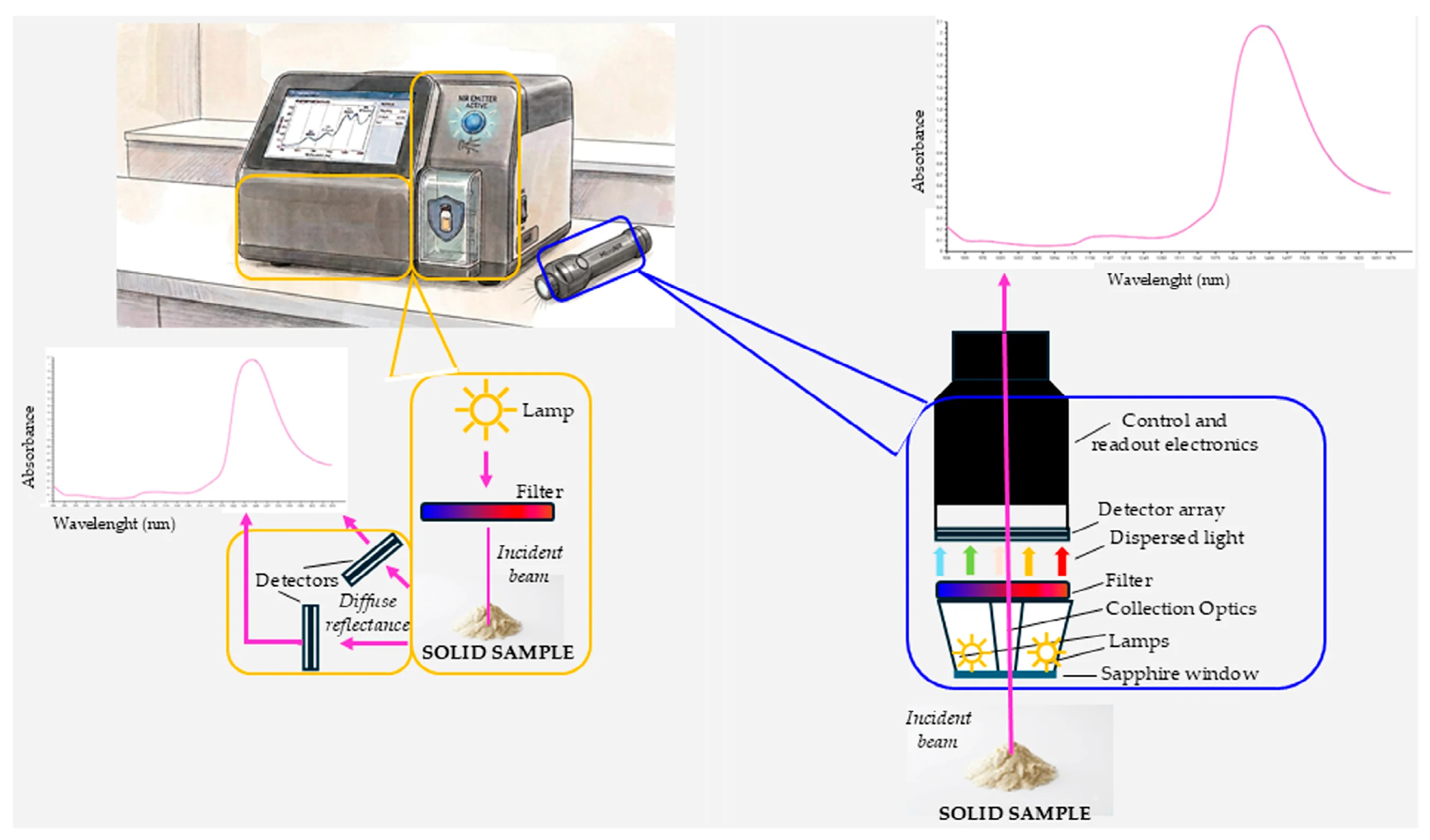 Benchtop and portable near-infrared (NIR) spectroscopy instruments and their measurement configurations. Schematic comparison of benchtop (yellow) and portable (blue) NIR systems, illustrating light sources, optical components, detector arrangements and diffuse-reflectance measurements of solid samples. The corresponding spectra demonstrate how NIR instruments record wavelength-dependent optical responses. Image credit: Pellicorio et al. (2026).
Raman spectroscopy measures changes in laser light energy after it interacts with molecular vibrations. These shifts produce narrower, molecule-specific features that can help distinguish chemical compounds and microbial samples. However, Raman signals are weak, making low-concentration targets difficult to detect. Fluorescence from food components can also interfere with Raman measurements and obscure diagnostically useful spectral features.2
Surface-enhanced Raman spectroscopy (SERS) addresses this limitation by using engineered metal surfaces or nanoparticles, commonly made from silver or gold, to amplify Raman signals. This can improve sensitivity for trace substances and microbial targets. However, performance depends partly on the substrate, which can introduce variability between measurements and laboratories. Unlike conventional Raman measurements, SERS generally requires a suitable enhancing substrate and may involve additional sample handling or target-capture procedures.2
Because food spectra can be complex, chemometrics and machine learning help identify patterns and compare samples with reference data. These models can classify authentic and adulterated products or microbial fingerprints, but require representative training data and independent validation. Active learning can prioritize informative samples for laboratory labeling, while semi-supervised learning can incorporate unlabeled spectra into model training. In two experimental spectroscopy datasets involving plasma-treatment dosage classification and foodborne-pathogen detection, a hybrid approach reduced the number of labeled samples required by more than 50% compared with passive learning. This demonstrated improved training-data efficiency, not equivalent reductions in industrial testing requirements.1,3
What Has Actually Been Validated?
Research has demonstrated promising results for food authentication and contaminant detection, although the strength of evidence varies by technique and application. NIR studies have detected several forms of food adulteration. For example, portable NIR instruments distinguished palm oil adulterated with Sudan dyes with identification rates above 95%. Other studies reported high classification or prediction performance when detecting mineral oils in edible oils, water, or whey in milk, and lower-value ingredients in juices. In one study, NIR combined with machine learning classified orange, apple, and pineapple juices adulterated with grape juice with 97–100% accuracy. These findings show that NIR can identify compositional changes when adulterants produce detectable spectral differences.3
Performance is less consistent when adulterants resemble the food matrix. Mineral oils in edible oils, for example, can be difficult to distinguish because their chemical features overlap. Powders, emulsions, and turbid liquids can also produce scattering patterns that affect measurements. High accuracy in one product cannot, therefore, be assumed for another. Much of the NIR evidence concerns food authenticity and chemical adulteration rather than direct detection of viable pathogens.3
Raman and SERS studies provide more direct evidence for microbial screening. Micro-Raman spectroscopy has differentiated bacterial species and strains, including organisms from the genera Salmonella, Listeria, Staphylococcus, and Escherichia. In one study, Raman analysis combined with machine learning classified bacterial strains at the serotype level with reported accuracies of 87.1–95.8%. SERS studies have also distinguished food-associated bacteria, including E. coli, S. aureus, and Salmonella, using characteristic spectral patterns. However, distinguishing laboratory-prepared bacterial samples is not equivalent to reliably detecting small numbers of pathogens within complex food products.2
Some studies have tested food samples directly. SERS detected E. coli O157 in apple juice at 10² colony-forming units (CFU)/mL in less than an hour. Another approach detected Salmonella in skimmed milk at 10² CFU/mL, although sample preparation and spectral mapping were required. A separate study detected L. monocytogenes and Salmonella in smoked salmon, ham, and eggs, and Cronobacter in infant formula and herbs, using isolation and enrichment steps. Raman spectroscopy has also been used to estimate microbial counts and spoilage-related changes on beef surfaces during storage. These studies are important because they examine signals in food matrices rather than isolated cultures.2
SERS has also been investigated for chemical hazards, including pesticides on fruit, melamine in milk and infant formula, and mycotoxins in food and feed. However, low detection limits in spiked samples or with specialized substrates do not establish performance in routine production. Validation varies substantially between applications.2
Where Does the Evidence Fall Short?
Food is a complex and variable material. Differences in moisture, fat content, particle size, processing, and storage can alter spectral signals. In NIR analysis, broad overlapping bands make it difficult to distinguish trace contaminants from dominant food components. Scattering effects in powders, emulsions, and turbid products can further reduce model reliability.3
Portable and benchtop devices may differ in wavelength range, resolution, detectors, and measurement geometry, making models difficult to transfer between instruments. Calibration libraries must also account for variations in food varieties, growing conditions, seasons, and processing. Maintaining representative datasets can be costly. Models developed using limited or closely related samples may appear highly accurate without demonstrating equivalent performance on independent batches, instruments, or production environments. External validation is therefore essential for assessing generalizability.1,3,4
Raman and SERS face different challenges. Raman signals can be weak, while SERS performance depends on substrate consistency and sample preparation. Reference spectra are often collected under different experimental conditions, complicating comparisons. Standardized databases, protocols, and data-processing methods are needed to improve reproducibility.2
Importantly, detecting a spectral signature does not establish that a pathogen is viable or present at a hazardous level. Bacterial cells may be dead, viable but non-culturable, or present in biofilms. Although Raman-based methods have investigated these states, their reliable detection in mixed, naturally contaminated foods remains insufficiently established. Laboratory classification accuracy should not be confused with validated performance in commercial food production. Furthermore, analytical detection limits, classification accuracy, and diagnostic sensitivity measure different aspects of performance. A method that classifies prepared samples accurately may still fail to detect low-level contamination in routine screening.2,3
Spectroscopy as a Triage Layer: What Comes Next?
Spectroscopy could serve as the first step in a tiered food safety workflow. Rapid screening could flag unusual samples for confirmatory testing using culture-based, molecular, and other validated methods. A negative spectral result cannot guarantee that a sample is free of contamination. Before routine use, methods need standardized protocols, independent testing across laboratories and food matrices, and clear performance measures. These should include sensitivity, specificity, false-negative rates, repeatability, analysis time, and cost. Validation should include naturally contaminated samples and assess performance across instruments and production conditions. Screening thresholds and follow-up procedures would also need to be defined for each application, with particular attention to false negatives when the target is a hazardous pathogen or contaminant.2,3
Portable sensors, automated sampling, and improved machine-learning models could support on-site screening. However, miniaturization and improved data analysis alone will not establish reliability. Reference libraries must be representative, regularly updated, and tested against independent samples. Collaboration among food producers, laboratories, regulators, and instrument developers will be important for establishing shared standards.1,3,4
Click here for an overview of Bruker and request information about products
Next Generation Handheld Raman Spectrometer for Material Verification and Identification
Video credit: NancyWrightRoss/Youtube.com
Can Spectroscopy Move Beyond Laboratory Demonstrations?
Portable spectroscopic systems are being explored for food authentication and quality assessment. Wider use in food safety surveillance will depend on consistent results across products, instruments, and operating environments. Cost, ease of use, sample heterogeneity, staff training, and integration into existing quality-control systems will also influence adoption. Although handheld spectroscopy and automated in-line scanning offer potential for more frequent monitoring throughout supply chains, the transition from controlled laboratory experiments to high-throughput industrial applications remains a significant challenge.3,4
Spectroscopy, therefore, offers a credible route to faster preliminary screening, rather than an independent means of preventing recalls or guaranteeing food safety. VIS-NIR may be useful for detecting compositional changes and screening for adulteration, while Raman and SERS offer opportunities for more specific chemical and microbial analysis. Further validation in naturally contaminated foods and industrial settings is needed before these methods become dependable routine tools. Their most practical near-term contribution may be to identify samples requiring closer examination, helping established microbiological and molecular tests be used more efficiently.1,4
References and Further Reading
- Zhang, H., Wisuthiphaet, N., Cui, H., et al. (2022). Spectroscopy Approaches for Food Safety Applications: Improving Data Efficiency Using Active Learning and Semi-supervised Learning. \Frontiers in Artificial Intelligence\. 5:863261. \DOI:\ \10.3389/frai.2022.863261\, \https\://www\.frontiersin.org/journals/artificial-intelligence/articles/10.3389/frai.2022.863261/full\\
- Petersen, M., Yu, Z., Lu, X. (2021). Application of Raman Spectroscopic Methods in Food Safety: A Review. \Biosensors\. 11(6):187. \DOI:\ \10.3390/bios11060187\, \https\://www\.mdpi.com/2079-6374/11/6/187\\
- Pellicorio, V., Colombo, R., Papetti, A. (2026). Applications of NIR Spectroscopy and Chemometrics for Food Authentication and Safety: Detection of Adulterants and Contaminants. \Molecules\. 31(17):3067. \DOI:\ \10.3390/molecules31173067\, \https\://www\.mdpi.com/1420-3049/31/17/3067\\
- Fernando, I., Fei, J., Cahoon, S., Close, D.C. (2025). A review of the emerging technologies and systems to mitigate food fraud in supply chains. \Critical Reviews in Food Science and Nutrition\. 65(26):5108–5135. \DOI:\ \10.1080/10408398.2024.2405840\, \https\://www\.tandfonline.com/doi/full/10.1080/10408398.2024.2405840\\
Last Updated: Nov 11, 2026