What Makes Biofilms So Difficult to Treat?
How Can Cold Atmospheric Plasma Attack a Biofilm?
When Plasma Alone Is Not Enough
Why the Chemistry of Plasma Matters
From Laboratory Biofilms to Future Treatments
References and Further Reading
Cold atmospheric plasma offers a promising approach to overcoming the protective defenses of microbial biofilms through reactive oxygen and nitrogen species. Emerging research demonstrates that combining plasma with biofilm-sensitizing compounds or antibiotics can significantly enhance microbial killing, although further clinical validation is required.
 Image credit: Arif biswas/Shutterstock.com
The growing challenge of antimicrobial resistance (AMR) demands innovative modernization of traditional therapeutic strategies, particularly for chronic infections characterized by biofilm formation.
While traditional treatment approaches have often relied on increasing antibiotic concentrations to overcome bacterial defenses, biofilms have been observed to reduce antimicrobial susceptibility through multiple interacting mechanisms, including altered microbial physiology, protective extracellular material, and reduced drug penetration in some circumstances, making many infections difficult to eradicate.2
Microbial biofilms are structured communities of microorganisms that act as biological fortresses, making embedded pathogens unusually tolerant to conventional antibiotics. While several strategies to address this tolerance have been proposed, one of the most promising is using a partially ionized gas to potentially overcome the biological defenses that make biofilms unusually tolerant to antimicrobial treatment.
This process (termed “cold atmospheric plasma” [CAP]) is now gaining traction as a localized, non-antibiotic intervention that bathes these biofilms in reactive oxygen and nitrogen species that significantly increase microbial mortality in laboratory settings. Unfortunately, studies that have sought to translate these laboratory observations into clinical practice have found that the latter is hindered by the fact that some mature biofilms exhibit formidable tolerance to plasma alone.
Encouragingly, recent evidence shows that using repurposed bioactive compounds to sensitize these communities before CAP treatment can substantially weaken microbial defenses, enabling subsequent CAP exposure to achieve significantly greater reductions in viable microbial populations under laboratory conditions. This combinatorial approach is thought to represent a promising research direction and has prompted a new field of research that focuses on dismantling the biofilm's protective microenvironment rather than relying solely on direct pharmacological killing.4
This article synthesizes this novel body of literature to explain the properties that make biofilms so resilient to conventional treatments, as well as the ongoing research that may enable clinicians to mitigate the escalating global burdens of AMR and chronic infections in the future.
What Makes Biofilms So Difficult to Treat?
Microbial biofilms have been identified as among the most significant challenges to effective infectious disease management and are estimated to cost billions in global healthcare annually.1
Unlike free-floating planktonic bacteria that are comparatively shown to be highly susceptible to environmental stressors, biofilms are complex, organized communities that may contain one or multiple microbial species encased in a self-produced extracellular polymeric substance (EPS) matrix.2
This EPS has been observed to function as a robust biochemical shield, significantly reducing the community's response to pharmacological interventions.3
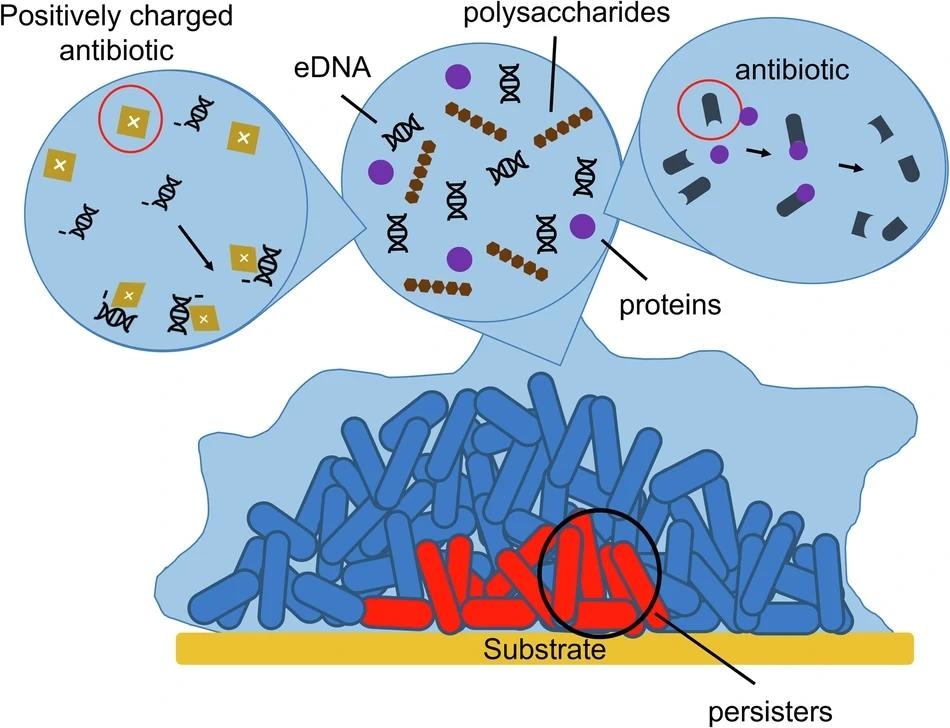 The extracellular matrix, composed of extracellular DNA (eDNA), polysaccharides, and proteins, can restrict antimicrobial penetration and interact with antibiotic molecules. Within the biofilm, persister cells exhibit increased tolerance to antibiotic treatment, contributing to the survival of microbial populations. Image credit: Liu et al. (2024).
Consequently, the clinical intractability of biofilms is now attributed to the distinction between genetic antimicrobial resistance and biofilm-associated tolerance. Typical antimicrobial resistance involves acquired genetic mechanisms (predominantly spontaneous mutations or horizontal gene transfer), where the pathogen may alter drug targets, enzymatically inactivate antimicrobial compounds, reduce drug uptake, or increase drug efflux. In contrast, biofilm-associated tolerance is a phenotypic adaptation characterized by several interacting mechanisms, including EPS-mediated restriction or sequestration of certain antimicrobials, nutrient and oxygen gradients, reduced growth rates, stress-response pathways, and heterogeneous microbial physiology.2,3,4
Furthermore, emerging evidence indicates that metabolic changes associated with nutrient limitation, stress responses, and reduced cellular activity can contribute to the survival of “persister cells”, small, transiently drug-tolerant subpopulations capable of surviving antimicrobial exposure without necessarily possessing heritable resistance.2
This traditionally unexpected relapse is one of the explanations for why modern AMR biofilms are now considered intrinsically linked to persistent infections, intractable colonizations of medical devices, and non-healing chronic wounds.4,5
How Can Cold Atmospheric Plasma Attack a Biofilm?
The remarkable resilience of biofilms has prompted researchers to investigate antimicrobial strategies that act beyond the conventional biochemical targets of antibiotics. Among these, CAP has emerged as a promising non-antibiotic approach, capable of exposing microbial communities to a complex mixture of chemically reactive species that can disrupt several of their protective mechanisms simultaneously.4
CAP is a partially ionized gas generated by applying an electric field to a carrier gas, typically helium, argon, or air. Unlike conventional thermal plasmas, its bulk gas temperature can remain sufficiently low for application to temperature-sensitive biological surfaces. Despite this relatively low temperature, CAP creates a highly reactive chemical environment containing reactive oxygen and nitrogen species (RONS), charged particles, and ultraviolet photons, which collectively contribute to its antimicrobial properties.5
The principal advantage of CAP lies in its ability to attack microbial structures through multiple oxidative and nitrosative pathways rather than relying on a single molecular target. When plasma-generated reactive species encounter a biofilm, they interact with components of its extracellular polymeric substance (EPS) matrix and can penetrate into the microbial community, where they damage cellular membranes, proteins, and nucleic acids. This multifaceted activity can compromise bacterial viability and increase susceptibility to conventional antimicrobial agents.1,3
These effects are not limited to direct plasma exposure. CAP can also be used to generate plasma-activated water (PAW), which retains biologically active chemical species after the plasma itself has been removed. Experimental investigations have demonstrated that PAW can induce intracellular oxidative stress, destabilize bacterial membranes, and enhance the activity of topical antiseptics against established biofilms. Although direct CAP and PAW share important chemical mechanisms, differences in reactive-species composition, delivery, and persistence mean that their antimicrobial effects are not necessarily equivalent.1,3
Beyond its direct antimicrobial activity, CAP is attracting attention for its potential application to infected or poorly healing tissues. Its localized delivery allows reactive species to be applied to accessible surfaces, such as chronic wound beds, while limiting thermal injury under appropriately controlled treatment conditions. Importantly, its biological effects may extend beyond microbial inactivation to include the regulation of inflammatory responses and the promotion of tissue repair. In a randomized clinical trial involving diabetic foot ulcers, CAP significantly accelerated wound-area reduction compared with placebo treatment, although reductions in microbial burden and clinical infection were not significantly different between groups. These findings suggest that CAP's therapeutic benefits cannot be explained solely by its antimicrobial activity.5,6
Nevertheless, the ability of plasma-generated reactive species to overcome biofilm defenses is not unlimited. The EPS matrix can interact with and consume reactive species before they reach microorganisms embedded in deeper layers, while variations in biofilm thickness, microbial composition, and metabolic activity can further influence treatment susceptibility. Consequently, CAP efficacy depends not only on the plasma source and exposure conditions but also on the structural and physiological characteristics of the targeted biofilm.3,7
This interplay between plasma chemistry and biofilm biology helps explain why CAP can produce substantial microbial killing in some experimental systems while leaving more tolerant populations viable in others. Understanding these limitations has increasingly shifted research toward approaches that weaken biofilm defenses or enhance microbial susceptibility before plasma exposure, potentially allowing CAP to achieve greater antimicrobial effects without relying solely on more intensive treatment.4,7
Download your PDF copy now!
When Plasma Alone Is Not Enough
Despite its broad antimicrobial activity, CAP is not universally effective against established biofilms. Certain microbial communities, particularly those formed by Staphylococcus aureus, can withstand plasma exposures that would otherwise be lethal to more susceptible microorganisms. This tolerance presents an important challenge, but has also encouraged researchers to reconsider how plasma-based treatments might be made more effective. Rather than simply increasing the intensity or duration of plasma exposure, an emerging strategy involves weakening the biological defenses of the biofilm before treatment begins.4
This concept, known as biofilm sensitization, was explored by Baz and colleagues (2026), who investigated whether a repurposed bioactive compound, KHS101, could make otherwise tolerant S. aureus biofilms more vulnerable to CAP. Using laboratory models designed to represent both single-species and polymicrobial wound-associated communities, the researchers examined whether exposing biofilms to the compound before plasma treatment could produce a greater antimicrobial effect than either intervention alone.4
The results illustrated the potential value of this approach. A five-minute exposure to KHS101 alone produced a relatively modest 0.5-log10 reduction in viable cells, with approximately 23.7% of the population remaining viable relative to untreated controls. However, when KHS101 pretreatment was followed by CAP exposure, the reduction increased dramatically to 3.8-log10, leaving just 0.08% of the original viable population under the investigated experimental conditions. The combination therefore achieved substantially greater microbial killing than the bioactive compound alone, demonstrating how an otherwise limited intervention could help overcome the biofilm's tolerance to plasma.4
Crucially, the significance of these findings extends beyond the magnitude of microbial killing. KHS101 exhibited only modest direct antibiofilm activity, yet appeared to make the surviving bacteria considerably more susceptible to subsequent plasma exposure. Microscopic observations revealed structural perturbations and signs of cellular stress following treatment, suggesting that the compound altered bacterial physiology in ways that could increase vulnerability to CAP. Although the precise molecular mechanisms remain unresolved, these observations support the broader principle that disrupting microbial defenses may be as important as increasing the direct antimicrobial potency of a treatment.4
The enhanced activity observed in polymicrobial laboratory models further suggests that sensitization could have applications beyond isolated bacterial populations. Nevertheless, these findings remain experimental, and the effects of KHS101 on wound-associated human cells, including keratinocytes and fibroblasts, require further investigation. Establishing whether such combinations can safely reproduce their laboratory efficacy in infected human tissues will therefore be essential before clinical application can be considered.4
More broadly, biofilm sensitization represents a potentially important shift in antimicrobial strategy: rather than attempting to overwhelm the biofilm's protective mechanisms through increasingly aggressive treatment, researchers may be able to exploit temporary vulnerabilities that make established microbial communities more susceptible to otherwise insufficient interventions. In the context of CAP, this raises an important question about which aspects of plasma chemistry are responsible for the enhanced killing observed when bacterial defenses have already been compromised.4
Why the Chemistry of Plasma Matters
The ability to sensitize biofilms to CAP raises an important question: what makes plasma exposure more effective than conventional oxidizing agents? Although much of CAP's antimicrobial activity is attributed to reactive oxygen and nitrogen species (RONS), its effects cannot be explained by the action of any single chemical compound. Instead, CAP produces a complex mixture of reactive species whose interactions with microbial cells and their surrounding environment appear central to its antimicrobial potential.3,4
Evidence for this chemical complexity emerged from the investigations of Baz and colleagues (2026), who examined whether hydrogen peroxide (H2O2), a prominent plasma-generated oxidant, could reproduce the enhanced antimicrobial effects observed when KHS101 was combined with CAP. Surprisingly, replacing plasma exposure with an equivalent concentration of laboratory-grade H2O2 failed to achieve comparable bacterial killing. This suggests that the effectiveness of plasma-based sensitization depends on more than hydrogen peroxide alone, potentially involving additional reactive species or interactions unique to the plasma environment.4
Understanding these interactions requires distinguishing between the different chemical species generated during plasma exposure. Some, including hydrogen peroxide, nitrite, and nitrate, are relatively long-lived and can persist in plasma-treated liquids after the discharge has ended. Others, such as hydroxyl radicals and certain reactive nitrogen intermediates, are considerably less stable but highly reactive, allowing them to contribute to localized oxidative and nitrosative damage. The relative abundance and biological activity of these species vary with plasma operating conditions, the surrounding chemical environment, and the composition of the biofilm itself.3
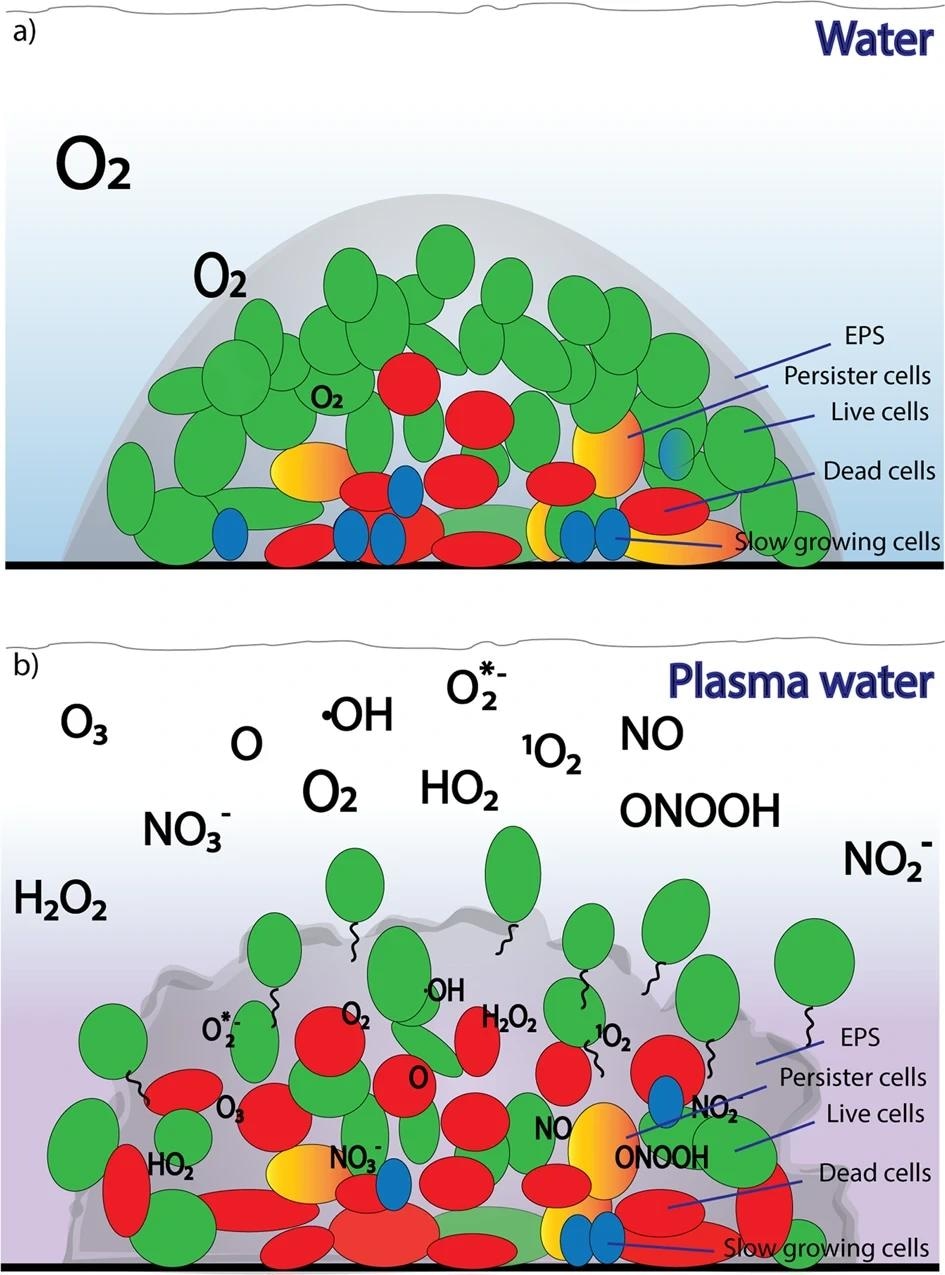 Schematic comparison of a biofilm in untreated water (a) and plasma-activated water (b). Plasma-generated reactive oxygen and nitrogen species interact with the extracellular polymeric substance (EPS) matrix and microbial cells, illustrating how oxidative and nitrosative chemistry can disrupt biofilm structure and contribute to bacterial inactivation. The diagram also highlights the heterogeneous distribution of viable, damaged, and slow-growing bacterial populations within the biofilm. Image credit: Mai-Prochnow et al. (2021).
This chemical diversity creates both an advantage and a challenge. By exposing microorganisms to multiple forms of oxidative stress, CAP can damage cellular structures and interfere with processes that support bacterial survival. However, the same reactive species must first navigate the extracellular matrix, where they may be consumed or transformed before reaching cells embedded deeper within the biofilm. Consequently, antimicrobial efficacy depends not simply on how much reactive chemistry is generated, but on which species remain active long enough to reach vulnerable microbial targets.3
The importance of these interactions extends beyond direct bacterial killing. In a study of Pseudomonas aeruginosa biofilms, Maybin and colleagues (2023) demonstrated that sublethal CAP pretreatment could substantially increase susceptibility to conventional antibiotics, reducing measured antimicrobial susceptibility thresholds by as much as 512-fold for ciprofloxacin or gentamicin and 256-fold for tobramycin under the investigated experimental conditions. These findings suggest that plasma-induced cellular damage can leave surviving bacteria more vulnerable to subsequent pharmacological intervention, even when plasma exposure alone is insufficient to eradicate the biofilm.7
Yet this enhanced susceptibility is accompanied by a more complex biological response. Transcriptomic investigations revealed that plasma exposure also activated bacterial defenses against oxidative stress, including pathways associated with reactive-species detoxification. Increased production of the signaling molecule ppGpp further indicated the activation of a stringent stress response, potentially associated with antimicrobial tolerance and persistence. Although persister-cell formation was not directly demonstrated, these observations highlight how the same plasma exposure that compromises bacterial defenses may simultaneously trigger mechanisms that help surviving microorganisms withstand environmental stress.7
Together, these findings suggest that the future effectiveness of plasma-based antibiofilm therapies will depend on understanding the balance between microbial damage and adaptive survival. Identifying which reactive species penetrate biofilms, how they interact with bacterial stress-response pathways, and how these effects can be coordinated with conventional antimicrobials will be essential for developing more predictable and reproducible treatments.1,3,7
From Laboratory Biofilms to Future Treatments
Before these emerging CAP-based antibiofilm approaches achieve clinical integration, the field must navigate several translational challenges, starting with the standardization of plasma dosing.1,4,8
To address this requirement, frameworks such as the DIN SPEC 91315 guidelines are being established and are now considered crucial for evaluating the safety and performance of medical CAP sources, including their electrical characteristics, gas emissions, and biological effects. Furthermore, laboratory successes (which are currently predominantly observed in single microbial cohorts) must be reproduced across polymicrobial communities, as chronic wounds are known to harbor intricate networks of inter-kingdom species that can influence antimicrobial susceptibility and treatment outcomes.8,9
Although clinical investigations have demonstrated promising improvements in wound healing following CAP treatment, its ability to reliably eradicate established biofilm infections in patients remains less certain. Ultimately, translating biofilm sensitization into clinical practice will require further investigation of treatment safety, optimal plasma exposure conditions, and the effectiveness of combined therapies against mature, polymicrobial biofilms.1,4-7
References and Further Reading
- Vyas, H. K. N., et al. (2023). Plasma activated water as a pre-treatment strategy in the context of biofilm-infected chronic wounds. Biofilm, 6, 100154. DOI: 10.1016/j.bioflm.2023.100154, https://www.sciencedirect.com/science/article/pii/S2590207523000515
- Liu, H. Y., Prentice, E. L., & Webber, M. A. (2024). Mechanisms of antimicrobial resistance in biofilms. npj Antimicrobials and Resistance, 2, 27. DOI: 10.1038/s44259-024-00046-3, https://www.nature.com/articles/s44259-024-00046-3
- Mai-Prochnow, A., et al. (2021). Interactions of plasma-activated water with biofilms: inactivation, dispersal effects and mechanisms of action. npj Biofilms and Microbiomes, 7, 11. DOI: 10.1038/s41522-020-00180-6, https://www.nature.com/articles/s41522-020-00180-6
- Baz, A., et al. (2026). Biofilm sensitization to break Staphylococcus aureus tolerance to cold atmospheric plasma therapy. Journal of Medical Microbiology, 75, 002193. DOI: 10.1099/jmm.0.002193, https://www.microbiologyresearch.org/content/journal/jmm/10.1099/jmm.0.002193
- Raissi-Dehkordi, N., et al. (2025). Advancing chronic and acute wound healing with cold atmospheric plasma: cellular and molecular mechanisms, benefits, risks, and future directions. Frontiers in Medicine, 12. DOI: 10.3389/fmed.2025.1527736, https://www.frontiersin.org/journals/medicine/articles/10.3389/fmed.2025.1527736/full
- Stratmann, B., et al. (2020). Effect of Cold Atmospheric Plasma Therapy vs Standard Therapy Placebo on Wound Healing in Patients With Diabetic Foot Ulcers. JAMA Network Open, 3(7), e2010411. DOI: 10.1001/jamanetworkopen.2020.10411, https://jamanetwork.com/journals/jamanetworkopen/fullarticle/2768245
- Maybin, J.-A., et al. (2023). Cold atmospheric pressure plasma-antibiotic synergy in Pseudomonas aeruginosa biofilms is mediated via oxidative stress response. Biofilm, 5, 100122. DOI: 10.1016/j.bioflm.2023.100122, https://www.sciencedirect.com/science/article/pii/S2590207523000199
- DIN SPEC 91315:2025-07, Allgemeine Anforderungen an Plasmaquellen für die Erzeugung eines kalten Atmosphärendruckplasmas (CAP) für medizinische Anwendungen; Text Deutsch und Englisch. (2025). DIN Media GmbH. DOI: 10.31030/3622776, https://www.dinmedia.de/en/technical-rule/din-spec-91315/392129615. Accessed 24th October 2026
- Silva, D. M. da, et al. (2024). Cold Atmospheric Helium Plasma in the Post-COVID-19 Era: A Promising Tool for the Disinfection of Silicone Endotracheal Prostheses. Microorganisms, 12(1), 130. DOI: 10.3390/microorganisms12010130, https://www.mdpi.com/2076-2607/12/1/130
Last Updated: Oct 27, 2026