New research from Professor Anna Slater and colleagues at the University of Liverpool demonstrates how continuous flow chemistry, combined with inline UV-Vis spectroscopy, can transform both the understanding and execution of porphyrin synthesis leading to improved yields in both quality and quantity.
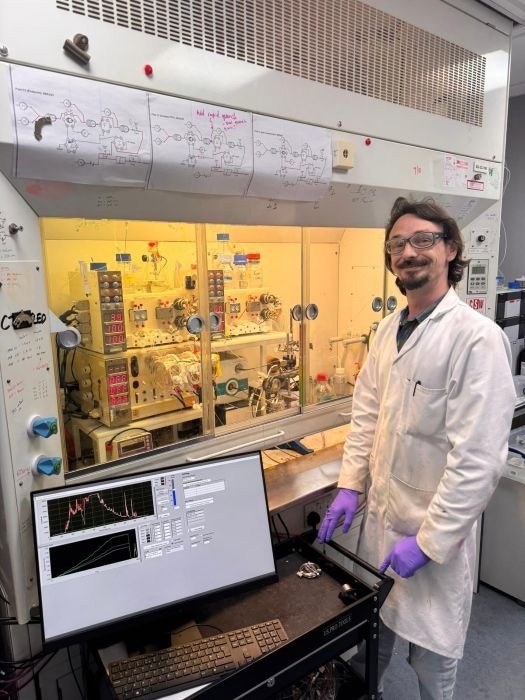 Harvey West of the Slater Group highlighting the benefits of Asynt’s FlowUV. Image Credit: Asynt
Porphyrins are among the most versatile and widely studied macrocyclic compounds in modern chemistry, playing critical roles in catalysis, photodynamic therapy, materials science and solar energy conversion. Yet, their synthesis remains inherently complex, requiring precise control over multi-step reaction pathways to achieve optimal yield, selectivity and reproducibility.
In this recently published study, the team successfully translated the classic Lindsey porphyrin synthesis into a continuous flow process. The reaction - comprising condensation of pyrrole with aldehydes followed by oxidation and neutralization - was divided into discrete, controlled stages. This modular flow approach enabled highly consistent reaction environments, significantly improving process control and offering deeper mechanistic insight into each step of the synthesis.
A key innovation in the work was the integration of inline UV-Vis spectroscopy to monitor the reaction in real-time. Porphyrins exhibit strong, characteristic absorption bands across the UV and visible spectrum, making them ideally suited to this analytical technique. By observing spectral changes directly within the flowing reaction stream, the researchers were able to track the formation of intermediates and products without interrupting the process for offline analysis.
This capability proved particularly valuable during the synthesis of tetraphenylporphyrin (TPP), where inline monitoring revealed the formation of protonated porphyrin species due to residual acidity. Identifying this behavior in situ enabled immediate optimization of the neutralization step, ultimately improving reaction efficiency and maximizing isolated yields.
The methodology was further extended to a range of functionalized porphyrins, including thio-, ether- and silyl-alkyne-substituted derivatives. Notably, inline UV-Vis data highlighted discrepancies between spectroscopic and isolated yields, providing clear evidence of material losses during downstream purification. These insights underline the growing importance of real-time analytical techniques in understanding and refining complex synthetic pathways.
Supporting this work, Asynt’s compact FlowUV inline full-spectrum UV-Vis spectrophotometer enabled continuous, non-invasive monitoring of reaction progress. Designed specifically for flow chemistry applications, FlowUV allows chemists to observe spectral changes as they occur, providing immediate feedback that can be used to optimize reaction conditions, improve reproducibility and accelerate method development.
Continuous flow chemistry already offers significant advantages for demanding transformations, including enhanced heat and mass transfer, precise control over residence time and improved safety when handling reactive intermediates. When combined with inline analytical tools such as FlowUV, these benefits are amplified, giving chemists unprecedented visibility into reaction behavior.
The integration of continuous flow processing with real-time analytical monitoring is becoming increasingly valuable, enabling more efficient and reproducible synthetic workflows, Being able to observe reaction progress directly within the flow stream allows researchers to better understand complex chemistry and optimize their processes with far greater confidence – as demonstrated clearly by the results achieved in this work on porphyrin synthesis.”
Andrew Mansfield, Flow Chemistry Specialist, Asynt
This work highlights a powerful shift in how complex molecules such as porphyrins can be synthesized and studied. By combining continuous processing with real-time analysis, chemists can not only improve outcomes but also gain deeper insight into reaction mechanisms - opening new opportunities across catalysis, advanced materials and photochemical research.
 Advanced Catalysts for Biomass Transformation