Young adult e-cigarette users with obesity worked harder to breathe during exercise and showed subtle changes in lung mechanics, suggesting that exercise testing may reveal respiratory effects that routine lung function tests can miss.
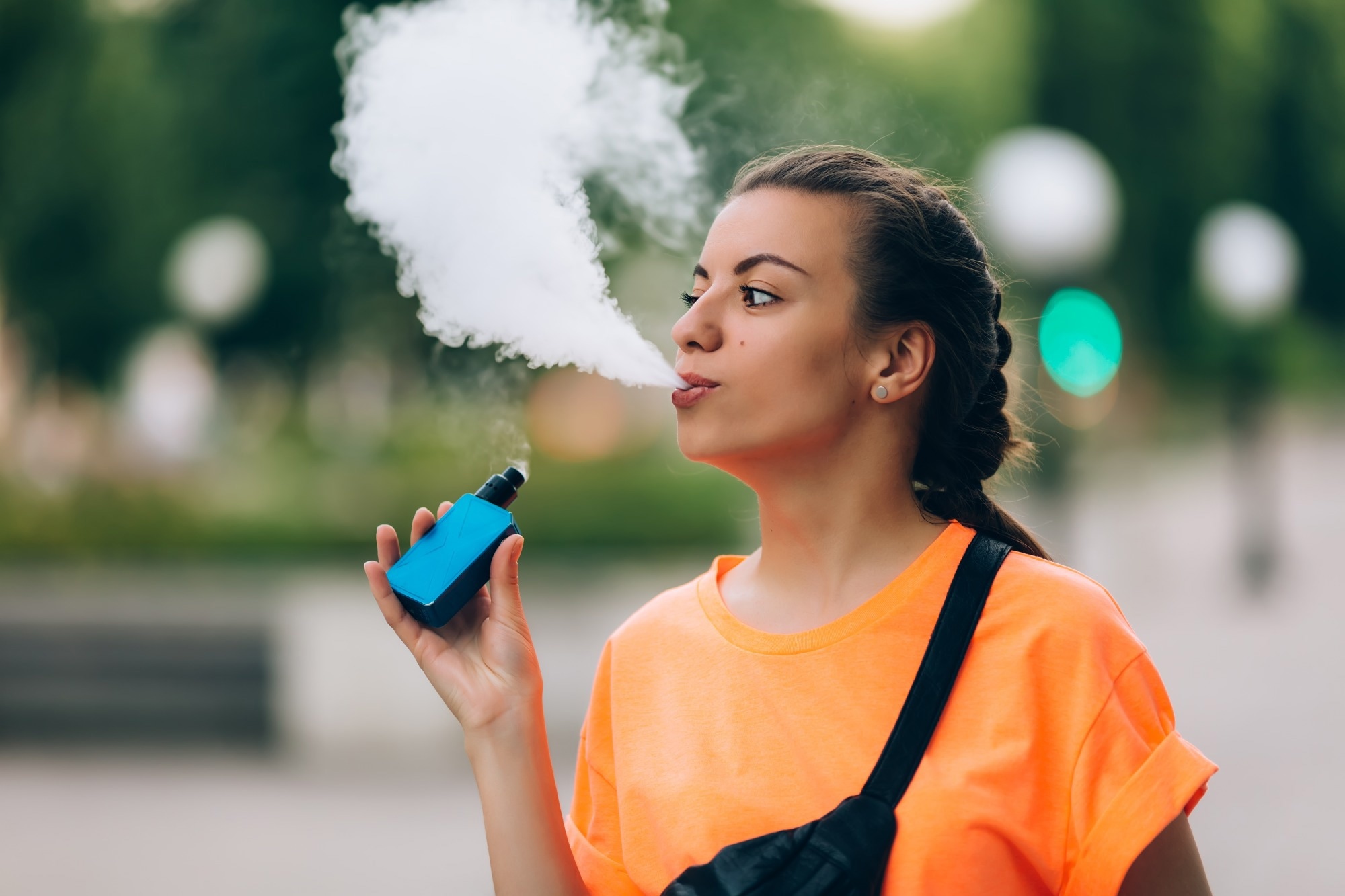 Study: Respiratory symptoms and exercise responses among adult E-cigarette users with and without obesity. Image credit: Aliaksandr Barouski/Shutterstock.com
A recent Physiological Reports study investigated whether obesity exacerbates lung function impairment, ventilatory constraints, and respiratory symptoms during exercise among young adult e-cigarette users.
Obesity and vaping may compound breathing challenges
E-cigarette use has increased significantly among young adults, reaching a prevalence of 15.5% and establishing it as the most commonly used tobacco product in this age group. Obesity, affecting more than one-third of adults aged 20 to 39, is associated with an elevated likelihood of e-cigarette use and imposes considerable mechanical and metabolic burdens on the respiratory system. Together, these factors contribute to ventilatory constraints, such as expiratory flow limitation and dynamic hyperinflation, which may intensify exertional breathlessness among young adults with obesity who use e-cigarettes.
Exertional breathlessness may further restrict physical activity, diminish cardiorespiratory fitness, and contribute to adverse metabolic outcomes. However, the precise impact of obesity on pulmonary function, ventilatory constraints, and exercise-related respiratory symptoms in young adult e-cigarette users remains poorly characterized.
While regular exercise is essential for weight management, exertional breathlessness may act as a barrier to physical activity in this population. Understanding the mechanisms underlying exertional breathlessness, particularly changes in lung function and ventilatory constraints, requires evaluating respiratory responses during exercise.
Resting pulmonary function tests are inadequate for evaluating ventilatory mechanics or symptom progression during exercise; submaximal exercise testing provides a more robust approach. Importantly, this methodology has not been applied to young adults with both obesity and e-cigarette use. Consequently, the combined impact of these factors on exercise-induced respiratory outcomes is unknown, highlighting a critical research gap.
Researchers compare exercise responses in two vaping groups
The study was conducted as part of a broader investigation into the respiratory effects of e-cigarette use in young adults with and without obesity. Researchers recruited adults aged 21 to 35 years who had used e-cigarettes daily for at least three months and had no diagnosed cardiopulmonary or metabolic diseases. Individuals who used other tobacco products, frequently used cannabis, were competitive athletes, or were actively trying to quit vaping were excluded.
Participants were divided into two groups based on body mass index (BMI): non-obese (18.5–24.9 kg/m²) and obese (30–50 kg/m²), with those classified as overweight excluded to enable clearer comparison between groups.
Each participant completed a questionnaire detailing their e-cigarette use, followed by height and weight measurements and comprehensive pulmonary function testing, including spirometry and lung volume assessments, performed according to American Thoracic Society (ATS) guidelines.
Approximately 15 minutes later, participants completed a submaximal cycle ergometer exercise test designed to evaluate cardiorespiratory responses and breathlessness during progressively increasing workloads. Because physiological responses differ between sexes, males and females exercised at different work rates. Throughout the test, researchers continuously monitored minute ventilation, gas exchange, breathing patterns, and heart rate.
Participants also rated their breathlessness and overall exertion using Borg scales during exercise. After the test, they completed a multidimensional dyspnea questionnaire assessing the unpleasantness and emotional aspects of breathlessness. Inspiratory capacity was measured both at rest and during exercise, enabling researchers to calculate lung volumes and determine whether participants experienced expiratory flow limitation or dynamic hyperinflation.
Breathing becomes more demanding during exercise with obesity
A total of 56 volunteers consented to participate, of whom 47 met the eligibility criteria and were included in the analysis. Participants represented 17 different e-cigarette brands, most commonly using fruity flavors (66%), followed by menthol (21%) and fruit-ice/fruit-mint (11%), while only one participant preferred a tobacco flavor. Most participants (90%) used 5% nicotine-strength products and reported taking an average of 134 puffs per day.
Individuals with obesity generally reported more daily puffs than those without obesity, and males with obesity were older and had begun regular e-cigarette use about five years later than their non-obese counterparts.
Despite differences in vaping habits, lung function was largely preserved across both groups. All participants had normal lung capacity and gas diffusion, and only one non-obese male had a reduced forced expiratory volume in one second (FEV1). However, around one-third of participants (34%) had lower-than-predicted mid-expiratory flow rates, suggesting possible early small airway dysfunction, although these findings did not differ significantly between the obesity groups.
Males had larger lung volumes and higher maximum voluntary ventilation (MVV) than females, while participants with obesity had higher predicted MVV and inspiratory capacity but lower functional residual capacity than those without obesity.
To account for sex-specific exercise workloads, exercise responses were analyzed separately for males and females. During exercise, participants with obesity showed a 13% higher metabolic cost and a 15% greater ventilatory demand than those without obesity. This greater demand was met by taking larger breaths rather than breathing more frequently. Females, meanwhile, exhibited higher heart rate responses, greater ventilatory equivalents for carbon dioxide, and lower end-tidal carbon dioxide than males.
These physiological differences were accompanied by lower operating lung volumes during exercise among participants with obesity. They also showed a greater tendency toward expiratory flow limitation and dynamic hyperinflation, particularly at higher exercise intensities, although these differences did not reach statistical significance. No meaningful sex differences were observed for these ventilatory constraints.
Breathlessness became increasingly common as exercise intensity increased. At the highest workload, 74% of participants with obesity and 64% of those without obesity reported at least moderate breathlessness. Within the obesity group, participants were twice as likely to report moderate breathlessness as to rate their overall exertion as high, suggesting that breathing discomfort exceeded their perception of whole-body effort.
However, overall breathlessness ratings did not differ significantly between the obesity groups. Females with obesity reported greater frustration associated with breathlessness than males with obesity, while females overall more frequently described the sensation that their "breath does not go out all the way." No other significant differences in breathlessness-related emotions or descriptors were observed.
Exercise reveals early respiratory differences in obesity
Obese e-cigarette users exhibit higher usage and potentially experience greater ventilatory constraints during exercise, although these differences were not statistically significant. Breathlessness during exercise was common across both obesity groups and appeared disproportionate to perceived whole-body exertion, particularly among individuals with obesity.
Larger studies with non-user control groups are needed to clarify physiological mechanisms underlying these symptoms and to determine whether early pulmonary abnormalities contribute to long-term declines in physical activity and cardiorespiratory fitness.
Download your PDF copy by clicking here.
 Voluntary exercise reduces stress-linked bladder pain and urinary frequency