News-Medical talked with Gary Stimson, Head of AI Technologies at LabVantage, at Pittcon 2026 about agentic AI and laboratory workflows. He explains LabVantage CORTEX, a platform that connects lab data across systems and supports analysis, not just storage. He also describes a step-by-step path to AI support in the lab, from UI prompts that reduce errors to autonomous agents that take on routine data tasks.
What’s your role at LabVantage, and what’s your path been to get there?
I’ve been with LabVantage for nearly 25 years. I went straight out of university to LabVantage, and they’ve been brilliant at coaching me.
Currently, I’m Head of AI Technology for LabVantage. I’ve also been a developer, worked on customer sites, and been a product manager. The company has really coached me through that career and into this role.
 Image Credit: Golden Sikorka/Shutterstock.com
Where did your interest in science and technology start, and when did you know you wanted to go into industry?
So, my father is a chemist. He worked for Associated Octel. He was increasing the octane number of gasoline - I think you call it gasoline over here.
I remember, at fifteen, I was looking for work experience, and my father said, “Oh, come in the lab. Come and see how it works.” I fell in love with it. I just thought the excitement of working with the machines they had back then, and the sight of the scientists all having fun and enjoying their work. I thought, “Right, this is what I want to do. I want to be a chemist.”
As a result, I went to university and studied chemistry. While I was there, I did a year out in Chicago with another university, and I had a crossover with computer science. One of my close friends there was a computer scientist, and I realized, “Oh wow, I love computer science too.” That’s why I did a second master’s degree in computer science.
That’s also why LabVantage is ideal, because it combines both of those together.
Who’s been a key mentor for you along the way?
Mark Hill, a colleague of mine, who is sadly retiring at the end of this month. I’ve worked with him for about 20 years now, and he’s been a fantastic mentor.
He’s been great at empowering me to just go off and research and look at new technology. That’s why we’ve made this leap forward, and it’s what the product we’re going to announce at Pittcon is going to pick up on.
It’s helped us leap forward, find these new technologies, and use them and apply them in a really good way.
This interview was conducted at Pittcon 2026 in San Antonio. What did you come to announce, and what is LabVantage CORTEX?
We were here to release our new platform and product. We feel it’s the right time for agentic AI, so we’ve created LabVantage CORTEX, which is a platform for this new technology.
For labs using LabVantage today, what changes with LabVantage CORTEX, and what does the announcement mean for customers?
I like to think of LabVantage CORTEX as an operating system for the laboratory now. Traditionally, we’re a LIMS company, and we’re still going to be a LIMS company, but now we have this. Not only do we store your data, but we can also analyze and process your data and work with you to power your laboratory.
LabVantage CORTEX and the agentic platform we’ve added inside that will allow you to power your lab. For customers, it will make day-to-day life easier, save time, and improve job efficiency.
What were customers asking for, and why does this feel like the right moment for agentic AI in the lab?
We often meet with our customers. We hold several conferences a year, including user conferences and stakeholder meetings. I’ve visited a few customers recently, and they’re all researching internally.
They actually came to us and said, “We want to move into a key area, and we want to have AI more in our laboratories.” So we thought this is a great time to create a centralized platform rather than having these bespoke applications everywhere.
I think a big thing is trust. We now use AI in our day-to-day lives. I don’t know what I’d do without it at the moment for summarizing meetings. It makes me more efficient, and I think that’s quite important.
We’ve actually used it in-house. We’ve implemented this technology for the last 12 months. Every employee at LabVantage uses it. We’ve seen applications like summarizing emails, summarizing meeting notes, and giving us agendas, and it’s made us able to focus on the job at hand rather than the mundane tasks.
Even though driverless cars have been here for nearly a decade, it’s only now that we’re starting to see them really adopted in cities. I think it’s the same thing here: it comes dowrn to trust in the technology.
That’s where I think it will translate into the lab: you’ll be able to focus on the science, and not focus on the mundane tasks of analyzing data.
When you think about AI working alongside scientists, what’s the progression you expect to see first?
Initially, the first agents that we’re releasing into our product will help scientists use the user interface more efficiently. A prime example is when you’re entering data on a page and filling in fields: it will prompt you if you make a mistake.
Say, for instance, the due date must be within seven days of a request. If they go outside of that seven-day period, it won’t stop them from doing their work. It’ll just prompt them to say, “Are you sure you want that date?” I think that makes it more efficient and less error-prone.
Where that will go is more autonomy, where the platform allows us to create fully autonomous agents that can be working on your data, like a digital version of yourself doing the mundane tasks of processing the data and looking at trends, so you can focus on the research science and actually getting the 'eureka' moments yourself.
Many labs are still dealing with data silos. What does a LabVantage CORTEX-ready environment look like, and do organizations need anything in place before they can use it?
We’re working with a hospital right now that has many laboratories scattered around, with different data in different systems, and they’ve got these silos. The problem is that if a patient comes in and asks, “Does Joe Bloggs have blood poisoning?”, the blood is, of course, all sitting in separate systems.
What we’re doing is using our BioTech360 plugin. It allows these agents to be prompted with “Does Joe Bloggs have blood poisoning?” and, using the semantic layer, it can pull all that data in. Those silos are gone.
With LabVantage CORTEX, it will link to all these external data sources, external systems like SAP, and Empower (Waters) products. We’re able to combine all that data and, from one simple chatbot interface, ask questions on it.
Institutions like these hospitals do not need any foundations in place before they can use LabVantage CORTEX. That’s the great thing with this platform. You have it, and it will basically be the operating system of your laboratory and your company.
If we look five to 10 years out, how do you expect LIMS systems to evolve for the scientists using them?
I’m a big science fiction fan, and if it were up to me, it would be robots in your lab alongside you, working with you as an assistant.
I think it’s going to be baby steps. At first, people will adopt this technology to make them more efficient at their jobs, but I believe over the next five to 10 years, we’ll have more autonomy in laboratories.
You’ll be able to focus on the work, and you’ll have a digital version of yourself to help process the mundane tasks and make you more efficient.
How agentic AI is reshaping laboratory workflows with LabVantage at Pittcon 2026
About Gary Stimson
Gary Stimson is Head of AI Technologies at LabVantage Solutions, Inc. He leads the company’s enterprise AI/ML strategy, architecture,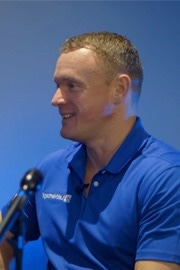 and roadmap, with responsibility for reference architectures spanning LLMs, predictive models, computer vision, and NLP. He also oversees MLOps implementation, data platform architecture, and governance, with an emphasis on security, privacy, and responsible AI.
Stimson has held a series of technical leadership roles at LabVantage since 2003, including Senior Architect Scrum Master, Senior Architect, and Senior Software Engineer. He holds a Master’s degree in Information Technology from the University of Nottingham and a Bachelor’s degree in Chemistry from the University of Leicester.
About Pittcon
Pittcon is North America’s largest conference and exposition in laboratory science, attracting thousands of industry, academia, and government attendees and exhibitors from around the world in. Pittcon goes beyond the typical conference; it's a global community dedicated to advancing science through education, collaboration, and philanthropy. By bringing together scientists, researchers, educators, students, and industry leaders, Pittcon creates opportunities to learn, connect, and inspire innovation. Beyond the event itself, more than 90% of Pittcon's net proceeds support science education and outreach initiatives locally and globally, funding scholarships, grants, STEM programs, laboratory improvements, and other efforts that strengthen communities and expand access to science.
Pittcon delivers world-class educational and professional development opportunities through its Technical Program, Short Courses, and Networking Workshops and Roundtables. Attendees can explore the latest scientific research through symposia, oral and poster presentations, enhance their skills with expert-led deep-dive courses, and connect with peers through interactive workshops and networking experiences designed to foster collaboration and career growth.
The Pittcon Expo brings the scientific community together in an immersive environment where attendees can discover the latest laboratory technologies, meet with leading instrument and service providers, and experience science in action. Beyond the exhibit booths, the Expo Floor features engaging attractions, educational experiences, demonstrations, and networking spaces, while receptions, parties, and social events create opportunities to build lasting connections with colleagues from around the world.
 Addressing Important Cardiac Biology Questions with Shotgun Top-Down Proteomics