Modern bioprocess development strategies are calling for increased automation and high-throughput experimentation, in turn placing a greater demand on the technology. To match the ongoing progress being made in genetic engineering, a diverse range of microbial hosts have been developed as the foundations for creating a great number of natural products.
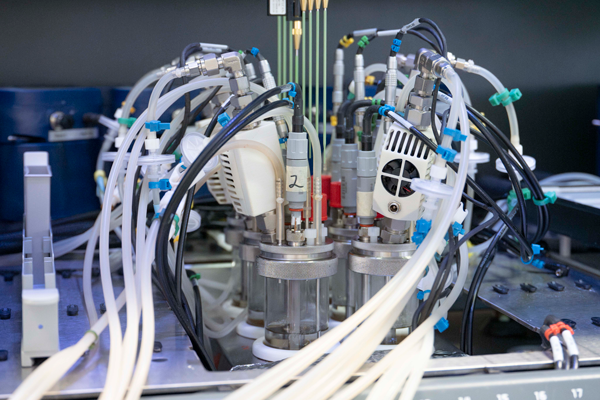
Image Credit: H.E.L Group
However, developments can be time-intensive, taking several days to complete, as these microbial hosts are pushed to their metabolic limits in batch, fed-batch, or continuous fermentations (chemostats, turbidostats, perfusion, or auxostats). Production strategies respond by limiting human interference through automation, maximizing rates, and minimizing working time as a result.
These demands are well documented at the Chair of Bioprocess Engineering at Technical University of Berlin (TU Berlin), and resulted in the development of a completely automated platform for microbial bioprocesses in the KIWI-biolab, in which H.E.L’s BioXplorer 100 serves as the operational core.
Integration of the BioXplorer 100 into a fully automated lab environment
The KIWI-biolab research focuses on establishing the model-based automation of bioprocesses and analytics: intelligently linking hardware with automation plays a central role in achieving this goal.
The pursuit of these aims led the KIWI-biolab to construct its BioXplorer Facility, an automated platform where H.E.L’s BioXplorer 100 serves as the central component. This system is capable of running continuous fermentations for up to seven days.
This platform considerably reduces manual intervention, enhances reproducibility, and delivers high-resolution data across a diverse range of experimental conditions, while cultivating diverse microbial strains, predominantly Pichia pastoris and Escherichia coli (E. coli).
The BioXplorer Facility’s abilities have been used across a wide range of projects, including cultivations for targeting vaccine antigens and antibody production, as well as enzyme synthesis, such as glucose oxidase.
To meet these objectives, the fed-batch fermentation strategies used at the KIWI-biolab demand stringent controls of liquid additions. This is where the BioXplorer 100’s liquid-feed module has been instrumental, as continuous and pulse-based feeding plans supply an assortment of solutions (acid and base for pH control, glucose or glycerol-based media, methanol, etc.) during fermentations, which can last for up to 50 hours.
Similarly, many of these bioprocesses include steps in which the temperature fluctuates, typically between 20 and 37 °C. Achieving control of cultivation conditions at temperatures lower than room temperature is easy, thanks to the BioXplorer 100’s compatibility with Huber Minichiller. Moreover, the parallel reactor platform incorporates off-gas analysis via BlueSens sensors.
The KIWI-biolab has also integrated the BioXplorer 100 into a robotic laboratory environment that supports dynamic fermentation and analytical workflows. To facilitate automated liquid sampling, a Tecan Freedom Evo 150 liquid-handling station was used. This allowed for the addition of supplementary pulses, among other solutions, such as IPTG to introduce plasmids and induce gene expression in engineered strains, or magnesium supplements to the cultures.
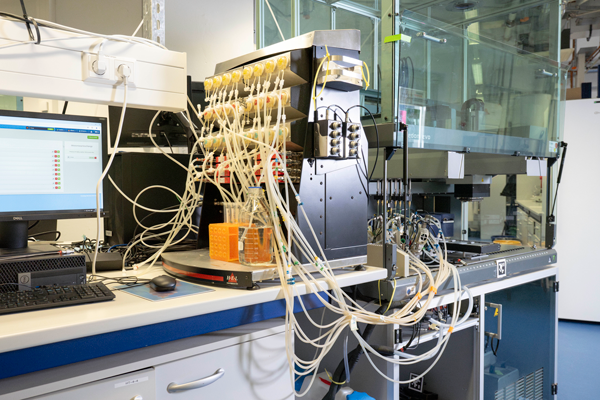
Image Credit: H.E.L Group
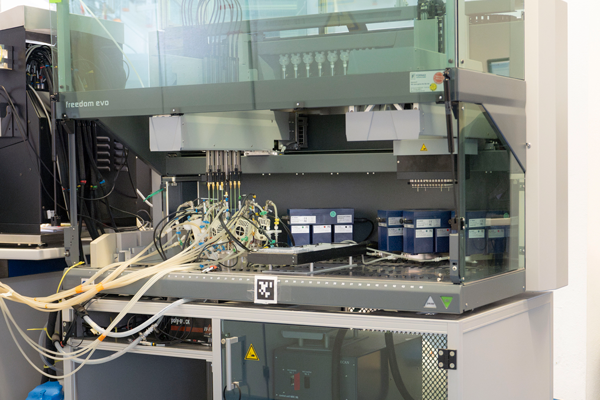
Image Credit: H.E.L Group
Integration with advanced and high-throughput analytical technologies
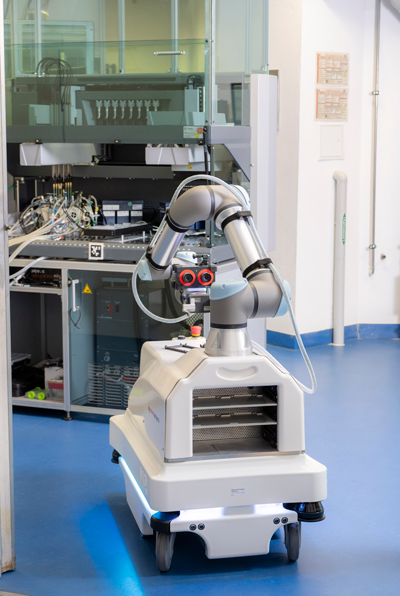
Image Credit: H.E.L Group
Reliable analytical data is just as important as fermentation automation in achieving high-quality bioprocesses. At KIWI-biolab, the mobile robotic lab assistant, MiLA, supports sample transfers to high-throughput analytic platforms. The liquid samples collected during the cultivation phase, using the Tecan Freedom Evo 150 liquid-handling station, are analyzed using sophisticated analytical techniques.
For instance, the Cedex Bio HT measures process-relevant parameters such as glucose, glycerol, acetate, magnesium, and ammonia, while the two-dimensional HPLC QTOF determines concentrations of other substrates and metabolites in the culture medium.
KIWI-biolab researchers are better equipped thanks to this automated infrastructure and tightly integrated workflow, which can produce high-resolution data. This allows for a better understanding of strain metabolism and related bioprocesses, supporting systematic process optimization centered on data interpretation rather than conventional manual sampling and offline measurements.
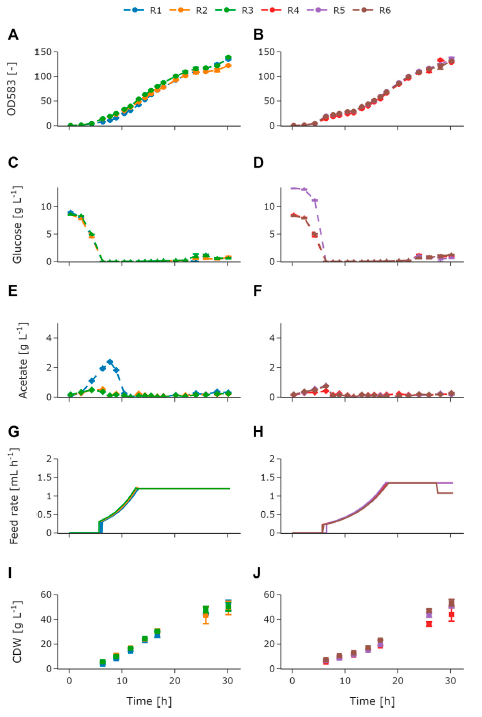
Image Credit: H.E.L Group
Adaptive platform development through technical support and customization
The H.E.L Group’s experience with automated systems was a key driver for the KIWI-biolab during platform development. The BioXplorer 100 was easily integrated into the existing laboratory infrastructure, while seamlessly delivering a complete solution.
By integrating H.E.L’s high-throughput automated fermentation system, with its automated liquid-handling station and high-throughput analytics equipment, members of the KIWI-biolab team have considerably extended the platform’s functionality. This, in turn, has boosted screening efficiency across a diverse range of experimental conditions for microbial bioprocesses.
The support the H.E.L Group technical team provides during and after commissioning, along with bespoke software development and customized function extensions, enables the platform to adapt to the challenges posed by evolving research methodologies. The system can therefore evolve alongside the lab’s research goals.
As bioprocess research continues its transition toward automation and data-driven decision making, the KIWI-biolab’s case study demonstrates how a well-managed, blended experimental platform can advance and accelerate microbial process development and facilitate scalable, efficient research operations.
About H.E.L Group
H.E.L develops and manufactures innovative scientific instruments and software designed to optimize the efficiency, safety, and productivity of key processes in chemistry and biology applications.
The H.E.L team of 70 includes highly skilled process and software engineers, based at their extensive research and manufacturing facilities in the UK, as well as sales and support offices around the world.
H.E.L has a long history of solving complex challenges for customers. Since 1987, the Company has worked with businesses and laboratories globally, providing proprietary automated solutions for the pharma, biotechnology, chemical, battery, and petrochemical sectors.
We continue to expand the reach of our products and services to further support and enable R&D and process optimization across Europe, the US, China, and India.
H.E.L is accredited with ISO 9001: 2015
Our mission
To help create a healthier, sustainable, safer world for everyone.
Our vision
We equip scientists with the right tools and knowledge to develop safe, efficient new processes and molecules that benefit the world and its population.
Our values
Insightful through experience. With over 30 years of in-house expertise and experience, we know how to overcome a challenge
Collaborative by design. Dedicated to listening, learning, and working closely with industry experts, we empower others to fulfill potential
Tenacious in spirit. Always looking for new and innovative solutions, we don’t stand still; instead, we are focused on reaching the next success
Proud of progress. Fueled by our ability to make a real difference, while celebrating the achievements of others
Sponsored Content Policy: News-Medical.net publishes articles and related content that may be derived from sources where we have existing commercial relationships, provided such content adds value to the core editorial ethos of News-Medical.net, which is to educate and inform site visitors interested in medical research, science, medical devices, and treatments.