A novel approach for the formulation of human skin equivalents (hSKE) has been developed, combining droplet-based 3D bioprinting and nebulization technology.1
This technique differs from traditional manual or extrusion-based methods as it facilitates high reproducibility, uniformity, and enhanced cell viability in skin constructs.
Methodology
- Dermis was created by printing collagen bioink with human dermal fibroblasts. These were stabilized by using nebulized sodium bicarbonate as a crosslinking agent.
- Epidermis formation was achieved by printing keratinocyte bioink, followed by the development of an air-liquid interface culture to induce stratification.
- Constructs were compared with native mouse and human skin in order to confirm morphological similarity.
- A skin grafting model was used to evaluate efficacy.
Outcome
1.Bioprinted hSKE mimics native skin
hSKE fabricated via droplet-based bioprinting and nebulization techniques has the potential to effectively replicate native skin’s dermal and epidermal architecture, including keratinocytes’ keratinization process within the epidermis.
2. Cell viability
Droplet-based printing at low pressure has been shown to preserve fibroblasts and keratinocytes, offering survival rates of >84 %.
3. Therapeutic efficacy
The use of hSKE transplantation in wound healing models has been shown to:
- Accelerate wound closure
- Promote vascularization, offering two times more blood vessels versus collagen-only controls
- Support organized dermal regeneration and mature collagen deposition
4. Advantages of nebulization
Nebulization was found to prevent nozzle clogging by spraying crosslinking agents as a fine mist. This also enabled the printing of low-viscosity collagen bioinks with no cell loss.
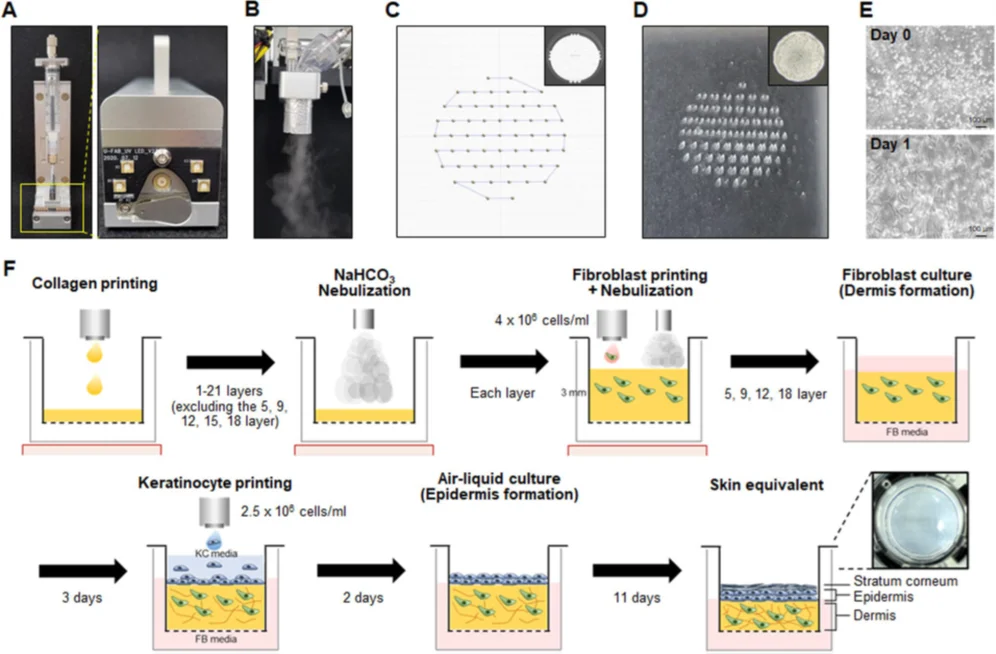
Figure 1. Fabrication of hSKE using droplet-based bioprinting with nebulization. A: Droplet nozzle, B: Nebulizer spray, C: Printing design, D: Printed collagen, E: Fibroblasts in collagen (day zero and day one), F: Schematic of hSKE fabrication. Scale bar: 200 μm. Image Credit: Molecular & Cellular Toxicology (2023)
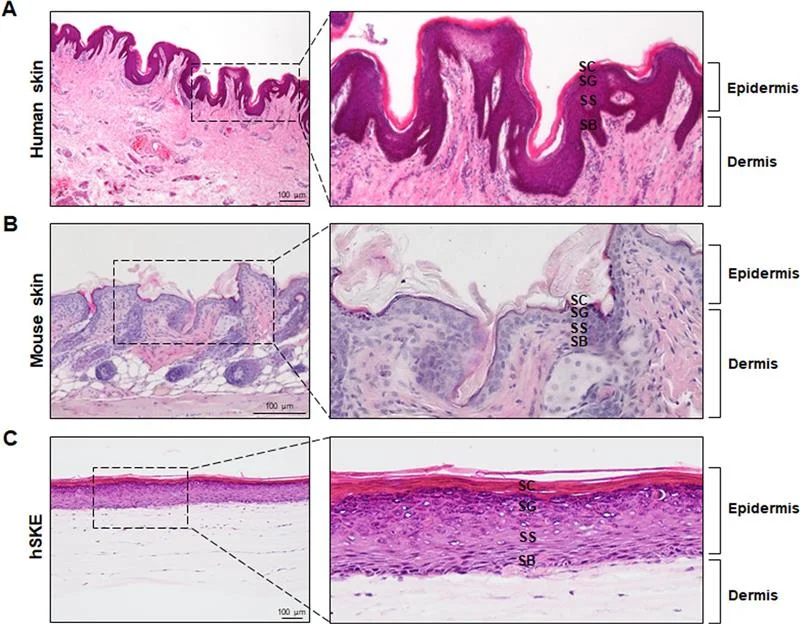
Figure 2. Comparison of morphological similarities between manufactured hSKE and native skin through H&E staining. A: Human native skin isolated from circum tissue. B: Mouse native skin sampled from the skin of nude mice. C: hSKE produced by printing each major cell. Scale bar: 100 μm. Image Credit: Molecular & Cellular Toxicology (2023)
Conclusion
Nebulization-enabled droplet bioprinting is a powerful fabrication method, enabling the production of scalable, reproducible, and functional human skin equivalents.
This approach also offers significant promise as a New Approach Methodology (NAM) in cosmetics, dermatology, and drug development.
Future work in this area is expected to focus on hiPSC-derived skin equivalents, facilitating the delivery of patient-specific and personalized skin therapies.
References and further reading
- Lee, S.-G., et al. (2023). Evaluation of the therapeutic efficacy of human skin equivalents manufactured through droplet-based bioprinting/nebulization technology. Molecular & Cellular Toxicology. (online) DOI: 10.1007/s13273-023-00330-9. https://link.springer.com/article/10.1007/s13273-023-00330-9.
About Scintica Instrumentation Inc.
At Scintica, we advance science and medicine by supplying researchers with reliable research instrumentation and equipment. Our carefully selected portfolio of imaging systems, research tools, and supporting technologies is designed to reduce complexity and help scientists focus on what matters most, generating
meaningful results.
We partner closely with the preclinical research community to connect teams with solutions that are scientifically robust and built to support research challenges. From system selection through long-term support, our goal is to make research more productive, efficient, and impactful.
Sponsored Content Policy: News-Medical.net publishes articles and related content that may be derived from sources where we have existing commercial relationships, provided such content adds value to the core editorial ethos of News-Medical.net, which is to educate and inform site visitors interested in medical research, science, medical devices and treatments.