This article and associated images are based on a poster originally authored by Helen V Bennett and presented at ELRIG Drug Discovery 2026 in affiliation with Automation Holdco Ltd.
This poster is being hosted on this website in its raw form, without modifications. It has not undergone peer review but has been reviewed to meet AZoNetwork's editorial quality standards. The information contained is for informational purposes only and should not be considered validated by independent peer assessment.

The emergence of Self-Driving Laboratories (SDLs) is reshaping the way scientific discovery is performed. By combining artificial intelligence, robotics, laboratory automation, and digital technologies, SDLs can move experimentation from sequential, human-directed workflows to continuous, data-driven cycles of hypothesis, experiment, analysis, and optimization.
In advanced materials research, this shift is particularly significant. The ability to explore large experimental spaces, rapidly evaluate candidate materials, and use experimental data to inform subsequent experiments could accelerate discovery while improving reproducibility, resource efficiency, and knowledge generation.
However, autonomous science requires more than an algorithm capable of selecting the next experiment. The physical laboratory must also translate that decision into a reliable, executable workflow. Instruments, sample handling, robotics, storage, analytical technologies and data systems must operate as a coordinated experimental environment.
This creates a fundamental infrastructure challenge: How can laboratories become sufficiently connected, modular and reconfigurable to support increasingly autonomous experimentation?
Rather than designing automation around a single fixed workflow, PAA's solutions enable heterogeneous instruments and robotic capabilities to connect, coordinate, and reconfigure as requirements evolve.
The future of the SDL therefore depends not only on making scientific decisions autonomously, but on building the flexible infrastructure that can turn those decisions into a closed experimental loop.
Decide → Plan → Execute → Measure → Learn → Decide
The objective is to automate today's workflow and build infrastructure that can support tomorrow's experiments.
PAA's approach treats laboratory automation as connected infrastructure rather than a collection of fixed workcells. Intelligent scheduling provides the digital layer for coordinating heterogeneous instruments, automated processes, and robotic systems, while modular automation provides the physical capability to execute complex workflows. Mobile platforms, such as SmartCarts and autonomous mobile robots, extend this concept, enabling equipment and automation capabilities to move between workflows and laboratory environments.
This architecture allows laboratories to evolve progressively. Existing instruments can be incorporated, additional automation can be introduced as requirements grow, and workflows can be reconfigured without redesigning the entire laboratory. Such flexibility is particularly important for research environments in which experimental questions, methods, and equipment requirements change continuously.
From fixed automation to adaptive infrastructure
Mobility as an enabling capability
As laboratory automation becomes more distributed, mobility becomes an increasingly important component of the automation architecture. Fixed robotic workcells provide powerful execution capabilities, but mobile platforms can extend automation beyond defined workcell boundaries.
PAA SmartCarts provide a modular, mobile platform for integrating laboratory equipment and automation capabilities. Combined with intelligent orchestration and mobile robotics, this creates the possibility of moving automation capabilities between experimental workflows rather than permanently assigning them to a single process.
This introduces a new dimension to laboratory automation:
Automating the laboratory and enabling the laboratory to reconfigure itself.
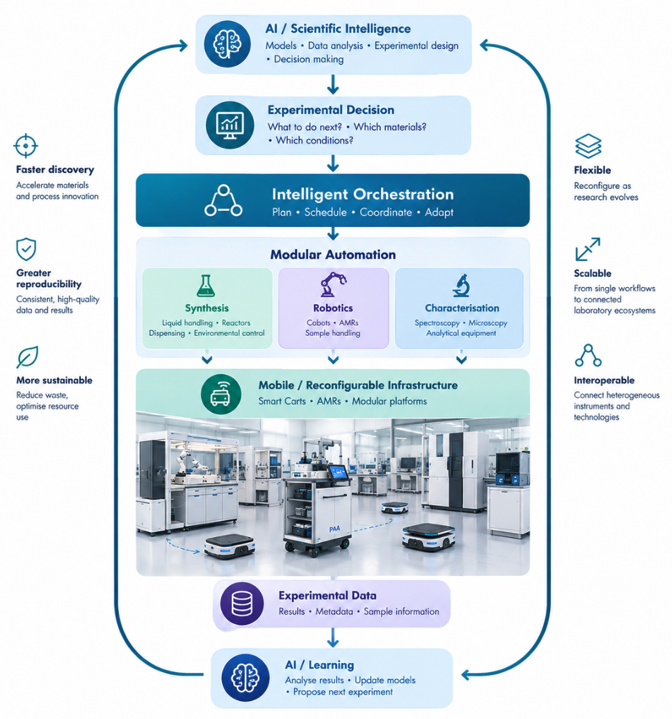
Image Credit: Helen V Bennett, in partnership with ELRIG (UK) Ltd.
The infrastructure challenge
The emergence of fSDLs is bringing together artificial intelligence, robotics, automation and scientific experimentation to create new approaches to accelerate discovery.
Initiatives such as DiscoveryLabNL, A-Lab (Lawrence Berkeley National Laboratory) and CAPeX (Technical University of Denmark) demonstrate different approaches to connecting computational methods, automated experimentation, and robotics and analytical technologies within increasingly autonomous experimental workflows.
However, moving from purpose-built demonstrations to scalable, transferable laboratory environments presents a further challenge. Scientific research is inherently dynamic: Instruments change, new analytical technologies become available, and experimental workflows evolve as knowledge is generated.
Autonomous science requires more than autonomous decision-making. It requires infrastructure capable of turning decisions into experiments reliably, flexibly and at scale.
A platform for the laboratory that has not yet been designed
Autonomous experimentation will continually introduce new questions, workflows, instruments and experimental requirements; therefore, the SDL cannot be fully predefined.
The enabling infrastructure needs to be:
- Modular: Assemble capabilities around the experiment
- Scalable: Expand from individual processes to connected laboratory ecosystems
- Interoperable: Coordinate heterogeneous instruments and technologies
- Intelligent: Translate experimental intent into executable workflows
- Mobile: Equipment movement and sample transport beyond fixed workcells
- Reconfigurable: Adapt as scientific requirements change
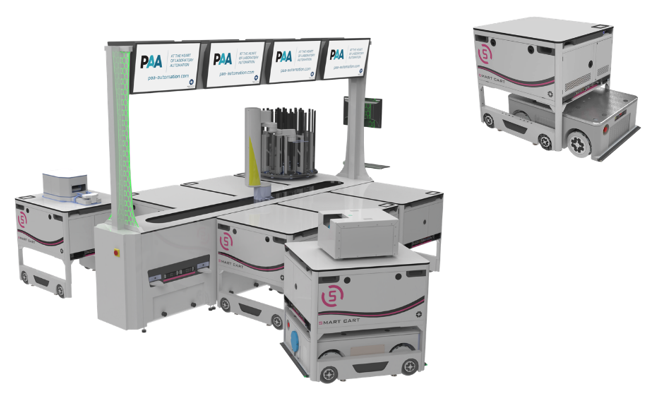
Image Credit: Helen V Bennett, in partnership with ELRIG (UK) Ltd.
PAA's vision is to provide this underlying infrastructure: connecting instruments, automation and robotics through modular, scalable infrastructure to create laboratories that can evolve alongside autonomous science.
About Peak Analysis & Automation Ltd
Peak Analysis & Automation – PAA – was formed by the merger in 2012 of Process Analysis & Automation (a UK limited company founded in 1992) and Peak Robotics Inc (a privately held Corporation founded in 1989).
Together the PAA companies provide a complete design and build service for laboratory automation, robots and robotic workcells. The company remains highly flexible and devoted to each customer’s special needs.
Provides state-of-the-art automation technology to the pharmaceutical and chemical industries. The company was founded by five former members of the PAA team at the BP Research Centre at Sunbury-on-Thames, UK. Originally supplying bespoke data acquisition systems to UK industries, we now trade globally with products and services covering the field of laboratory automation. Our key products are Overlord an advanced laboratory automation software package and extensive range of S-CEL robotic workcells.
About ELRIG (UK) Ltd.
The European Laboratory Research & Innovation Group (ELRIG) is a leading European not-for-profit organization that exists to provide outstanding scientific content to the life science community. The foundation of the organization is based on the use and application of automation, robotics and instrumentation in life science laboratories, but over time, we have evolved to respond to the needs of biopharma by developing scientific programs that focus on cutting-edge research areas that have the potential to revolutionize drug discovery.
Comprised of a global community of over 12,000 life science professionals, participating in our events, whether it be at one of our scientific conferences or one of our networking meetings, will enable any of our community to exchange information, within disciplines and across academic and biopharmaceutical organizations, on an open access basis, as all our events are free-of-charge to attend!
Our values
Our values are to always ensure the highest quality of content and that content will be made readily accessible to all, and that we will always be an inclusive organization, serving a diverse scientific network. In addition, ELRIG will always be a volunteer led organization, run by and for the life sciences community, on a not-for-profit basis.
Our purpose
ELRIG is a company whose purpose is to bring the life science and drug discovery communities together to learn, share, connect, innovate and collaborate, on an open access basis. We achieve this through the provision of world class conferences, networking events, webinars and digital content.
Sponsored Content Policy: News-Medical.net publishes articles and related content that may be derived from sources where we have existing commercial relationships, provided such content adds value to the core editorial ethos of News-Medical.net, which is to educate and inform site visitors interested in medical research, science, medical devices and treatments.
Last Updated: Oct 30, 2026
 PAA releases new application notes demonstrating the versatility of S-LAB automated plate handler