Introduction
Distinct metabolic and cellular signatures
Comparative clinical efficacy and biomarkers
Clinical applications: Oncology and neuroprotection
Adherence, safety, and operational trade-offs
Conclusions
References
Further reading
Brief fasting-like cycles and sustained calorie reduction affect overlapping biological pathways, raising questions about how timing, protein intake, and refeeding shape their effects.
 Image Credit: TatianaKim / Shutterstock.com
Introduction
Chronic caloric restriction (CCR) involves a sustained reduction in daily energy intake while maintaining adequate nutrition, whereas the fasting-mimicking diet (FMD) imposes substantial, often temporary, calorie restriction while permitting limited nutrient intake. A commonly studied FMD uses five consecutive days of restriction each month, emphasizing plant-based foods that reproduce selected fasting-related metabolic effects without complete food deprivation. These approaches differ in the timing and intensity of energy restriction, dietary composition, and whether they include refeeding periods between FMD cycles.1,2,5
Periodic FMD cycles may activate adaptive metabolic and cellular responses, including reduced insulin-like growth factor 1 (IGF-1) signaling, ketogenesis, and cellular stress responses, whereas CCR restricts intake continuously, rather than in discrete cycles. Both approaches can influence nutrient-sensing pathways and metabolic risk factors, with the cumulative energy deficit dependent on intake throughout the intervention, including FMD refeeding periods.
FMD may be more acceptable for some individuals. To date, neither better adherence nor metabolic superiority over CCR has been established.
Human studies report improvements in body mass index (BMI), waist circumference, and metabolic risk factors, though heterogeneous designs and dropout rates limit conclusions about superiority over CCR. Evidence from other intermittent fasting schedules provides context; however, it cannot establish the comparative effects of FMD.1,2,3,4
How the Fasting Mimicking Diet works
FMD produces a characteristic reduction in nutrient availability that affects growth and energy-sensing pathways. Low protein and amino acid intake can reduce IGF-1 signaling, while fasting-associated reductions in mammalian target of rapamycin (mTOR) and protein kinase A (PKA) activity have been implicated in metabolic adaptation and autophagy. CCR also affects nutrient-sensing and cellular stress-response pathways; therefore, these mechanisms are not exclusive to FMD.
Experimental work in pancreatic cells has linked mTOR and PKA inhibition to regeneration-related pathways. Moreover, IGF-1 levels declined following both low-protein and higher-protein FMD formulations, indicating that marked energy restriction can lower this marker without severe protein restriction.5
Autophagy is one of the most frequently proposed cellular mechanisms underlying fasting-associated benefits. Reduced nutrient availability and downregulation of the IGF-1/mTOR pathway can favor cellular recycling and stress-resistance mechanisms.
Human findings provide indirect molecular support. In a randomized study, both low-protein/high-fat and high-protein/low-fat seven-day FMDs increased blood expression of microtubule-associated proteins 1A/1B light chain 3A (MAP1LC3A), with increased unc-51-like autophagy-activating kinase 1 (ULK1) expression in the high-protein group. Measured autophagy-related protein abundance did not change, and autophagic flux was not assessed; thus, these findings support altered expression of autophagy-related genes, rather than demonstrating increased cellular recycling.1,5
During FMD, restricted energy availability can promote a shift toward fat utilization and ketogenesis. The combination of calorie restriction and dietary composition supports the production of ketone bodies like β-hydroxybutyrate and acetoacetate, which can serve as alternative fuels to glucose.
Continuous caloric restriction can also promote fat oxidation and metabolic adaptation, while the magnitude of ketogenesis depends on the degree of restriction and dietary composition. A stronger ketone response alone does not establish greater clinical benefit.1,2,5
 Image Credit: myboys.me / Shutterstock.com
Comparative clinical efficacy and biomarkers
Human evidence suggests that FMD can improve several metabolic outcomes relevant to obesity and metabolic syndrome, including reductions in BMI and waist circumference, with some evidence of preserved lean mass. FMD has also been associated with improvements in fasting plasma glucose, insulin resistance, glycated hemoglobin (HbA1c), and lipid-related measures; however, these findings are not consistent across trials. CCR studies also report improvements in body weight and metabolic risk factors, making the choice of comparator central to interpreting FMD findings.1,2
In one study, 46 healthy adults received a weight-maintaining diet or one of two plant-based FMDs designed to provide approximately 850 kcal daily. Both FMD formulations reduced body weight and fat mass, fasting glucose by about 10%, and IGF-1 after only seven days.
The high-protein FMD also reduced visceral adipose tissue and triglycerides relative to the control group, though the difference in visceral fat reduction between the two FMD formulations was not statistically significant. Because the control group maintained its usual diet, the trial does not separate the effects of FMD from those of energy restriction generally or compare FMD with CCR.5
FMD may influence cardiovascular risk by changing body composition, glucose regulation, lipids, inflammation, and vascular function. Previous human studies have reported improvements in selected metabolic and cardiovascular risk factors. For example, the high-protein FMD substantially increased root mean square of successive differences (RMSSD), a measure of heart-rate variability, although systolic blood pressure, mean arterial pressure, and heart rate did not change significantly.5
Other cardiovascular findings were mixed. Circulating C-reactive protein (CRP), tumor necrosis factor alpha (TNF-α), and interleukin-6 (IL-6) levels did not change significantly during the aforementioned two-month intervention. Low-density lipoprotein cholesterol also remained unchanged, while the low-protein group had significantly lower high-density lipoprotein cholesterol levels than the control group. These changes do not establish a reduction in cardiovascular events.5
FMD has also attracted interest because its potential effects that may extend beyond weight loss. One study reported a reduction in estimated biological age after three FMD cycles, accompanied by changes in markers related to insulin resistance, hepatic fat, and immune-system aging. In this study, researchers estimated biological age from systemic clinical biomarkers, rather than an epigenetic clock; therefore, these estimates do not show that aging has been reversed or lifespan extended.
To date, current human evidence supports changes in selected metabolic risk factors, while an extension of lifespan remains unproven for either FMD or CCR.1,2
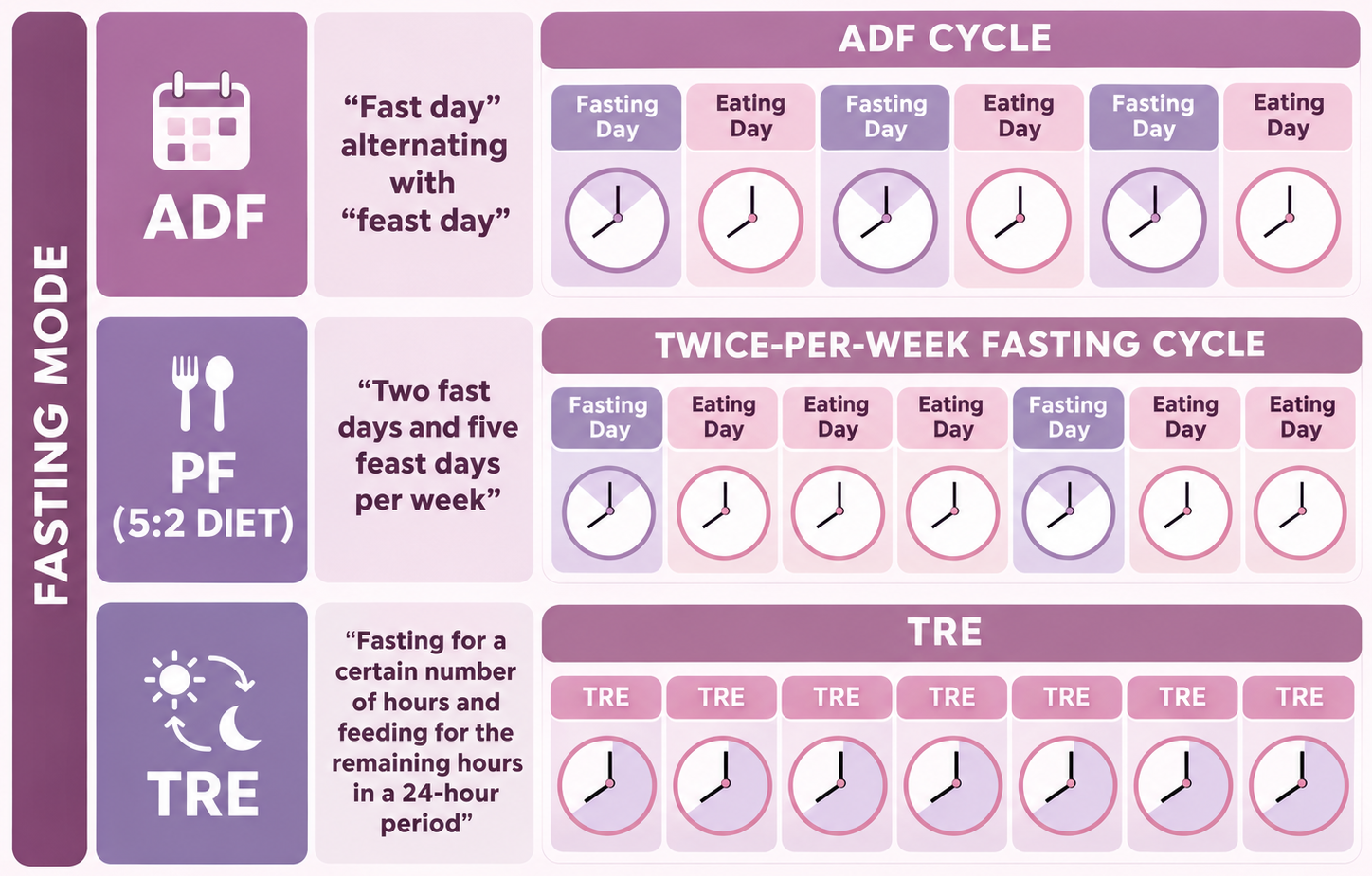
Types of intermittent fasting. Three commonly used IF protocols are illustrated: alternate-day fasting (ADF), periodic fasting (5:2), and time-restricted eating (TRE). The diagrams depict the fasting duration and corresponding eating windows for each approach. Darker shading indicates eating periods within the fasting regimen, facilitating visual comparisons of timing and duration across protocols.4
Clinical applications: Oncology and neuroprotection
Preclinical studies suggest that fasting or FMD can produce differential stress resistance, in which normal cells become more resistant to metabolic stress while tumor cells may remain vulnerable. FMD has also been investigated alongside chemotherapy and endocrine therapy, including one trial involving 131 patients with HER2-negative stage II/III breast cancer receiving neoadjuvant chemotherapy. No major difference in treatment toxicity was observed, but patients receiving FMD had a greater likelihood of significant or complete radiological response and reduced DNA damage in T lymphocytes. These findings cannot be generalized to all cancers or interpreted as evidence of improved survival; furthermore, they do not establish an advantage over CCR, which was not the comparator.3
The neurological rationale for FMD involves ketone metabolism, cellular stress responses, inflammation, and pathways implicated in neurodegeneration. Ketone bodies generated during fasting can provide an alternative energy substrate and may exert neuroprotective and anti-inflammatory effects. In Alzheimer’s disease (AD) models, FMD has been associated with reduced amyloid-beta accumulation, tau phosphorylation, neuroinflammation, and cognitive decline.2,3
To date, the optimal duration, frequency, long-term safety, and efficacy of FMD for AD remain unresolved.2
 Image Credit: Studio Romantic / Shutterstock.com
Adherence, safety, and operational trade-offs
Adherence is a central consideration when comparing FMD with CCR. Continuous restriction requires sustained behavioral changes and can become difficult to maintain over time, whereas FMD concentrates the restrictive phase into defined cycles. Preliminary evidence suggests that monthly five-day FMD cycles can be feasible, as some studies have reported satisfactory adherence.
Acceptability varies, with human studies reporting dropout rates ranging from approximately 2.3% to 30%. Periodicity may improve acceptability for some individuals; however, it does not eliminate the behavioral challenges of dietary restriction.1,2
Preservation of lean tissue is an important consideration with any energy-restricted diet. Across studies, assessing preservation requires distinguishing absolute lean mass from its proportion of body weight. Despite observed short-term reductions in both fat mass and lean mass after a seven-day FMD, changes in body water or organ mass may explain part of the measured lean-mass reduction.
These findings do not establish the extent of lasting skeletal-muscle loss or recovery after refeeding. Moreover, bone mineral content did not change during that short intervention. Long-term comparisons of FMD and CCR for skeletal muscle and bone health remain insufficient.1,5
FMD is not appropriate for every individual and should not be treated as a universally safe substitute for conventional dietary management. The available human literature highlights the importance of appropriate participant selection, monitoring, and consideration of adherence and nutritional adequacy.
Eligibility criteria also limit how widely trial findings apply, as people with active metabolic, endocrine, or cardiovascular abnormalities, as well as those with elevated eating-disorder screening scores, should consult their physician before adopting these dietary strategies. The broader intermittent fasting review reports hypoglycemia, dizziness, and weakness, with particular concern about hypoglycemia in people taking glucose-lowering medication. These observations support clinical assessment and monitoring, but they do not quantify the incidence of these events during FMD itself.4
Conclusions
FMD and CCR share an underlying principle of energy restriction but differ substantially in temporal organization. CCR restricts daily energy intake continuously, whereas FMD produces repeated, short fasting-like metabolic states separated by refeeding periods. Thus, the effects of these strategies must be interpreted in relation to total energy intake, dietary composition, participant characteristics, and adherence.
Current evidence supports FMD as an approach that can improve body composition and selected cardiometabolic biomarkers while increasing ketogenesis and altering autophagy-related gene expression. To date, available evidence does not yet demonstrate that FMD consistently outperforms CCR for long-term weight control, metabolic health, longevity, or preservation of lean tissue.
Periodic implementation may suit some individuals, but its comparative clinical value remains uncertain. Larger, longer randomized trials directly comparing FMD with CCR are needed to determine whether differences in restriction schedules and dietary composition produce sustained clinical benefits.1,2,4,5
References
- Popa, A. D., Gherasim, A., Mihalache, L., et al. (2025). Fasting Mimicking Diet for Metabolic Syndrome: A Narrative Review of Human Studies. Metabolites 15(3). DOI: 10.3390/metabo15030150. https://www.mdpi.com/2218-1989/15/3/150
- Boccardi, V., Pigliautile, M., Guazzarini, A. G., & Mecocci, P. (2023). The Potential of Fasting-Mimicking Diet as a Preventive and Curative Strategy for Alzheimer’s Disease. Biomolecules 13(7). DOI: 10.3390/biom13071133. https://www.mdpi.com/2218-273X/13/7/1133
- Lin, X., & Gao, Y. (2024). A bibliometric analysis of the fasting-mimicking diet. Frontiers in Nutrition 11. DOI: 10.3389/fnut.2024.1328450. https://www.frontiersin.org/journals/nutrition/articles/10.3389/fnut.2024.1328450/full
- Diaz-Garrido, N., Zagmutt, S., Regaldiz, A., Cisternas, P., & Bastías-Pérez, M. (2026). Intermittent fasting: A metabolically focused therapeutic strategy for obesity. Nutrients 18(3). DOI: 10.3390/nu18030371. https://www.mdpi.com/2072-6643/18/3/371
- Burns, L., Cooper, S., Sarmad, S., et al. (2025). Effects of fasting-mimicking diets with low and high protein content on cardiometabolic health and autophagy: A randomized, parallel group study. Clinical Nutrition 52; 299–312. DOI: 10.1016/j.clnu.2025.08.004. https://www.sciencedirect.com/science/article/pii/S0261561425002183
Last Updated: Nov 15, 2026