Introduction
Early clinical benefits in psoriasis and HS
Weight loss-dependent vs. independent effects
Future directions
References
Further reading
What happens to inflamed skin when treatment targets metabolism? Studies of GLP-1 drugs are testing the connections between weight, immune signaling, and chronic skin disease.
 Image Credit: SeventyFour / Shutterstock.com
Introduction
Inflammatory skin diseases like psoriasis and hidradenitis suppurativa (HS) are chronic, immune-mediated conditions often accompanied by other health conditions. Glucagon-like peptide-1 (GLP-1) receptor agonists, which are currently approved to treat type 2 diabetes and obesity, are increasingly being studied for potential dermatologic applications because of their anti-inflammatory effects.1,2
GLP-1 RAs have anti-inflammatory and immunomodulatory properties that extend beyond their primary roles in glycemic control and weight management. Experimental studies and small clinical investigations suggest that GLP-1 RAs alter inflammatory signaling cascades involving pro-inflammatory cytokines such as tumor necrosis factor-α (TNF-α), interleukin (IL)-17, and IL-23, which contribute to inflammatory dermatological disorders.
These findings include changes in cytokine expression in skin tissue and preclinical models; they do not establish consistent reductions in circulating levels of all these cytokines in patients. GLP-1 RAs may also affect immune cell activity, including invariant natural killer T-cells, to regulate inflammatory processes underlying psoriasis and potentially HS.1,2
GLP-1 RAs promote weight loss and improve metabolic dysfunction, both of which may reduce the chronic low-grade systemic inflammation associated with obesity. As obesity and insulin resistance contribute to the development and progression of inflammatory skin disorders, improved metabolic function may also reduce skin inflammation.
Together, possible direct immune modulation and metabolic improvement provide a biological rationale for investigating GLP-1 RAs as potential therapeutic agents for inflammatory skin diseases. The relative contribution of these pathways to clinical improvement remains uncertain.1,2,3
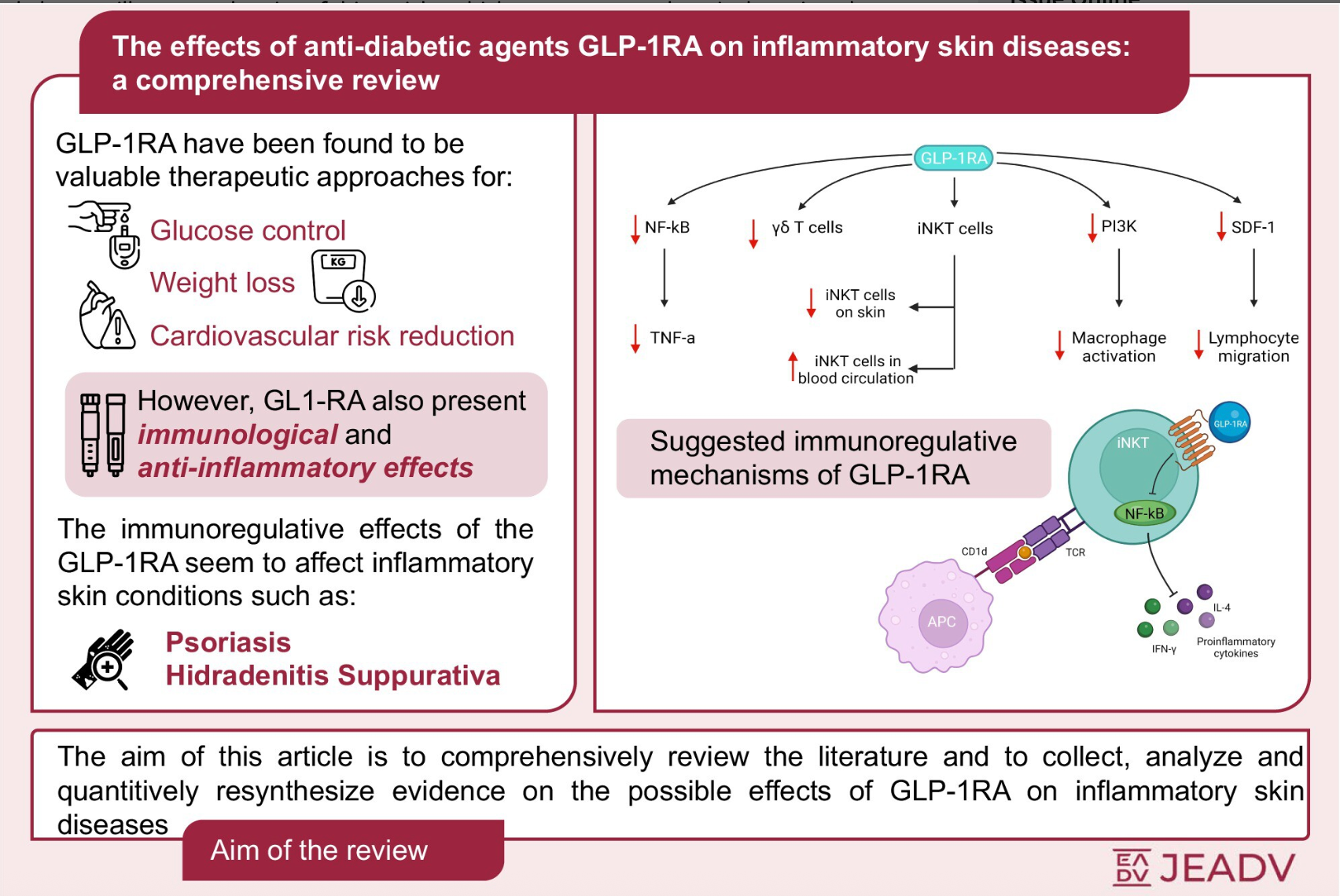 The graphical abstract summarizes Paschou and colleagues' review of the potential effects of GLP-1RAs on inflammatory skin diseases. It lists GLP-1RAs' actions on glucose regulation, weight management, and cardiovascular risk, and presents their immunoregulatory effects.1
Early clinical benefits in psoriasis and HS
GLP-1 RA use has been associated with reduced psoriasis severity in some patients, with most evidence coming from populations with obesity, type 2 diabetes, or other features of metabolic dysregulation. Studies of liraglutide and semaglutide have reported improvements in Psoriasis Area and Severity Index (PASI) scores, lesion extent, and quality of life following treatment.
These findings have not been consistent across all trials. An eight-week randomized trial involving 20 patients with overweight or obesity and without diabetes found no significant improvement in PASI or dermatology-related quality of life compared with placebo, even with greater weight loss. A separate small randomized trial in patients with type 2 diabetes reported benefits when liraglutide was added to other treatments.
The Cureus review also includes a 31-participant, open-label randomized trial of semaglutide in patients with psoriasis and type 2 diabetes. The review reported improvements in psoriasis severity and quality of life, but the small sample size and lack of blinding limit interpretation.1,2
GLP-1 RA treatment may also improve outcomes among patients with HS, although research has largely involved people with obesity or metabolic syndrome, rather than establishing that these groups respond better. Reported benefits include reduced disease flare frequency, lesion severity, pain, and antibiotic use.
Several studies reported improvements in quality of life, and one small prospective study reported reduced depressive symptoms. Some observational studies also reported reduced healthcare utilization, including lower antibiotic use and fewer emergency department visits among patients with HS receiving GLP-1 RA therapy. Responses varied, and one study found a statistically significant reduction in flare frequency, while another did not. These observational findings do not establish that GLP-1 RAs caused the improvements.1,2,3
Reported adverse effects included gastrointestinal symptoms, a rash leading to exclusion from a psoriasis trial, and an isolated case of psoriasis worsening during liraglutide treatment. The broader literature also includes reports of cutaneous hypersensitivity and other uncommon skin reactions; their frequency and causal relationship to treatment remain uncertain. GLP-1 RA therapy requires assessment of systemic safety alongside any potential dermatologic benefit.2
GLP 1 receptor agonists may be effective as adjunct therapy for skin diseases
Weight loss-dependent vs. independent effects
Weight loss may reduce mechanical stress in areas where skin surfaces rub together. Weight loss may also improve psoriasis by reducing systemic inflammation, and bariatric surgery has been associated with improvements in PASI scores.
Surgery also alters gut hormone secretion, so these observations cannot isolate weight loss's contribution. GLP-1 RAs also improve insulin resistance (IR), a shared feature of both psoriasis and HS associated with chronic inflammation and cytokine dysregulation that are characteristic of these conditions.1,2,3
Some observations suggest that GLP-1 RA therapeutic effects on skin conditions may involve mechanisms beyond weight loss. Small psoriasis studies have reported improvement before substantial weight loss or changes in glycemic control. In one small HS study, changes in body mass index did not correlate with changes in disease severity, pain, or depressive symptoms. These findings support further investigation but do not prove a weight-independent treatment effect.1,3
Mechanistic studies indicate that GLP-1 RAs may modulate inflammation through GLP-1 receptors on invariant natural killer T (iNKT) cells. Proposed downstream effects include CREB phosphorylation and inhibition of nuclear factor κB (NF-κB) signaling, which could reduce pro-inflammatory mediator secretion.
GLP-1 RAs have also been reported to reduce stromal cell-derived factor 1 (SDF-1) levels, thereby limiting CD4+ lymphocyte migration. Much of this mechanistic evidence comes from experimental or systemic studies, and its contribution to clinical improvement in psoriasis and HS remains uncertain.1,2
In HS studies, systemic inflammatory markers generally showed no statistically significant changes, apart from a reduction in ultrasensitive C-reactive protein in one small study. Laboratory findings were available for only 44 patients across two studies, limiting conclusions about anti-inflammatory mechanisms.3 Clinical improvement alone cannot establish that direct immune modulation caused the response.1,2,3
Evidence for other conditions, including localized scleroderma, folliculitis decalvans, and acne keloidalis nuchae, is limited to isolated case reports. For these conditions, GLP-1 RAs require further clinical study, while their ability to suppress cytokines in preclinical and systemic studies provides a biologically plausible rationale for further investigation.2
 Image Credit: MillaF / Shutterstock.com
Future directions
Heterogeneous study populations, treatment regimens, outcomes assessed, and follow-up durations limit the generalizability of these findings.1,2,3 Current data are derived primarily from case reports, case series, retrospective and prospective cohort studies, with a limited number of randomized or early clinical trials that have been dedicated to studying GLP-1 RAs to treat skin conditions.
Concurrent medications and lifestyle interventions further complicate attribution of benefits to GLP-1 RAs. Larger, well-designed randomized controlled trials are needed to confirm efficacy, establish optimal treatment strategies, and identify patients most likely to benefit.1,2,3
These trials should use standardized measures of disease severity and patient-reported outcomes, compare individual agents, assess the durability of skin responses and long-term safety, and determine whether benefits extend to patients without obesity or diabetes. Head-to-head comparisons between GLP-1 RAs are lacking, and observational associations between higher doses and better HS responses do not establish an optimal dermatologic dose.2 Research should also test whether biomarkers can reliably predict which patients are most likely to respond positively to GLP-1 RA therapy.1,2,3
Mechanistic studies are needed to explore the molecular and cellular pathways through which these agents regulate immune responses and inflammation. Studies that distinguish metabolic effects from direct immune effects could clarify these drugs' role as adjunctive treatments. This requires assessing skin responses alongside changes in weight, glycemic control, and inflammatory markers. Their use specifically to treat psoriasis or HS remains investigational.1,2,3
References
- Paschou, I. A., Sali, E., Paschou, S. A., et al. (2025). The effects of GLP-1RA on inflammatory skin diseases: A comprehensive review. Journal of the European Academy of Dermatology and Venereology, 39(12), 2047- 2055. DOI: 10.1111/jdv.20694. https://onlinelibrary.wiley.com/doi/10.1111/jdv.20694.
- Tassavor, B., & Al Salem, S. (2025). Use of glucagon-like peptide-1 (GLP-1) agonists in modulating preexisting dermatologic disease: A systematic review. Cureus 17(9). DOI: 10.7759/cureus.93282. https://www.cureus.com/articles/404845-use-of-glucagon-like-peptide-1-glp-1-agonists-in-modulating-preexisting-dermatologic-disease-a-systematic-review#!/
- Caliezi, A., Hosseini, A., Wolf, R., & Seyed Jafari, S. M. (2026). Effects of GLP-1 Agonists on Patients with Hidradenitis Suppurativa: A Systematic Review. Journal of Clinical Medicine, 15(8). DOI: 10.3390/jcm15082909. https://www.mdpi.com/2077-0383/15/8/2909
Further Reading
Last Updated: Oct 22, 2026