This article and associated images are based on a poster originally authored by J. Bogomolovas and presented at ELRIG Drug Discovery 2026 in affiliation with University of California.
This poster is being hosted on this website in its raw form, without modifications. It has not undergone peer review but has been reviewed to meet AZoNetwork's editorial quality standards. The information contained is for informational purposes only and should not be considered validated by independent peer assessment.

This study presents:
- Development of a homogeneous TR-FRET binding assay to enable screening for modulators of the STUB1 (CHIP)–HSP70 interaction
- The TR-FRET assay pairs mClover3–STUB1(TPR) with an N-terminal CoraFluor™ 1–labeled HSP70 C-terminal peptide
- The assay delivers an ∼50% window and Z′ = 0.92, supporting high-throughput screening (HTS) and structure–activity relationship (SAR) workflows.
Introduction
STUB1 (CHIP) is a chaperone-associated E3 ubiquitin ligase that connects Hsp70/Hsp90 client handling to ubiquitin-dependent protein quality control.
In this pathway, the N-terminal TPR domain binds the conserved Hsp70/Hsp90 C-terminal EEVD motif, providing a defined recruitment interface that links chaperone engagement to STUB1 function. Because this axis is important for human health, STUB1 has become a focus for chemical modulation.
To enable discovery and profiling of compounds that modulate the STUB1–Hsp70 interaction, this study developed a homogeneous TR-FRET assay.
This assay pairs a genetically encoded, site-defined acceptor (mClover3–STUB1(TPR)), avoiding chemical labeling of the protein and simplifying assay build, with an N-terminal CoraFluor™ 1–labeled Hsp70 C-terminal peptide donor, leveraging a bright terbium donor chemistry for TR-FRET.
CoraFluors are highly sensitive, high-brightness terbium FRET donors, developed by Bio-Techne for TR-FRET assay development. Despite this streamlined format, the assay delivers an ∼50% window and excellent robustness (Z′ = 0.92), supporting HTS and SAR workflows.
Assay principle
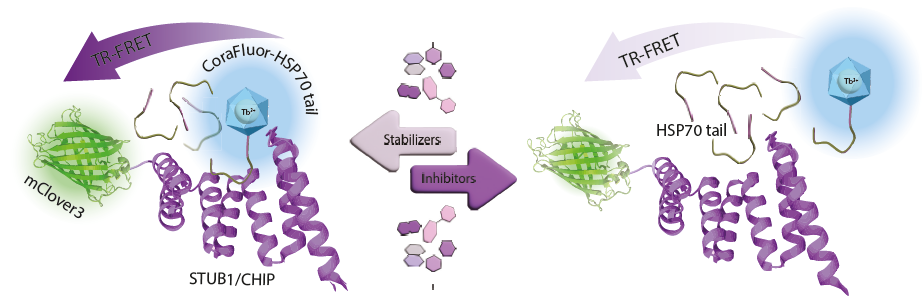
Fig 1. TR-FRET competitive binding assay for the STUB1/CHIP–HSP70 interaction. CoraFluor1–Tb–labeled HSP70 C-terminal tail (donor) binds the mClover3-tagged STUB1/CHIP TPR domain (acceptor), bringing fluorophores into proximity and generating a TR-FRET signal.
Addition of unlabeled HSP70-tail competitor displaces the labeled tracer from STUB1/CHIP, increasing donor–acceptor distance and reducing TR-FRET. Stabilizers shift the equilibrium toward the bound complex (↑TR-FRET), whereas inhibitors favor dissociation (↓TR-FRET). Image Credit: Image courtesy of J. Bogomolovas, in partnership with ELRIG (UK) Ltd.
Materials and methods
- Solid white, 384-well, flat-bottom microplate (Corning, #3825)
- CoraFluor™ 1, amine-reactive dye (Tocris/Bio-Techne, #7920)
- Human STUB1 (CHIP) TPR domain fused to mClover3 (expressed in-house)
- HSP70 peptide (SGGASSGPTIEEVD; AnaSpec)
- Assay buffer: 50 mM HEPES (pH 7.4), 50 mM KCl, 0.01% Triton X-100 (v/v)
- Other reagents from commercial sources
- CLARIOstarPlus (BMG LABTECH)
Experimental procedure
Assays were assembled directly in solid white 384-well plates in a final volume of 30 μL per well using assay buffer. STUB1– mClover3 was first dispensed into wells, followed by test compounds or unlabeled peptide competitors from intermediate working dilutions, such that the final DMSO concentration was ≤0.1% (v/v).
The CoraFluor-labeled HSP70 peptide (amine-reactive labeling performed in-house) was added last to initiate the binding reaction. Plates were incubated at room temperature for five minutes and measured as an endpoint TR-FRET read with top optics.
Instrument settings
Source: BMG LABTECH GmbH
| |
|
| Optic settings |
TR-FRET, endpoint |
| Dual Chromatic |
| Filters |
Ex: EX TR
Dichroic: LP TR
Em 1: 490-10
Em 2: 520-10 |
| Flashes |
200 |
| Gain |
EDR |
| Focus |
8.1 mm |
| General settings |
Settling time |
0.3 s |
| Integration start |
100 μs |
| Integration time |
400 μs |
Results and discussion
The researchers first optimized assay conditions to maximize the competitive TR-FRET window for the STUB1–HSP70 peptide interaction. CoraFluor-labeled HSP70 peptide was tested at 1, 5, 10, and 20 nM against mClover3–STUB1 across 250, 500, 1000, and 5000 nM.
Donor (490 nm) and acceptor (520 nm) signals were blank-subtracted using buffer-only wells, and TR-FRET was calculated as the ratiometric signal (520/490 × 10,000). For each matrix condition, high-FRET (no competitor) and low-FRET controls (10 μM unlabeled peptide competitor) were measured and used to calculate the normalized assay window, which was visualized as a heatmap (Figure 2).
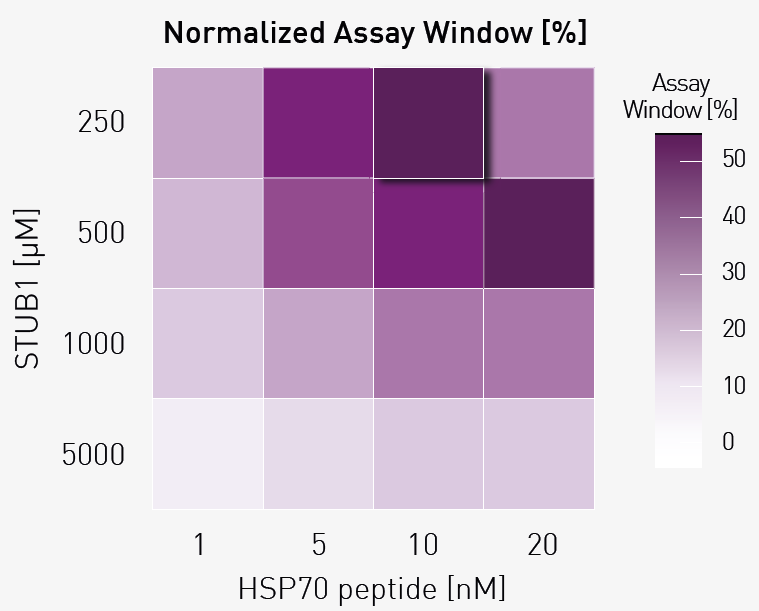
Fig 2. Protein–peptide optimization heatmap. Normalized assay window (%) across a cross-titration of labeled HSP70 peptide (1–20 nM) and mClover3–STUB1 (250–5000 nM), calculated from high- (no competitor) and low-FRET (10 μM competitor) conditions. Image Credit: Image courtesy of J. Bogomolovas, in partnership with ELRIG (UK) Ltd.
This analysis identified 10 nM labeled peptide with 250 nM mClover3–STUB1 as the condition providing the largest separation between high and low controls, reaching an assay window of ∼50%, and this condition was carried forward for subsequent assay validation.
Using the optimized concentrations, assay robustness was assessed by comparing replicate high- and low-FRET control wells and calculating the Z′ factor. The control populations were well separated with low variance, yielding a Z′ of 0.92, consistent with a highly robust assay suitable for screening and profiling workflows in 384-well format (Figure 3).
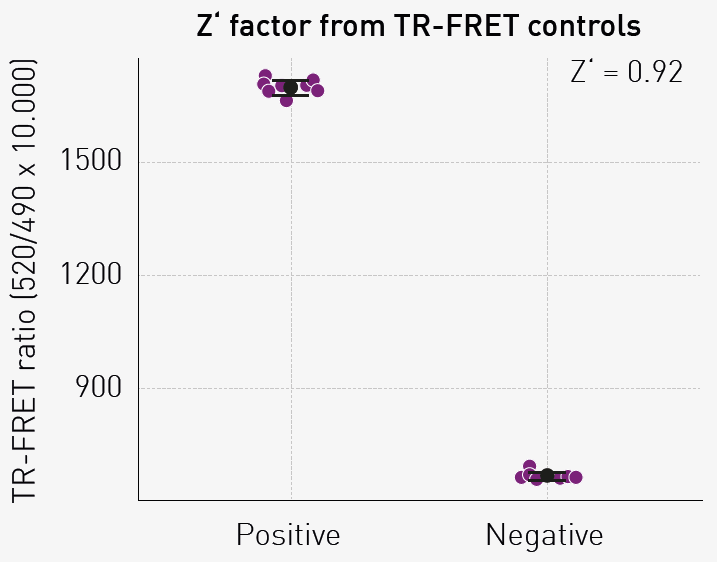
Fig 3. Assay quality assessment (Z′ factor). Distribution of TR-FRET ratios for positive (no competitor) and negative control wells (10 μM unlabeled peptide competitor). Image Credit: Image courtesy of J. Bogomolovas, in partnership with ELRIG (UK) Ltd.
To confirm that the readout reflects specific binding and can be displaced in a concentration-dependent manner, an eight-point titration of unlabeled competitor peptide was performed under the optimized conditions. Increasing competitor concentrations reduced TR-FRET in a sigmoidal manner, and curve fitting returned an EC50 of 0.71 μM (Figure 4).
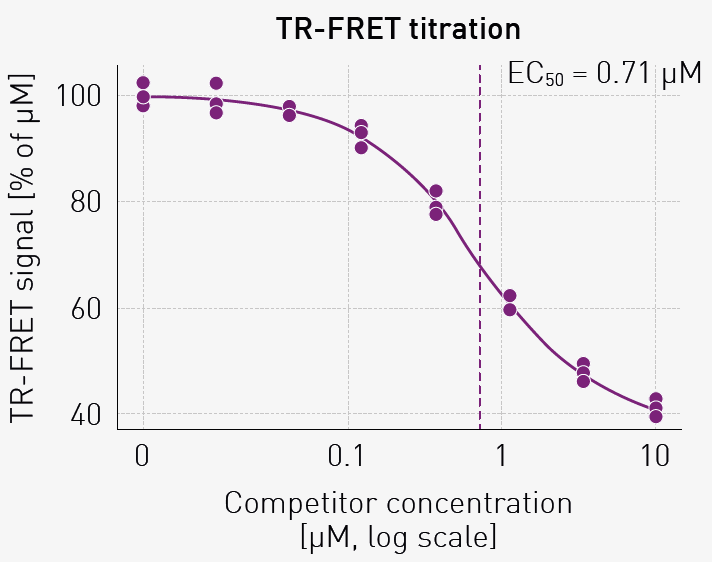
Fig 3. Assay quality assessment (Z′ factor). Distribution of TR-FRET ratios for positive control wells (no competitor) and negative control wells (10 μM unlabeled peptide competitor). Image Credit: Image courtesy of J. Bogomolovas, in partnership with ELRIG (UK) Ltd.
Conclusion
This application note describes a homogeneous, ratiometric TR-FRET competitive binding assay to monitor STUB1/CHIP interaction with an HSP70 C-terminal peptide in a 384-well microplate format. The streamlined format supports screening and SAR workflows and can be adapted to other peptide-protein interaction assays.
About BMG LABTECH
 BMG LABTECH has been committed to producing microplate readers for more than twenty years. By focusing on the needs of the scientific community, the company’s innovative microplate readers have earned the company the reputation of being a technology leader in the field.
BMG LABTECH has developed a wide range of dedicated and multi-mode microplate readers for life sciences applications and high-throughput screening.
About ELRIG (UK) Ltd.
The European Laboratory Research & Innovation Group (ELRIG) is a leading European not-for-profit organization that exists to provide outstanding scientific content to the life science community. The foundation of the organization is based on the use and application of automation, robotics, and instrumentation in life science laboratories, but over time, we have evolved to respond to the needs of biopharma by developing scientific programmes that focus on cutting-edge research areas that have the potential to revolutionize drug discovery.
Comprised of a global community of over 12,000 life science professionals, participating in our events, whether it be at one of our scientific conferences or one of our networking meetings, will enable any of our community to exchange information, within disciplines and across academic and biopharmaceutical organizations, on an open access basis, as all our events are free-of-charge to attend!
Our values
Our values are to ensure the highest quality of content and make it readily accessible to all. We will also strive to be an inclusive organization, serving a diverse scientific network. In addition, ELRIG will always be a volunteer-led organization, run by and for the life sciences community, on a not-for-profit basis.
Our purpose
ELRIG is a company whose purpose is to bring the life science and drug discovery communities together to learn, share, connect, innovate, and collaborate on an open-access basis. We achieve this through the provision of world-class conferences, networking events, webinars, and digital content.
Sponsored Content Policy: News-Medical.net publishes articles and related content that may be derived from sources where we have existing commercial relationships, provided such content adds value to the core editorial ethos of News-Medical.net, which is to educate and inform site visitors interested in medical research, science, medical devices and treatments.
Last Updated: Oct 12, 2026
 VANTAstar Microplate Reader from BMG LABTECH