This article and associated images are based on a poster originally authored by Kristin M. Riching, Amy Landreman and Danette L. Daniels and presented at ELRIG Drug Discovery 2026 in affiliation with Promega and BMG LABTECH.
This poster is being hosted on this website in its raw form, without modifications. It has not undergone peer review but has been reviewed to meet AZoNetwork's editorial quality standards. The information contained is for informational purposes only and should not be considered validated by independent peer assessment.

PROTACs are a new class of therapeutic compounds that target cellular proteins for degradation. Their function and mechanism of action must be validated. The CLARIOstar with ACU monitors PROTAC function in live cells using NanoBRET™ ternary complex and ubiquitination assays developed by Promega.
Introduction
Proteolysis targeting chimeras (PROTACs) are small molecules that have received attention recently as a therapeutic modality and use the cell's protein degradation machinery to target the elimination of a specific protein from the cell.1
PROTACs achieve this by directly engaging a target protein with an E3 ubiquitin ligase through two binding ligands joined by a chemical linker: one specific to the ligase and the other to the target protein. The formation of this induced ternary complex between the E3 ligase, PROTAC, and target protein is the first mechanistic step required for targeted degradation.
A productive ternary complex will result in ubiquitination and ultimately degradation of the protein (Figure 1). The potential of PROTACs as therapeutics is especially relevant for regulating the levels of transcription factors and non-enzymatic proteins implicated in disease, for which small-molecule inhibitors have proven ineffective.
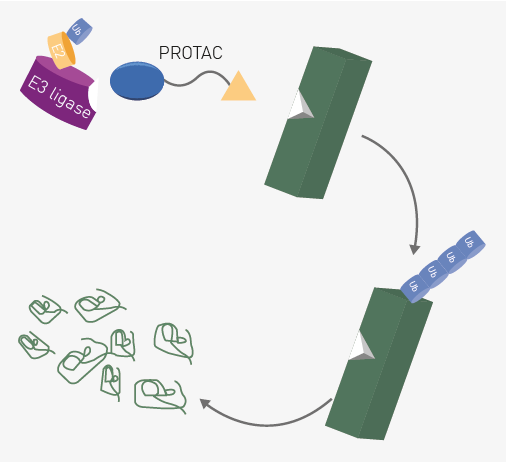
Fig. 1. Schematic of PROTAC function. PROTACs simultaneously bind an E3 ligase and a target protein to form a ternary complex. The target is then poly-ubiquitinated and degraded. Image Credit: Image courtesy of Kristin M. Riching et al., in partnership with ELRIG (UK) Ltd.
While the promise of PROTACs is high, there are still significant challenges for their design and optimization. This includes characterization of the mechanism of action employed by a PROTAC and understanding which steps need to be improved for more efficient degradation.
This research shows how the CLARIOstar with ACU can be used to measure NanoBRET™ signal in live cells to assess the kinetics of ternary complex formation and target protein ubiquitination following PROTAC treatment. Exemplary data is provided for BRD4 and the BET family PROTAC ARV-771, which recruits BET family proteins to the VHL E3 ligase complex.
Assay principle
BRD4 was tagged with the 11-amino-acid peptide HiBiT using CRISPR/Cas9 genome-editing technology in cell lines stably expressing LgBiT. The high-affinity association between HiBiT and LgBiT reconstitutes NanoBiT® luciferase fused to the endogenous BRD4 protein.
PROTAC-induced ternary complex formation or ubiquitination can then be monitored by expressing a fluorescently labeled HaloTag® fusion to either the E3 ligase recruiter or ubiquitin (Figure 2).
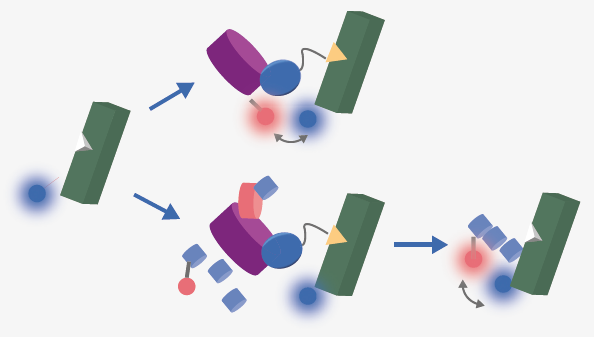
Fig. 2. Schematic of PROTAC function. PROTACs simultaneously bind an E3 ligase and a target protein to form a ternary complex. The target is then poly-ubiquitinated and degraded. Image Credit: Image courtesy of Kristin M. Riching et al., in partnership with ELRIG (UK) Ltd.
Materials and methods
- CLARIOstar with ACU (BMG LABTECH)
- HaloTag® fusion constructs and NanoBRET™ reagents (Promega)
- HEK293 cells were obtained from American Type Culture Collection
- PROTACs and other chemicals and reagents were from commercially available sources
Experimental procedure
For complete experimental details, please refer to the NanoBRET™ protocols for ternary complex and ubiquitination.
CRISPR/Cas9 genome editing was employed in HEK293 cells stably expressing LgBiT to knock in HiBiT into BRD4. Clonal cells were transfected to express a HaloTag®-VHL or HaloTag®-Ubiquitin fusion protein.
On the day of the experiment, the medium was replaced and supplemented with 20 μM Nano-Glo® Vivazine, an extended-release substrate. After a one-hour incubation at 37 °C with 5% CO2, cells were treated with DMSO or the ARV-771 PROTAC. Kinetic NanoBRET™ measurements were collected using a CLARIOstar with ACU employing the following settings.
Instrument settings
Source: BMG LABTECH GmbH
| . |
. |
. |
| Optic settings |
Multichromatic luminescence, plate mode kinetic |
| Filters |
460–80 / 610 LP |
| General settings |
Settling time |
0.1 s |
| Measurement interval time |
0.5 s |
| Kinetic settings |
Number of cycles |
120 (or 63) |
| Cycle time |
180 s |
| Incubation |
CO2 |
5% |
Results and discussion
Endogenously tagged HiBiT-BRD4 cells co-expressing either HaloTag®-VHL or HaloTag®-Ubiquitin show rapid and dose-dependent ternary complex formation (Figure 3) and ubiquitination (Figure 4) upon treatment with a concentration series of ARV-771 PROTAC.
Ternary complex formation with VHL remained stable at three hours, and BRD4 ubiquitination began to reach a plateau at four hours. In both assays, NanoBRET™ signal above the baseline was detected down to 4 nM ARV-771, demonstrating high sensitivity and assay robustness.
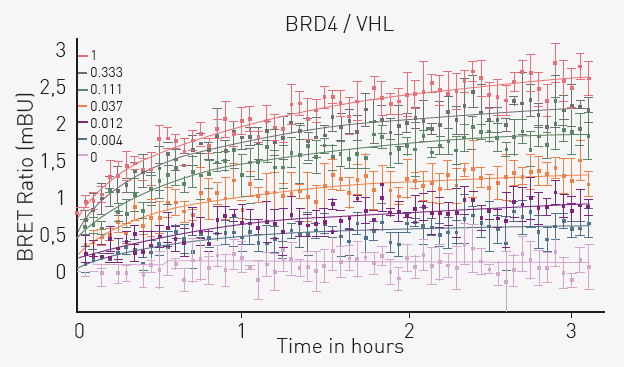
Fig. 3. NanoBRET™ ternary complex formation assay: ARV-771 induces rapid and dose-dependent ternary complex formation of BRD4 with VHL E3 ligase recruiter. Data is expressed in milliBRET units (mBU), and the error bars represent the standard deviation of n=4 technical replicates. Image Credit: Image courtesy of Kristin M. Riching et al., in partnership with ELRIG (UK) Ltd.
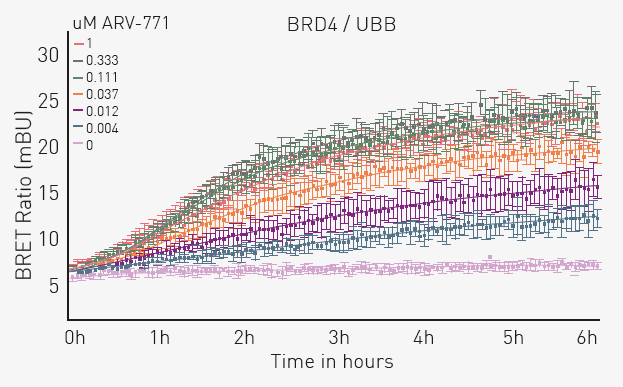
Fig. 4. NanoBRET™ ubiquitination assay: ARV-771 induces rapid and dose-dependent ubiquitination of BRD4. Data are expressed in milliBRET units (mBU) and error bars represent the standard deviation of n=4 replicates. Image Credit: Image courtesy of Kristin M. Riching et al., in partnership with ELRIG (UK) Ltd.
Conclusion
We demonstrate here the application of NanoBRET™ technology and the CLARIOstar with ACU to measure the key steps for targeted protein degradation by PROTACs. The ability to measure the live cell kinetics of ternary complex formation with an E3 ligase as well as the efficiency with which the target protein is ubiquitinated is essential for PROTAC optimization, confirming MoA and understanding degradation efficacy. Both assays can be used in conjunction with endogenously expressed target proteins tagged with HiBiT via CRISPR/Cas9 and show high sensitivity in detecting events at very low concentrations of PROTAC. These tools can further enable an understanding of strategies for chemical optimization, ultimately aiding design and development of highly efficacious PROTAC compounds.
About BMG LABECH
 BMG LABTECH has been committed to producing microplate readers for more than twenty years. By focusing on the needs of the scientific community, the company’s innovative microplate readers have earned the company the reputation of being a technology leader in the field.
BMG LABTECH has developed a wide range of dedicated and multi-mode microplate readers for life sciences applications and high-throughput screening.
About ELRIG (UK) Ltd.
The European Laboratory Research & Innovation Group (ELRIG) is a leading European not-for-profit organization that exists to provide outstanding scientific content to the life science community. The foundation of the organization is based on the use and application of automation, robotics, and instrumentation in life science laboratories, but over time, we have evolved to respond to the needs of biopharma by developing scientific programmes that focus on cutting-edge research areas that have the potential to revolutionize drug discovery.
Comprised of a global community of over 12,000 life science professionals, participating in our events, whether it be at one of our scientific conferences or one of our networking meetings, will enable any of our community to exchange information, within disciplines and across academic and biopharmaceutical organizations, on an open access basis, as all our events are free-of-charge to attend!
Our values
Our values are to ensure the highest quality of content and make it readily accessible to all. We will also strive to be an inclusive organization, serving a diverse scientific network. In addition, ELRIG will always be a volunteer-led organization, run by and for the life sciences community, on a not-for-profit basis.
Our purpose
ELRIG is a company whose purpose is to bring the life science and drug discovery communities together to learn, share, connect, innovate, and collaborate on an open-access basis. We achieve this through the provision of world-class conferences, networking events, webinars, and digital content.
Sponsored Content Policy: News-Medical.net publishes articles and related content that may be derived from sources where we have existing commercial relationships, provided such content adds value to the core editorial ethos of News-Medical.net, which is to educate and inform site visitors interested in medical research, science, medical devices and treatments.
Last Updated: Oct 12, 2026
 Micro Products with Macro Impact; The Role of Microplate Readers in Life Sciences