This article and associated images are based on a poster originally authored by Ravindra Chaudhari, Philipp Schramm, Christian Osseforth, and Andreas Langer and presented at ELRIG Drug Discovery 2026 in affiliation with NanoTemper Technologies.
This poster is being hosted on this website in its raw form, without modifications. It has not undergone peer review but has been reviewed to meet AZoNetwork's editorial quality standards. The information contained is for informational purposes only and should not be considered validated by independent peer assessment.

Abstract
Comprehensive interaction profiling supports hit identification, validation, and lead optimization. Equilibrium affinity measures the strength of binding, but it does not reveal how quickly an interaction forms, how long it persists, or how ligand binding affects target thermal stability. Obtaining these complementary insights often requires multiple assays, in turn increasing sample consumption, workflow complexity, and time to decision.
Researchers have introduced Monolith™ Omni, a low-sample, solution-based platform for multi-parameter characterization of interactions. Spectral Shift measures equilibrium affinity, while measurements across a defined temperature range support thermodynamic insights.
nano Temperature Alteration Kinetics (nanoTAK) determines association and dissociation rate constants by monitoring relaxation to a new equilibrium following a rapid temperature perturbation, while nano Laser-Induced Stability Analysis (nanoLISA) compares temperature-induced unfolding profiles with and without a ligand to assess changes in the target's thermal stability.
By combining these measurements in a single in-solution workflow, Monolith Omni provides a broader view of molecular interactions while minimizing sample use and avoiding surface immobilization. It can characterize targets and ligands across modalities, including membrane proteins, IDPs, molecular glues, PROTACs, and other challenging interaction systems. The resulting insights into affinity, kinetics, thermodynamics, and ligand-induced stability complement biochemical and cellular assays, and support decisions in lead optimization.
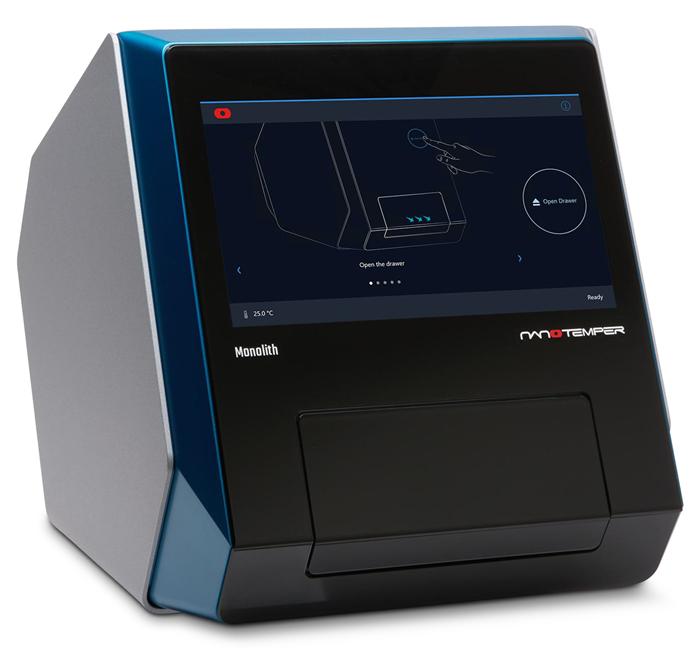
Affinity, kinetics, and stability in one workflow. Image Credit: Image courtesy of Ravindra Chaudhari et al., in partnership with ELRIG (UK) Ltd.
Spectral Shift for determining affinities
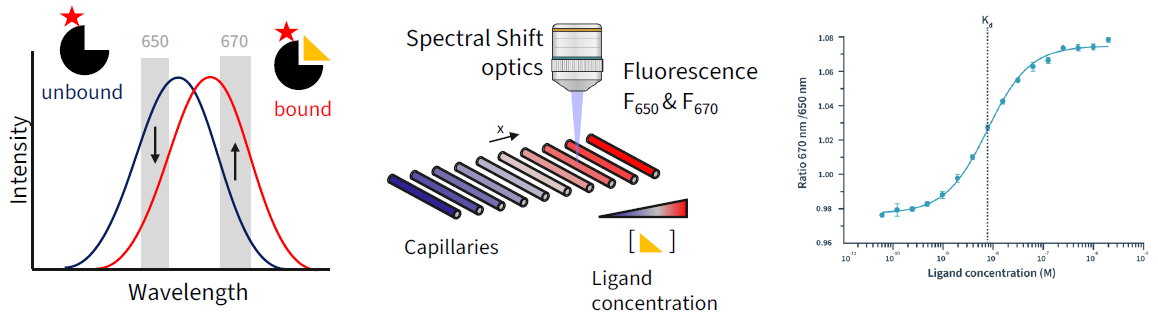
Image Credit: Image courtesy of Ravindra Chaudhari et al., in partnership with ELRIG (UK) Ltd.
- Spectral Shift monitors binding events on a target through environmental changes of a fluorophore.
- The ratiometric signal (F670/F650) is recorded for a ligand dilution series with constant target concentration.
- The resulting dose-response curve is fitted with a binding model, and the affinity (Kd/EC50) is extracted.
nanoTAK for determining kinetics
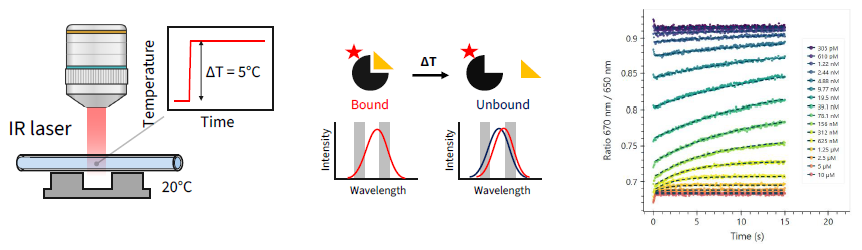
Image Credit: Image courtesy of Ravindra Chaudhari et al., in partnership with ELRIG (UK) Ltd.
- A precise laser-induced temperature increase disturbs the equilibrium of the interaction and causes dissociation of the complex.
- Relaxation to the new equilibrium at the higher temperature is recorded for all ligand concentrations and monitored with Spectral Shift.
- All recorded traces are fitted with a global kinetic model to obtain kon, koff, and Kd at the new temperature.
nanoLISA for determining stability
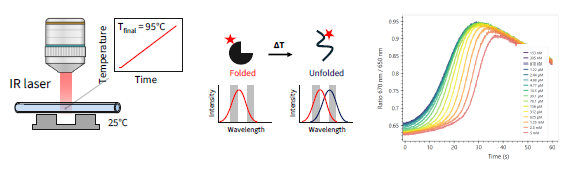
Image Credit: Image courtesy of Ravindra Chaudhari et al., in partnership with ELRIG (UK) Ltd.
- Each capillary is gradually heated with an infrared laser to a final temperature of 95 °C, thereby inducing thermal unfolding of the target.
- The heating profile is highly reproducible, allowing for thermal shift assays and comparison of target stability under different assay conditions.
- Ligand-induced stabilization of the target is identified by a shift in the inflection time of the unfolding profile.
Kinase–inhibitor interaction characterization
1. Validate binding with nanoLISA
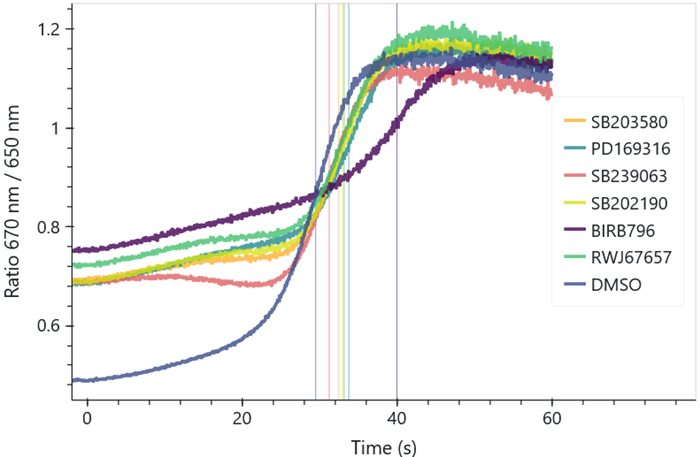
Image Credit: Image courtesy of Ravindra Chaudhari et al., in partnership with ELRIG (UK) Ltd.
- Stability analysis with nanoLISA shows that the labeled p38α is stable under the chosen buffer conditions.
- The addition of known binders further stabilizes the kinase, orthogonally validating the binding.
2. Determine affinity for selected inhibitors
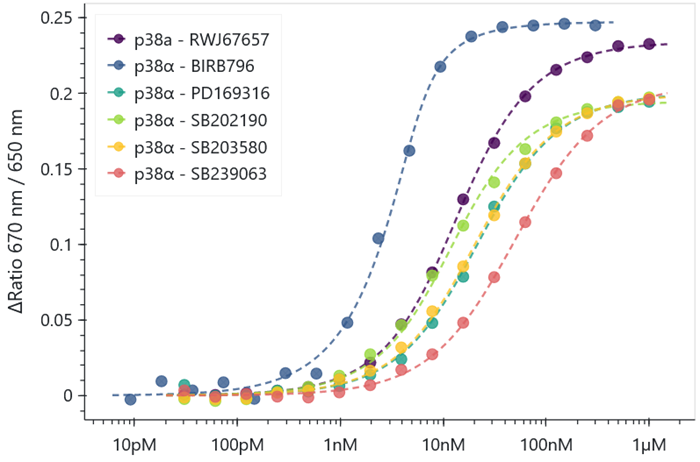
Image Credit: Image courtesy of Ravindra Chaudhari et al., in partnership with ELRIG (UK) Ltd.
| Ligand |
Kd |
| BIRB796 |
(663 ±112) pM |
| SB202190 |
(5.54 ±0.43) nM |
| RWJ67657 |
(5.57 ±0.13) nM |
| SB203580 |
(11.0 ±0.4) nM |
| PD169316 |
(11.6 ±0.6) nM |
| SB239063 |
(30.7 ±1.1) nM |
- Dose-response measurements with Spectral Shift allow ranking affinities from the nanomolar to millimolar range.
- Even subtle differences in affinity can be detected, and ranking allows to move forward with the most promising candidates.
3. Determine kinetic profile for the ligand panel
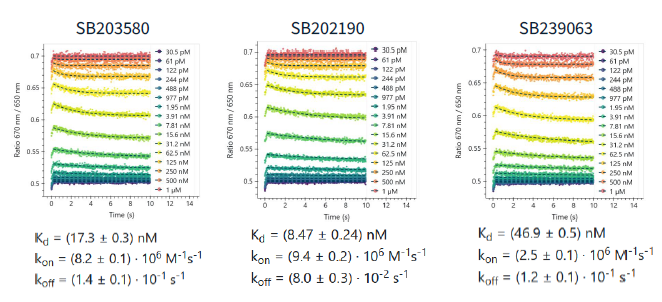
Image Credit: Image courtesy of Ravindra Chaudhari et al., in partnership with ELRIG (UK) Ltd.
- nanoTAK allows the study of binding kinetics of interactions in solution.
- From the same sample, nanoTAK delivers kon, koff, and Kd at the new temperature, providing a full kinetic profile of the ligand.
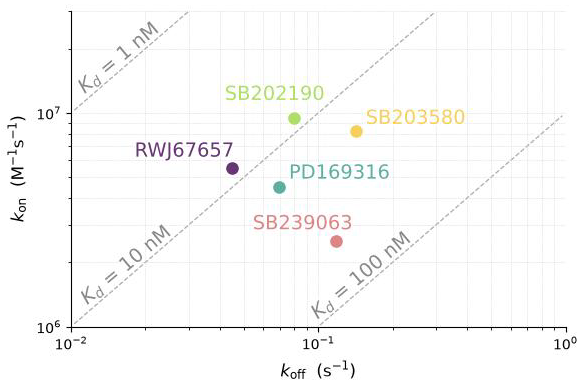
Image Credit: Image courtesy of Ravindra Chaudhari et al., in partnership with ELRIG (UK) Ltd.
- Subtle differences in the kinetic profile can be resolved, allowing optimization of ligands for affinity and kinetic properties.
4. Characterize kinetics of binding in detail
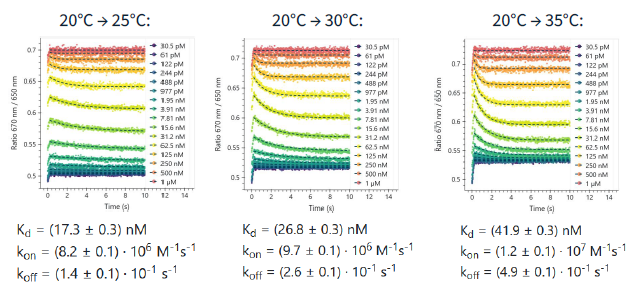
Image Credit: Image courtesy of Ravindra Chaudhari et al., in partnership with ELRIG (UK) Ltd.
- nanoTAK experiments can be repeated on the same sample to study the kinetics at different temperatures, ranging from 25 °C to 40 °C.
- Affinity of SB203580 to p38α decreases with increasing temperature.
- The on-rate increases modestly with temperature, while the off-rate increases three-fold from 25 °C to 35 °C.
5. Determine thermodynamics
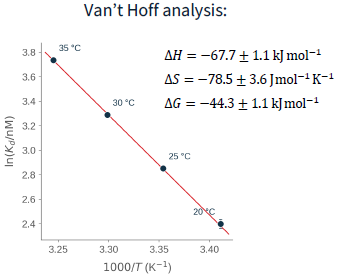
Image Credit: Image courtesy of Ravindra Chaudhari et al., in partnership with ELRIG (UK) Ltd.
- Thermodynamic parameters can be derived from Van’t Hoff experiments or nanoTAK experiments.
- Analysis shows that SB203580 binding to p38α is primarily enthalpy-driven.
About NanoTemper Technologies, Inc.
NanoTemper’s mission is to enable everyone to do science that matters by always pushing the limits
We’re a passionate team
Stefan Duhr and Philipp Baaske set out to build a company to address challenges researchers were facing with the ultimate goal of helping to move science forward.
NanoTemper was started in 2008 after Stefan and Philipp met at Ludwig-Maximilians-University, Munich. At the time, the effect of thermophoresis was not known within the Life Sciences community, but Stefan and Philipp knew that it was important. Realizing the shortcomings of current protein research techniques, they came up with a method, MicroScale Thermophoresis that was enormously sensitive, and would bring researchers one step closer to developing better drugs faster.
Representation in 13 countries, over 25 languages spoken
Now, NanoTemper has over 150 employees with representation in 13 countries around the world, including Germany, the UK, Poland, Denmark, Belgium, the Netherlands, Spain, France, the USA, Brazil, Russia, China, and India.
About ELRIG (UK) Ltd.
The European Laboratory Research & Innovation Group (ELRIG) is a leading European not-for-profit organization that exists to provide outstanding scientific content to the life science community. The foundation of the organization is based on the use and application of automation, robotics and instrumentation in life science laboratories, but over time, we have evolved to respond to the needs of biopharma by developing scientific programmes that focus on cutting-edge research areas that have the potential to revolutionize drug discovery.
Comprised of a global community of over 12,000 life science professionals, participating in our events, whether it be at one of our scientific conferences or one of our networking meetings, will enable any of our community to exchange information, within disciplines and across academic and biopharmaceutical organizations, on an open access basis, as all our events are free-of-charge to attend!
Our values
Our values are to always ensure the highest quality of content and that content will be made readily accessible to all, and that we will always be an inclusive organization, serving a diverse scientific network. In addition, ELRIG will always be a volunteer led organization, run by and for the life sciences community, on a not-for-profit basis.
Our purpose
ELRIG is a company whose purpose is to bring the life science and drug discovery communities together to learn, share, connect, innovate and collaborate, on an open access basis. We achieve this through the provision of world class conferences, networking events, webinars and digital content.
Sponsored Content Policy: News-Medical.net publishes articles and related content that may be derived from sources where we have existing commercial relationships, provided such content adds value to the core editorial ethos of News-Medical.net, which is to educate and inform site visitors interested in medical research, science, medical devices and treatments.
Last Updated: Oct 30, 2026
 Five leading life science organizations collaborate on inaugural London Bio-Innovation Week