Evident unveiled the winners of its sixth annual Image of the Year contest, an awards competition that recognizes the world’s best in scientific microscopic imaging. The winners were selected from submissions from 34 countries around the world.
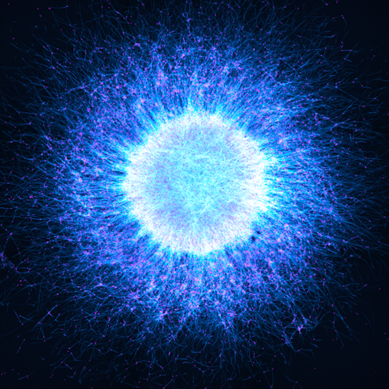 Evident Image of the Year Award 2025: Global Winner. Pluripotent stem cell-derived neurospheres. Captured using an Evident IXplore™ IX83 SpinSR super-resolution microscope system. Image Credit: Katie Holden, Great Britain
Global winner
Katie Holden of the United Kingdom was selected as the global winner for her striking image titled “Neuronal Cosmos.” The image showcases induced pluripotent stem cell-derived neurospheres consisting of neuronal cells, which self-organize into structures resembling the layered architecture of the human brain. Neurospheres serve as an important platform for studying brain cells, allowing for research into the effects of environmental and genetic factors on neuronal development.
“Visually, the star-like pattern reflects intriguing parallels between astronomy and biology at hugely different scales,” Holden explained. In recognition of her grand prize submission, Holden will receive an Evident SZX7 stereo microscope with a DP23 digital camera or a set of X Line™ UPLXAPO objectives.
Take A Closer Look At The Winning Images Here
Materials science winner
Muhammad Tahir Khan of Ireland was selected as the materials science winner. Khan’s winning image shows a lignin fiber that closely resembles glowing desert dunes under a scanning electron microscope. Khan will receive an Evident SZ61 stereo microscope for his winning image.
Regional winners
Three regional prizes were awarded to Gerd Günther (Germany) for EMEA (stigma of chicory with pollen grains), Igor Siwanowicz (USA) for the Americas (mallow pollen on stigma) and Kentaro Mochizuki (Japan) for Asia Pacific (sarcomere structures within cardiomyocytes in a rat heart). Each regional winner will receive their choice of an Evident CX23 upright microscope or SZ61 stereo microscope.
Honorable mentions
Honorable mentions include Javier Rupérez (Spain), Joe McKellar (France), Marko Pende (Austria), Alexandre Dumoulin (Switzerland), Bettina Rákóczi (Hungary), Walter Ferrari (Argentina), Hannah Somers (United States), Yue Rong Tan (Taiwan), Tong Zhang (Canada), Hange Du (China), Hanyang Xue (China) and Jan Rosenboom (Germany).
The contest launched on October 8, 2025, with a call for users to submit their best scientific images through January 30, 2026. A third-party jury from the global scientific community evaluated all entries based on artistic and visual appeal, scientific impact and microscope proficiency.
We are deeply inspired by the creativity and technical mastery reflected in this year’s entries, Each year, this contest celebrates what’s possible when art and science come together to illuminate the unseen.”
Wes Pringle, CEO, Evident
About the EVIDENT Image of the Year Award
Evident’s Image of the Year Award began as the Image of the Year European Life Science Light Microscopy Award with the aim to celebrate both the artistic and scientific value of microscopy images. Today, the competition stays true to this mission by encouraging people around the world to look at scientific images in a new way, appreciate their beauty and share images with others.
 New partnership creates an automated anatomic pathology slide-scanning solution