Jun 11 2026
An eight-month-old baby from Israel has become the first human ever to receive an experimental gene therapy designed to replace a missing gene responsible for a devastating neurological disease that until now offered no hope of survival.
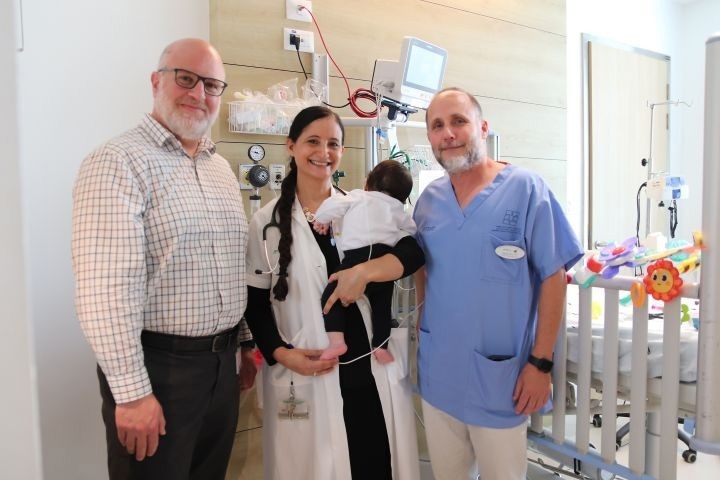 From right to left: Dr. Dror Kraus, Senior Physician, Neurology Unit and Epilepsy Specialist, Clalit-Schneider Children’s Medical Center; Dr. Naama Ornstein, Head of the Genetics Unit, Clalit-Schneider Children’s Medical Center; Prof Rami I. Aqeilan. Image Credit: Clalit Health Services - Schneider Children’s Spokesperson’s Office
The treatment was performed at Clalit-Schneider Children’s Medical Center, part of Clalit Health Services, Israel's largest health organization running 14 hospitals and 1600 community clinics nationwide. It took part after an extraordinary international effort involving physicians, researchers, regulators and biotech leaders who moved urgently to make the impossible possible for one small child.
The breakthrough began with Dr. Naama Ornstein, head of genetics unit at Clalit- Schneider, who immediately recognized the rare disorder after the baby was hospitalized with seizures and severe developmental decline. Years earlier, she had treated another child with the same condition, but at the time, the experimental therapy had not yet been available, and the child died. Alongside the genetic team, Dr. Dror Kraus, senior physician in the Neurology unit at Clalit-Schneider Children’s Medical Center and an epilepsy specialist, has been closely monitoring and treating the child since the day he arrived at the hospital.
Determined not to lose another patient, Dr. Ornstein reached out to the scientist who originally developed the therapy, Professor Rami I. Aqeilan, an Arab researcher from the Hebrew University of Jerusalem, whose academic discovery had since evolved into a clinical treatment acquired by a U.S. biotech company led by an Israeli-born physician and CEO.
Together, the unlikely team crossed borders, systems and bureaucracies to secure special emergency approval for the treatment, despite the fact that it had never before been administered to a human being.
In a delicate neurosurgical procedure, Dr. Ido Ben Zvi, from the Neurosurgery Unit at Clalit-Schneider Medical Center, injected a functioning copy of the missing gene directly into the baby’s brain, using a specially engineered viral vector designed to deliver the healthy gene into the central nervous system.
The operation required unprecedented medical and regulatory coordination, including special approvals from Israeli health authorities and international oversight bodies. Doctors say even the dosage calculations were extraordinarily sensitive, as the amount had to be tailored precisely to the infant’s brain size.
This was much more than a medical procedure. It was a fight for a child’s chance to smile, develop and live. Families often ask us: if a child is missing a working gene, why can’t we simply give them one? Usually, we have no answer. This time, for the first time in the world, we could."
Dr. Naama Ornstein, Head of Genetics Unit, Clalit- Schneider
The baby has since been discharged home, while doctors continue closely monitoring his neurological condition. At Clalit-Schneider Children’s Medical Center, the case is already being described as a landmark moment in the future of personalized genetic medicine ,and a rare story of science, humanity and cooperation overcoming every possible barrier in order to save a child’s life.
 Maternal stress alters placental pathways affecting fetal brain development