Sponsored Content by EvotecReviewed by Emily MageeJul 22 2026
The manufacture of cell-based therapies is inherently complex, but these therapies offer significant potential to cure a wide range of diseases.
 Image Credit: Shutterstock.com/Anusorn Nakdee
Transferring the manufacturing process from the development stage to a GMP manufacturing facility (often through an external partner) for a first-in-human clinical trial is one of the most challenging steps in the progression from early development to commercial production.
This step is especially important for small biotech companies because it requires considerable resource commitments in terms of personnel and finances, along with successful cooperation between manufacturers and partner companies over several years.
A new whitepaper from Evotec explores the key role of technology transfer activities and aims to help early developers navigate these manufacturing transitions.
Challenges and considerations are assessed, alongside the steps needed to ensure the successful transfer of process and product knowledge between facilities and teams to support a first-in-human study.
Technology transfer and its role in the drug product lifecycle
Technology transfer, or “tech transfer” as it is often referred to, is a key component of drug development and manufacturing.
Tech transfer involves transferring the cell-based product’s manufacturing process and its related analytical methods from the biotech company, referred to as the sending unit (SU), to the external partner, the receiving unit (RU). In this context, the RU is generally a contract development and manufacturing organization (CDMO).
Successfully undertaking the tech transfer process maintains consistency with the SU’s procedures by ensuring that all manufacturing and analytical processes are accurately reproduced at the RU.
Tech transfer seeks to ensure alignment with regulatory filings such as marketing authorizations or clinical trial applications, safeguard product quality, and adhere to applicable GMP and other regulatory requirements.
The ICH guideline Q10 on pharmaceutical quality systems states that:
"The goal of tech transfer activities is to transfer product and process knowledge between development and manufacturing, and within or between manufacturing sites to achieve product realization. This knowledge forms the basis for the manufacturing process, control strategy, process validation approach and ongoing continual improvement."
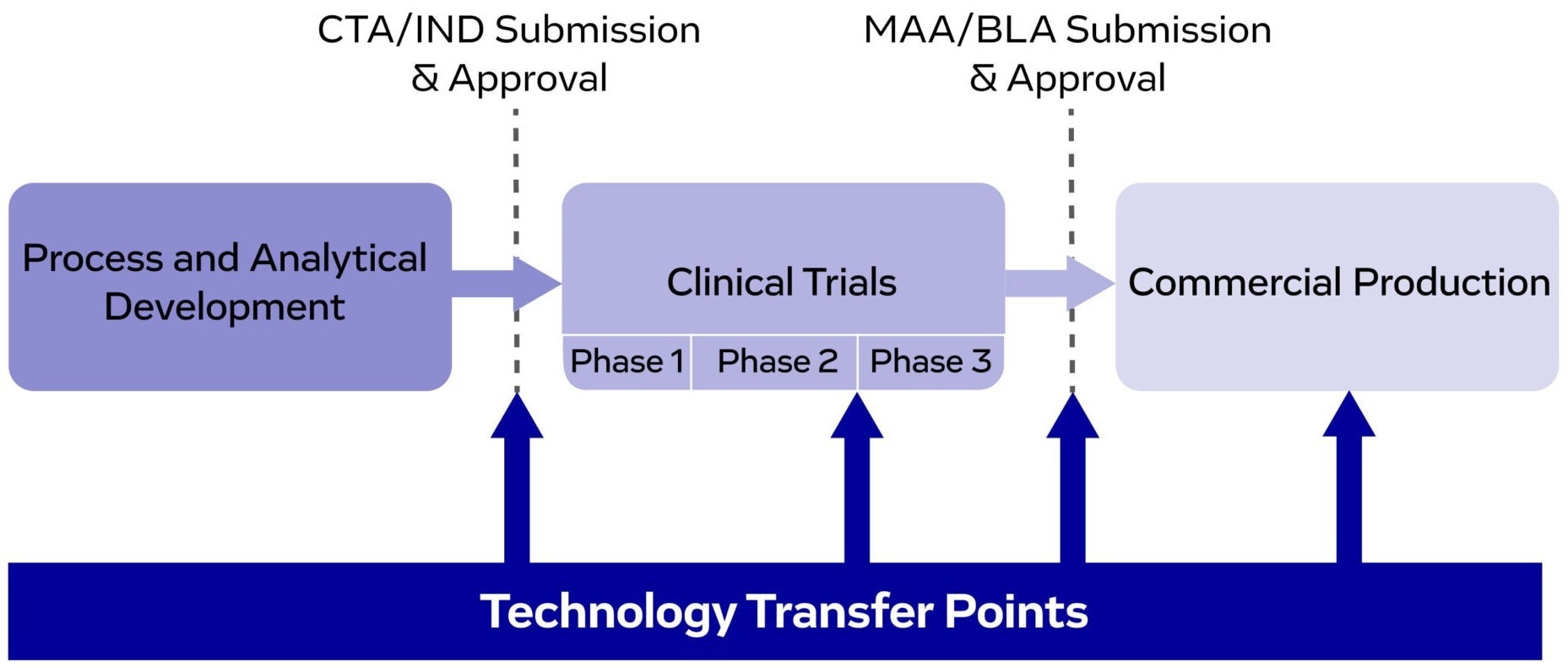
Figure 1. Technology transfer points throughout drug development and manufacturing, ensuring a smooth progression from preclinical development to commercial production. Image Credit: Evotec
Tech transfer is central to several stages of the drug product lifecycle, underpinning and facilitating the transition from development to GMP manufacturing for initial clinical supply.
It may be necessary to conduct additional tech transfers during later development phases and at market entry, for example, when offering the product in different regulatory regions or scaling product supply.
Challenges faced during the tech transfer of a cell therapy product
Developers regularly face major challenges when transferring manufacturing processes for cell-based products between organizations. For example, it can be difficult to ensure appropriate regulatory compliance and maintain product quality while adapting processes.
The use of research-grade raw materials remains a common issue because higher-quality alternatives remain scarce. This could necessitate additional testing to ensure consistent quality or the implementation of material substitutions during tech transfer.
In addition, equipment often varies among developers because standardized platform processes remain limited. Tech transfer may therefore require integrating a new device at the CDMO or switching to an alternative, both of which entail significant effort.
Cell-based products also tend to rely on distinct analytical assays, and these assays may be challenging to implement and validate at the RU.
Cell therapy manufacturing typically relies on manual processing steps, potentially necessitating longer periods in a cleanroom environment versus operations in a development laboratory.
The extended processing time in this scenario may also require reassessing the in-process stability of cell-based intermediates to ensure their viability and quality are maintained throughout the longer handling period.
Tech transfer in cell therapy faces a range of complexities, demanding substantial labor, materials, time, and cost. It is imperative that a successful transfer be ensured, however, because poor execution has the potential to compromise patient safety and product quality.
Evotec’s new whitepaper outlines the key steps for a successful tech transfer, from initial planning through to completion, helping developers better navigate these challenges.
About Evotec
Evotec is a life science company that is pioneering the future of drug discovery and development. By integrating breakthrough science with AI-driven innovation and advanced technologies, we accelerate the journey from concept to cure – faster, smarter, and with greater precision. Our expertise spans small molecules, biologics, cell therapies and associated modalities, supported by proprietary platforms such as Molecular Patient Databases, PanOmics and iPSC-based disease modeling.
With flexible partnering models tailored to our customers’ needs, we work with all Top 20 Pharma companies, over 800 biotechs, academic institutions, and healthcare stakeholders. Our offerings range from standalone services to fully integrated R&D programs and long-term strategic partnerships, combining scientific excellence with operational agility.
Through Just – Evotec Biologics, we redefine biologics development and manufacturing to improve accessibility and affordability. With a strong portfolio of over 100 proprietary R&D assets, most of them being co-owned, we focus on key therapeutic areas including oncology, cardiovascular and metabolic diseases, neurology, and immunology.
Evotec’s global team of more than 4,500 experts operates from sites in Europe and the U.S., offering complementary technologies and services as synergistic centers of excellence. Learn more at www.evotec.com and follow us LinkedIn and X/Twitter @Evotec.
Sponsored Content Policy: News-Medical.net publishes articles and related content that may be derived from sources where we have existing commercial relationships, provided such content adds value to the core editorial ethos of News-Medical.net, which is to educate and inform site visitors interested in medical research, science, medical devices and treatments.