Sponsored Content by EvotecReviewed by Ify IsiborAug 11 2026
RNA is a novel therapeutic target for small-molecule discovery, yet advancement has been constrained by limited structural data. Cryo-EM can address this limitation, however it favors larger molecular weight targets. By employing an RNA scaffold, Evotec resolved the structure of an 85-nt branched RNA identified in Nipah virus, obtaining a 2.9 Å global map with approximately 4 Å local resolution on the target RNA.
The perception of RNA as an ‘undruggable’ target is rapidly changing. Advancements in computational instruments, combined with diversification in compound mode of action, have started to produce promising results with the arrival of the first FDA-approved RNA-targeting compound (risdiplam) on the market alongside a growing list of compounds in clinical trials.1
Despite these developments, drugging RNA remains extremely difficult due to the lack of hydrophobic pockets, conformational heterogeneity, and low sequence complexity, as RNA is composed of just four different nucleotides.
In addition, the Protein Data Bank (PDB) lacks experimentally determined RNA structures, with just ~0.8% of deposited structures comprising RNA-only structures.
This low number of structures substantially restricts the training sets of artificial intelligence (AI) instruments, limiting their ability to correctly predict target RNA three-dimensional structures. For this reason, experimentally derived structural data plays a key role in facilitating structure-based drug discovery (SBDD), which helps to both reduce risk and accelerate RNA pharmaceutical discovery programs.
However, RNA structural biology continues to pose significant challenges. NMR model determination requires homogeneous samples of isotopically labeled RNA, ideally with low molecular weight (<15 kDa).
X-ray crystallography requires the production of well-ordered crystals that diffract to high resolution and, unlike most protein targets, continues to face the phase problem, which must be addressed with heavy atom soaks.
Cryo-electron microscopy (Cryo-EM), however, faces different challenges, instead restricted to a minimum target molecular weight (although RNA versatility still makes it a capricious target). To address the low-molecular-weight challenge, electron microscopists can fuse the target to a rigid RNA scaffold to increase the molecular weight of the targets, making them sufficiently large for cryo-EM.
Inspired by recent developments in RNA scaffold development, Evotec used a literature Tetrahymena ribozyme scaffold to determine the structure of a new RNA sequence.2 A judicious construct design enabled the fusion of a new 85-nucleotide viral branched RNA sequence, identified from the highly pathogenic Nipah virus genome, to the Tetrahymena ribozyme scaffold.
After completing in-house in vitro transcription, cryo-EM grids were prepared and optimized using Evotec’s in-house FEI Vitrobot. A total of 8000 exposures were then collected on eBIC’s industrial access Titan Krios. CryoSPARC was subsequently used to process data, generating a map with 2 Å average resolution and 4 Å local resolution for the target viral RNA.
Generating the first 3D structure of the target provided valuable insights into possible druggable pockets and accelerated Evotec’s chemistry program, which is focused on discovering innovative antivirals that bind to and inhibit the specific RNA sequence.
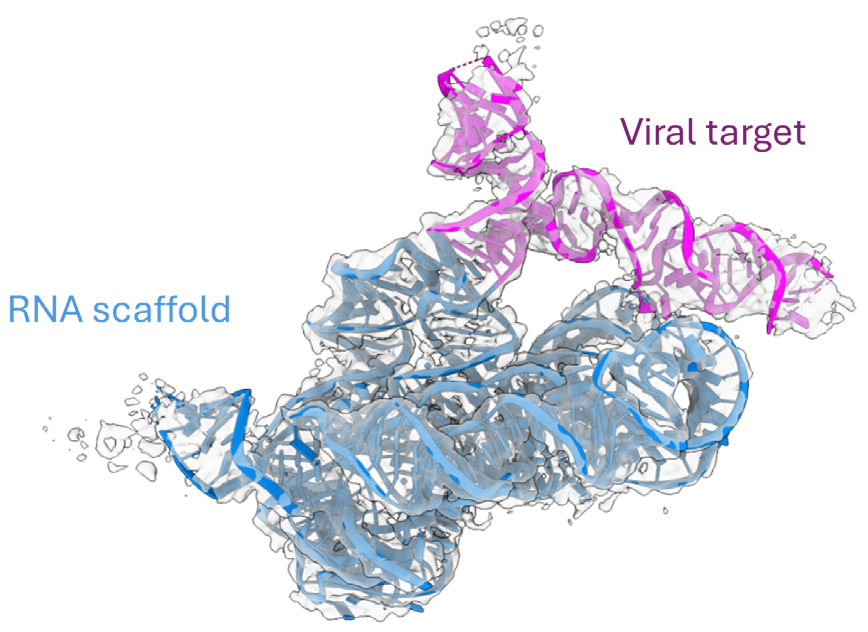
Figure 1. Cryo-EM structure of branched Nipah virus RNA (pink) fused to an RNA scaffold (blue). RNA shown in cartoon form with electron density envelope in transparent gray. Image Credit: Evotec
This successful and time-efficient strategy, which achieved full structure determination in 16 weeks, will serve as a template to structurally enable future RNA targets.
References and further reading
- Chen, S., et al. (2024). RNA-Binding Small Molecules in Drug Discovery and Delivery: An Overview from Fundamentals. Journal of Medicinal Chemistry. DOI:10.1021/acs.jmedchem.4c01330. https://pubs.acs.org/jmcmar/article-abstract/67/18/16002/171269/RNA-Binding-Small-Molecules-in-Drug-Discovery-and?redirectedFrom=fulltext.
- Conner J, L. and Kieft, J.S. (2023). A generalizable scaffold-based approach for structure determination of RNAs by cryo-EM. Nucleic Acids Research, 51(20), pp.e100-e100. DOI:10.1093/nar/gkad784. https://academic.oup.com/nar/article/51/20/e100/7288835.
Acknowledgments
Produced from materials originally authored by Ciaran McFarlane, PhD, Tamas Yelland, PhD, Mateusz Mieczkowski, PhD, and Mélissanne de Wispelaere, PhD, from Evotec.
This work was supported by Coefficient Giving (previously Open Philanthropy) and Good Ventures Foundation, under award number GV673602866.
About Evotec
Evotec is a life science company that is pioneering the future of drug discovery and development. By integrating breakthrough science with AI-driven innovation and advanced technologies, we accelerate the journey from concept to cure – faster, smarter, and with greater precision. Our expertise spans small molecules, biologics, cell therapies and associated modalities, supported by proprietary platforms such as Molecular Patient Databases, PanOmics and iPSC-based disease modeling.
With flexible partnering models tailored to our customers’ needs, we work with all Top 20 Pharma companies, over 800 biotechs, academic institutions, and healthcare stakeholders. Our offerings range from standalone services to fully integrated R&D programs and long-term strategic partnerships, combining scientific excellence with operational agility.
Through Just – Evotec Biologics, we redefine biologics development and manufacturing to improve accessibility and affordability. With a strong portfolio of over 100 proprietary R&D assets, most of them being co-owned, we focus on key therapeutic areas including oncology, cardiovascular and metabolic diseases, neurology, and immunology.
Evotec’s global team of more than 4,500 experts operates from sites in Europe and the U.S., offering complementary technologies and services as synergistic centers of excellence. Learn more at www.evotec.com and follow us LinkedIn and X/Twitter @Evotec.
Sponsored Content Policy: News-Medical.net publishes articles and related content that may be derived from sources where we have existing commercial relationships, provided such content adds value to the core editorial ethos of News-Medical.net, which is to educate and inform site visitors interested in medical research, science, medical devices and treatments.