Lil’ Tuna is an automated, plate-based system designed for ultrafiltration and diafiltration (UF/DF). This system efficiently performs buffer exchange, concentration, and desalting of proteins, viral vectors, and nucleic acids, consistently yielding high recoveries.
It enables parallel processing of 1 to 96 samples, requires minimal user intervention, and ensures reliable sample preparation for applications such as formulation screening, stability testing, and other downstream assays.
- Plates or single samples: Process 96- or 24-well plates, or one to six individual samples.
- Parallel processing with flexible volumes: 96-well plates accommodate 100–450 µL, while 24-well plates and single samples handle 0.45–8 mL per sample.
- Stellar recoveries: Achieve ≥96% sample recovery during buffer exchange or concentration.
- Concentration with full process control: Concentrate samples with accurate, automated final volume adjustment.
- Durable, low-binding consumables: Select regenerated cellulose (RC) or polyethersulfone (PES) membranes based on sample compatibility.
- Hands-free operation: Load samples, initiate the run, and allow the system to manage the complete UF/DF process independently.
- Automation-ready: Universal API software and a robot-compatible sample stage enable effortless integration into automated workflows.
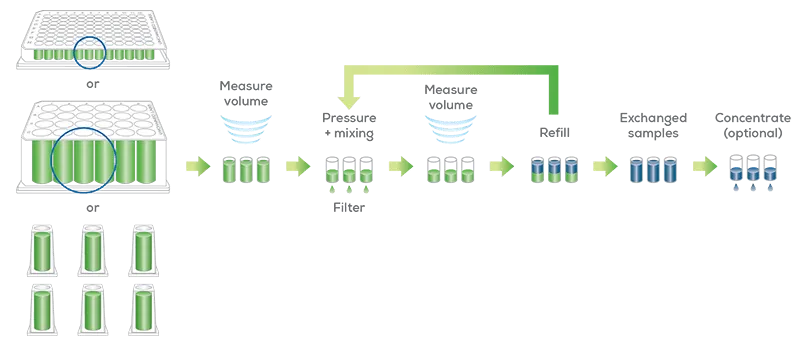
Image Credit: Unchained Labs
Capabilities
Whatever floats the throughput boat
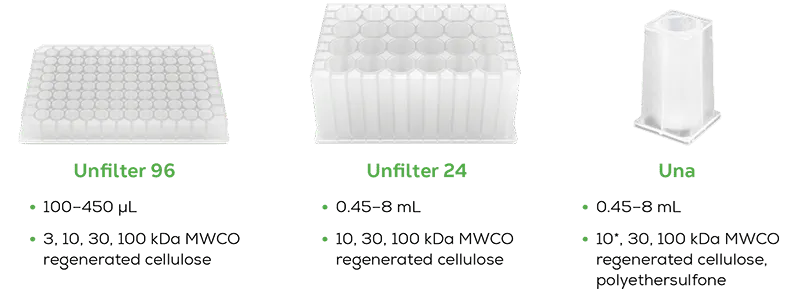
Image Credit: Unchained Labs
Lil' Tuna accommodates various sample volumes, from small batches to extensive formulation screens. For large sample quantities, Unfilter 96- or 24-plate options are available. For smaller projects, one to six Unas can be used. The system offers a selection of membrane chemistries and molecular weight cutoffs, ensuring sample compatibility with recoveries of 96% or higher.
Just flow with it
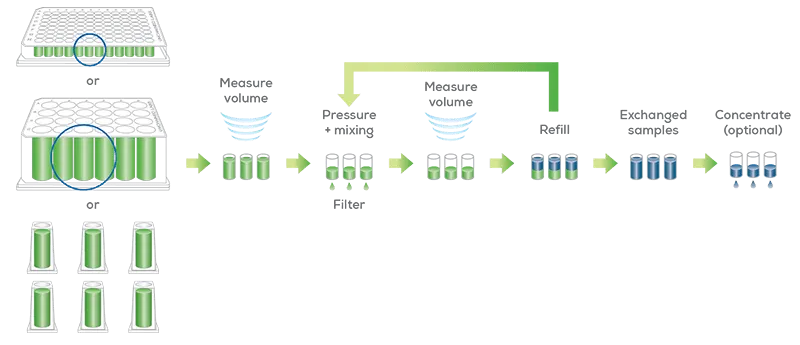
Image Credit: Unchained Labs
Lil' Tuna employs a proven pressure-based ultrafiltration/dia filtration method for buffer exchange. Each run begins with an ultrasonic volume sensor verifying the initial sample volume in each well. Samples are then pressurized, forcing filtrate through the membrane.
Gentle mixing maintains sample distribution and smooth flow. The volume is rechecked, and Lil' Tuna replenishes each well with exchange buffer. This process repeats until the target exchange percentage and volume are achieved.
Dive deep on concentration
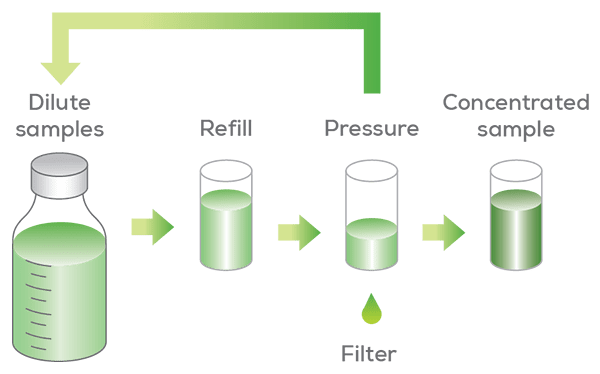
Image Credit: Unchained Labs
Concentration of samples for downstream assays is also possible. Lil' Tuna can reduce a liter of dilute sample to 192 mL, with further reduction achievable through an additional concentration step.
Tackle thick exchanges
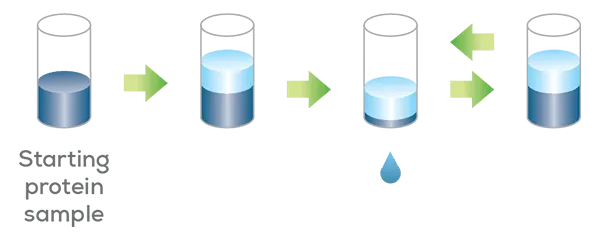
Image Credit: Unchained Labs
To address challenges with high viscosity, which can prolong buffer exchange, Lil' Tuna adds exchange buffer before initial pressurization. This ensures efficient sample flow and maintains viscosity control throughout the run.
User-friendly setup
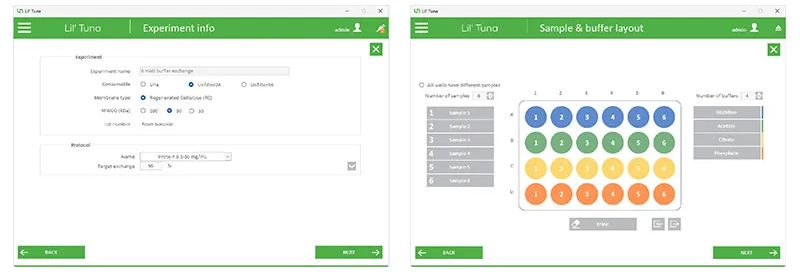
Image Credit: Unchained Labs
Setting up a Lil' Tuna run is straightforward. The software allows for quick exchange design, enabling users to specify target exchange percentage and volume. Samples and buffers can be easily assigned to wells via drag-and-drop functionality. A pipette guide eliminates guesswork when handling multiple samples. Loaded plates or Unas are placed on the stage, buffer bottles are filled, and the run is initiated.
Check the line
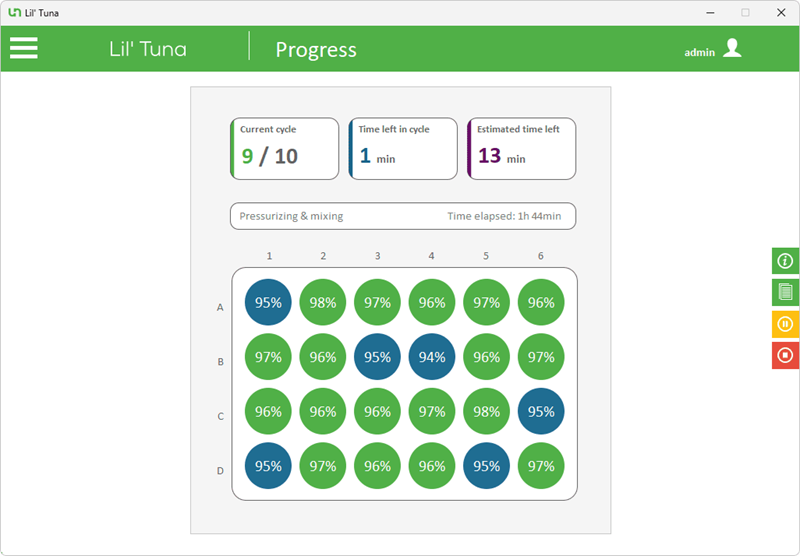
Image Credit: Unchained Labs
Users can monitor run progress at any time. Lil' Tuna displays completed exchange cycles, current filtration status, per-sample exchange percentage, and estimated time remaining. Early-finishing samples can be removed during a paused run while others continue. The system indicates when the run is complete.
Easy syncing with other Unchained devices
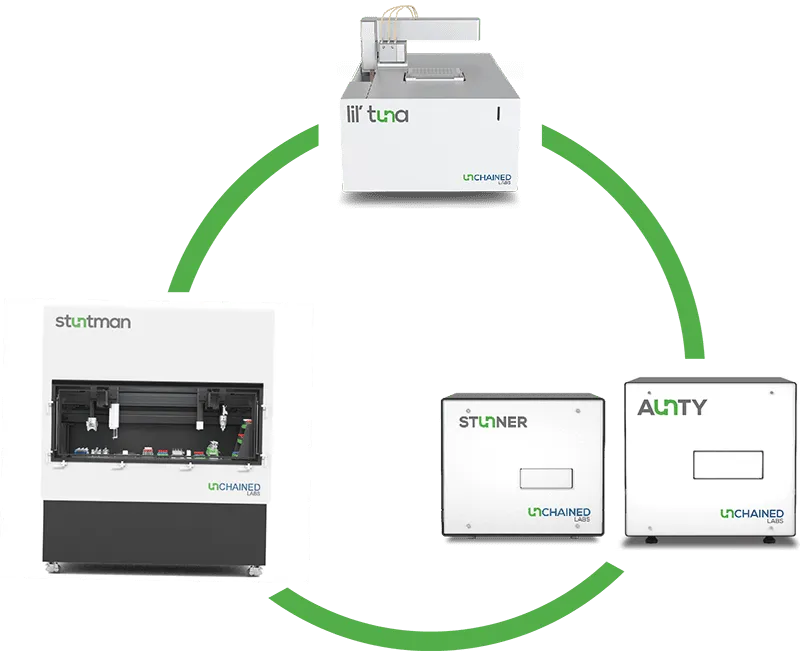
Image Credit: Unchained Labs
Lil' Tuna integrates seamlessly into automated laboratory environments through API software, an accessible sample stage, and simple template import functions. The system is designed to work in harmony with any automation setup, linking with analytical tools and workflow solutions.
Tech
Ultrafiltration and diafiltration (UF/DF)
What it does
UF/DF uses size-selective membranes to hold larger molecules (proteins, nucleic acids, viral vectors, and LNPs) while allowing smaller molecules (salts, solvents, and buffers) to flow through.
Why it matters
This process facilitates controlled buffer exchange, desalting, and concentration without the need for manual centrifugation, thereby maintaining sample integrity and guaranteeing reproducible downstream outcomes.
Specifications
Source: Unchanged Labs
| Application |
|
| Buffer exchange volume range |
Una: 0.45–8 mL
Unfilter 24: 0.45–8 mL
Unfilter 96: 100–450 µL |
| Formulations |
Up to six formulations in parallel |
| Samples |
Una: up to six samples in parallel
Unfilter 24: up to 24 samples in parallel
Unfilter 96: up to 96 samples in parallel |
| Sample types |
Antibodies and other proteins, nucleic acids, viral vectors |
Exchange time at full volume
(96%, at 10 mg/mL IgG) |
Una: 4.5 hours*
Unfilter 24: 4.5 hours*
Unfilter 96: 3 hours* |
| Protein concentration (range) |
Up to 200 mg/mL* |
| Dispense precision |
<300 µL: ≤3 µL
0.3–8 mL: ≤1%
|
| Target concentration accuracy |
±10%* |
| Sample recovery |
≥96%* |
| System |
|
| Volume measurement |
Ultrasonic sensor |
| Exchange pressures |
15–60 psi |
| Operating temperature |
Room temperature |
| Buffer exchange orbital mixing |
Unfilter 24 and Una: optimized at 700 rpm
Unfilter 96: optimized at 875 rpm
Duty cycle programmable |
| Physical |
36.8 cm W x 57.8 cm D x 37.2 cm H; 38.4 kg (instrument) |
| Electrical |
Voltage 100–260 VAC, 50–60 Hz |
| Nitrogen or CDA requirement |
Pressure 0.55–0.9 MPa (80–130 psi) |
| Consumables |
|
| Una |
10, 30, and 100 kDa, regenerated cellulose
30 and 100 kDa polyethersulfone |
| Unfilter 24 |
10, 30, and 100 kDa, regenerated cellulose |
| Unfilter 96 |
3, 10, 30, and 100 kDa, regenerated cellulose |
*Sample and formulation dependent.