Stunner AF is a plate-based dynamic-light scattering, UV/visible, and fluorescence tool developed for lipid nanoparticles.
Conquer LNP characterization with DLS, UV/Vis, and fluorescence
Stunner AF combines fluorescence detection with plate-based, high-throughput, rotating-angle UV/Vis and dynamic light scattering (DLS) absorbance measurements to analyze up to 96 samples using as little as 2 µL per sample.
It integrates all three technologies to measure particle concentration data, encapsulation efficiency, and lipid nanoparticle size in a single experiment. The solution is used for quantifying antibody drug conjugates, proteins, and peptides, similar to Unchained Labs' Stunner.
- Encapsulation efficiency: This is measured by integrating total RNA quantification from UV/Vis and free RNA quantification from fluorescence; the measurement is seamless, provides high-throughput, and is detergent-free.
- Conjugate characterization: Allows for quantifying protein concentration in parallel with lipid nanoparticle characterization.
- Particle concentration: The system can measure the total number of lipid nanoparticles (LNP) in a sample to compare LNP production from one batch or condition with the other.
- Size and polydispersity: It allows users to measure the diameter of lipid nanoparticles, which is essential for screening, formulation, and quality control.
- Aggregate detection: The RADLS feature helps in removing unwanted samples and particles, thereby ensuring smooth process flow.
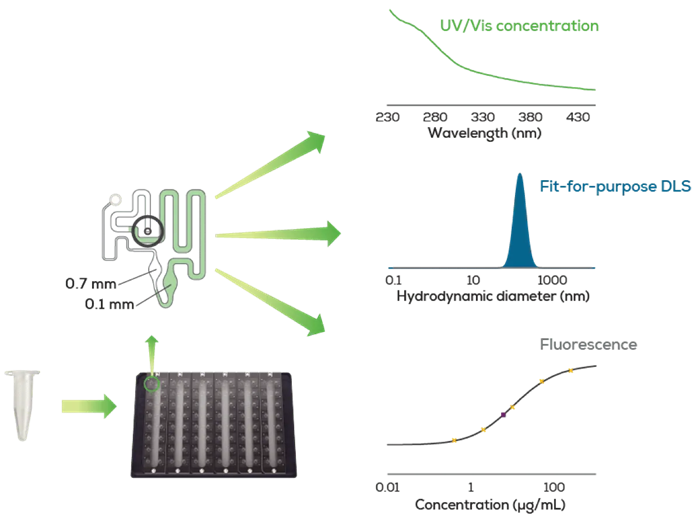
Image Credit: Unchained Labs
Revolutionize EE%
Stunner AF (Add Fluorescence) combines UV/Vis analysis and particle sizing with fluorescence detection to enable dye-based quantification of free RNA, helping users analyze standards, RiboGreen-treated LNPs, and LNPs to measure both free RNA and total RNA.
It also allows users to create custom assays or deploy Unchained Labs’ optimized applications for encapsulation efficiency and particle sizing to streamline LNP characterization.
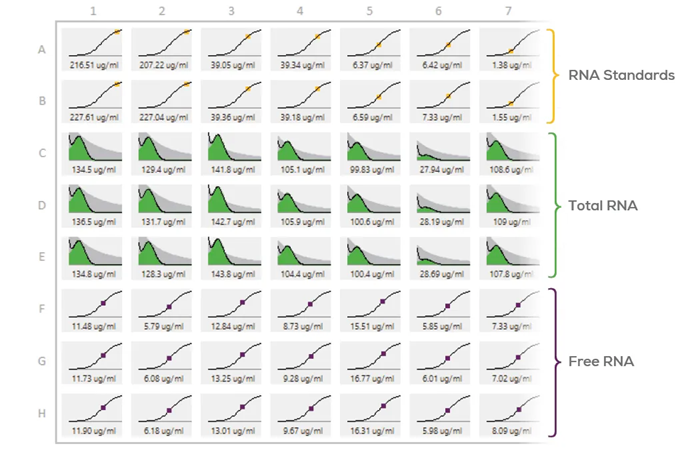
Image Credit: Unchained Labs
See through the fog
Traditional techniques have challenges with analyzing cloudy solutions of LNPs and other nanoparticles. However, Stunner’s short path lengths combined with UV/Vis remove the bottlenecks. The Unmix feature removes the turbidity and provides an accurate absorbance signal from the payload.
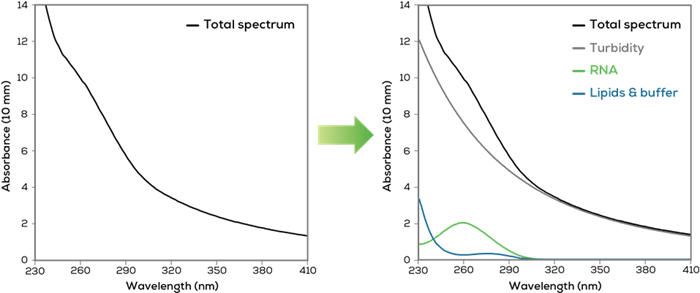
Image Credit: Unchained Labs
LNP sizing and quant in one shot
Stunner counts and sizes up LNPs by integrating static and dynamic light-scattering data from various angles. Users can compare different mixing parameters and formulations to arrive at the right LNP size along with the maximum number of particles.
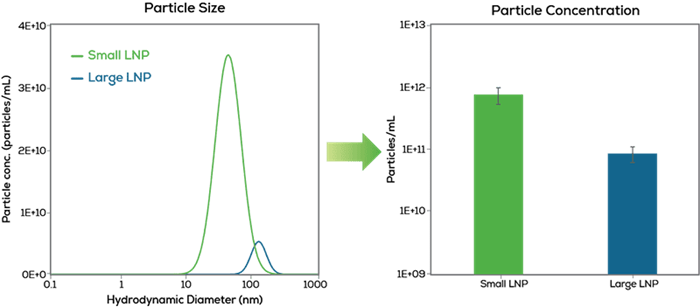
Image Credit: Unchained Labs
Distribution levels
Stunner can identify even minimal aggregation levels. Users can analyze their LNP sizes by intensity distribution and also identify any aggregates. If aggregation becomes a concern, users can switch to mass distribution analysis to better understand its extent and impact. Users can also gain detailed insights about particle size distribution and identify aggregate populations with improved confidence.
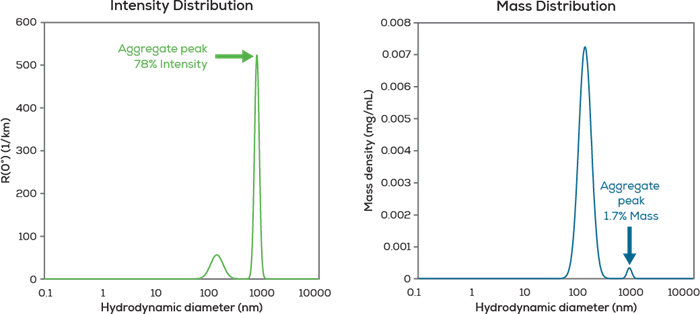
Image Credit: Unchained Labs
Screening at speed
Stunner is ideal for LNP screening and characterization, enabling users to analyze up to 44 samples on a single plate in two hours. The system integrates fluorescence, dynamic light scattering, static light scattering, and UV/Vis from different angles to measure the encapsulation efficiency, size, particle concentration, and total payload concentration. It provides detailed analysis of the entire lipid nanoparticle.
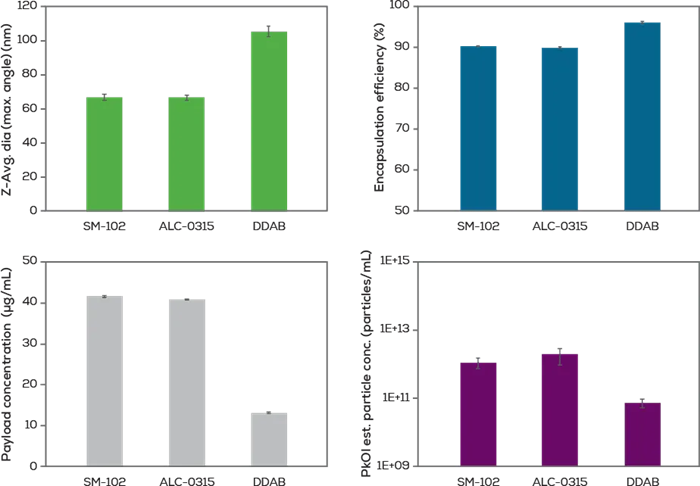
Image Credit: Unchained Labs
Technology
Rotating-angle dynamic light scattering (RADLS)
What it does
Rotating-angle dynamic light scattering (RADLS) is a type of dynamic light scattering that analyzes a sample at different angles in a single experiment by rotating a detector. It is a sensitive method to determine the particle size and distribution for larger particles and also provides accurate information on particle concentration.
Why it matters
RADLS assists LNP scientists in rapidly measuring aggregation and particle size and in ensuring the production of ideal-sized particles using specific processes and formulations. Particle concentration provides data on the number of particles in different batches.
Fluorescence
What it does
The fluorescence of nucleic acid-sensitive dyes is proportional to the RNA (or DNA) concentration free-floating in the sample.
Why it matters
Fluorescence is a reliable method to measure the amount of free RNA present in a sample to determine LNP encapsulation efficiency.
UV/Vis
What it does
UV/Vis measures light absorbance in the UV and visible spectrum to analyze the concentration of peptides, proteins, nucleic acids, and other small molecules.
Why it matters
UV/Vis can rapidly measure nucleic acid concentrations, and the Unmix deconvolution algorithms can analyze LNP-encapsulated total RNA concentration. This measurement is also critical to determine the encapsulation efficiency.
Static light scattering
What it does
Static light scattering (SLS) is the measurement of light scattered by particles in a solution. An SLS measurement collected during a RADLS experiment is equivalent to a multi-angle SLS experiment.
Why it matters
SLS measurements are used to analyze particle concentration, molecular weight, or B22 measurements, depending on the experimental design.
Specifications
Source: Unchained Labs
| Stunner instrument specifications |
| Dimensions |
Stunner: 37 cm W x 58 cm D x 33 cm H; 29.3 kg
Stunner AF: 37 cm W x 58 cm D x 33 cm H; 30 kg |
| Electrical |
Universal input voltage 100–240 V AC, 50–60 Hz |
| Computer |
Separate computer with Windows 11 included |
| Connection |
USB, TCP/IP (Service) |
| Approval |
CE, FCC, CSA |
| Regulatory compliance |
Optional 21CFRp11 software package; USP and Ph. Eur. Performance verification standards |
Source: Unchained Labs
| UV/Vis |
| Light source |
Xenon flash lamp |
| Detectors |
UV/Vis polychromatic spectrophotometer |
| Wavelength range |
230–750 nm |
| Wavelength accuracy |
≤400 nm: ±1 nm; >400 nm: ±2 nm |
| Spectral resolution |
Better than 2 nm (toluene in hexane) |
| Absorbance precision (1 cm quartz cuvette) |
<1 OD: ±0.005 OD st dev |
1–2 OD: ±0.5% CV |
| Absorbance accuracy (1 cm quartz cuvette) |
<1 OD: ±0.01 OD |
1–2 OD: ±1% |
Source: Unchained Labs
| Fluorescence (Stunner AF only) |
| Channels |
Blue/Green (Ex. 475 nm LED / Em. 515–565 nm)
Red/Far Red (Ex. 624 nm LED / Em. 672–712 nm) |
Source: Unchained Labs
| DLS and rotating angle DLS |
| Light source |
Two 660 nm laser diodes |
| Detection |
Avalanche photodiode module |
| Number of angles |
One (DLS), five to 30 (RADLS) |
| Angular range |
30–42 ° and 110–162 ° |
| Size accuracy |
±2% |
| Minimum sample concentration |
0.1 mg/mL lysozyme |
| Hydrodynamic diameter range |
0.3–1000 nm |
| Particle concentration range |
109–5x10¹³ particles/mL (dependent on particle size, determined on 80 nm beads) |
Source: Unchained Labs
| Stunner plate specifications |
| Samples per plate |
96 (12 x eight microplate format) |
| Sample retention time |
Up to two hours |
| Recommended sample volume |
2 µL |
| Pathlength(s) |
0.1 mm & 0.7 mm path |
| Measurement time for full plate |
∼10 minutes for UV/Vis only
∼One hour for UV/Vis and DLS (five x four s x one angle)
∼Two hours 15 minutes for UV/Vis and RADLS (five x one s x seven angles) |
Measurement range:
OD 10 mm:
ng/µL dsDNA:
mg/mL ave protein mix: |
0.03–275 OD 10 mm
1.5–13750 ng/µL
0.03–275 mg/mL |
| Absorbance precision (10 mm pathlength) |
<1 OD: ±0.01 OD st dev |
1–200 OD: ±1% CV |
| Absorbance accuracy (10 mm pathlength) |
<1 OD: ±0.02 OD |
1–200 OD: ±2% |