Sunscreen, from Unchained Labs, uses microfluidics to quickly generate low-volume nanoparticle samples while automating the screening process of nanoparticle formulations. All the processes, including sample collection, reagent handling, and cleaning, are automated, thereby producing stable, ready-to-test particles in minutes. This allows users to screen more formulations and payloads.
- Range of reusable mixers: Sunnies (microfluidic mixers) are manufactured using glass and are available in a wide range of shapes and sizes. The system automatically cleans the mixers after each experiment, thereby reducing the costs and manual intervention involved in the process.
- Scale-ready results: Sunscreen uses the same mixers and pumps as the Sunbather and Sunshine. This ensures seamless process transfer from screening to good manufacturing practices.
- Microfluidic precision: The system allows users to generate uniform nanoparticles with improved consistency using controlled microfluidic workflows, with less than 1% CV over 90 runs
- No cross-contamination: The system automatically cleans all wetted parts between each experiment, preventing reagent carryover and providing high-integrity samples.
- Low reagent consumption: Users can run 400 µL (3:1 ratio) experiments using as little as 100 µL per reagent input. This minimizes material waste while improving data quality.
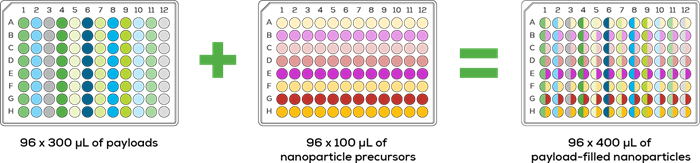
Image Credit: Unchained Labs
Find the user’s flow
By loading the plates, users can operate Sunny to mix up their nanoparticles. The systems are available in a wide range of sizes and shapes, with nine different options to meet the requirements of any application. The systems are infinitely reusable, can be changed in seconds, are automatically cleaned after every experiment, and can accommodate any increase in the sample volume.
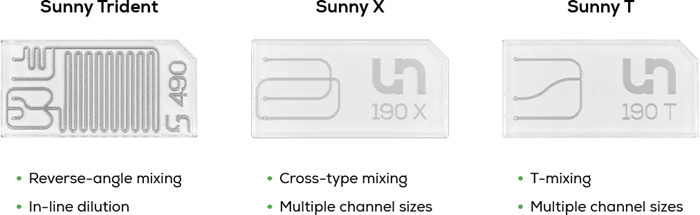
Image Credit: Unchained Labs
Set it and forget it
Sunscreen’s Sunny Suite Software operates with basic user instructions such as the nature of the sample on the plate, flow rate, and ratio. The system has an integrated validation feature to check each experiment to prevent any interruption in the workflow. As the system takes minimal time to generate nanoparticles, users will have ample time to perform buffer exchange or characterize the nanoparticles.
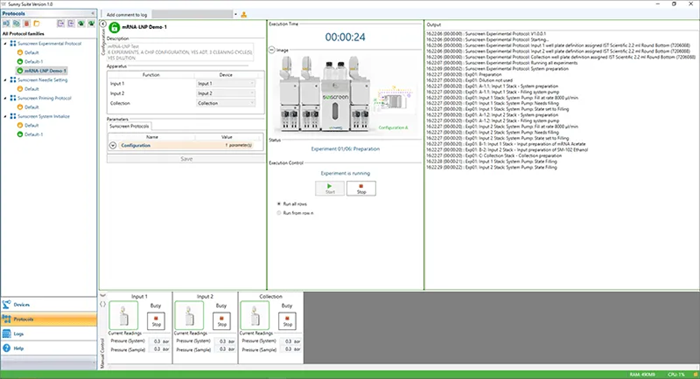
Image Credit: Unchained Labs
Do more with less
Nucleic acid synthesis often requires significant expense and complex processes. Conversely, Sunscreen allows users to customize volumes and concentrations, which enables the use of minimal payloads to generate the most valuable polymers. The system can operate with reusable consumables to generate 96 formulations in less than 15 minutes.
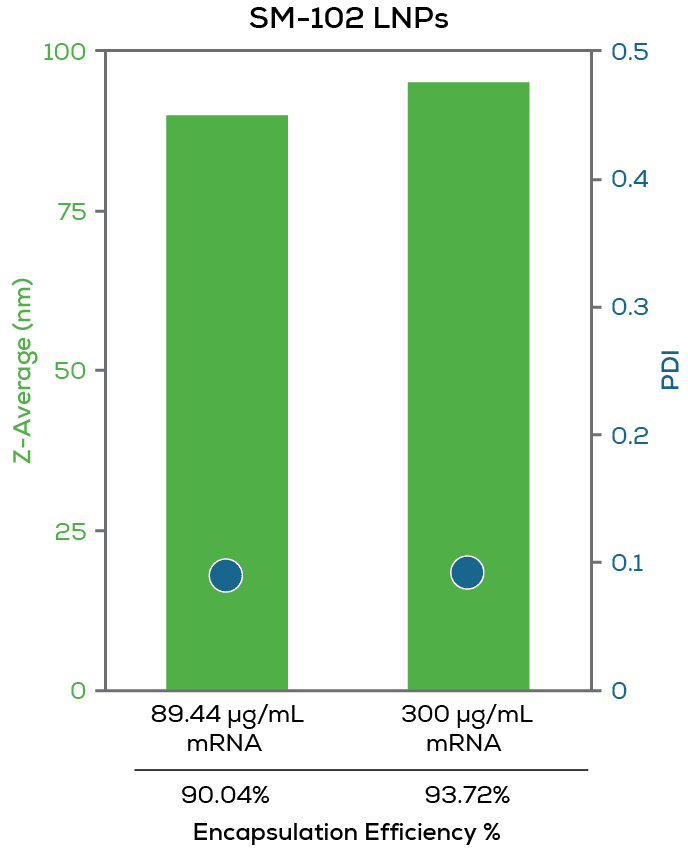
Image Credit: Unchained Labs
Bank on it
Sunscreen provides each formulation with high consistency. Automated cleaning between experiments prevents reagent carryover, thus ensuring the quality of each formulation. Users can also integrate the system with Stunner AF (Add Fluorescence) to improve their workflow and check the payload quantity, particle size, and encapsulation efficiency.
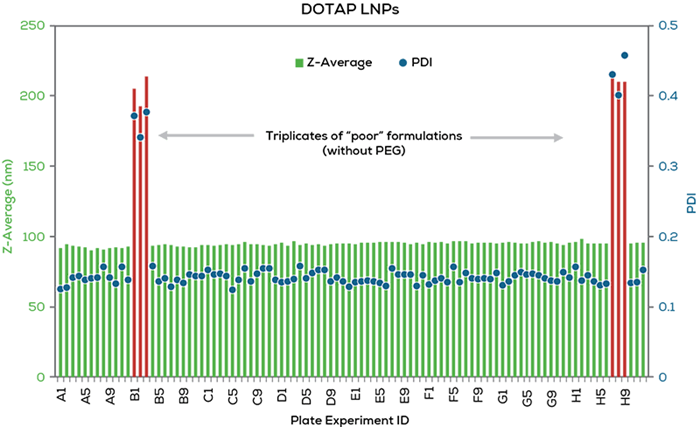
Image Credit: Unchained Labs
Narrow it down
Sunscreen allows users to test various formulations, so they can differentiate good formulations from the bad ones and identify the correct formulation combo to finalize the payload and particle delivery performance. Users can optimize top-tier formulations by transferring them to Sunshine, Sunbather, or Sunny.
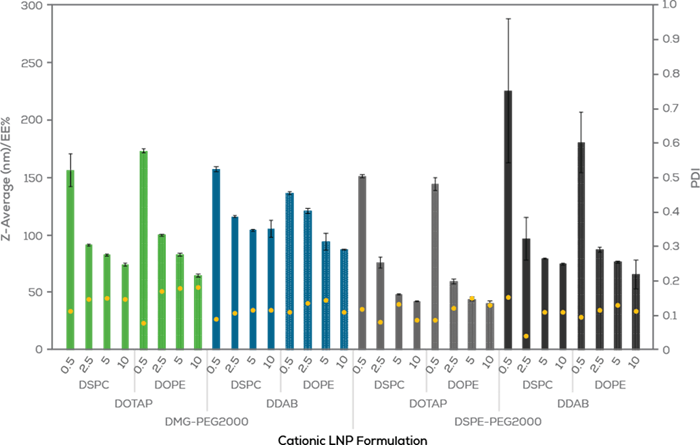
Image Credit: Unchained Labs
An end-to-end workflow with the Sunny Suite
The Sunny Suite has a solution for every step in nanoparticle development. Sunscreen automates high-throughput screening of up to 96 formulations. Sunshine monitors the ideal conditions required for mixing in both automated experiments and continuous-flow modes. Sunbather finetunes the particles in a GMP-compliant environment during clinical trials.
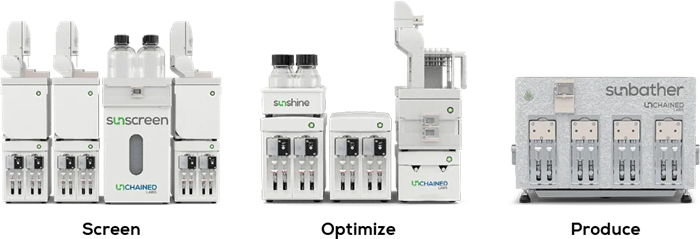
Image Credit: Unchained Labs
Trust the process
The Sunny Suite ensures a seamless workflow from formulation screening to process development to GMP production by providing identical fluid and microfluidic mixing at each stage of the process. The system is suitable for screening hundreds of formulations as well as producing liters of particles for clinical trials.
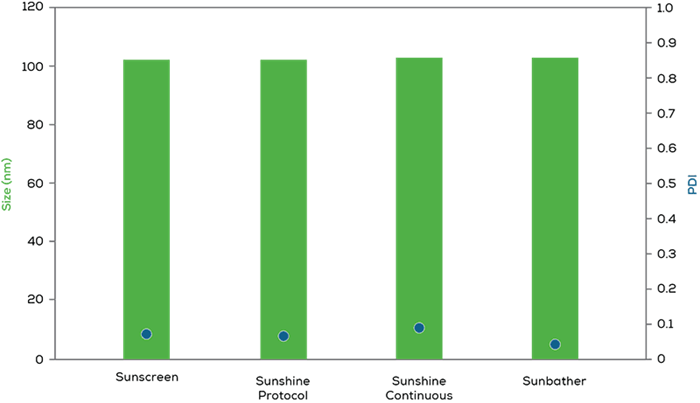
Image Credit: Unchained Labs
Technology
Microfluidics
What it does
Microfluidics uses sub-millimeter channels to mix reagents under highly controlled flow conditions for precise, reproducible particle formation.
Why it matters
By enabling quick self-assembly, a feature required for process optimization and scale-up, the technology generates nanoparticles with uniform size and encapsulation.
Driving fluids
What it does
Ethanol and buffer streams push the reagents through the flow path, ensuring continuous flow with minimal reagent use.
Why it matters
Driving fluids enable users to perform realistic, continuous-flow screening and direct translation from microliter- to liter-scale runs.
Anti-dispersion technology
What it does
A small volume of air is passed before and after the reagent to prevent it from mixing with the driving fluids used to propel the reagent through the flowpath, while protecting it from dispersion mixing.
Why it matters
It maintains sample integrity and yield even at ultra-low sample volumes.
T-mixing
What it does
The T-shaped channel allows two fluids to be added together to ensure quick mixing.
Why it matters
T-mixers can be scaled down to a microfluidic scale and used for particle formation, as well as X-type channels and more.
Specifications
Source: Unchained Labs
| Application |
|
| Throughput |
Three to four minutes per sample, up to 96 samples |
| Total flow rate range (Sunny dependent) |
0.1–30 mL/min |
| Typical sample volume (3:1 FRR) |
0.4–2 mL |
| Minimum input volume (including dead volume) |
≥105 µL |
| Continuous mode |
No |
| In-line dilution |
Yes |
| Flow rate ratio range (aqueous to organic) |
1:1 to 5:1 |
| Typical particle size range |
40–200 nm* |
| PDI |
<0.2* |
| Encapsulation efficiency |
>90%* |
| Instrument |
| Physical |
| Weight and dimensions (cm) |
57 kg; 60 H × 90 W × 40 D |
| Electrical |
| Voltage input |
100 V–240 V AC, 50–60 Hz |
| Communications |
USB |
| Other Information |
| Sample loop size |
2.5 mL |
| Fluid store volumes |
4 × 1000 mL bottles |
| Wetted materials |
PTFE, PCTFE, FEP, ETFE, PEEK, Polypropylene, FFKM, Hastelloy C276, Stainless Steel T316, Glass, Tygon (waste tubes), HDPE (waste container) |
| Computer |
Separate computer with Win 11, monitor, keyboard, and mouse (not included in dimensions) |
| Consumable |
|
| Sunnies |
Glass microfluidic mixing devices of various geometries and channel sizes |
| Available types |
Sunny 490 Trident T, Sunny 100 X, Sunny 100 T, Sunny 190 X, Sunny 190 T, Sunny 275 X, Sunny 275 T, Sunny 150 3D, Sunny 50 Micromixer |
* Formulation dependent