Stunner provides plate-based, high-throughput dynamic light scattering (DLS) and UV/Vis absorbance data using only 2 µL of sample for up to 96 samples. UV/Vis measurements can be acquired concurrently with DLS runs, enabling the pairing of quantification and sizing for proteins, ADCs, and peptides.
- Size and polydispersity: Assess expected protein diameter and uniformity, which are crucial for screening, formulation, and quality control
- Aggregate detection: Identify undesirable particles and compromised samples for rapid issue resolution
- Protein concentration: Obtain highly accurate quantification from sample absorbance across a broad range of 0.03-275 mg/mL, while also detecting potential impurities
- Conjugate characterization: Characterize ADC samples with DAR analysis, suitable for high-throughput optimization
- B22 and kD: Gain early insights into colloidal stability through protein self-interactions, aiding in the prediction of protein stability and the effects of various formulations
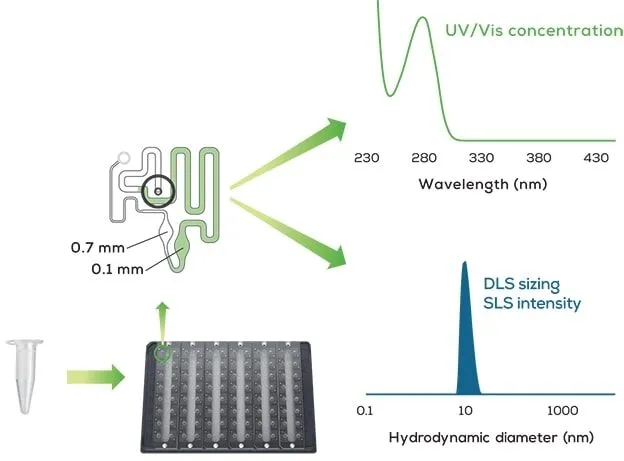
Image Credit: Unchained Labs
Capabilities
Ridiculously good data
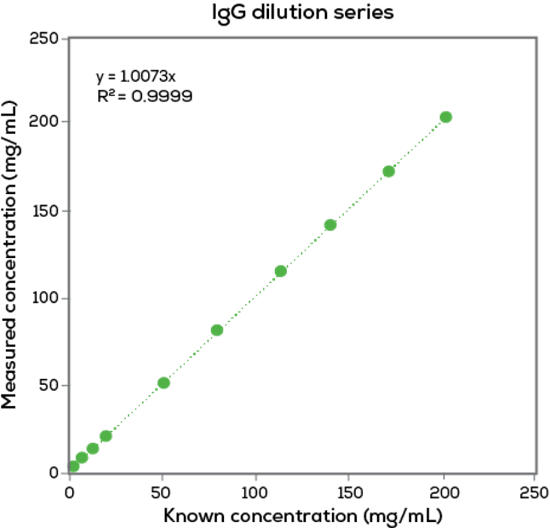
Image Credit: Unchained Labs
Source: Unchained Labs
| Known Conc. (mg/mL) |
Average Conc. (mg/mL) |
CV (%) |
| 201.4 |
201.7 |
0.7% |
| 169.9 |
171.1 |
0.7% |
| 139.4 |
140.7 |
0.4% |
| 113.1 |
115.0 |
0.6% |
| 79.4 |
80.7 |
0.2% |
| 50.2 |
51.2 |
0.2% |
| 19.9 |
20.3 |
0.3% |
| 12.1 |
12.2 |
0.2% |
| 7.21 |
7.28 |
0.2% |
| 2.35 |
2.37 |
0.2% |
Achieve precise measurements within 1% and accuracy within 2%. Stunner utilizes two fixed pathlengths to deliver exceptional data across a range of protein concentrations, consistently yielding expected results. With the smallest sample volume, highest throughput, and remarkably accurate outcomes, Stunner stands out as the premier instrument for protein quantification.
Get the skinny on proteins
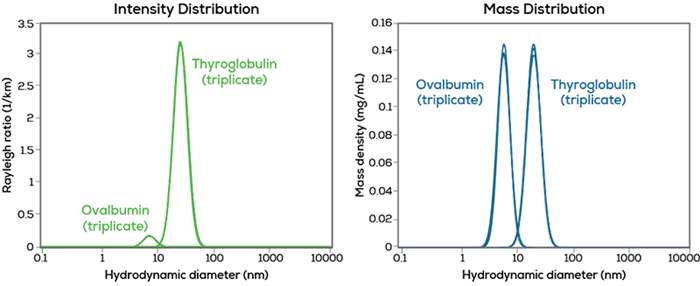
Image Credit: Unchained Labs
Source: Unchained Labs
| Protein |
Z-Avg Dia (nm) |
PDI |
| Ovalbumin |
6.6 ± 0.1 |
0.09 ± 0.01 |
| Thyroglobulin |
22.0 ± 0.7 |
0.12 ± 0.01 |
Stunner provides highly accurate light scattering data for proteins, enabling direct comparison of samples based on size, intensity, mass, and particle count. The instrument measures hydrodynamic size, determines polydispersity for uniformity assessment, and demonstrates excellent reproducibility with replicates aligning closely.
Track down the big boys
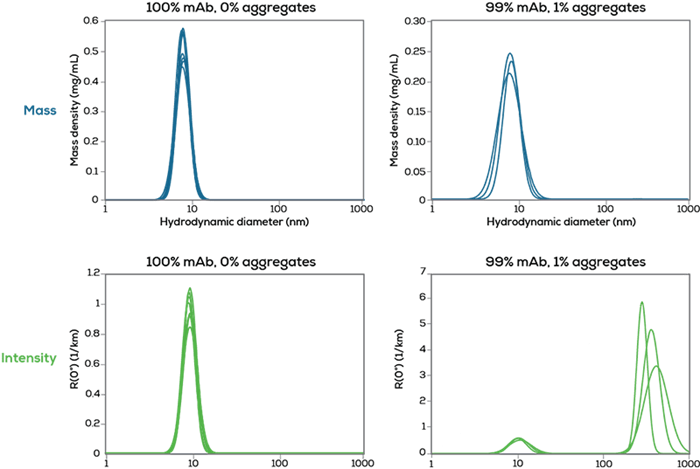
Image Credit: Unchained Labs
Stunner is the best when it comes to the rapid and easy detection of aggregates. Monomer mass can be determined, and a switch to intensity measurements allows for the identification of even minor aggregation. This capability facilitates protein quality control throughout the process, enabling the detection of aggregation before it escalates.
Decode any ADC spectra
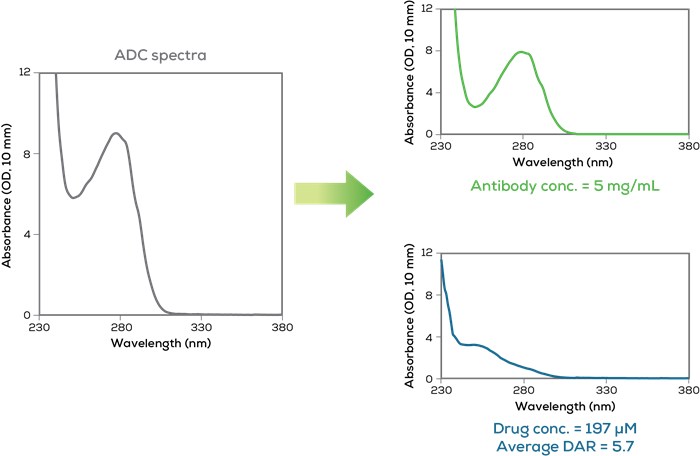
Image Credit: Unchained Labs
Quantifying ADCs using UV/Vis can be challenging due to drug spectra interference in the UV range. Stunner's Unmix feature deconvolutes ADC absorbance into distinct spectra for the antibody and the drug or linker, even with overlapping spectral profiles. This automated spectral decoding provides a simple, high-throughput method for determining antibody concentration, conjugate concentration, and DAR.
Feel the attraction
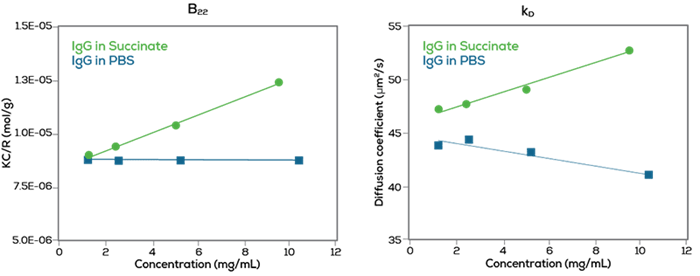
Image Credit: Unchained Labs
Preventing aggregation is essential. Stunner identifies potential issues by measuring B22 and kD in a single, straightforward experiment. The process involves creating a rapid dilution series, loading it onto a plate, and proceeding. Stunner determines precise concentrations, while light scattering reveals whether the protein is attractive (negative slope) or repulsive (positive slope).
Know the AAV inside out
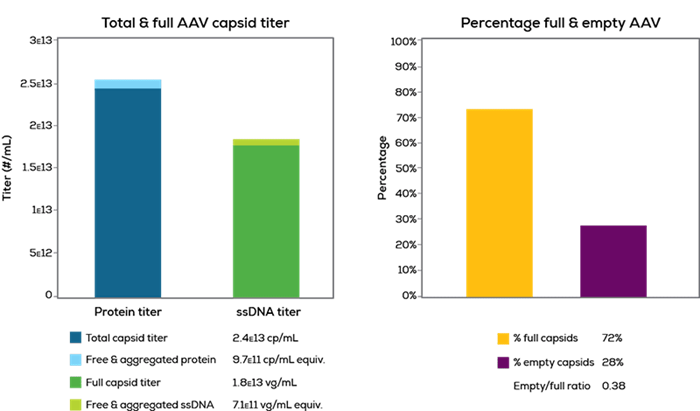
Image Credit: Unchained Labs
Obtain the desired quantitative results - titers. Stunner integrates DLS and UV/Vis data to calculate the quantities of full and empty capsids, along with any residual free protein and DNA. Analyze purified AAV down to 1012 vg/mL. In a single assay, Stunner's dye-free, label-free, standard-free, and user-friendly workflow provides a complete titer analysis.
Tech
Dynamic Light Scattering (DLS)
What it does: Dynamic Light Scattering (DLS) is a technique that quantifies the speed of particle diffusion in solution to ascertain particle size and size distribution.
Why it matters: DLS assists biologics researchers in rapidly determining particle size and aggregation, providing crucial information regarding protein stability and sample quality.
UV/Vis
What it does: UV/Vis spectroscopy measures light absorbance within the ultraviolet and visible (UV/Vis) portions of the spectrum, which directly relates to the concentration of proteins, peptides, nucleic acids, and other small molecules.
Why it matters: UV/Vis enables rapid measurement of protein or nucleic acid concentrations. Furthermore, Stunner's advanced Unmix deconvolution algorithms can differentiate absorbance from various molecules, allowing for the quantification of components within a mixture or conjugate, such as protein and DNA, or an antibody and its attached drug.
Static Light Scattering (SLS)
What it does: Static Light Scattering (SLS) involves measuring the quantity of light scattered by particles suspended in solution.
Why it matters: SLS measurements are utilized to determine particle concentration, B22 values, or molecular weight, contingent upon the specific experimental configuration.
Specifications
Biologics. Source: Unchained Labs
| Stunner instrument specifications (Biologics) |
| Dimensions |
37 cm W x 58 cm D x 33 cm H; 29.3 kg |
| Electrical |
Universal input voltage 100-240 V AC, 50-60 Hz |
| Computer |
Separate computer with Windows 11 included |
| Connection |
USB, TCP/IP (Service) |
| Approval |
CE, FCC, CSA |
| Regulatory compliance |
Optional 21 CFR p11 software package
USP and Ph. Eur. Performance verification standards |
| UV/Vis |
| Light source |
Xenon flash lamp |
| Detectors |
UV/Vis polychromatic spectrophotometer |
| Wavelength range |
230-750 nm |
| Wavelength accuracy |
≤ 400 nm: ± 1 nm; > 400 nm: ± 2 nm |
| Spectral resolution |
Better than 2 nm (toluene in hexane) |
| Absorbance precision (1 cm quartz cuvette) |
< 1 OD: ± 0.005 OD st dev |
1-2 OD: ± 0.5% CV |
| Absorbance accuracy (1 cm quartz cuvette) |
< 1 OD: ± 0.01 OD |
1-2 OD: ± 1% |
| DLS and rotating angle DLS |
| Light source |
2 x 660 nm laser diodes |
| Detection |
Avalanche photodiode module |
| Number of angles |
1 (DLS), 5 – 30 (RADLS) |
| Angular range |
30-42 °
110-162 ° |
| Size accuracy |
± 2% |
| Minimum sample concentration |
0.1 mg/mL lysozyme |
| Hydrodynamic diameter range |
0.3–1000 nm |
| Molecular weight range |
1 kDa – 10 GDa |
| Particle concentration range |
109 – 5x10¹³ particles/mL (dependent on particle size, determined on 80 nm beads) |
| Stunner plate specifications |
| Samples per plate |
96 (12 x 8 microplate format) |
| Sample retention time |
Up to 2 hours |
| Recommended sample volume |
2 µL |
| Pathlength(s) |
0.1 mm & 0.7 mm path |
| Measurement time for full plate |
∼10 minutes for UV/Vis only
∼1 hour for UV/Vis and DLS (5 x 4 s x 1 angle)
∼2 h 15 min for UV/Vis and RADLS (5 x 1 s x 7 angles) |
Measurement range:
OD 10 mm
ng/µL dsDNA
mg/mL ave protein mix |
0.03–275 OD 10 mm
1.5–13750 ng/µL
0.03–275 mg/mL |
| Absorbance precision (10 mm pathlength) |
< 1 OD: ± 0.01 OD st dev
1–200 OD: ± 1% CV |
| Absorbance accuracy (10 mm pathlength) |
< 1 OD: ± 0.02 OD
1–200 OD: ± 2% |
Viral Vectors. Source: Unchained Labs
| Stunner instrument specifications (Viral Vectors) |
| Dimensions |
37 cm W x 58 cm D x 33 cm H; 29.3 kg |
| Electrical |
Universal input voltage 100-240 V AC, 50-60 Hz |
| Computer |
Separate computer with Windows 11 included |
| Connection |
USB, TCP/IP (Service) |
| Approval |
CE, FCC, CSA |
| Regulatory compliance |
Optional 21 CFR p11 software package
USP and Ph. Eur. Performance verification standards |
| UV/Vis |
| Light source |
Xenon flash lamp |
| Detectors |
UV/Vis polychromatic spectrophotometer |
| Wavelength range |
230-750 nm |
| Wavelength accuracy |
≤ 400 nm: ± 1 nm; > 400 nm: ± 2 nm |
| Spectral resolution |
Better than 2 nm (toluene in hexane) |
| Absorbance precision (1 cm quartz cuvette) |
< 1 OD: ± 0.005 OD st dev |
1-2 OD: ± 0.5% CV |
| Absorbance accuracy (1 cm quartz cuvette) |
< 1 OD: ± 0.01 OD |
1-2 OD: ± 1% |
| DLS and rotating angle DLS |
| Light sources |
2 x 660 nm laser diodes |
| Detection |
Avalanche photodiode module |
| Number of angles |
1 (DLS), 5 – 30 (RADLS) |
| Angular range |
30-42 °
110-162 ° |
| Size accuracy |
± 2% |
| Minimum sample concentration |
0.1 mg/mL lysozyme |
| Hydrodynamic diameter range |
0.3–1000 nm |
| Molecular weight range |
1 kDa – 10 GDa |
| Stunner plate specifications |
|
| Samples per plate |
96 (12 x 8 microplate format) |
| Sample retention time |
Up to 2 hours |
| Recommended sample volume |
2 µL |
| Pathlength(s) |
0.1 mm & 0.7 mm path |
| Measurement time for full plate |
∼1 h for AAV Quant (UV/Vis + DLS)
∼2 h 15 min for Adeno Quant (UV/Vis + RADLS) |
Measurement range:
OD 10 mm
AAV Quant
Adeno Quant |
0.03–275 OD 10 mm
1012 – 5x10¹⁵ cp/mL
109 – 5x10¹⁴ cp/mL |
| Absorbance precision (10 mm pathlength) |
< 1 OD: ± 0.01 OD st dev
1–200 OD: ± 1% CV |
| Absorbance accuracy (10 mm pathlength) |
< 1 OD: ± 0.02 OD
1–200 OD: ± 2% |