Introduction & Theoretical Foundations
Clinical Efficacy and Comparison to Standard Care
Primary Clinical Applications
Technological Augmentation & Delivery
Operational Limitations & Implementation Barriers
References
Further reading
Virtual environments let clinicians adjust feared situations with unusual precision, but what determines whether VR learning carries into everyday life?
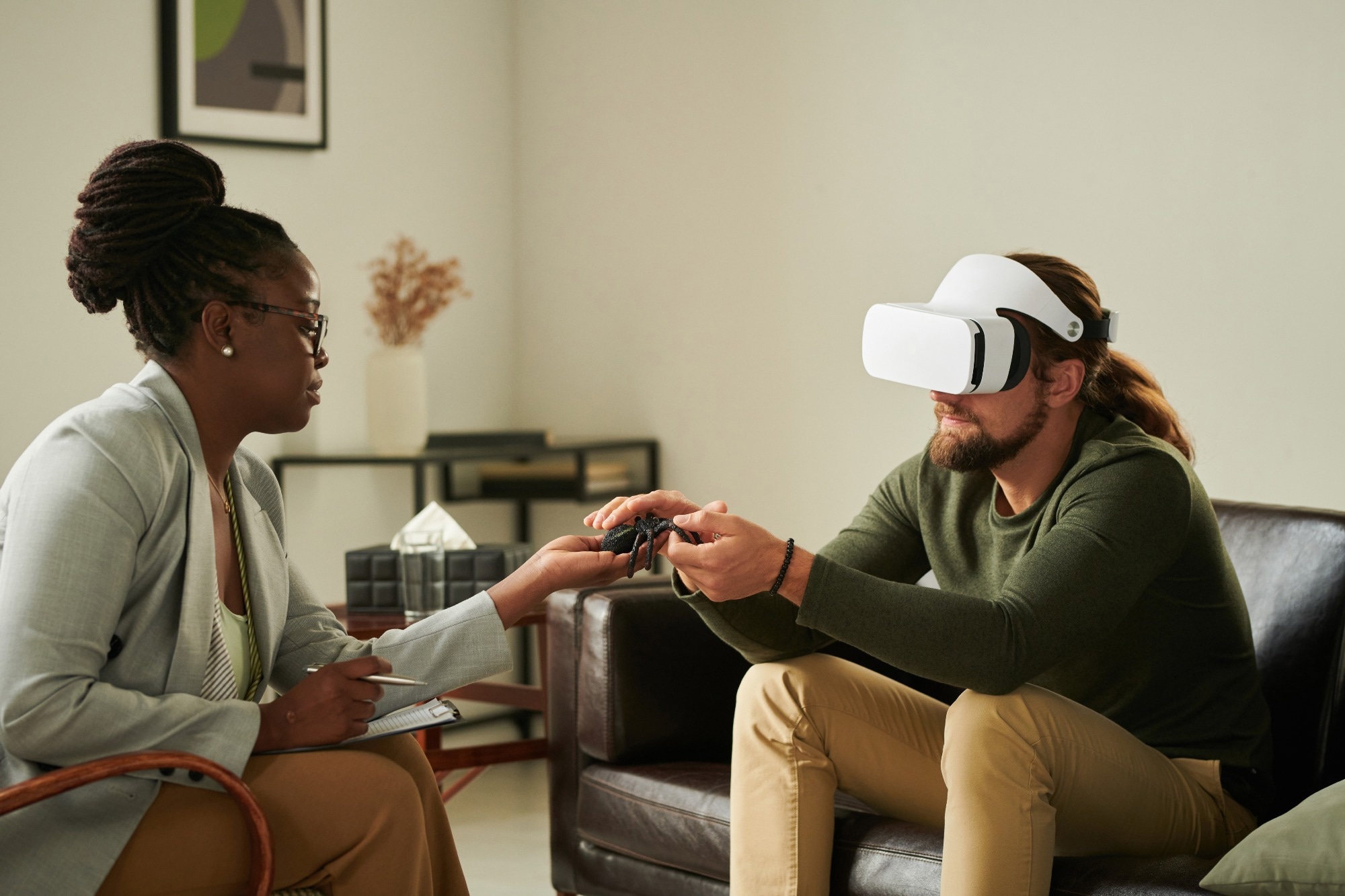 Image Credit: Anna Stills / Shutterstock.com
Introduction & Theoretical Foundations
Traditional in-person exposure therapy can be difficult to arrange and offers limited control over real-world stimuli, driving interest in technology-based interventions that offer greater flexibility with fewer logistical demands. Virtual Reality Exposure Therapy (VRET) has been widely studied for treating specific phobias and social anxiety disorder (SAD). During VRET, patients repeatedly confront fear-provoking stimuli and situations in a controlled virtual environment.
VR can provide an immersive, three-dimensional setting, with interactivity varying between systems. Exposure within these environments can activate fear and support inhibitory learning through expectancy violations, in which feared outcomes fail to occur as predicted. This learning creates new associations that compete with existing fear associations, which may persist after treatment.1-4
VRET is a digital adaptation of exposure therapy, often delivered within cognitive behavioral therapy (CBT), in which immersive simulation replaces or augments in vivo and imaginal exposure. Three relevant concepts in VRET include presence, immersion, and embodiment.
Presence, or the feeling of “being there” in the virtual world, can help virtual stimuli evoke emotional responses, whereas immersion refers to the technical ability of hardware and software to create a surrounding sensory environment. Embodiment is the extent to which a patient feels a virtual body is their own, and is particularly relevant to interventions involving body representation.1
VRET can create scenarios that are challenging or impractical to replicate in real life and tailor them to elicit fear responses. Therapists can pause, repeat, or select scenarios based on patient progress and feedback. VRET offers controlled exposure in the office and can reduce the travel and organizational demands of therapist-supported real-world exposure.3,4
How Does Virtual Reality Exposure Response Prevention Therapy Work? | Treating Anxiety with VR-ERP.
Clinical Efficacy and Comparison to Standard Care
VRET has demonstrated efficacy in treating anxiety and related disorders, with meta-analyses reporting large effect sizes against waiting-list or control conditions. Comparisons with active treatments require separate interpretation, as some studies have reported no significant overall difference in effect size or attrition as compared to in vivo exposure. The absence of a statistically significant difference does not, by itself, demonstrate treatment equivalence.
Virtual environments can avoid some physical hazards associated with real-world scenarios and may improve treatment acceptability. Lower refusal rates have been reported, but lower dropout rates are not consistently established.3,4
Two common VRET delivery approaches are interactive computer-generated environments and 360° video systems. Interactive computer-generated VRET allows patients to engage with avatars, affect their surroundings, or receive immediate feedback during exposure.
Using 360° video systems, clinicians may present prerecorded scenarios without interactive elements. Evidence is particularly developed for specific phobias, including fear of heights, spiders, and flying, while blood-injury-injection phobias remain less represented in RCTs. Treatment effects and evidence quality vary across disorders and delivery systems.1,4
In one RCT comparing VRET, eye movement desensitization, and reprocessing (EMDR), and a waiting-list condition, both active treatments reduced self-reported symptoms of acrophobia and anxiety sensitivity as compared with the waiting list after six weekly sessions. Outcomes were assessed one week after treatment, without a real-world behavioral test or long-term follow-up; furthermore, the small, all-female adolescent sample limits generalization to other populations.2
In clinical trials, automated, gamified virtual height environments have significantly reduced fear without a therapist’s presence. Single-session VRET appears to be non-inferior to traditional in vivo treatment for arachnophobia in a specific trial, though this finding should not be generalized to all VRET protocols.1,3
In SAD, virtual environments simulate public speaking and social interactions that are difficult to replicate reliably in real-world settings. Studies suggest VRET may be as effective as in vivo CBT in some treatment protocols.
Consumer-grade hardware can simulate job interviews or audience presentations without hiring interviewers or audience members. For public speaking anxiety, one trial reported comparable improvements with therapist-led and self-led VRET; however, this does not establish equivalence across the wider range of symptoms associated with SAD.1,3
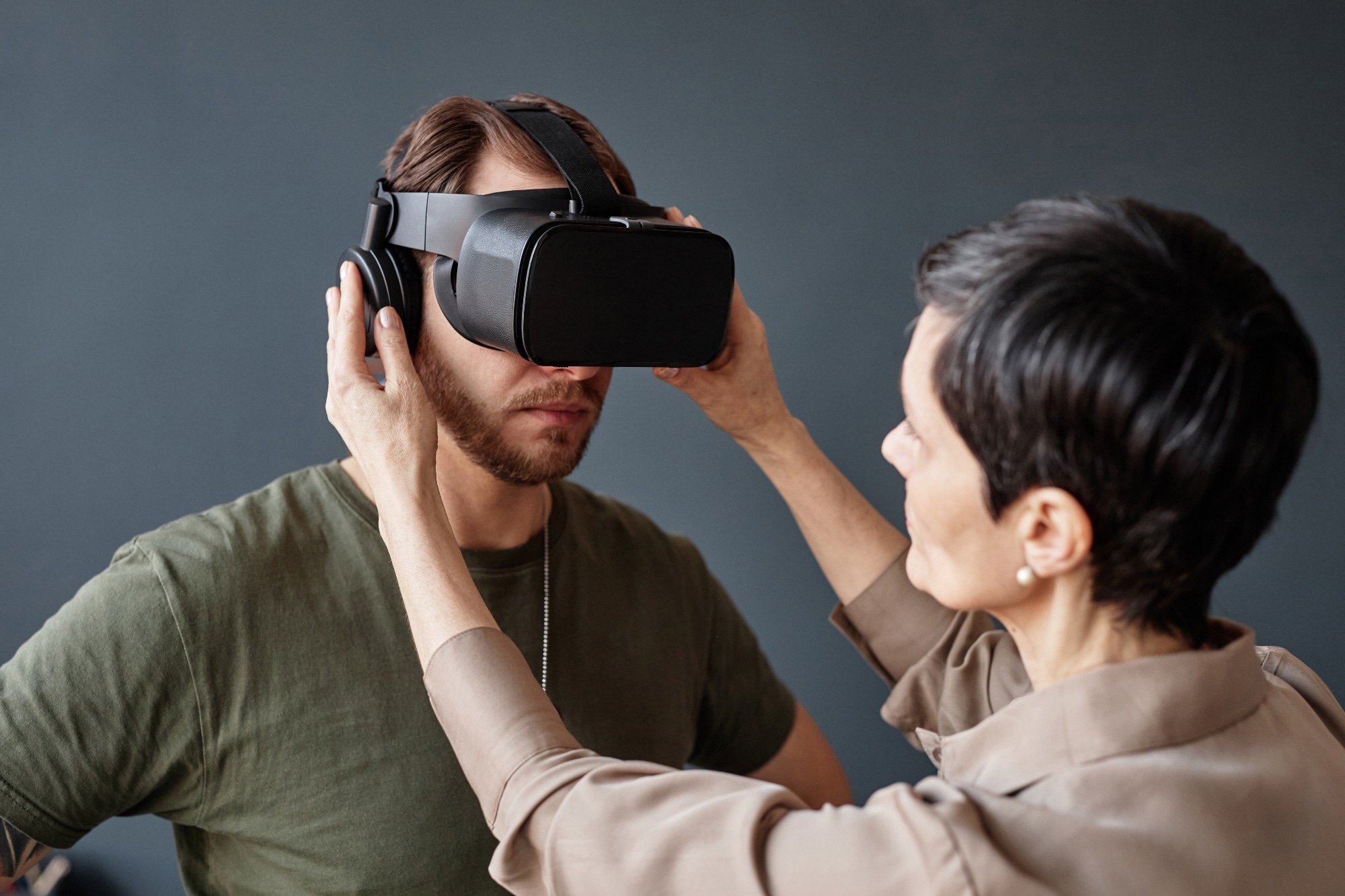 Image Credit: SeventyFour / Shutterstock.com
Primary Clinical Applications
VRET has been widely studied for anxiety, phobias, and trauma-related disorders such as post-traumatic stress disorder (PTSD), during which precise, repeatable exposure scenarios for agoraphobia, claustrophobia, specific phobias, and public speaking anxiety are presented. Repeated confrontation with anxiety-inducing stimuli can produce habituation, or a reduction in fear responses with repeated exposure.
For situational fears, virtual scenarios can reproduce enclosed spaces, crowded places, or public transport. For social anxiety, the number and behavior of virtual audience members can be adjusted to vary the perceived social threat.1,3,4
PTSD has a substantial clinical research history in VRET, primarily driven by military-focused programs. Military studies have reported symptom improvements, though the supplied evidence does not establish that VRET consistently matches or exceeds imaginal prolonged exposure across trauma populations.
Tailored, multi-sensory combat or trauma cues can support controlled emotional processing. As compared to imaginal exposure, VRET does not require patients to create vivid mental images, which may benefit trauma survivors who struggle with imagery or avoid mentally engaging with their fears during traditional therapy.
While military applications are most prominent, civilian trauma research, including sexual trauma and disaster-related PTSD, has expanded as well. Importantly, differences in trauma types and hardware platforms complicate comparisons between studies.1,3
Several additional clinical applications are also being explored, with differing levels of evidence, some of which include adjunctive interventions for depression, treating obsessive-compulsive disorder (OCD), improving social skills training for autism, and addressing anxiety in elderly patients. For OCD, virtual contamination or symmetry cues may support exposure and response prevention, but large controlled trials remain limited.
Eating-disorder research includes exposure to food-related cues and interventions targeting body image. Other VR applications, including chronic and procedural pain management and social skills training, can involve distraction or skills practice, rather than exposure therapy, and should be distinguished from VRET.1
 Image Credit: dizain / Shutterstock.com
Technological Augmentation & Delivery
Artificial intelligence (AI)-based systems using “reinforcement learning” are being investigated to adapt virtual content and exposure difficulty based on patient responses, though fully automated AI-generated exposure hierarchies remain in early research. Digital twin models of patients have also been proposed to combine clinical, physical, and behavioral data over time to suggest how treatment should progress. Still, their clinical value in VRET remains unestablished.1
Researchers are investigating real-time physiological monitoring systems that measure heart rate variability (HRV), galvanic skin response, or changes in skin conductance associated with sweating, as well as respiration, to inform adjustments to scenario difficulty. These systems aim to support appropriate fear activation, though physiological monitoring cannot guarantee that exposure will remain tolerable or therapeutically effective.
Eye-tracking systems, physiological sensors, and electroencephalography (EEG), which records the brain’s electrical activity, are currently being incorporated into experimental adaptive and biofeedback-driven therapy. Machine learning models can estimate fear levels in real time; however, additional research is needed to establish their accuracy and clinical usefulness across patients and treatment settings.1
The technology has evolved from costly, lab-based Cave Automatic Virtual Environment (CAVE) systems in the 1990s to less expensive wireless headsets with fewer setup requirements. Cloud-based infrastructures now support remote scenario delivery and session synchronization, which may reduce travel demands and some access barriers. Remote delivery still requires suitable equipment, technical support, and appropriate clinical arrangements.1
 Image Credit: Thx4Stock team / Shutterstock.com
Operational Limitations & Implementation Barriers
The lack of standardized VRET-specific clinical guidelines and a shortage of long-term follow-up studies are major systemic barriers to adoption. Unresolved questions about patient selection, competency requirements, and safety procedures also persist. Small samples, varied outcome measures, and limited follow-up also restrict estimates of treatment durability and comparisons between protocols.1
While smartphone-based VR offers high accessibility, it presents clinical drawbacks, including a narrower field of view and lower refresh rates, which can increase cybersickness and diminish patient tolerability. Cybersickness can include nausea, disorientation, and postural instability, while some patients have also reported headset discomfort or insufficient interaction in prerecorded scenarios.
Technical issues related to hardware calibration and rapid software obsolescence also need to be addressed. Future clinical trials also need to assess whether improvements transfer from virtual environments to real-world triggers.
Regulatory hurdles, limited health economic evaluations, high upfront equipment costs, and a lack of clinician training are other barriers. Protecting sensitive mental health and physiological data is necessary, with legal requirements varying by jurisdiction and service configuration.
Tethered head-mounted displays (HMDs) linked to high-performance computers can provide high-quality rendering and precise tracking; however, their equipment and infrastructure costs can limit use outside specialist centers. Trauma-focused exposure also requires careful assessment and monitoring, as poorly calibrated scenarios may provoke excessive distress.1,3
Standalone wireless headsets offer more portable delivery options, as consumer-grade hardware has produced beneficial outcomes in acrophobia trials, supporting the feasibility of portable VRET for specific phobias. Hardware affordability alone does not establish equivalence between treatment systems or remove the need for clinical assessment.
Evidence-based self-guided programs may provide an adjunct to therapy or an option for selected patients. Overall, the appropriate level of professional support should reflect the disorder, symptom severity, patient needs, and evidence for the particular program.1,3,4
References
- Cinar, O. E. (2026). Virtual reality exposure therapy: A systematic review and bibliometric analysis of clinical applications and research trends. Frontiers in Virtual Reality 7. DOI: 10.3389/frvir.2026.1826777, https://www.frontiersin.org/journals/virtual-reality/articles/10.3389/frvir.2026.1826777/full
- Azimisefat, P., De Jongh, A., Rajabi, S., et al. (2022). Efficacy of virtual reality exposure therapy and eye movement desensitization and reprocessing therapy on symptoms of acrophobia and anxiety sensitivity in adolescent girls: A randomized controlled trial. Frontiers in Psychology 13. DOI: 10.3389/fpsyg.2022.919148. https://www.frontiersin.org/journals/psychology/articles/10.3389/fpsyg.2022.919148/full
- Boeldt, D., McMahon, E., McFaul, M., & Greenleaf, W. (2019). Using Virtual Reality Exposure Therapy to Enhance Treatment of Anxiety Disorders: Identifying Areas of Clinical Adoption and Potential Obstacles. Frontiers in Psychiatry 10. DOI: 10.3389/fpsyt.2019.00773. https://www.frontiersin.org/journals/psychiatry/articles/10.3389/fpsyt.2019.00773/full
- Planert, J., Hildebrand, A., Machulska, A., et al. (2025). Blended Mobile-Based Interventions with Integrated Virtual Reality Exposure Therapy for Anxiety Disorders: Thematic Analysis of Patient Perspectives. JMIR Human Factors. DOI: 10.2196/60957. https://humanfactors.jmir.org/2025/1/e60957
Further Reading
Last Updated: Nov 15, 2026