Introduction
What does ‘organic’ mean?
Organic certification and enforcement
Standards for organic crops, livestock, and processing
How to read organic food labels
Do organic systems benefit the environment?
References
Further reading
Organic food labels reflect certified production standards, not guaranteed health superiority. Organic systems can support biodiversity, soil health, and lower residue exposure, but benefits vary by crop, region, and management.
 Image Credit: TihomirLikov / Shutterstock.com
Introduction
The global organic market has grown rapidly over the past two decades due to rising consumer interest in health, environmental sustainability, and food transparency. Despite the growing popularity of organic products, which currently have a market value of over $106 billion USD, the regulations and scientific standards behind organic labeling remain poorly understood by many consumers.
Organic agriculture is regulated through certification systems designed to promote ecological balance, biodiversity conservation, and responsible resource management while limiting reliance on most synthetic agricultural inputs.5,6
What does ‘organic’ mean?
The Agricultural Marketing Service (AMS) mandates that organic foods are produced through agricultural practices that support ecological balance and conserve biodiversity.5 These production requirements are primarily characterized by restrictions on the application of synthetic pesticides, fertilizers, and other chemically synthesized additives, which are prohibited unless specifically allowed on the National List of Allowed and Prohibited Substances.2
AMS-approved organic systems prohibit the use of genetically modified organisms (GMOs), sewage sludge, and ionizing radiation.5 In livestock management, organic standards restrict or prohibit the use of most antibiotics and growth hormones, emphasizing natural resource cycling and biological processes.7
Organic farming standards vary somewhat between countries and certifying bodies; however, most systems share core principles involving soil health preservation, biodiversity protection, animal welfare considerations, and reduced use of synthetic chemical inputs.2,5,6
Organic certification and enforcement
To legally use the organic label, products must be verified by a United States Department of Agriculture (USDA)-accredited certifying agent to ensure compliance with federal standards.5 Sustained certification requires an annual inspection of all farms and processing facilities, where agents account for all operational components like soil conditions, water utilization, seed sources, and pest management.2
Detailed recordkeeping is crucial to ensure traceability throughout every stage of production, processing, and distribution. Only operations that maintain verified compliance are permitted to use the USDA Organic Seal, which serves as a key marker of authenticity and consumer confidence in organic labeling claims.2,5
Certification systems also require measures to prevent contamination or commingling between organic and non-organic products during handling, transport, storage, and processing.5,6
What Is Organic Food?
Standards for organic crops, livestock, and processing
Organic crop production requires that the agricultural land be free from all prohibited substances for a minimum of three years prior to harvesting an organic crop.5 Organic producers are required to manage soil fertility through tillage, crop rotations, and cover crops, supplemented by animal wastes to enhance soil organic carbon (SOC).4
Biological and mechanical methods are prioritized for weed and pest management, whereas synthetic pesticides may only be used under restricted circumstances when approved for organic production.5,6
Livestock standards are equally robust and mandate that animals receive 100% organic feed and have year-round access to outdoor areas to accommodate natural animal behaviors. Ruminants must graze on pastures for the entire grazing season and a minimum of 120 days, with at least 30% of their dry matter intake (DMI) obtained from forage.5
Organic livestock systems are also associated with differences in meat composition, including higher reported omega-3 fatty acid concentrations in some studies; however, the direct health implications of these compositional differences remain under investigation.9
Some stringent processing standards further limit the use of artificial additives and require the physical separation of organic and non-organic ingredients to prevent the introduction of prohibited artificial additives.2
How to read organic food labels
The USDA categorizes organic labeling based on the percentage of certified organic ingredients. Products labeled as ‘100% Organic’ must contain only organically produced ingredients, whereas products labeled as ‘Organic’ contain at least 95% certified organic ingredients.
Both ‘100% Organic’ and ‘Organic’ products are eligible to display the USDA seal.5 Comparatively, products labeled as "Made with organic ingredients" cannot use the USDA seal and must contain at least 70% organic ingredients.2
If a product contains less than 70% organic ingredients, the term ‘organic’ may only be used in the ingredients list for specific items. These labels are designed to accurately reflect the percentage of organic content and should not be automatically interpreted as evidence that a product is healthier, safer, or nutritionally superior to conventional alternatives.6,7
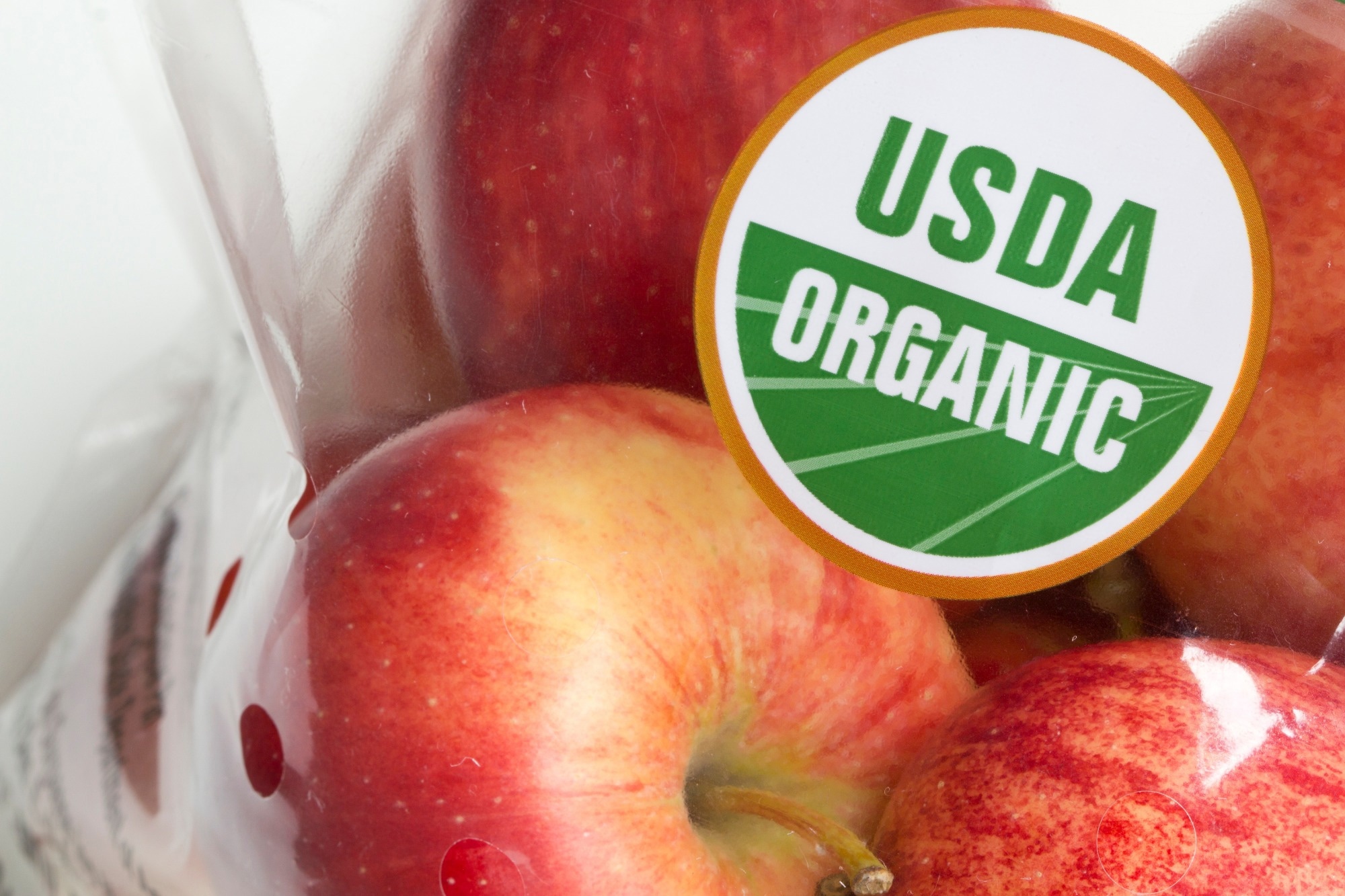 Image Credit: Tada Images / Shutterstock.com
Do organic systems benefit the environment?
Organic farming systems emphasize soil health and the enhancement of SOC stocks, which are typically maintained or increased through the application of farmyard manure.4 Recent meta-analyses indicate that organic sites exhibit significantly greater biotic richness and abundance than conventional sites, with studies documenting biodiversity benefits, although the magnitude varies by organism group, crop type, and landscape context.4
Organic farming has also been associated with higher abundance of some beneficial organisms, enhanced soil biological activity, and lower pesticide residue exposure in crops compared to many conventional systems.4,8
Although organic systems rely more on ecological processes, such as natural pest control, they can be more vulnerable to environmental fluctuations. Nevertheless, organic systems often exhibit superior drought resilience due to greater soil organic matter and biologically mediated nutrient cycling, rather than mineral fertilizer dependence.4
However, organic farming systems may also produce lower average yields than conventional agriculture depending on crop type, climate conditions, and management practices, which remains an important consideration in discussions surrounding global food security.4
The most prevalent misconception popularized by social media is that organic food is inherently more nutritious or safer than conventional food, regardless of geography, population, or clinical context. Some meta-analyses have reported higher levels of certain secondary phytochemical metabolites, such as a 19-69% increase in specific polyphenols like flavanones and anthocyanins; however, the clinical significance of these differences remains unclear.7,8
Systematic reviews have additionally reported lower detectable pesticide residues and lower cadmium concentrations in certain organically grown crops, as well as lower risk of antibiotic-resistant bacteria in some organic meat studies, though current evidence remains insufficient to conclude that consuming organic foods leads to clear long-term clinical health advantages.7,8
References
- Bhagavathula, A. S., Vidyasagar, K., & Khubchandani, J. (2022). Organic Food Consumption and Risk of Obesity: A Systematic Review and Meta-Analysis. Healthcare 10(2); 231. DOI: 10.3390/healthcare10020231. https://www.mdpi.com/2227-9032/10/2/231
- Nagy, L. B., Lakner, Z., & Temesi, Á. (2022). Is it really organic? Credibility factors of organic food–A systematic review and bibliometric analysis. PLoS ONE 17(4); e0266855. DOI: 10.1371/journal.pone.0266855. https://journals.plos.org/plosone/article?id=10.1371/journal.pone.0266855
- Sharma, A., Shahzad, B., Rehman, A., et al. (2019). Response of Phenylpropanoid Pathway and the Role of Polyphenols in Plants under Abiotic Stress. Molecules 24(13); 2452. DOI: 10.3390/molecules24132452. https://www.mdpi.com/1420-3049/24/13/2452
- Smith, O. M., Cohen, A. L., Rieser, C. J., et al. (2019). Organic Farming Provides Reliable Environmental Benefits but Increases Variability in Crop Yields: A Global Meta-Analysis. Frontiers in Sustainable Food Systems 3. DOI: 10.3389/fsufs.2019.00082. https://www.frontiersin.org/journals/sustainable-food-systems/articles/10.3389/fsufs.2019.00082/full
- Agricultural Marketing Service. (2024). About the organic standards. U.S. Department of Agriculture. https://www.ams.usda.gov/grades-standards/organic-standards.
- Food and Agriculture Organization of the United Nations [FAO]. (2021). Organic foods – Are they safer? FAO Regional Office for Asia and the Pacific. https://openknowledge.fao.org/server/api/core/bitstreams/b5377c27-d4b1-4cf1-9186-3eb7e702a18b/content. Accessed 28th April 2026.
- Smith-Spangler, C., Brandeau, M. L., Hunter, G. E., et al. (2012). Are Organic Foods Safer or Healthier Than Conventional Alternatives? Annals of Internal Medicine 157(5); 348-366. DOI: 10.7326/0003-4819-157-5-201209040-00007. https://www.acpjournals.org/doi/10.7326/0003-4819-157-5-201209040-00007
- Barański, M., Srednicka-Tober, D., Volakakis, N., et al. (2014). Higher antioxidant and lower cadmium concentrations and lower incidence of pesticide residues in organically grown crops: a systematic literature review and meta-analyses. British Journal of Nutrition 112(5); 794–811. DOI: 10.1017/S0007114514001366. https://www.cambridge.org/core/journals/british-journal-of-nutrition/article/higher-antioxidant-and-lower-cadmium-concentrations-and-lower-incidence-of-pesticide-residues-in-organically-grown-crops-a-systematic-literature-review-and-metaanalyses/33F09637EAE6C4ED119E0C4BFFE2D5B1
- Średnicka-Tober, D., Baranski, M., Seal, C., et al. (2016). Composition differences between organic and conventional meat: a systematic literature review and meta-analysis. British Journal of Nutrition 115(6); 994-1011. DOI: 10.1017/S0007114515005073. https://www.cambridge.org/core/journals/british-journal-of-nutrition/article/composition-differences-between-organic-and-conventional-meat-a-systematic-literature-review-and-metaanalysis/B333BC0DD4B23193DDFA2273649AE0EE
Further Reading
Last Updated: May 27, 2026