Introduction
Biological barriers to zoonotic adaptation
Transmission dynamics and ecological constraints
Evolutionary bottlenecks and viral adaptation limits
Emerging research, surveillance, and future directions
References
Further reading
From receptor mismatch to risky human-animal interfaces, this article explains why spillover is common but true pandemic emergence remains rare.
 Image Credit: PatrickAssale / Shutterstock.com
Introduction
Humans are constantly exposed to animal viruses through farming, wildlife contact, and the environment; however, most animal viruses never reach pandemic potential. Successful spillover events are uncommon, as viruses must navigate complex biological, ecological, and evolutionary barriers before human-to-human transmission can occur. In the spillover cascade, an infected reservoir host must shed enough virus, the virus must survive or be carried to a susceptible human, and infection must then progress to onward transmission; failure at any one step can stop emergence.1,5 These barriers are also shaped by human behavior, land-use change, wildlife trade, farming systems, and other interfaces that determine how often people encounter infectious animals or contaminated environments.1,2,3,5
Biological barriers to zoonotic adaptation
Receptor incompatibility limits efficient animal-to-human transmission, as animal viruses rarely bind to human receptors with optimal efficiency, thereby restricting their entry into host cells. For example, avian influenza viruses preferentially bind to SAα-2,3 receptors in birds, whereas human influenza strains preferentially bind to SAα-2,6 receptors in the human upper respiratory tract.2 Because SAα-2,3 receptors are found mainly deeper in the human respiratory tract, some avian influenza viruses may infect exposed people yet still transmit poorly between humans.2
After entering the host, viruses must evade innate immune responses characterized by interferons (IFN), antiviral proteins, macrophages, dendritic cells, and natural killer cells, as well as mucosal barriers and programmed cell death pathways, before establishing productive infection. Some viruses develop adaptations to evade these immune responses; however, these modifications are often species-specific and may not function effectively in humans.1,2
Many animal viruses that can enter human cells still fail to complete the human-cell replication cycle, including genome replication, assembly, budding, fusion, and release, because they cannot always use the required human host factors efficiently.4,5 Thus, despite entering the host, most viruses cause dead-end spillover infections, rather than sustained transmission. Collectively, failure to bind host cell receptors, evade immunity defenses, or replicate efficiently within human cells results in a self-limiting event. 4,5
Transmission dynamics and ecological constraints
The route of pathogen shedding strongly influences transmission potential. For many efficiently transmitted respiratory viruses, replication and shedding in the upper respiratory tract can facilitate spread, but transmission also depends on infectious dose, tissue tropism, host behavior, and environmental survival.2,3,5
Infection by many animal viruses requires high-dose exposure, vector bites, contaminated food, or close contact with bodily fluids, which sharply limits opportunities for onward human transmission.1,5 For example, avian influenza viruses can infect humans exposed to infected poultry; however, these pathogens do not efficiently transmit between humans due to poor replication in the upper respiratory tract.2
To maintain continuous transmission, a virus must encounter new, uninfected individuals faster than infected individuals recover or die. In epidemiological terms, sustained spread usually requires the basic reproductive number, R0, to remain above 1.5 If human population density is low or spillover events occur in isolated rural areas, the virus naturally exhausts its pool of susceptible hosts for transmission.
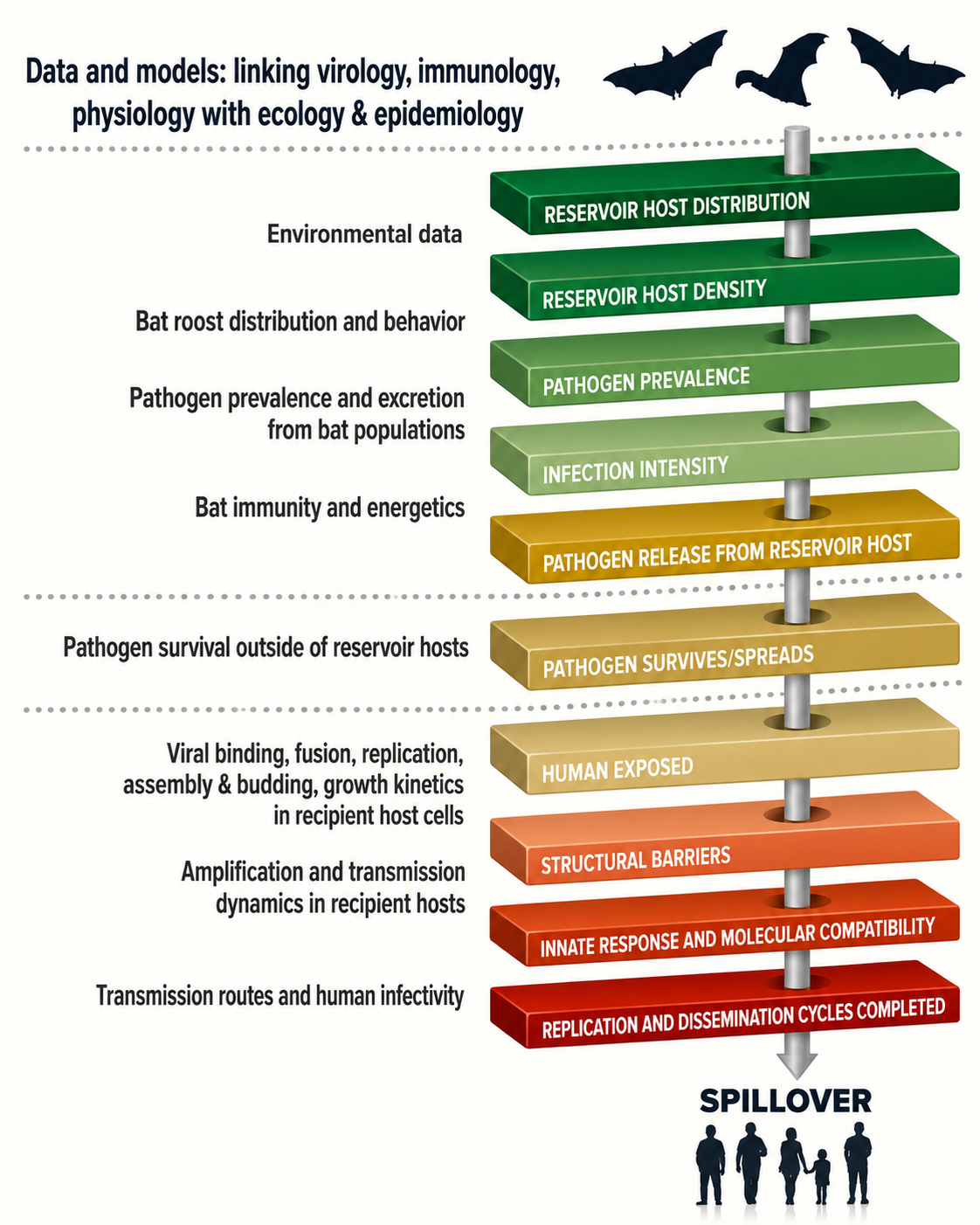
Biological data needed to understand and predict spillover (left) aligned to the key mechanisms of spillover (right). In addition, epidemiology and social sciences are employed to understand human exposure. Adapted from Plowright et al.
Conversely, dense farms, live-animal markets, shelters, transport networks, and highly connected urban centers can increase contact rates and create more opportunities for rare spillovers to be amplified.2,3,5
Short infectious periods and the ecological dependence on specific wildlife hosts or seasonal vectors similarly disrupt transmission dynamics. Moreover, environmental survival outside the host is itself a barrier to spillover, because heat, desiccation, ultraviolet (UV) light, and other conditions can reduce the infectious dose that reaches people.1
How do viruses jump from animals to humans? - Ben Longdon
Evolutionary bottlenecks and viral adaptation limits
Animal viruses constantly evolve through mutations, recombination events, and genetic reassortment; however, only a small fraction acquire the combination of genetic traits required to adapt to human systems for sustained transmission. Importantly, genetic mutations may come at an evolutionary cost, as alterations in viral surface proteins that improve binding to host cell receptors can become unstable in the original host, limiting the virus's ability to survive and spread.2,4
Ribonucleic acid (RNA) viruses, such as coronaviruses and influenza viruses, evolve rapidly because their replication processes generate frequent genetic changes. Recombination events in the coronavirus spike protein receptor-binding domain can alter host range and receptor recognition.2,4 For segmented viruses such as influenza A, reassortment can also create novel gene combinations, but most such combinations are not fit enough to spread efficiently in humans.2
Viruses may utilize intermediate hosts to gradually adapt to new species. The human immunodeficiency virus (HIV), for example, arose after simian immunodeficiency viruses crossed from non-human primates, including chimpanzees and gorillas, into humans; these primates are better described as source or bridging hosts than as simple “intermediate evolutionary hosts.”5
Intermediate hosts may possess cellular receptors compatible with both the original animal reservoir and humans, thereby facilitating viral replication while gradually accumulating adaptive mutations. They may also amplify exposure by bringing the virus closer to people, as observed in coronavirus spillover events involving civets, camelids, farmed animals, and other domestic and captive mammals.3 However, intermediate hosts are not required for every emergence event, and their importance depends on the virus, reservoir ecology, and level of human exposure.1,3,5
Importantly, successful transitions remain rare, as most viruses fail to bypass the complex evolutionary constraints required for stable viral host adaptation and pandemic emergence.5
 Image Credit: Lightspring / Shutterstock.com
Emerging research, surveillance, and future directions
Recent advances in genomic surveillance have enabled proactive research to identify viruses with the potential to threaten human health. Collaborative efforts such as the United States Agency for International Development (USAID) PREDICT initiative and the proposed Global Virome Project have expanded viral discovery and highlighted the need to connect sequence data with ecological and functional evidence.3,5
By using metagenomic sequencing of wildlife and high-risk human-animal interfaces, scientists can prioritize viruses and settings for further investigation, but they cannot yet predict pandemic emergence with certainty from sequence data alone.4,5
Furthermore, artificial intelligence (AI) and machine learning (ML) models are improving zoonosis risk assessment by integrating viral genomics, ecological disruption, wildlife movement, and human exposure patterns. These models analyze complex variables like host density, habitat loss, and receptor configuration of uncharacterized viruses to prioritize high-risk host-virus interfaces and guide targeted functional testing, rather than definitively identifying future pandemic viruses.4,5 Such tools are best viewed as hypothesis-generating systems that must be paired with field ecology, experimental infection studies, and public-health surveillance.4,5
Next-generation vaccines are further strengthening pandemic preparedness, as demonstrated by the rapid development and deployment of messenger RNA (mRNA) vaccines during the coronavirus disease 2019 (COVID-19) pandemic. However, the reviewed spillover literature emphasizes that medical countermeasures usually act after exposure or emergence, whereas the most complete form of pandemic prevention is to prevent the spillover event itself.5
To overcome the time-consuming timelines of single-virus vaccines, researchers are investigating pan-viral approaches that target highly conserved regions of viral families to confer protection against multiple viruses.
Functional viromics, in silico receptor modeling, in vitro entry and replication assays, and in vivo transmission studies can help connect viral genotypes to phenotypes and prioritize multivalent vaccines or therapeutics before an outbreak escalates.4,5
A One Health approach also emphasizes upstream prevention, including reducing risky wildlife contact, improving domestic-animal management, monitoring high-risk interfaces, and addressing environmental changes that increase spillover pressure.1,3,5
References
- Plowright, R., Parrish, C., McCallum, H. et al. (2017). Pathways to zoonotic spillover. Nature Reviews Microbiology 15; 502-510 (2017). DOI: 10.1038/nrmicro.2017.45, https://www.nature.com/articles/nrmicro.2017.45
- Alvarez-Munoz, S., Upegui-Porras, N., Gomez, A. P., & Ramirez-Nieto, G. (2021). Key Factors That Enable the Pandemic Potential of RNA Viruses and Inter-Species Transmission: A Systematic Review. Viruses 13(4); 537. DOI: 10.3390/v13040537. https://www.mdpi.com/1999-4915/13/4/537
- Nova, N. (2021) Cross-Species Transmission of Coronaviruses in Humans and Domestic Mammals, What Are the Ecological Mechanisms Driving Transmission, Spillover, and Disease Emergence? Frontiers in Public Health 9. DOI: 10.3389/fpubh.2021.717941. https://www.frontiersin.org/journals/public-health/articles/10.3389/fpubh.2021.717941/full
- Letko, M., Seifert, S.N., Olival, K.J. et al. (2020). Bat-borne virus diversity, spillover and emergence. Nature Reviews Microbiology 18; 461-471. DOI: 10.1038/s41579-020-0394-z. https://www.nature.com/articles/s41579-020-0394-z
- Plowright, R. K., & Hudson, P. J. (2021). From Protein to Pandemic: The Transdisciplinary Approach Needed to Prevent Spillover and the Next Pandemic. Viruses 13(7); 1298. DOI: 10.3390/v13071298. https://www.mdpi.com/1999-4915/13/7/1298
Further Reading
Last Updated: Jul 7, 2026