Introduction
Why Emerging Contaminants Are Difficult to Detect
Analytical Technologies Used in 2026
The Rise of Non-Targeted and AI-Assisted Analysis
Environmental and Regulatory Challenges
Conclusion
References
Further Reading
Emerging contaminants such as microplastics, pharmaceutical residues, and PFAS are pushing environmental monitoring systems beyond the limits of conventional detection methods due to their persistence, complexity, and ultra-trace concentrations. Advances in AI-assisted analytics, high-resolution spectroscopy, and non-target screening are transforming the way scientists identify, classify, and monitor these pollutants in water and wastewater systems.
 Image credit: Saharat Thinagun/Shutterstock.com
Introduction
Emerging contaminants are an increasingly urgent challenge for global water and environmental monitoring systems. Scientists are detecting microplastics (MPs, <5mm long), pharmaceutical residues (such as leftover medications), and per- and polyfluoroalkyl substances (PFAS), often called “forever chemicals” because of their extreme environmental persistence and resistance to degradation.3,5
These contaminants are increasingly detected in rivers, groundwater, soils, drinking water, and wastewater systems. These pollutants bypass traditional treatment infrastructure, persist in the environment, and accumulate in living organisms. They can adversely affect human health, especially disrupting endocrine, immune, reproductive, and neurological function, even at very low concentrations.
However, detecting them remains technically difficult because they occur as complex mixtures and continuously transform across environmental media. Recent advances in high-resolution mass spectrometry, non-target screening, real-time sensing platforms, and AI-assisted monitoring are rapidly reshaping contaminant surveillance strategies.1,5
Why Emerging Contaminants Are Difficult to Detect
Emerging contaminants are difficult to detect due to analytical hurdles such as ultra-low concentrations, sample complexity, and a lack of standardized testing methods. Their physical, chemical, and structural diversity poses challenges to accurate identification and quantification. MPs, pharmaceutical residues, and PFAS rarely occur in isolation. Instead, they appear as complex mixtures embedded in wastewater, sediments, sludge, and biological tissues, containing dissolved organic matter, microbes, and particulate debris.2,3
MPs present particular difficulties because they vary dramatically in shape, polymer composition, and particle size, ranging from millimeter-scale debris down to nanoplastics smaller than 1 μm. They can exist as beads, fibers, films, foams, and irregular fragments. No single analytical instrument can simultaneously characterize all MP forms and sizes with high accuracy. Nanoplastics are especially hard to isolate and characterize because they can pass through conventional filtration workflows and interact strongly with dissolved organic matter.4
Environmental aging further complicates detection by altering particle surfaces and increasing interactions with metals, pharmaceuticals, and persistent organic pollutants. Processes such as UV-driven oxidation, biofilm formation, and surface weathering can significantly change MP adsorption behavior and surface chemistry over time. The lack of globally standardized sampling and extraction workflows also limits comparisons between studies.2,4
Pharmaceutical residues exist in water at parts-per-trillion levels. Target compounds are easily lost among background water molecules. Natural water contains sand, algae, and organic debris that can clog ultrafine filters and require extensive sample cleanup procedures before analysis. Wastewater matrices can suppress ionization signals and reduce analytical accuracy during mass spectrometric analysis. Seasonal drug use, geographic differences, and the constant emergence of new metabolites add further variability. For example, cold seasons often increase antibiotic and antiviral levels in wastewater, while urban centers frequently exhibit elevated antidepressant concentrations, and agricultural regions contain more veterinary pharmaceuticals.3
PFAS detection is equally challenging. More than 10,000 PFAS-related compounds have been identified globally, spanning short-chain, long-chain, polymeric, and precursor compounds. Their high solubility allows many PFAS compounds to travel rapidly through aquifers and water distribution systems. The carbon–fluorine bond resists heat, acids, oxidation, and microbial degradation, enabling long-term environmental persistence. PFAS can also adsorb to laboratory tubing, sampling containers, and analytical surfaces, causing sample carryover and contamination artifacts. Many PFAS compounds are now regulated at ultra-trace concentrations in the low ng/L or ppt range, requiring extremely sensitive analytical instrumentation and contamination-free workflows.1,3
Analytical Technologies Used in 2026
Environmental laboratories in 2026 increasingly rely on advanced analytical platforms to detect contaminants at ultra-trace levels in complex environmental samples. Among these, liquid chromatography–tandem mass spectrometry (LC-MS/MS) remains the gold standard for measuring PFAS and pharmaceutical residues in water, wastewater, soil, and biological samples. The technique separates individual target contaminants from complex matrices based on molecular weight and chemical structure, while tandem MS fragments molecules into diagnostic ions that improve compound identification. These systems provide extremely high sensitivity and selectivity, allowing detection at nanogram-per-liter and sometimes picogram-level concentrations.1,3
High-resolution mass spectrometry platforms, such as Orbitrap and time-of-flight (TOF) instruments, are increasingly used in suspect and non-target screening workflows to identify previously unknown contaminants and transformation products. Gas chromatography–MS (GC-MS/MS) remains important for volatile and semi-volatile contaminants such as fragrances, phthalates, and industrial chemicals. However, thermally unstable compounds typically require LC-based workflows instead.1,3,5
For MP detection, vibrational spectroscopy and advanced optical imaging technologies are central to polymer identification. These methods analyze how light interacts with chemical bonds to generate polymer-specific spectral fingerprints. Fourier-transform infrared spectroscopy (FTIR), Raman spectroscopy, and hyperspectral imaging (HSI) identify plastics by measuring molecular vibrations unique to specific polymer structures. They are particularly useful for identifying polyethylene (PE), polystyrene (PS), polyethylene terephthalate (PET), and polypropylene (PP).
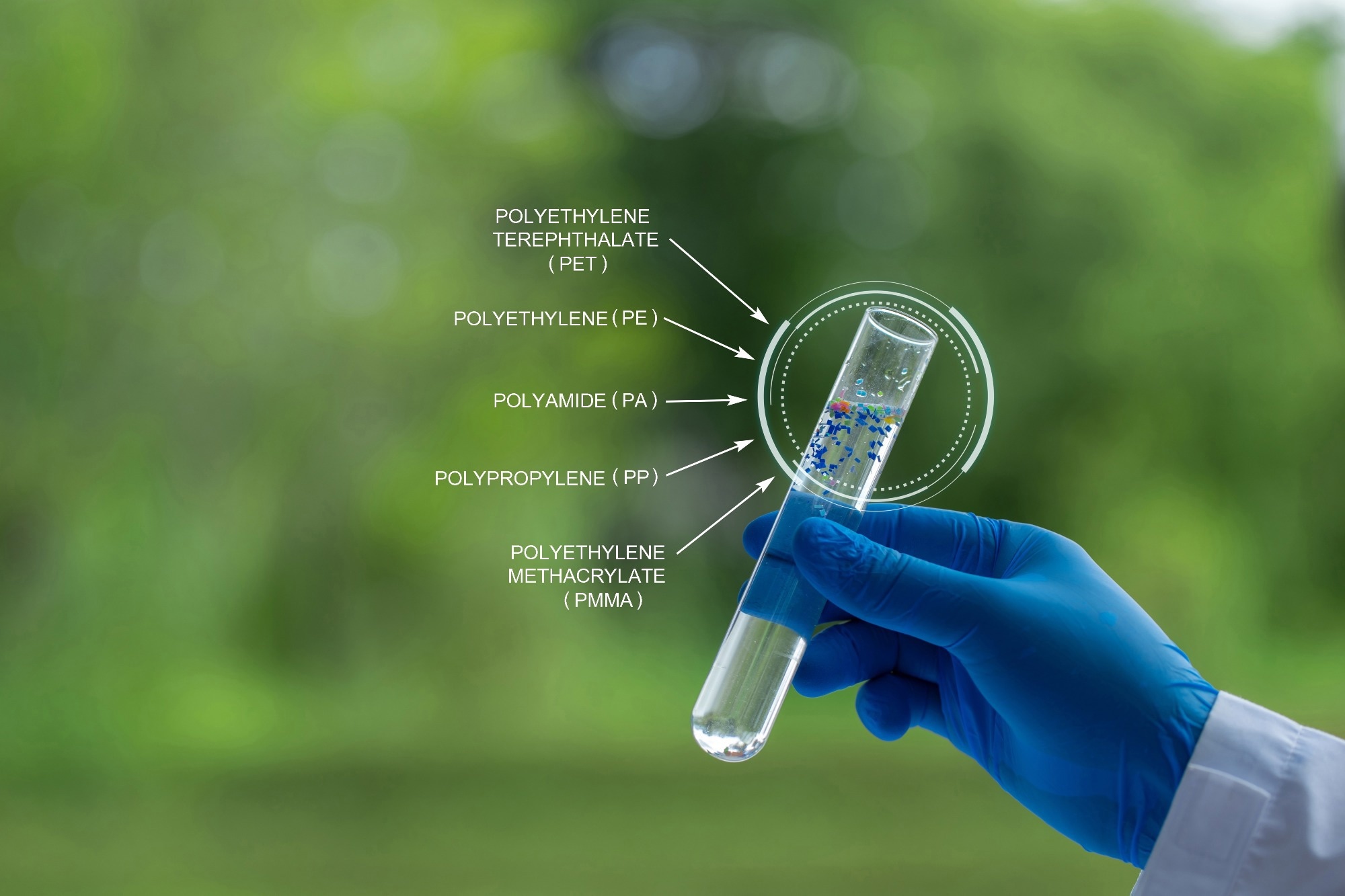 Image credit: chayanuphol/Shutterstock.com
While FTIR performs better for larger particles and bulk polymer characterization, Raman spectroscopy can resolve smaller fibers and fragments with higher spatial resolution. HSI generates pixel-wise chemical maps that enable large-scale screening of environmental samples and particle distributions. Recent studies also demonstrate that Raman spectroscopy combined with density functional theory (DFT) modeling and machine learning tools such as principal component analysis (PCA) and t-distributed stochastic neighbor embedding (t-SNE) can improve PFAS classification and differentiation based on chain length and functional groups.
Discover how AI-powered Raman and IR microscopy are redefining microplastics detection in our interview with Bruker’s Dr. Alexander Staub.
However, these methods still struggle to reliably characterize nanoplastics and heavily weathered environmental particles. Biological stains, dyes, and environmental fluorescence can interfere with Raman measurements and reduce signal quality. Scientists are increasingly integrating automated imaging systems, AI-assisted spectral interpretation, and surface-enhanced Raman spectroscopy (SERS) platforms to improve throughput and detection sensitivity.2,5
The Rise of Non-Targeted and AI-Assisted Analysis
Traditional contaminant workflows primarily focus on targeted analysis, where laboratories search for predefined compounds using reference standards. However, this strategy cannot fully capture the enormous diversity of modern emerging contaminants and their transformation products. Non-targeted screening methods now use high-resolution MS data, combined with AI and machine learning algorithms, to identify unknown compounds, predict molecular structures, and prioritize contaminants based on their probable toxicity and environmental persistence.1,5
AI-assisted workflows are increasingly supporting automated spectral matching, contaminant source tracking, geospatial exposure mapping, and predictive modeling of contaminant transport and fate. Machine learning approaches are also improving PFAS classification from Raman and SERS spectra while accelerating MP image analysis and particle recognition. These systems reduce manual interpretation workloads and allow environmental laboratories to process larger datasets at higher speed.2,5
Real-time sensing technologies, including microfluidic sensors and portable spectroscopic systems, are also emerging as promising tools for rapid field-based contaminant detection. Although many of these technologies still require validation and standardization, they may eventually support decentralized environmental monitoring and continuous wastewater surveillance systems.5
Environmental and Regulatory Challenges
Regulatory frameworks for emerging contaminants continue to evolve unevenly across regions, with many contaminants remaining unregulated or only partially monitored. Conventional wastewater treatment plants were originally designed to remove nutrients, suspended solids, and pathogens rather than ultra-trace synthetic contaminants. As a result, many pharmaceuticals, PFAS compounds, and MPs survive treatment processes and enter aquatic ecosystems.3,5
Recent international policy efforts increasingly emphasize harmonized monitoring standards, risk-based prioritization, advanced treatment upgrades, and integrated “One Health” approaches linking environmental, animal, and human health. However, major gaps remain in long-term toxicological data, standardized testing protocols, and scalable remediation technologies. Detecting contaminants at extremely low concentrations also remains expensive and technically demanding, limiting widespread adoption in many regions.3,5
Conclusion
The detection of MPs, pharmaceutical residues, and PFAS represents one of the defining environmental monitoring challenges of 2026. These contaminants persist at ultra-low concentrations, occur as highly complex mixtures, and continuously transform across water, soil, sediment, and biological systems. Traditional targeted analytical workflows alone are no longer sufficient to capture the scale and diversity of modern contaminant exposure.
Advances in LC-MS/MS, high-resolution MS, Raman spectroscopy, hyperspectral imaging, AI-assisted analytics, and non-target screening are substantially improving detection sensitivity and environmental surveillance capacity. At the same time, scientific and regulatory communities continue to face major challenges involving standardization, contamination control, toxicological uncertainty, and treatment scalability. Continued collaboration between analytical chemists, environmental scientists, engineers, toxicologists, and policymakers will remain essential for improving contaminant detection, exposure assessment, and long-term environmental protection.1,2,5
References
- Nishmitha, P., Akhilghosh, K. A., Aiswriya, V. P., Ramesh, A., Muthuchamy, M., & Muthukumar, A. (2025). Understanding emerging contaminants in water and wastewater: A comprehensive review on detection, impacts, and solutions. Journal of Hazardous Materials Advances, 18, 100755. DOI:10.1016/j.hazadv.2025.100755, https://www.sciencedirect.com/science/article/pii/S2772416625001664
- Mousazadehgavan, M. (2026). Microplastics in Aquatic Systems: Dual Roles as Pollutant Carriers and Emerging Functional Materials for Water Treatment. Water Air Soil Pollut, 237, 449. DOI:10.1007/s11270-026-09138-4, https://link.springer.com/article/10.1007/s11270-026-09138-4
- Sujan Sai, P., Hemanth Kumar, K., Nidhi Sri, A., Katakojwala, R., Shanthi Sravan, J., & Hemalatha, M. (2026). Emerging Contaminants in Wastewater: Mitigation Approaches for Environmental Management and Future Sustainability. Water, 18(7), 860. DOI:10.3390/w18070860, https://www.mdpi.com/2073-4441/18/7/860
- Kumar, A., Rothstein, J. C., Chen, Y., Zhang, H., & Zhao, Y. (2025). Experimental Raman spectra analysis of selected PFAS compounds: Comparison with DFT predictions. Journal of Hazardous Materials, 494, 138704. DOI:10.1016/j.jhazmat.2025.138704, https://www.sciencedirect.com/science/article/abs/pii/S0304389425016206
- Wang, F., Xiang, L., Sze-Yin, Leung, K. et al. (2024). Emerging contaminants: A One Health perspective. The Innovation, 5, https://www.cell.com/the-innovation/fulltext/S2666-6758(24)00050-X
Further Reading
Last Updated: May 27, 2026