Introduction: Connecting Genetic Variants to Clinical Insight
ML-Driven Variant Annotation: What Works Today?
Multiomics and Pharmacogenomics: Progress Toward Personalized Treatment
Biomarker Discovery: From Predictive Models to Clinical Validation
What Remains Aspirational?
Future Directions: Building Trustworthy Multiomics Models
References and Further Reading
Multiomics and machine learning are advancing genetic variant interpretation, pharmacogenomics, and biomarker discovery, offering new opportunities for precision medicine. However, clinical adoption depends on rigorous validation, reproducibility, population diversity, and demonstrated clinical utility.
 Image credit: Jack_the_sparow/Shutterstock.com
Genome sequencing has become faster and cheaper, so the challenge now is to reliably interpret variants and link them to disease. Combining multiomics with machine learning (ML) has expanded what variant interpretation and pharmacogenomics can achieve. This article examines established machine learning applications in multiomics for research and clinical decision support and considers what lies ahead for the field.1,3,4
Introduction: Connecting Genetic Variants to Clinical Insight
Sequencing technology has now made it routine to catalog a patient's genetic variation. However, interpretation of variants found in whole-genome sequences still presents challenges. Many missense variants are filed as variants of uncertain significance because evidence for or against harm is insufficient. Whole-genome and exome testing for rare Mendelian conditions has been reported to yield a diagnosis in fewer than 25% of patients.1,2
Multi-omics data provide different perspectives to address this challenge. By layering genomic data with epigenomic, transcriptomic, proteomic, and metabolomic measurements, researchers can ask whether a variant leaves a detectable trace in splicing, regulation, protein abundance, or metabolism. These molecular measurements provide intermediate phenotypes that can help connect genetic variation to disease mechanisms.3
However, the resulting datasets are large and noisy, which makes manual analysis tedious and prone to errors. They also frequently contain far more molecular features than patient samples, increasing the risk of overfitting. In recent times, machine learning (ML) analytical tools have been increasingly used for variant interpretation.4
Multi-omics integration can occur at three main stages: early integration combines molecular features before model training; intermediate integration learns shared representations across omics layers; and late integration combines predictions from separately trained models. Approaches such as graph neural networks, transformers, and variational autoencoders offer ways to model complex relationships between molecular layers.3,4
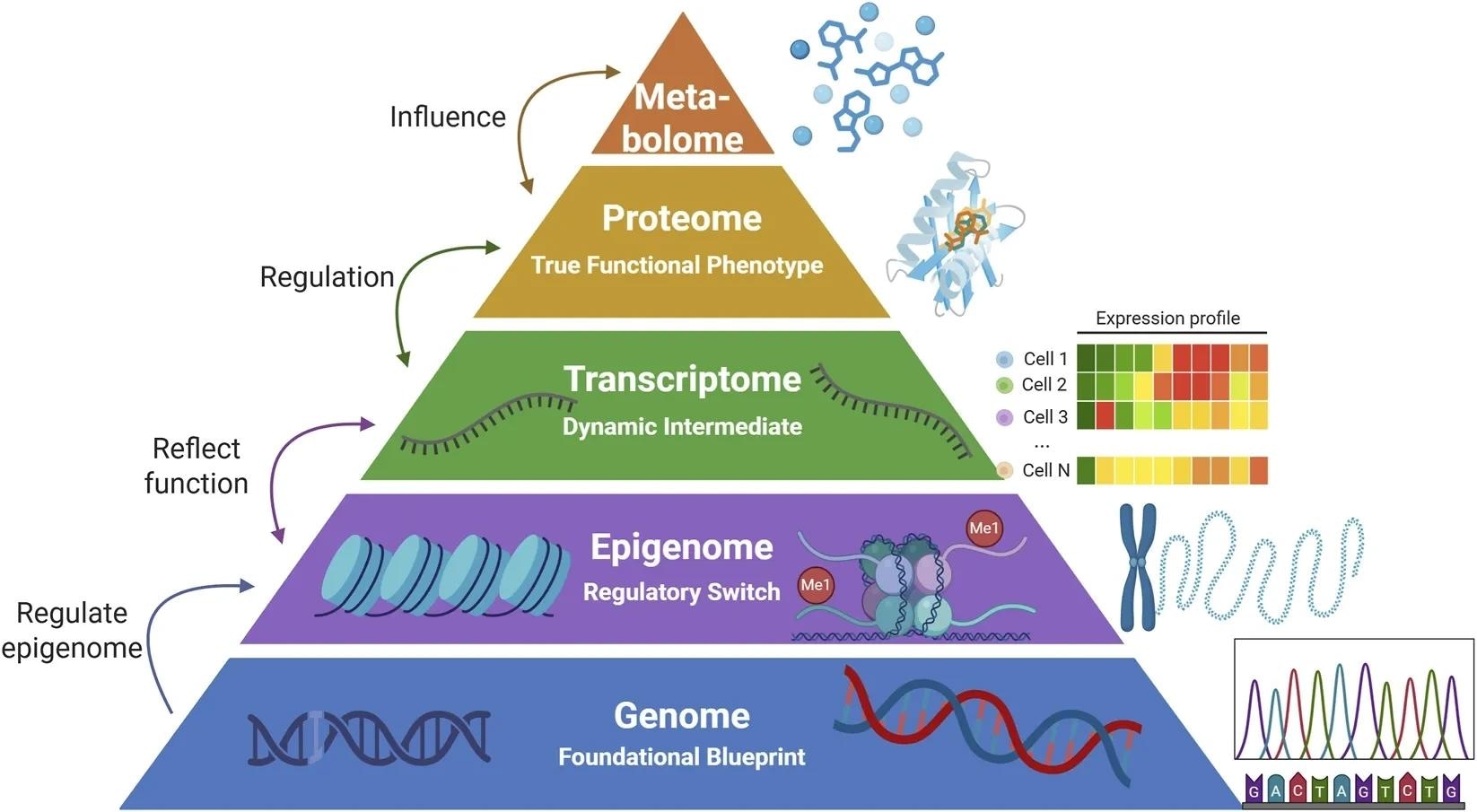 The five interconnected layers of multiomics link genetic variation to molecular regulation and biological function. Image credit: Lv et al. (2026).
ML-Driven Variant Annotation: What Works Today?
Machine learning models help sort through the numerous variants found in sequencing by predicting whether a variant disrupts a protein's function and how likely it is to cause disease. This is especially relevant because many newly detected variants remain functionally uncharacterized or are classified as variants of uncertain significance, whose clinical impact cannot be ascertained from the sequence alone.1,3
While default cutoffs in many models flag too many harmless variants as damaging, established tools such as BayesDel, MutPred2, REVEL, and VEST4 can provide strong evidence for pathogenicity once their scores are properly calibrated. Newer deep learning models can now extend prediction to splicing (SpliceAI), gene regulation (Enformer), and protein-altering changes (AlphaMissense).1,3
However, these predictions identify candidates but do not confirm clinical significance. AlphaMissense, for example, agrees only partly with expert-curated classifications in a rare disease cohort, recovering just over half of the pathogenic variants curated by experts. It also struggles in intrinsically disordered regions, where structural confidence is low.2 Some clinically pathogenic missense variants may also act through altered RNA splicing rather than disruption of the encoded amino acid alone, illustrating why protein-focused predictions can miss relevant disease mechanisms.1,2
Multi-omics measurements can help address these limitations by providing evidence of abnormal splicing, altered gene expression, or disrupted molecular pathways. However, such observations do not automatically qualify as strong functional evidence under ACMG/AMP criteria (PS3/BS3). Their evidential strength depends on assay validation, appropriate controls, relevance to the disease mechanism, and applicable gene-specific guidance.3
ML models still have several limitations. Studies show that overlaps between training and test data inflate apparent performance, and limited reliable labels and shifting classifications also limit the performance of deep learning models. Training data also favor well-studied genes, which further weakens both model development and benchmarking. Moreover, a 2019 analysis reported that approximately 79% of genome-wide association study participants were of European descent, illustrating a major source of reduced polygenic score accuracy in underrepresented populations.1,2,5
Download your PDF copy by clicking here.
Multiomics and Pharmacogenomics: Progress Toward Personalized Treatment
Pharmacogenomics is one of the most established examples of genetic information guiding treatment. Variants in genes for drug-metabolizing enzymes, transporters, and drug targets shape patient responses. Guidelines from the Clinical Pharmacogenetics Implementation Consortium (CPIC) and the Dutch Pharmacogenomics Working Group (DPWG) collectively address about 20 genes and more than 100 drugs as of 2023, providing prescription recommendations based on genotypes.6
In oncology, genetic testing before certain chemotherapy drugs is now standard practice in some healthcare settings, because some inherited variants raise toxicity risk and call for lower starting doses. A large multinational trial of panel-based testing (PREPARE), involving 6,944 patients and a 12-gene panel, showed that genotype-guided prescribing reduces clinically relevant adverse reactions. Among patients with an actionable variant, adverse reactions occurred in 21% of the genotype-guided group compared with 28% of the control group. A similar reduction in the overall study population suggests that testing may also encourage a more cautious approach to prescribing drugs.6,7
Although multiomics and ML approaches are in the early stages, they aim to link variants in metabolic genes to gene-expression or metabolite readouts to sharpen predictions of drug response. Applications such as antiplatelet and thiopurine response beyond established genotype rules remain investigational. One study reported that among metastatic colorectal cancer patients from a clinical trial that had failed to demonstrate an overall benefit from cetuximab, the RainForest algorithm used single nucleotide polymorphism (SNP) germline profiles and identified a small subgroup that responded to the drug.3,7
However, validation, reproducibility, cost, and workflow integration remain major hurdles. Findings need independent confirmation before clinical use, and regulators expect reproducible assays and stable, explainable models. Wider adoption also depends on standardization, lower cost, and healthcare system support.3,7
Biomarker Discovery: From Predictive Models to Clinical Validation
Researchers are increasingly using multiomics and ML to find biomarkers that help with diagnosis, prognosis, and predicting treatment response. In oncology, cancer subtyping and drug response prediction are among the most common applications. However, in these applications, a key distinction exists between a statistical association and demonstrated clinical usefulness. An association shows that a feature is correlated with an outcome in one dataset, whereas clinical usefulness requires replication in independent cohorts, reproducibility across different laboratories and assays, and added value beyond established clinical variables. Clinical utility ultimately requires evidence that using the biomarker improves clinical decisions or patient outcomes.3,4
Several technical pitfalls also weaken these biomarker findings. Data leakage occurs when test samples are used in preprocessing steps such as normalization or feature selection, inflating apparent accuracy. Batch effects, or technical variation between processing sites or runs, can also obscure real biological signals. Lastly, interpretability tools such as SHAP (SHapley Additive exPlanations) can identify the features that drive a prediction but do not establish the biological mechanism.3,4
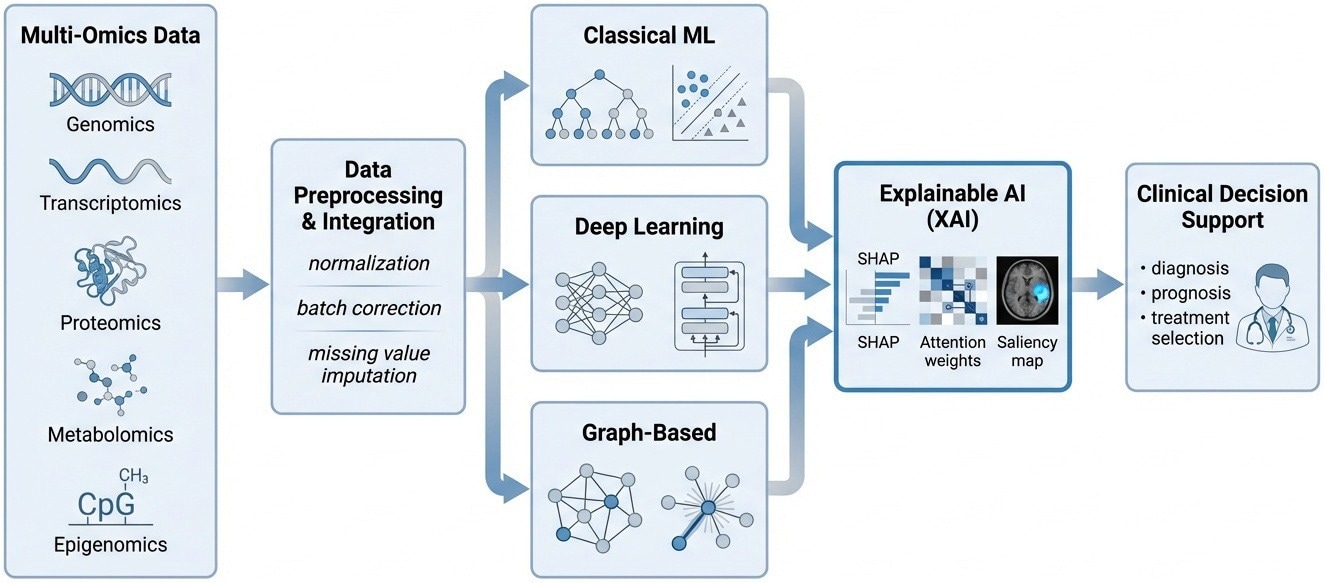 Integrating multiomics data with machine learning and explainable AI to support precision medicine and clinical decision-making. Image credit: Hasnain et al. (2026).
A melanoma study highlights both the promise and limitations of a multiomics biomarker discovery approach. In this study, the researchers combined deoxyribonucleic acid (DNA) and ribonucleic acid (RNA) sequencing data from patients treated with anti-PD1 immunotherapy to build an interpretable model of treatment response. The study assembled a retrospective cohort of 449 patients and used LASSO regression with 49 genomic and transcriptomic biomarkers. The model modestly outperformed nonsynonymous tumor mutation burden (nsTMB), an established comparator for immunotherapy response prediction, achieving a ROC AUC of 0.70 in the training set and 0.64 in the test set. Transcriptomic models alone also outperformed nsTMB, so the added benefit of combining omics layers remains uncertain. However, the small test set and sequencing batches requiring statistical correction also limited the findings. The researchers emphasized the need for prospective studies with larger cohorts and consistent sequencing.8
What Remains Aspirational?
Several goals in this field remain aspirational, including comprehensive patient-level molecular models, predictions that hold across populations, and automated identification of clinically actionable biomarkers. Emerging approaches such as patient-specific digital twins, foundation models, and causal AI may help address some of these challenges, but they remain research directions rather than established solutions for routine clinical care.4
Limited dataset diversity is the first barrier. Major public cancer resources consist mostly of people of European ancestry, which limits generalization to other populations. Polygenic scores also run into the same problem and predict risk far less accurately in non-European populations. Consequently, deploying models without population-specific evaluation could exacerbate existing health disparities. Preprocessing choices, random seeds, and study design can all change reported results, and no agreed benchmark exists for judging explanation quality.4,5
Biological complexity and insufficient validation add additional hurdles. Gene activity explains only part of protein levels, and environmental factors can outweigh individual genetic effects in complex traits. Post-transcriptional regulation, protein turnover, and tissue-specific molecular activity mean that changes in one omics layer do not necessarily translate directly into changes in another.3,5,7
Few models have been clinically validated, most studies are retrospective, and effects on patient outcomes are rarely measured, so prospective testing remains the key missing step. A 2026 systematic review of 116 studies published between 2020 and 2025 identified persistent problems with overfitting, reproducibility, data heterogeneity, and insufficient clinical validation despite advances in explainable multiomics AI.4
Future Directions: Building Trustworthy Multiomics Models
Turning promising computation into dependable practice requires concrete steps. Shared reference datasets with common preprocessing would allow fair comparison, and transparent reporting that lists data sources, code, and evaluation design would allow accurate replication. Models should also be compared with established clinical predictors and simpler single-omics approaches to establish whether multi-omics integration provides added value.3,4,8
Calibration work on variant predictors also depends on records of tool version and raw scores, so those details should accompany database submissions. Additionally, publicly releasing summary statistics across diverse ancestries would help close accuracy gaps.1,5
Validation is an equally important aspect for improving ML models for multiomics data. Researchers suggest that external testing across institutions and populations should precede deployment, followed by prospective evaluation. Furthermore, collaboration among computational scientists, molecular biologists, and clinicians is needed to get different perspectives on model performance.3,7
ML and multiomics already provide useful research and decision-support tools, particularly for prioritizing variants and generating biomarker hypotheses. Calibrated computational variant interpretation and genotype-guided prescribing represent more mature applications, whereas most integrated multi-omics models for treatment selection remain investigational. Their clinical impact will depend upon the strength of the supporting evidence and the rigor of calibration and validation processes.1,3,6,8
References and Further Reading
- Pejaver, V., Byrne, A. B., Feng, B. J., Pagel, K. A., Mooney, S. D., Karchin, R., O'Donnell-Luria, A., Harrison, S. M., Tavtigian, S. V., Greenblatt, M. S., Biesecker, L. G., Radivojac, P., Brenner, S. E., & ClinGen Sequence Variant Interpretation Working Group (2022). Calibration of computational tools for missense variant pathogenicity classification and ClinGen recommendations for PP3/BP4 criteria. American Journal of Human Genetics, 109(12), 2163–2177. DOI:10.1016/j.ajhg.2022.10.013, https://www.cell.com/ajhg/fulltext/S0002-9297(22)00498-1
- Kong, S. W., Lee, I. H., Collen, L. V., Field, M., Manrai, A. K., Snapper, S. B., & Mandl, K. D. (2025). Discordance between a deep learning model and clinical-grade variant pathogenicity classification in a rare disease cohort. NPJ Genomic Medicine, 10(1), 17. DOI:10.1038/s41525-025-00480-w, https://www.nature.com/articles/s41525-025-00480-w
- Lv, J., Guo, J., Wang, Y., Wang, J., Guo, L., & Zhang, H. (2026). Integrating multi-omics with machine learning: from genomic variant functional annotation to pharmacogenomics and biomarker discovery. Frontiers in Pharmacology, 17, 1980359. DOI:10.3389/fphar.2026.1980359, https://www.frontiersin.org/journals/pharmacology/articles/10.3389/fphar.2026.1980359/full
- Hasnain, M., Hameed, S., Azim, K., & Waseem, M. (2026). Explainable AI for multi-omics in precision medicine: A systematic review. Exploration of Digital Health Technologies, 4, Article 1011102. DOI:10.37349/edht.2026.1011102, https://www.explorationpub.com/Journals/edht/Article/1011102
- Martin, A. R., Kanai, M., Kamatani, Y., Okada, Y., Neale, B. M., & Daly, M. J. (2019). Clinical use of current polygenic risk scores may exacerbate health disparities. Nature Genetics, 51(4), 584–591. DOI:10.1038/s41588-019-0379-x, https://www.nature.com/articles/s41588-019-0379-x
- Cavallari, L. H., & Johnson, J. A. (2023). Use of a multi-gene pharmacogenetic panel reduces adverse drug effects. Cell Reports. Medicine, 4(5), 101021. DOI:10.1016/j.xcrm.2023.101021, https://doi.org/10.1016/j.xcrm.2023.101021
- Mondello, A., Dal Bo, M., Toffoli, G., & Polano, M. (2024). Machine learning in onco-pharmacogenomics: a path to precision medicine with many challenges. Frontiers in Pharmacology, 14, 1260276. DOI:10.3389/fphar.2023.1260276, https://www.frontiersin.org/journals/pharmacology/articles/10.3389/fphar.2023.1260276/full
- Gschwind, A., & Ossowski, S. (2025). AI Model for Predicting Anti-PD1 Response in Melanoma Using Multi-Omics Biomarkers. Cancers, 17(5), 714. DOI:10.3390/cancers17050714, https://www.mdpi.com/2072-6694/17/5/714
Last Updated: Nov 17, 2026