Survey data from more than 240,000 adults reveal persistent gaps in awareness of tobacco-related cardiovascular and secondhand smoke risks despite decades of global prevention efforts.

Study: Changes in knowledge of the major harms of tobacco smoking and secondhand smoke exposure among adults who smoke: findings from 26 countries of the International Tobacco Control (ITC) Project (2002–2022) and 32 countries of the Global Adult Tobacco Survey (GATS) (2008–2020). Image Credit: vchal / Shutterstock
In a recent study published in the journal BMJ Open, researchers assessed levels of and trends in knowledge regarding the adverse effects of tobacco smoking and exposure to secondhand smoke (SHS) among adults who smoked tobacco.
The study drew upon data from longitudinal cohort surveys with sample replenishment conducted in 26 nations participating in the 2002-2022 International Tobacco Control (ITC) Project, and from repeated cross-sectional surveys conducted in 32 nations that were part of the 2008-2020 Global Adult Tobacco Survey (GATS).
They found that adults who smoked were generally aware that tobacco smoking causes lung cancer, but had less knowledge regarding cardiovascular harms, including heart disease, heart attack, and stroke, despite cardiovascular disease (CVD) being a major cause of premature non-communicable disease deaths worldwide.
These findings highlight the need to improve and sustain knowledge of smoking- and SHS-caused diseases, particularly cardiovascular risks, through comprehensive tobacco control measures.
Tobacco smoking takes millions of lives each year across the globe. Since tobacco smoking is a major modifiable risk factor, assessing knowledge levels and developing interventions and policies to improve awareness and modify health behavior could help curtail smoking habits as one component of a broader strategy for disease prevention. If people become increasingly aware of tobacco smoking-related disease and cancer risks, they may be more likely to consider or attempt quitting.
Greater awareness of SHS harms and improved risk perceptions may also encourage people to take initiatives to protect themselves as well as others from tobacco-related harms. Such steps, taken at an individual level and supported by effective tobacco control policies, could help decrease CVD- and cancer-related illness and deaths worldwide. However, the researchers noted that knowledge alone may be insufficient to change behavior without self-efficacy and supportive smoke-free environments.
About the study
In the present study, researchers investigated the level of awareness among adult smokers regarding tobacco smoke and SHS as causes of lung cancer and cardiovascular outcomes across 46 countries over two decades.
The study comprised longitudinal ITC cohort surveys with sample replenishment and repeated cross-sectional GATS household surveys from 26 ITC Project nations and 32 GATS nations. The respective datasets included 133,410 and 110,537 individuals who currently smoked tobacco. Participants were aged ≥18 years. In the ITC surveys, cigarette smokers currently smoked manufactured or roll-your-own cigarettes at least monthly and had smoked at least 100 cigarettes during their lifetime. Current bidi smokers were also included in Bangladesh, India, and Zambia. GATS participants currently use any combustible tobacco product.
For the ITC analyses, current cigarette smoking was defined as use at least monthly, with current bidi smoking also included in Bangladesh, India, and Zambia. GATS analyses included the current use of combustible tobacco products.
The researchers analyzed the two project datasets separately. Generalized estimating equations (GEE) and weighted multinomial survey logistic regression models helped them assess country-level prevalence of reported knowledge or belief about smoking and SHS outcomes.
The team adjusted the findings for variables such as age, sex, smoking habits (daily vs. non-daily), survey design factors, and time-in-sample (ITC nations). Trend models also accounted for the number of years between the initial and final surveys.
Multilevel models estimated the all-country mean prevalence and tested within-country linear trends for five indicators based on survey information. The indicators included knowledge that tobacco smoking could cause lung cancer, heart disease, or heart attack, and stroke among smokers and that SHS exposure could cause lung cancer and heart disease or heart attack among people who do not smoke.
To assess consistency across these disease indicators, the team evaluated Pearson correlations between ITC and GATS estimates in 12 overlapping countries, although only seven countries had comparable data for the SHS indicators.
Results
Using the most recent available survey for each country, most adults who smoked in the participating countries were aware that smoking can cause lung cancer (ITC 92.2% and GATS 91.9%). However, fewer knew that smoking causes heart disease (ITC, 84.7%), heart attacks (GATS, 80.0%), and stroke. In fact, only 75.0% of adults in the ITC countries and 66.1% in the GATS countries knew of the associated stroke risk.
Knowledge that SHS causes lung cancer in people who do not smoke was also comparatively lower (ITC 77.3%, GATS 82.1%), with still fewer participants aware that SHS causes heart attacks (ITC, 61.8%) or heart disease (GATS, 72.5%).
These all-country means gave countries roughly equal weight and should not be interpreted as population-weighted global prevalence estimates. Questions covering all five disease outcomes were also not available in every country or at every survey wave.
Across the ITC and GATS country groups, the estimated average net change in knowledge across the five disease indicators was only 0.14 percentage points per year, indicating near-zero overall change.
Among the 12 nations participating in both surveys, ITC and GATS estimates were strongly and significantly correlated for the three active-smoking indicators. Correlations for the two SHS indicators were moderate but not statistically significant, partly because only seven countries could be compared. Over the years, knowledge increased in some nations and declined in others. For most indicators, however, the majority of countries showed no statistically significant change.
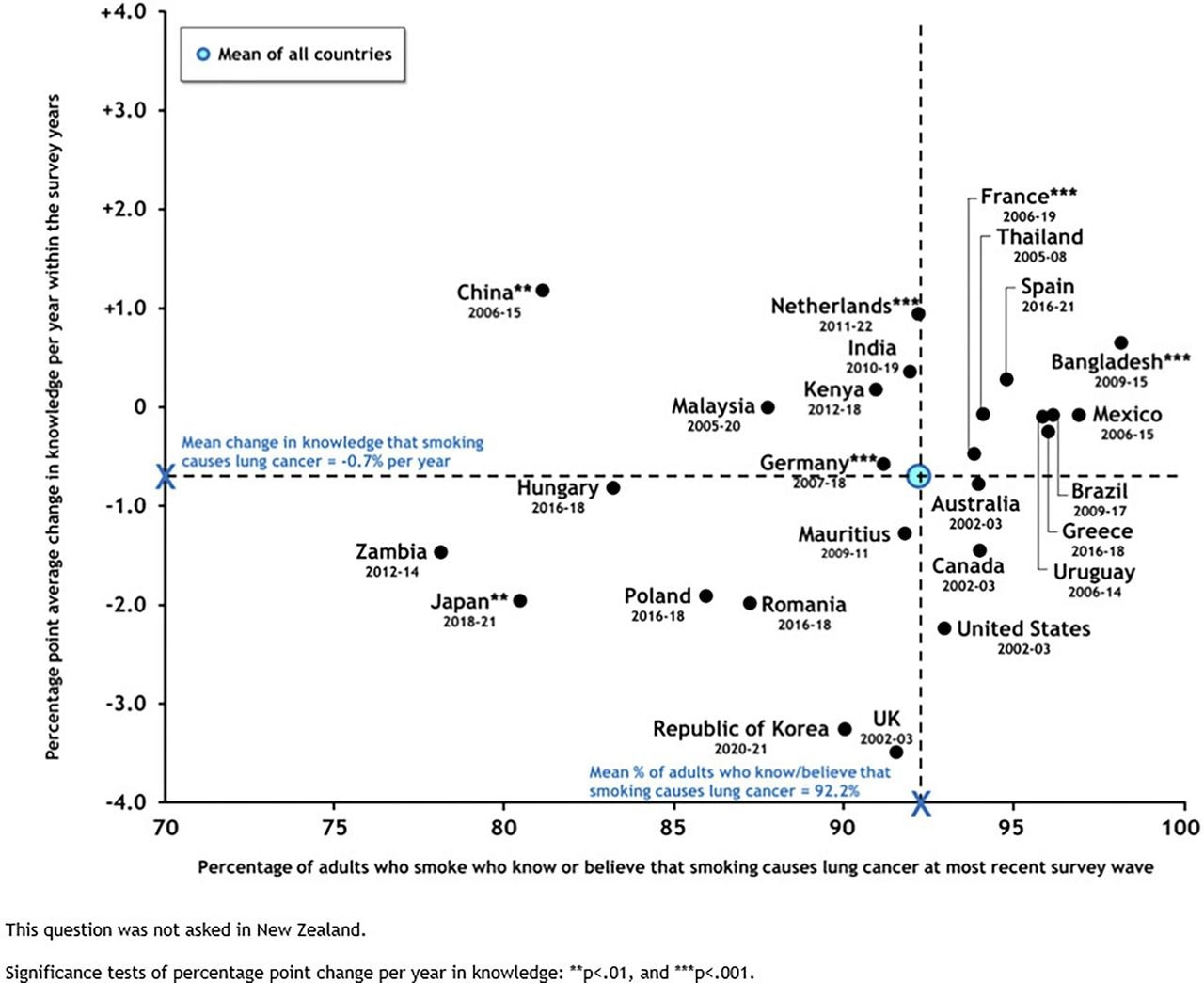
Percentage of adults who smoke who know or believe that smoking causes lung cancer in 25 International Tobacco Control (ITC) Project countries, 2002–2022.
Knowledge that active smoking causes lung cancer increased significantly in China, the Netherlands, Bangladesh, and India. In contrast, residents of Japan, Germany, France, Romania, Russia, and Turkey showed declining knowledge trends for this specific outcome.
Patterns for heart disease, heart attack, and stroke differed across countries. Stroke was the only indicator that increased on average in both the ITC and GATS datasets, while lung cancer knowledge declined slightly in both.
Regarding knowledge that SHS causes lung cancer in people who do not smoke, ITC data showed significantly increasing knowledge trends for Australia, China, India, Bangladesh, and Thailand.
Contrastingly, people from Germany, New Zealand, France, and Uruguay were increasingly less aware of this risk. For SHS-related heart attack knowledge in ITC countries, significant increases occurred in Bangladesh, India, the Netherlands, Kenya, and China, while declines occurred in Australia, Malaysia, Japan, and New Zealand. In GATS, Vietnam was the only country showing significant increases in both assessed SHS indicators.
Implications
The study findings highlight international patterns in knowledge regarding the influence of tobacco smoking and SHS exposure on the risk of developing lung cancer and CVDs. Based on the observations, health bodies should consider tailored and comprehensive tobacco control strategies, including prominent health warnings, mass media campaigns, and well-enforced smoke-free policies, to improve knowledge of the adverse effects of tobacco consumption and SHS exposure, especially regarding CVD risks, among nations with declining knowledge levels.
The findings apply primarily to adults who currently smoke tobacco and may not represent knowledge trends in the wider population. Other limitations included reliance on self-reported knowledge, possible recall and social-desirability bias, low response rates in some ITC surveys, and the limited number of countries available for direct ITC-GATS comparisons.
In future studies, researchers should examine how the content, size, and placement of health warnings and other tobacco control policies relate to knowledge levels. Studies involving more overlapping countries could also strengthen comparisons between survey systems and improve the generalizability of the findings.
Journal reference:
- Chung-Hall, J., Fong, G.T., Meng, G., et al. (2026). Changes in knowledge of the major harms of tobacco smoking and secondhand smoke exposure among adults who smoke: findings from 26 countries of the International Tobacco Control (ITC) Project (2002-2022) and 32 countries of the Global Adult Tobacco Survey (GATS) (2008-2020), BMJ Open;16:e107667. DOI: 10.1136/bmjopen-2025-107667, https://bmjopen.bmj.com/content/16/8/e107667
 Why addiction researchers are paying closer attention to GLP-1 drugs