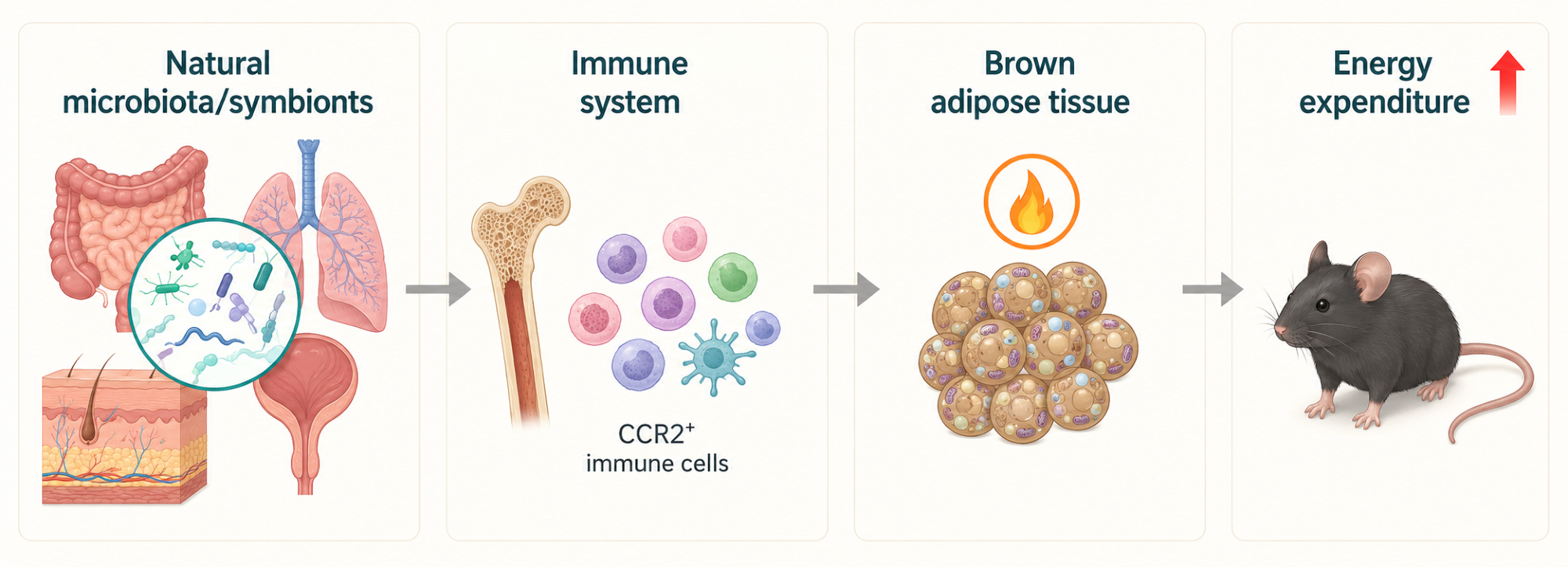
A natural microbial community reshaped immune signaling and brown fat activity in mice, revealing how an early biological encounter can leave a metabolic imprint that lasts throughout life.
Study: Natural microbiota confer life-long protection against obesity via an early-life, immune-mediated effect on brown adipocytes
A recent study published in the journal Gut Microbes found that natural wild-derived microbiota interact with the immune system and brown adipose tissue (BAT), protecting against diet-induced obesity throughout life.
Background
Obesity rates are rising rapidly worldwide. According to the World Obesity Federation, by 2030, the number of adults with obesity will reach 1.13 billion, with about 1.6 million premature deaths projected to occur due to diabetes, cardiovascular disease, and cancer, secondary to obesity.
Multiple factors contribute to the development of obesity, including the gut microbiota. Both human and animal studies demonstrate that early-life disruption of the microbiota increases the risk of later obesity. In turn, obesity and a high-fat diet both adversely influence the gut microbiota, affecting energy harvest from food, inflammation, and metabolism. This promotes the persistence of obesity and its associated conditions.
Laboratory mice have a simpler microbial community composition compared to their wild counterparts. This affects the extent to which findings from such models are relevant to human physiology.
Study characteristics
To correct this, the current study compared wildling mice with conventional laboratory mice. A wildling colony was founded from laboratory mouse embryos introduced into pseudopregnant wild mice. This allowed the researchers to work with the convenient genetic profile of laboratory mice while retaining complex wild-derived microbiota and an immune profile resembling that of microbe- and pathogen-experienced adult humans.
In previous work, they demonstrated that wildlings are protected against obesity when placed on a high-fat, obesity-inducing diet from week 10 to week 20 of life. In this study, they exposed both the wildling mice colonized with natural microbiota and the laboratory mice (who had conventional laboratory microbiota) to an obesity-inducing diet.
Early-life exposure to natural microbes is protective against obesity
Wildling mice with natural microbiota gained less weight on an ordinary diet than their laboratory counterparts. This protective effect occurred in both male and female mice.
The obesity-resistant phenotype was preserved in the colony for more than five years. In addition, the protective effect continued to be observed when the mice were put on high-fat diets.
Energy expenditure is higher in wildlings
On a standard chow diet, the wildling mice had higher energy expenditure without increased physical activity compared with laboratory mice. This suggests that the natural microbiota altered energy balance, leading to increased food consumption to meet the need for extra energy rather than reducing food intake.
This trend persisted when they were housed at a higher temperature of 30 °C. Though both wildling and laboratory mice showed reduced energy expenditure at this temperature, it was still a little higher in wildling mice. There was no difference in either food consumption or physical activity. There were signs of greater reliance on fat oxidation.
Thus, neither increased ambient temperature nor a shift to a high-fat diet led to any difference in food consumption between wildling and lab mice. Rather, natural microbiota were linked to increased energy expenditure.
Natural microbiota alter transcription within brown fat cells
The researchers examined adipose tissue to determine how the microbiota might produce this effect. Single-nucleus RNA sequencing of brown adipose tissue (BAT) showed that one population of fat cells became dominant in mice exposed to natural microbiota, but not in lab mice.
These cells transcribed genes associated with increased heat production, fat oxidation, and, consequently, energy expenditure. This differential pattern was seen at baseline, without a high-fat diet challenge. However, the marked difference between the brown adipocyte transcriptional profiles of wildling and laboratory mice was much reduced when housed at a higher temperature.
In addition, these mice had reduced white adipose tissue mass and lower expression of thermogenic genes in inguinal white adipose tissue, indicating that increased beiging was not involved. This suggests that the protective effect was not due to such conversion, but to the higher activity of pre-existing BAT.
Immune response induction confers protection
When adult germ-free mice were exposed to natural microbiota, they acquired protection against obesity compared to germ-free mice subsequently colonized with conventional laboratory microbiota. This effect was observed during a subsequent 10-week high-fat diet challenge.
In contrast, the authors had previously established that wildlings develop this protective phenotype only when exposed to the natural microbiota during the first two weeks of life.
Thus, the microbiota-induced protective phenotype appears to be determined by the timing of the naïve immune system's first interaction with the natural microbiota. These findings suggested that developmental programming of BAT in early life was not the sole reason for such protection.
Immune mechanisms underlying the protective effect
Earlier research suggested that type 2 immune responses were involved in regulating heat production by fat cells. Therefore, the researchers investigated immune system activation by microbiota.
They found that mice lacking interleukin-33 (IL-33) and STAT6 were protected against obesity when exposed to the natural microbiota. STAT6 is an important type 2 immune signaling protein.
This suggests that type 2 immune signaling was not required for protection against diet-induced obesity, contrary to hypotheses based on earlier research.
The role of CCR2
Conversely, the investigators found higher levels of the chemokine CCL2 and monocytes in the BAT of mice exposed to natural microbiota in early life. This suggests that myeloid immune cells recruited to the BAT may contribute to the development or maintenance of a pattern of heat production that protects against obesity.
To test this, they assessed mice lacking CCR2, a chemokine receptor that is required for CCL2-dependent recruitment of immune cells from the bone marrow. CCR2 is expressed on many leukocytes but is most highly expressed on monocytes, some of which migrate into tissue to differentiate into tissue-resident macrophages.
When exposed to natural microbiota, CCR2-deficient wildlings failed to show the thermogenic transcriptional profile within BAT seen in wild-type wildlings and had lower energy expenditure on a standard chow diet despite similar physical activity.
In a separate high-fat diet challenge, the CCR2-deficient wildlings put on more weight than wildlings, opposite to the pattern observed in CCR2-deficient laboratory mice. Thus, the absence of CCR2 eliminated the protection against obesity in wildlings but reduced weight gain in lab mice, moving the two groups closer together.
Bone marrow injection restores protective phenotype
Wildtype bone marrow was injected into CCR2-deficient wildling mouse pups, allowing them to acquire bone marrow-derived immune cells. At week 10, they were put on a high-fat diet for 10 weeks.
Following the bone marrow transfer, transferred cells were detected in both BAT and the spleen, while their body weight at the end of the high-fat diet challenge was comparable with that of wild-type wildlings.
In contrast, CCR2-deficient lab mice that had received the same bone marrow remained significantly heavier than bone marrow-reconstituted CCR2-deficient wildlings. These results indicate the key role of CCR2-dependent bone marrow-derived cells in protection against obesity in the context of a natural microbiome.
What the study adds
This study builds on earlier research by the same authors, which demonstrated the development of stable immune responses in a wildling mouse model. Here, they demonstrated a durable metabolic phenotype that conferred resistance to obesity across sexes, genetic backgrounds, and diets following colonization with natural microbiota.
The earlier study showed that the obesity-resistant phenotype was acquired with early-life exposure to natural microbiota. Here, the authors found that during this critical period, wildling pups had higher monocyte frequencies and increased chemokine levels in BAT, linking early microbial exposure with an immune response within the tissue.
They also revealed the importance of the timing of the initial encounter between the naïve immune system and the natural microbiota, as well as the role of CCR2. The authors suggest that this effect may be mediated by the continuing replacement of BAT macrophages by bone marrow-derived macrophages throughout adult life. However, because CCR2 also affects processes outside BAT, the precise mechanism remains to be established.
“We demonstrate the first interaction between the microbiota and the immune system rather than the developmental age of BAT as a critical factor for the establishment of a beneficial metabolic phenotype.”
Conclusion
Overall, the findings identify a microbiota–immune–adipose tissue axis whereby exposure to natural microbiota can produce long-lasting protection against diet-induced obesity. The authors suggest that initial exposure of a naïve immune system to the natural microbiota may promote a CCR2-dependent myeloid response in BAT, associated with increased BAT thermogenesis and energy expenditure.
Since BAT activity in humans is also associated with improved metabolic parameters, the authors suggest that modifying the microbiota could eventually offer a way to influence similar metabolic pathways. However, the present findings are limited to mice, and it remains unknown whether the same mechanism operates in humans.
 Poor sleep health in late pregnancy linked to higher childhood obesity risk