Sponsored Content by NocomedReviewed by Ify IsiborOct 9 2026
In this interview, News Medical speaks with Rosemary Durcan, CEO and Co-Founder of Nocomed, about healthcare sustainability, measuring and reducing carbon emissions across healthcare and life sciences, and how better sustainability data can support more efficient, resilient organizations.
Can you please introduce yourself and your role at Nocomed, and explain what inspired the company’s focus on healthcare sustainability?
I’m Rosemary Durcan, CEO and Co-Founder of Nocomed. We’re a Dublin-based sustainability data and measurement platform company, and we built our platform specifically around healthcare and life sciences.
My background is in life sciences and healthcare, where I’ve spent over 25 years. A number of years ago, I completed a certificate in climate change at the University of Cambridge, and that really got me thinking about sustainability in the sector I had spent my career working in.
I reached out to my network and spoke with around 30 companies about the challenges they expected to face over the next 10 years. Sustainability was one of the major challenges they identified.
That is really how Nocomed was born. Organizations were increasingly being asked to measure sustainability data, but people didn’t necessarily know where to start. Healthcare and life sciences are highly regulated, so we saw a need for a platform built specifically around the sector's requirements.
Therefore, we developed our first products with companies in the sector, using their data to understand what they actually needed and what their data looked like. We continue to work that way today, so we are constantly getting deeper into the sector-specific requirements.
What are the main sustainability challenges faced by healthcare and life science organizations, and where should they begin?
Typically, companies come to us because a customer or third party has asked them to provide sustainability data. Initially, that generally means calculating their corporate greenhouse gas footprint across Scopes 1, 2, and 3.
Scope 1 covers fossil fuels used within the organization, Scope 2 covers purchased electricity, and Scope 3 covers emissions upstream and downstream across the supply chain.
One of the biggest challenges is that organizations simply don’t know where to start. People sometimes feel that they are already behind, but sustainability is still relatively new to the sector. Whole generations of employees and teams were never trained in sustainability, so there is a reskilling and education element involved.
We help organizations identify the information they need, identify where that data sits within the business, and standardize that data. Once it is on the platform, they can visualize their emissions across the different scopes.
That visualization creates a map of the emissions hotspots. Companies can then make informed decisions about where reductions will have the greatest impact.
Many organizations begin with Scope 1 and 2, which is a sensible starting point, but it's important to look across Scope 3 as well to see where the real hotspots are. Then you can build a reduction plan that fits the organization: its size, its budget and its people. The most successful projects work with the existing culture that bring teams along.
Once companies can actually see their data, they tend to become quite motivated by it. Sustainability data helps you make better management decisions; in addition to reducing emissions, you can reduce costs and waste, become more efficient, and improve productivity.
How does the Nocomed platform measure environmental impact and translate that information into practical carbon-reduction strategies?
We support clients at two levels. At the corporate level, we measure emissions across Scopes 1, 2, and 3 using the Greenhouse Gas Protocol. At the product level, we work directly with clients' teams on lifecycle assessments of their medical devices and pharmaceutical products.
Sometimes this requires examining the emissions associated with a particular product or considering that product within a patient pathway. We tend to work with organizations on specific projects when they want to understand products or products within patient pathways.
The difference for us is that the platform was built specifically around healthcare data, healthcare products, and the regulations attached to them; we understand how the sector operates and the regulatory environment around it.
Once emissions have been measured, we help organizations identify practical opportunities to reduce them. Those changes can then be mapped on the platform so teams can see the progress they are making.
We have also developed what we call carbon reduction simulators. Once organizations become comfortable with their data, they naturally start asking questions such as, “What happens if I change this product, this supplier, or this transport route?”
The carbon reduction simulators allow them to examine both carbon and cost-benefit analyses, so they can forecast the potential impact of a change before deciding whether to make it. This, in turn, can also help an organization prioritize carbon-reduction projects.
The acquired information can then be communicated to internal and external stakeholders. That becomes particularly important with Scope 3 because many of those emissions are outside your direct control. You may need to work with suppliers, distributors, or service providers on changes such as packaging, transportation routes, or electric vehicles.
The overall process is to measure emissions, develop a plan to reduce them, and report the results. We build reporting templates into the system for customers, stakeholders, and governance requirements. The aim is to automate and streamline the measurement and reporting as much as possible so organizations can concentrate on actually reducing their emissions.
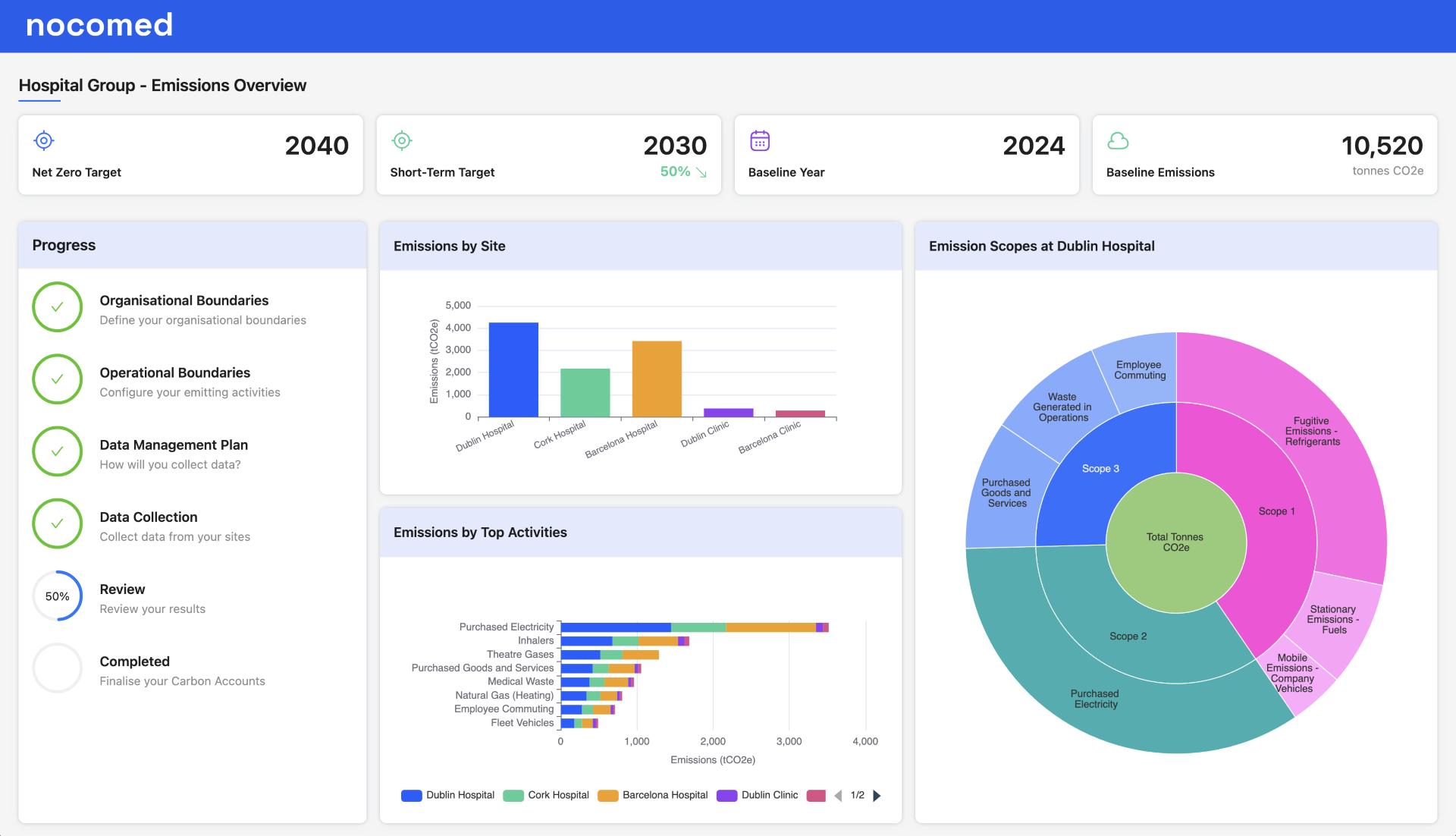
The Nocomed platform provides healthcare organizations with a centralized view of emissions across sites, activities and Scope 1, 2 and 3 categories. Image Credit: Nocomed
Why are Scope 3 emissions particularly difficult for healthcare organizations to identify and manage?
Around 71%1 of healthcare's carbon emissions come from the supply chain: the medicines, medical devices, and other goods and services the sector buys.2 Pharmaceuticals account for an estimated 25–35% of healthcare emissions, and medical technologies for 15–25%.3
That puts manufacturers in a strong position to drive reductions, and many are already leading the way.
When companies start asking suppliers for sustainability information, they generally begin with Scopes 1 and 2. Those are easier because suppliers can compile their fossil fuel usage and purchased electricity data and calculate the associated footprint.
Scope 3 emissions are shared across the supply chain, so reducing them depends on buyers and suppliers working together on the data.
The first key problem is ownership: no single party owns all the data, as it spans the entire supply chain.
The second challenge is data quality and standardization. You may receive information from transportation partners, waste companies, service providers, and product suppliers, and there can be little standardization between those different data sources.
Some Scope 3 categories are relatively straightforward. Employee commuting data can usually be gathered through a short staff survey, and business travel data is often already held by finance. Others take more work, particularly upstream and downstream transportation and distribution, and waste.
With transportation, a company may use several logistics providers, all supplying data in different formats. Waste data can present a similar issue. That is why we provide a data cleanroom service to clean and standardize information before it is put onto the platform. Third-party data can require quite a lot of work before it is ready to use. But once data sources and processes are set up, it becomes routine
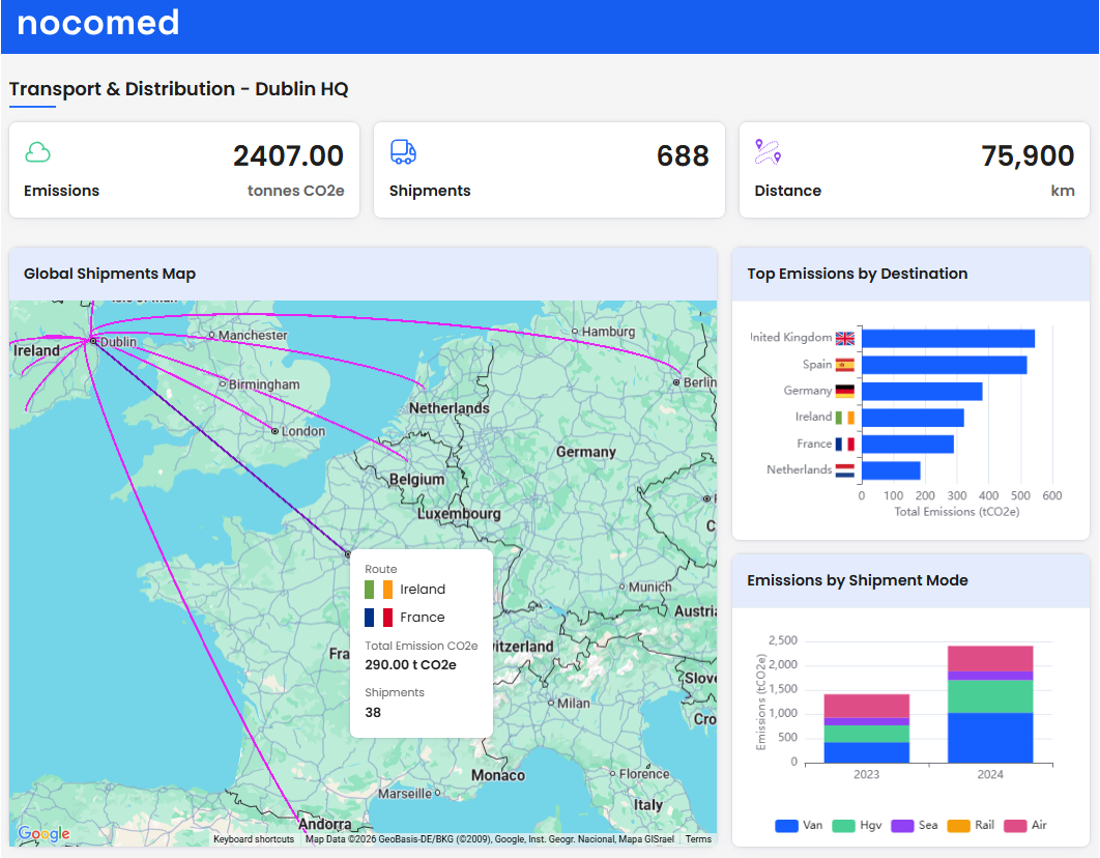
Transport and distribution data can be visualized within the Nocomed platform to identify emissions by destination, shipment mode and transport route. Image Credit: Nocomed
How can emissions data help organizations improve efficiency, reduce costs, and lower their environmental impact?
The first step is to pull together the data for Scopes 1, 2, and 3. That information may come from finance, procurement, HR, logistics, and supply chain teams. Once it has been collected, cleaned, and uploaded, the platform calculates greenhouse gas emissions and allows the organization to visualize them. This is when you can start asking, “Why are we doing this in this way?” Visualizing the data encourages healthy conversations about alternatives.
We have seen clients reduce costs quite considerably while reducing emissions. Green energy can be cheaper, for example, and working with suppliers can identify better alternatives. Even something such as changing the transport system can make a difference.
There are also competitiveness benefits. Customers across the healthcare supply chain are increasingly asking organizations not only for emissions data but also for plans to reduce them.
By measuring and visualizing the data and making stronger management decisions, you can reduce emissions while taking waste and cost out of the system. At the same time, you become more competitive in your customers' eyes.
Sustainability is a big word, and it does not just mean carbon emissions. Organizations need to become sustainable across all aspects of their operations, including financial and operational.
How do healthcare emissions connect with public health, patient care, and the need for greater climate resilience?
This is something we think about a lot at Nocomed because there is a difficult contradiction within healthcare.
Everybody working in healthcare is ultimately trying to make people healthier, but the sector is also generating a significant proportion of global emissions. We are increasingly seeing the health effects of climate change through air pollution, extreme heat, and flooding. For example, heat waves can put significant pressure on healthcare systems, particularly through increased attendance among elderly and vulnerable patients, and flooding can disrupt healthcare services and facilities.
For me, there are two oars here. The first is reduction; we need to continue reducing carbon emissions. The second is resilience. Healthcare organizations need to become more resilient to the effects of climate change already underway. This requires asking how hospitals and other healthcare organizations continue operating during heat waves or flooding and assessing the resilience of supply chains.
Climate change is an enormous problem, and it can be overwhelming. At Nocomed, our approach is to focus on the areas where we can create change: healthcare and life sciences. If we can help reduce even a small proportion of the sector’s emissions, then it is worth doing.
What barriers do organizations encounter when starting their healthcare sustainability journey, and how can they overcome them?
When an organization is asked to supply sustainability data, it suddenly has to determine what the sustainability journey looks like, where the data is stored, and who needs to be involved.
Companies often worry their data isn't good enough. The key is to start with what you have and improve it over time. Once the data is visualized, it becomes a strategic tool for decision-making, not just a reporting requirement.
The longest stage is usually data collection, particularly the first time an organization does it.
Despite these barriers, companies can typically be up and running within a couple of months, although the regulated nature of healthcare can introduce delays. A company might suddenly have a customer audit or be involved in a major tender, for example.
Over time, the process becomes routine. An organization might begin by reviewing its data annually, then move to quarterly, every two months, and eventually monthly reporting and analysis.
The service element of our work is as important as the software. We provide kickoff workshops, assist with data onboarding, and bring practical examples of carbon-reduction projects to the table.
I also think sustainability aligns very closely with lean methodology and business transformation. Hospitals and life science companies often already have lean, business transformation, or business excellence teams whose role is to remove inefficiency and waste from the system.
For me, sustainability is essentially lean with green lenses. You are making the organization more efficient and removing waste, but you are also measuring emissions, providing an additional data point for decision-making.
How are sustainability reporting requirements affecting healthcare suppliers, particularly those working with organizations such as the NHS?
Requirements are increasing, and that means organizations need systems capable of dealing with more comprehensive Scope 3 data.
The NHS has already been asking suppliers for Scope 1 and 2 data, as well as selected Scope 3 categories. These can include upstream and downstream transportation and distribution, waste, employee commuting, and business travel.
The requirements are becoming more extensive, including expectations for suppliers meeting relevant thresholds to report across all 15 Scope 3 categories.
Once the data sources have been identified and processes are established, this becomes much more manageable. The important thing is to build a repeatable system rather than starting over every time someone asks for sustainability information.
Looking ahead, how do you expect sustainability reporting and green procurement to reshape healthcare and life sciences?
We are moving toward a world where carbon and sustainability data are becoming increasingly important alongside financial data.
We can see that happening through our customers. An organization might have had one customer asking for sustainability information 12 months ago, whereas now it could have six different stakeholders asking for that same information. These stakeholders can include customers, boards, investors, and landlords. Sustainability reporting now serves a much wider audience.
Climate change is also a business risk. Investors increasingly want to understand what an organization’s emissions look like, how it intends to reduce them, and how resilient that organization will be in the future.
We are also seeing healthcare move towards green procurement, where sustainability data is used to support greener purchasing decisions. Waste is a huge issue for healthcare organizations. Increasingly, they are asking how they can work with suppliers to decrease waste associated with the products and services being purchased by hospitals and healthcare systems.
For Nocomed, our role is to help organizations make that transition practical. It is about making the data manageable, helping people understand what it means, and enabling them to use it to make better decisions.

About Rosemary Durcan
Rosemary Durcan is CEO and Co-Founder of Nocomed, a Dublin-based sustainability data and measurement platform built specifically for healthcare and life sciences. Nocomed uses internationally recognised standards to help healthcare providers, insurers, MedTech and pharmaceutical companies measure corporate and product emissions across their operations and supply chains. It also helps them model the cost and carbon impact of reduction projects and meet sustainability reporting requirements.
A scientist by training, Rosemary holds an MSc in Food Science from University College Dublin. She has more than 25 years of experience across Ireland's healthcare and life sciences sector, including as COO of Sims Clinic, as a senior life sciences advisor at Enterprise Ireland, and in leadership roles with the Irish Medical Devices Association and the Irish BioIndustry Association. She co-founded Nocomed in 2023 with Dónal Adams, the company's CTO, after completing the University of Cambridge's Climate Change for Decision-Makers programme.
About Nocomed
At Nocomed our mission is to empower life sciences companies and healthcare providers to advance sustainability across the healthcare supply chain. Our foundational 'why' is a deep commitment to the future: We care about the health of the planet, your business, and the global population's health and wellbeing. Our aim is to make sustainability simpler, reduce operating costs, and accelerate carbon reduction, thereby lowering global healthcare emissions and improving global health.
References and further reading
- Healthcare's Global Climate Footprint https://global.noharm.org/media/4364/download?inline=1
- Health Care Without Harm and Arup (2019). Health Care's Climate Footprint.https://global.noharm.org/media/4364/download?inline=1
- MedTech Europe and Boston Consulting Group (2025). Decarbonising Healthcare: How a Competitive MedTech Industry Can Contribute. https://www.medtecheurope.org/wp-content/uploads/2025/05/decarbonising-healthcare.pdf